

Corrections in the 21st Century 7th Edition Test Bank
- Criminal Justice
- 414 pages
- Shared May 2025
Corrections in the 21st Century 7th Edition Test Bank offers practice exams, quiz answers, and insights to help you succeed.
Preview 16 of 414 pages
See the first 16 pages exactly as they appear in the document.
Page 1 Read page 1 as text
1 Student: ___________________________________________________________________________ 1. Which of the following statements is true of crime rates and prison population in the United States? A. Serious crime continues to increase while the prison population continues to decrease. B. Serious crime continues to decrease while the prison population continues to increase. C. Serious crime continues to increase causing the prison population to increase. D. Serious crime continues to decrease causing the prison population to decrease. 2. A serious criminal offense; specifically, one punishable by death or by incarceration in a prison facility for more than a year is called a(n) _____. A. infraction B. misdemeanor C. felony D. perjury 3. Which among the following is an example of a felony? A. Burglary B. Simple assault C. Jaywalking D. Littering 4. A relatively minor violation of the criminal law, such as petty theft or simple assault, punishable by confinement for one year or less is called a(n) _____. A. infraction B. misdemeanor C. felony D. perjury
Page 2 Page 3 Read page 3 as text
5. Which among the following is an example of a misdemeanor? A. Robbery B. Simple assault C. Arson D. Jaywalking 6. A minor violation of state statute or local ordinance punishable by a fine or other penalty, but not incarceration, or by a specified, usually very short term of incarceration is called a(n) _____. A. infraction B. misdemeanor C. felony D. perjury 7. Which among the following is an example of an infraction? A. Murder B. Breaking and entering C. Littering D. Auto theft 8. Who among the following is a correctional client? A. A recreation coordinator B. A unit leader C. A field administrator D. A probationer 9. Which of the following is a component of the criminal justice system? A. A court B. Sole proprietorship C. Arbitration D. A cooperative
Page 4 Read page 4 as text
10. The prosecutor dropping charges after filing them is called a _____. A. nollo judicus B. nolo contendere C. nolle prosequi D. noelle persecutus 11. The main function of the preliminary hearing is to: A. ensure the incarceration and rehabilitation of adults and juveniles convicted of offenses against the law. B. determine whether there is cause to believe that the accused committed a crime within the jurisdiction of the court. C. ensure the maintenance and upkeep of the correctional facilities that are used for incarceration. D. determine whether there are adequate facilities in the correctional facilities for the convicted offenders. 12. The process by which a court arrives at a final decision in a case is called _____. A. arbitration B. arraignment C. certification D. adjudication 13. If the defendant accepts a penalty without admitting guilt it is called _____. A. nollo judicus B. nolo contendere C. nolle prosequi D. noelle persecutus 14. Cultural restrictions on behavior that forbid serious violations — such as murder, rape and robbery — of a group's values are called _____. A. folkways B. mores C. anomies D. feeling rules
Page 5 Read page 5 as text
15. _____ are time - honored ways of doing things. Although they carry the force of tradition, their violation is unlikely to threaten the survival of the social group. A. Folkways B. Mores C. Anomies D. Feeling rules 16. The first training standards established by the American Correctional Association on Accreditation set specific numbers of _____ hours for preservice. A. 70 B. 150 C. 100 D. 120 17. The major Code of Ethics governing the field of corrections was created by the _____. A. Federal Bureau of Investigation B. American Correctional Association C. National Criminal Justice Association D. Academy of Criminal Justice Sciences 18. In _____, the Professional Education Council of the American Correctional Association developed a model entry test for correctional officers. A. 1970 B. 1980 C. 1990 D. 2000 19. A credentialing process, usually involving testing and career development assessment, through which the skills, knowledge, and abilities of correctional personnel can be formally recognized is called _____. A. legislation B. accreditation C. adjudication D. certification
Page 6 Read page 6 as text
20. It wasn't until the _____ that women began to enter the corrections professions in significant numbers. A. 2000s B. 1990s C. 1980s D. 1970s 21. The prison population in the United States is higher today than at any time in history. True False 22. Murder, rape, aggravated assault, robbery, burglary, and arson are felonies in all jurisdictions within the United States. True False 23. A few states make conviction of a felony and the resulting incarceration grounds for uncontested divorce. True False 24. Some crimes classified as felonies in one part of the country may be misdemeanors in another. True False 25. Major violations of the law that often involve long term incarceration are called infractions. True False 26. The process of achieving justice through the application of the criminal law and through the workings of the criminal justice system is called criminal justice. True False 27. According to the Bureau of Justice Statistics, noninstitutional corrections, which is sometimes called community corrections, includes pardon, probation, and parole activities, correctional administration not directly connectable to institutions, and miscellaneous [activities] not directly related to institutional care. True False 28. The word "evidence" refers to criminal evidence, and not scientific evidence. True False
Page 7 Read page 7 as text
29. A person's race is recognized as an objective biological fact, and not a social construct. True False 30. It wasn't until the 1970s that women began to enter the corrections professions in significant numbers. True False 31. In the United States, there are more female police officers than female correctional officers. True False 32. The use of _____ in corrections and public policy is now considered the gold standard for policy and program development. ________________________________________ 33. _____ is defined as criminal laws and criminal justice institutions, policies, and practices that achieve justice in the present without compromising the ability of future generations to have the benefits of a just society. ________________________________________ 34. A serious criminal offense; specifically, one punishable by death or by incarceration in a prison facility for more than a year is called a _____. ________________________________________ 35. A relatively minor violation of the criminal law, such as petty theft or simple assault, punishable by confinement for one year or less is called a _____. ________________________________________ 36. The prosecutor can drop charges after filing them. Such a choice is called _____. ________________________________________ 37. _____ is the process by which a court arrives at a decision in a case. ________________________________________ 38. If the defendant accepts a penalty without admitting guilt it is called _____. ________________________________________ 39. After losing all their available direct appeals, state prisoners may also seek to have their convictions reviewed collaterally in the federal courts via a _____. ________________________________________
Page 8 Read page 8 as text
40. Race, ethnicity, and gender are all aspects of _____. ________________________________________
Page 9 Read page 9 as text
1 Key 1. Which of the following statements is true of crime rates and prison population in the United States? A. Serious crime continues to increase while the prison population continues to decrease. B. Serious crime continues to decrease while the prison population continues to increase. C. Serious crime continues to increase causing the prison population to increase. D. Serious crime continues to decrease causing the prison population to decrease. Schmalleger - Chapter 01 #1 2. A serious criminal offense; specifically, one punishable by death or by incarceration in a prison facility for more than a year is called a(n) _____. A. infraction B. misdemeanor C. felony D. perjury Schmalleger - Chapter 01 #2 3. Which among the following is an example of a felony? A. Burglary B. Simple assault C. Jaywalking D. Littering Schmalleger - Chapter 01 #3 4. A relatively minor violation of the criminal law, such as petty theft or simple assault, punishable by confinement for one year or less is called a(n) _____. A. infraction B. misdemeanor C. felony D. perjury Schmalleger - Chapter 01 #4
Page 10 Read page 10 as text
5. Which among the following is an example of a misdemeanor? A. Robbery B. Simple assault C. Arson D. Jaywalking Schmalleger - Chapter 01 #5 6. A minor violation of state statute or local ordinance punishable by a fine or other penalty, but not incarceration, or by a specified, usually very short term of incarceration is called a(n) _____. A. infraction B. misdemeanor C. felony D. perjury Schmalleger - Chapter 01 #6 7. Which among the following is an example of an infraction? A. Murder B. Breaking and entering C. Littering D. Auto theft Schmalleger - Chapter 01 #7 8. Who among the following is a correctional client? A. A recreation coordinator B. A unit leader C. A field administrator D. A probationer Schmalleger - Chapter 01 #8
Page 11 Read page 11 as text
9. Which of the following is a component of the criminal justice system? A. A court B. Sole proprietorship C. Arbitration D. A cooperative Schmalleger - Chapter 01 #9 10. The prosecutor dropping charges after filing them is called a _____. A. nollo judicus B. nolo contendere C. nolle prosequi D. noelle persecutus Schmalleger - Chapter 01 #10 11. The main function of the preliminary hearing is to: A. ensure the incarceration and rehabilitation of adults and juveniles convicted of offenses against the law. B. determine whether there is cause to believe that the accused committed a crime within the jurisdiction of the court. C. ensure the maintenance and upkeep of the correctional facilities that are used for incarceration. D. determine whether there are adequate facilities in the correctional facilities for the convicted offenders. Schmalleger - Chapter 01 #11 12. The process by which a court arrives at a final decision in a case is called _____. A. arbitration B. arraignment C. certification D. adjudication Schmalleger - Chapter 01 #12
Page 12 Read page 12 as text
13. If the defendant accepts a penalty without admitting guilt it is called _____. A. nollo judicus B. nolo contendere C. nolle prosequi D. noelle persecutus Schmalleger - Chapter 01 #13 14. Cultural restrictions on behavior that forbid serious violations — such as murder, rape and robbery — of a group's values are called _____. A. folkways B. mores C. anomies D. feeling rules Schmalleger - Chapter 01 #14 15. _____ are time - honored ways of doing things. Although they carry the force of tradition, their violation is unlikely to threaten the survival of the social group. A. Folkways B. Mores C. Anomies D. Feeling rules Schmalleger - Chapter 01 #15 16. The first training standards established by the American Correctional Association on Accreditation set specific numbers of _____ hours for preservice. A. 70 B. 150 C. 100 D. 120 Schmalleger - Chapter 01 #16
Page 13 Read page 13 as text
17. The major Code of Ethics governing the field of corrections was created by the _____. A. Federal Bureau of Investigation B. American Correctional Association C. National Criminal Justice Association D. Academy of Criminal Justice Sciences Schmalleger - Chapter 01 #17 18. In _____, the Professional Education Council of the American Correctional Association developed a model entry test for correctional officers. A. 1970 B. 1980 C. 1990 D. 2000 Schmalleger - Chapter 01 #18 19. A credentialing process, usually involving testing and career development assessment, through which the skills, knowledge, and abilities of correctional personnel can be formally recognized is called _____. A. legislation B. accreditation C. adjudication D. certification Schmalleger - Chapter 01 #19 20. It wasn't until the _____ that women began to enter the corrections professions in significant numbers. A. 2000s B. 1990s C. 1980s D. 1970s Schmalleger - Chapter 01 #20 21. The prison population in the United States is higher today than at any time in history. TRUE Schmalleger - Chapter 01 #21
Page 14 Read page 14 as text
22. Murder, rape, aggravated assault, robbery, burglary, and arson are felonies in all jurisdictions within the United States. TRUE Schmalleger - Chapter 01 #22 23. A few states make conviction of a felony and the resulting incarceration grounds for uncontested divorce. TRUE Schmalleger - Chapter 01 #23 24. Some crimes classified as felonies in one part of the country may be misdemeanors in another. TRUE Schmalleger - Chapter 01 #24 25. Major violations of the law that often involve long term incarceration are called infractions. FALSE Schmalleger - Chapter 01 #25 26. The process of achieving justice through the application of the criminal law and through the workings of the criminal justice system is called criminal justice. TRUE Schmalleger - Chapter 01 #26 27. According to the Bureau of Justice Statistics, noninstitutional corrections, which is sometimes called community corrections, includes pardon, probation, and parole activities, correctional administration not directly connectable to institutions, and miscellaneous [activities] not directly related to institutional care. TRUE Schmalleger - Chapter 01 #27 28. The word "evidence" refers to criminal evidence, and not scientific evidence. FALSE Schmalleger - Chapter 01 #28 29. A person's race is recognized as an objective biological fact, and not a social construct. FALSE Schmalleger - Chapter 01 #29
Page 15 Read page 15 as text
30. It wasn't until the 1970s that women began to enter the corrections professions in significant numbers. TRUE Schmalleger - Chapter 01 #30 31. In the United States, there are more female police officers than female correctional officers. FALSE Schmalleger - Chapter 01 #31 32. The use of _____ in corrections and public policy is now considered the gold standard for policy and program development. evidence - based practices Schmalleger - Chapter 01 #32 33. _____ is defined as criminal laws and criminal justice institutions, policies, and practices that achieve justice in the present without compromising the ability of future generations to have the benefits of a just society. Sustainable justice Schmalleger - Chapter 01 #33 34. A serious criminal offense; specifically, one punishable by death or by incarceration in a prison facility for more than a year is called a _____. felony Schmalleger - Chapter 01 #34 35. A relatively minor violation of the criminal law, such as petty theft or simple assault, punishable by confinement for one year or less is called a _____. misdemeanor Schmalleger - Chapter 01 #35 36. The prosecutor can drop charges after filing them. Such a choice is called _____. nolle prosequi Schmalleger - Chapter 01 #36 37. _____ is the process by which a court arrives at a decision in a case. Adjudication Schmalleger - Chapter 01 #37
Page 16 Read page 16 as text
38. If the defendant accepts a penalty without admitting guilt it is called _____. nolo contendere Schmalleger - Chapter 01 #38 39. After losing all their available direct appeals, state prisoners may also seek to have their convictions reviewed collaterally in the federal courts via a _____. writ of habeas corpus Schmalleger - Chapter 01 #39 40. Race, ethnicity, and gender are all aspects of _____. social diversity Schmalleger - Chapter 01 #40
398 more pages in the full document
Unlock it once and it stays in your library, ready to chat with or turn into flashcards.
Unlock the full documentMore Criminal Justice study materials
See all Exam Guides
Test Bank For Forensic Science, 4th Edition
Criminal Justice
370 pages132downloadsFeb 2025 Exam Guides
Criminal Investigation 9th Edition Test Bank
Criminal Justice
344 pages103downloadsFeb 2025 Exam Guides
Test Bank For Criminal Law and Procedure , 7th Edition
Criminal Justice
65 pages96downloadsFeb 2025 Past Exams
2024-2025 TCOLE Basic Jailer Course Practice Exam with Answers (259 Solved Questions)
Criminal Justice
33 pages47downloadsFeb 2025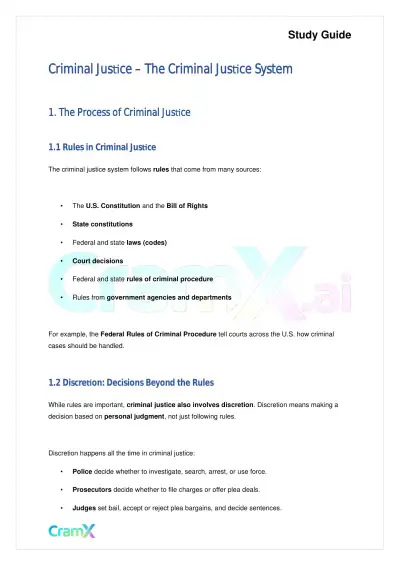 Quick Guides
Criminal Justice - The Criminal Justice System
Criminal Justice
12 pagesMar 2026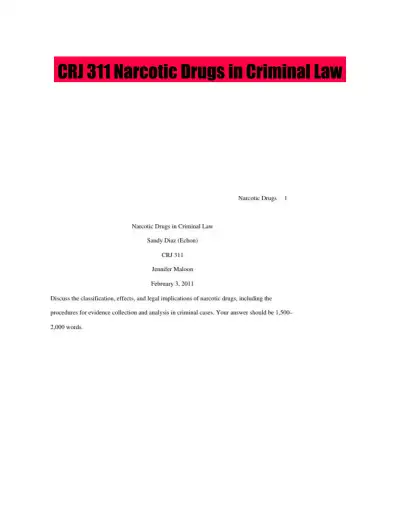 Solved Assignments
CRJ 311 Narcotic Drugs in Criminal Law
Criminal Justice
7 pagesMay 2025- Past ExamsPast Exams
3-3 Module Three Quiz
Criminal Justice
1 pageJun 2025 - Solved AssignmentsSolved Assignments
Levels of Law Enforcement in the United States
Criminal Justice
1 pageJun 2025
Study this document with CramX
Once it is in your library, every tool can work from it.