

Criminal Investigation 11th Edition Test Bank
- Criminal Justice
- 233 pages
- Shared May 2025
Want to ace your exam? Criminal Investigation 11th Edition Test Bank is your solution, with solved MCQs and questions tailored to your syllabus.
Preview 16 of 233 pages
See the first 16 pages exactly as they appear in the document.
Page 1 Read page 1 as text
Chapter 01: The Evolution of Criminal Investigation and Forensic Science Multiple Choice Questions 1. The first modern detective force was A) the Bow Street Runners. B) established by the Metropolitan Police Act of 1829. C) created by Patrick Colquhoun. D) headed by attorney Howard Vincent. Ans: A Page ref: 3 2. When the London Metropolitan Police force was established in 1829, the British public was at first suspicious and at times even hostile towards it because A) King Edward II had supported its creation. B) Rowan and Mayne had intimate ties to the royal family. C) social reformers such as Jeremy Bentham had long argued that it was a danger to personal liberty. D) French citizens had experienced oppression under centralized police. Ans: D Page ref: 3 3. In 1833, _______ an ordinance creating America's first paid, daylight police force? A) Philadelphia B) Chicago C) New York City D) Baltimore Ans: A Page ref: 3 - 4 4. After the Civil War, Pinkerton’s National Detective Agency engaged in the two broad areas of ____________? A) Locating war criminals and providing protection to the President of the United States. B) Controlling a discontented working class and protection of the President of the United States. C) Pursuing bank robbers and arresting train robbers. D) Controlling a discontented working class and pursuing bank and railroad robbers. Ans: D Page ref: 4 5. Which state and city was the first to create a unified police force in this country? A) New Orleans, LA. B) New York, NY. C) Baltimore, MD. D) Philadelphia, PA Ans: B Page ref: 4
Page 2 Page 3 Read page 3 as text
6. Which of the following is not one of the reasons cited in the textbook for having reliable detectives in Americain the 1800’s? A) Graft and corruption were common among America’s big city police officers. B) Police jurisdictions were limited. C) There was little information sharing among police departments. D) All of the above are reasons cited in the textbook. Ans: D Page ref: 4 7. A rogues' gallery is A) only practical in cities of 100,000 population or more. B) photographs of known criminals arranged by criminal specialty and height. C) a line - up of known offenders for viewing by detectives so they can recognize the criminals later on the street. D) only practical in cities of 100,000 population or more and are photographs of known criminals arranged by criminal specialty and physical height. Ans: B Page ref: 6 8. What was the original mission of the Secret Service when created by Congress in 1865? A) Combat counterfeiting. B) Provide protection for Presidents. C) Prevent drug importation into this country. D) All of the preceding was addressed in the Secret Service’s original Charter. Ans: A Page ref: 6 9. What municipal agency was the first to establish a Criminal Identification Bureau? A) Chicago, Ill. B) Atlanta, GA. C) Philadelphia, PA. D) New Orleans, LA. Ans: A Page ref: 6 10. Which agency was the prototype for modern state police organizations? A) New York State Police. B) Georgia State Police. C) Pennsylvania State Police. D) Pinkerton International Detective Agency. Ans: C Page ref: 611. 11. The Harrison Act of 1914 mad the distribution of nonmedical drugs a crime. The agency currently charged with enforcing its provisions is _________________.
Page 4 Read page 4 as text
A) Federal Bureau of Investigations B) Narcotics Bureau C) Drug Enforcement Agency D) Bureau of Narcotics and Dangerous Drugs Ans: C Page ref: 8 12. During 1961 - 1966, the U.S. Supreme Court became unusually active in hearing cases involving the rights of criminal suspects and defendants. This is referred to as the ____________ A) radical court era. B) conservative court era. C) due process revolution. D) ex - post facto period. Ans: C Page ref: 8 - 9 13. The first major book describing the application of scientific disciplines to criminal investigation was written in 1893 by Hans Gross. Translated into English in 1906, it remains highly respected today as a seminal work in the field. What is the book’s title? A) Criminal Investigation. B) The Scientific Method of Criminal Inquiry . C) Science and Criminal Conduct. D) Forensic Science and Crime. Ans: A Page ref: 9 14. What early method of criminal identification is based on the fact that every human being differs from every other one in the exact measurements of their body, and that the sum of these measurements yields a characteristic formula for each individual? A) Dactylography. B) Ectomorphism. C) Anthropometry. D) Meso - morphism. Ans: C Page ref: 9 15. The father of criminal identification is: A) Hans Gross. B) Alfonse Bertillon. C) Edward Henry. D) William Herschel. Ans: B Page ref: 9 16. The first country to use fingerprints as a system of criminal identification was: A) Germany.
Page 5 Read page 5 as text
B) France. C) China. D) England. Ans: D Page ref: 11 17. Which 1903 case was the most important incident to advance the use of fingerprints in America? A) Lindberg kidnapping. B) "James Jones." C) West. D) Faurot. Ans: C Page ref: 11 - 12 18. In 1985, research by ______________ and his colleagues at Leicester University, England led to the discovery that portions of the DNA structure of certain genes are as unique to individuals, as are fingerprints. A) Watson B) Ashworth C) Crick D) Jeffreys Ans: D Page ref: 12 19. What is the significance of the Enderby Cases that are referred to in the textbook? A) It proved without a doubt that DNA results were unreliable in court. B) The first use of DNA to exonerate a person convicted of the rape of two persons. C) The first use of DNA typing in a criminal trial. D) Both B and C. Ans: C Page ref: 13 20. The Palo Verde case is significant because it _______________ A) excluded evidence due to improper police training. B) was the first use of plant DNA in a criminal case. C) established the scientific basis for dactylography. D) confirmed Gravelle's Principal. Ans: B Page ref: 14 21. _______________________ is considered most responsible for raising firearms identification to a science and for perfecting the bullet comparison microscope? A) Paul Jeserich. B) Henri Lacassagne. C) Henry Balthazard.
Page 6 Read page 6 as text
D) Calvin Goddard. Ans: D Page ref: 14 22. Who made the first successful attempt to identify a murderer from the bullet recovered from the body of a victim? A) Paul Jeserich. B) Henri Lacassagne. C) Henry Balthazard. D) Henry Goddard. Ans: D Page ref: 14 23. The impact of Supreme Court decisions in criminal investigation cases and the adaptation to them by the police has A) slowed police professionalization. B) hastened police professionalization. C) had no effect on the police. D) handcuffed the police. Ans: B Page ref: 9 24. Which of the following is not one of the three major scientific systems for personal identification of criminals in wide use? A) Anthropometry. B) Dactylography. C) Ectomorphism. D) Deoxyribonucleic acid. Ans: C Page ref: 9 25. In 1892, who published the first definitive book on dactylography, Finger Prints? A) Sir Francis Galton. B) Henri Lacassagne. C) Henry Balthazard. D) Calvin Goddard. Ans: A Page ref: 11 True/False Questions 26. Criminalistics draws from diverse disciplines, such as geology, physics, chemistry, biology, and mathematics, to study physical evidence related to crime. Ans: True Page ref: 9 27. The Metropolitan Police act was enacted in 1829, the first time it was introduced in
Page 7 Read page 7 as text
England’s Parliament. Ans: False Page ref: 3 28. Pinkerton’s National Detective Agency’s trademark was an open eye above the slogan “We are ever Vigilant.” Ans: False Page ref: 4 29. After Prohibition was adopted nationally in 1920, the Bureau of Internal Revenue was responsible for its enforcement. Ans: True Page ref: 7 30. When Prohibition was repealed by the 18 th Amendment to the U.S. Constitution in 1933, many former bootleggers turned to bank robbery and kidnapping. It then became the FBI’s role to deal with the criminals. Ans: True Page ref: 7 31. The Bureau of Narcotics and Dangerous Drugs was an offshoot organization from the Drug Enforcement Administration that was formed to handle national terroristic drug use. Ans: False Page ref: 8 32. Bertillon produced the portrait parle’ or “speaking picture,” which combines full - face and profile photographs of each criminal with his or her exact body measurements and other descriptive data onto a single card. Ans: True Page ref: 10 33. Without exception, every person has distinctive DNA. In every cell of the same human that contains DNA, this blueprint is identical, whether the material is blood, tissue, spermatozoa, bone marrow, tooth pulp, or a hair root cell. Ans: False Page ref: 13 34. The Orlando Cases set the stage for the first use of DNA typing in the United States. Ans: True Page ref: 13 36. In 1913, Professor Balthazard published an article on firearms identification in which he noted that the firing pin, extractor, and ejector all leave marks on cartridges, and that they vary among weapons. Ans: True Page ref: 14
Page 8 Read page 8 as text
Fill - in - the - Blank Questions 36. ________ efforts led to the establishment of the London Metropolitan Police in 1829. English police officers are still affectionately referred to as “bobbies,” a play on his first name. Ans: Sir Robert Peel’s Page ref: 3 37. Stephen Girard bequeathed $33,190 to ________ to develop a competent police force. Ans: Philadelphia Page ref: 3 - 4 38. The major private detective agency of the 19 th century was formed by ________. Ans: Alan Pinkerton Page ref: 4 39. To supplement the rogues’ gallery, Thomas Byrnes instituted the ________ where at 9 o’clock every morning; all criminals arrested in the past 24 hours were marched before his detectives who were expected to make notes and to recognize the criminals later. Ans: Mulberry Street Morning Parade Page ref: 6 40. In 1967, the ________ was made operational by the FBI, providing data on wanted persons and property stolen from all 50 states. Ans: National Crime Information center (NCIC) Page ref: 8 41. The ________ revolution and subsequent Supreme Court decisions changed questionable and improper police procedures and tactics. Ans: due process Page ref: 8 - 9 42. All crime scenes are searched on the basis of Edmond Locard’s ________, which asserts that when perpetrators come into contact with the scene, they will leave something of themselves and take away something from the scene. Ans: exchange principle Page ref: 9 43. The first foreigner trained in the use of the Henry classification system was New York City Detective ________ in 1904. Ans: Joseph Faurot Page ref: 11 44. The ________ Cases involved blood samples from about 5,500 men living in the area for DNA typing in an attempt to identify a rape suspect. Ans: Enderby
Page 9 Read page 9 as text
Page ref: 13 45. ________ helped produce the first workable polygraph in 1921 and established America’s first full forensic laboratory in Los Angeles in 1923. Ans: August Vollmer Page ref: 15 Essay Questions 46. Who were the Bow Street Runners and of what historical importance are they? Ans: The Bow Street Runners were a small group of volunteer, non - uniformed homeowners established in 1750 by Henry Fielding to "take thieves." In "taking thieves" they would hurry to the scene of a crime and begin an investigation, thus becoming the first modern detective force. Page ref: 3 47. Why did the British public object to the use of detectives following the Metropolitan Police Act of 1829? Ans: French citizens had been repressed under centralized policing. In England there was fear that the use of "police spies" (detectives in plain clothes) would reduce civil liberties. In 1833 a Sergeant Popay was dismissed from the London Metropolitan Police because he infiltrated a radical group, acquired a leadership position, and argued for the use of violence. Page ref: 3 48. Why did the office of detective in this country initially evolve in the private sector? Ans: First, graft and corruption were common in big city police departments. Second, municipal police jurisdictions were limited. Third, there was little communication between police departments in different cities. Thus, offenders could flee from one jurisdiction to another with impunity. When individuals and businesses could not get reliable investigative services from the public sector, it created the possibility of the private sector (such as Pinkerton's National Detective Agency) providing such services. Page ref: 4 49. What parallels can be drawn between Allan Pinkerton and J. Edgar Hoover? Ans: Both of them understood the importance of: (1) information, (2) criminal records, and (3) publicity favorable to their efforts. Page ref: 5 & 8 50. What did the “due process revolution” and subsequent Supreme Court decisions change with respect to the police? Ans: Questionable and improper police procedures and tactics were greatly reduced. In turn, this created the need to develop new procedures and tactics and to make sure that officers were well trained in their uses. There has been an ongoing cycle of decisions and adaptation to them by the police since the due process revolution. To no small extent, this ongoing cycle has hastened the continuing professionalization of the police, while also asserting the principle that the action of police officers anywhere may be subject to close scrutiny by the Supreme Court. Page ref: 9
Page 10 Read page 10 as text
51. What are the milestones in the development of dactylography? Ans: (1) 1st century: Roman lawyer Quintilianus used a bloody fingerprint to successfully defend a child accused of murder. (2) 8th century: Used on contracts in China (also in 14th century Persia and 17th century England, thought to awe people into keeping agreements, no individual identification by fingerprints possible at the time). (3) 1684: England's Dr. Grew called attention to systems of pores in ridges in hands and feet. (4) 1686: Mercello Malpigni confirmed Grew's observations. (5) 1823: Professor Perkinje named nine standard fingerprint patterns and outlined a broad method of classifying them. (6) 1877: Herschel wrote to the Inspector General of the Prisons of Bengal about using fingerprints as means of personal identification. This suggestion was rejected as Inspector General thought that Herschel's letter was the product of delirium. (7) 1880: Faulds matched sooty fingerprint on a whitewashed wall to that of suspect. (8) 1880: Faulds reported his finding in Nature, provoking controversy between Herschel and Faulds. (9) 1892: Galton published Fingerprints, the first definitive book on dactylography. (10) 1892: Inspector Alvarez, a disciple of Vucetich, got the first South American criminal conviction based on fingerprints. (11) 1894: Vucetich published Dictiloscopia Comparada, outlining his system of fingerprint classification. (12) 1900: Henry system adopted in England. (13) 1901: Henry publishes Classification and Use of Fingerprints, outlining his system of fingerprint classification. (14) 1903: the Will West/William West case at the U.S. Penitentiary at Leavenworth, Kansas demonstrated the superiority of dactylography to anthropometry. (15) 1904: Detective Sergeant Faurot of the NYCPD becomes the first foreigner to study the Henry system; in 1906 he obtained the theft conviction of "James Jones" by the use of fingerprints. (16) 1917: the Argentine government seized all of Vucetich's records and forbade him to do further work, largely because of strong protests in Buenos Aires against wide - spread fingerprint registration. Page ref: 10 - 12 52. Why does the Henry classification enjoy greater use than Vucetich's system? Ans: In 1917, the Argentine government seized all of Vucetich's records and forbade him to do further work (due to strong protests in Buenos Aires against wide - spread fingerprint registration). In 1925, Vucetich died a disappointed man. In contrast, Henry became the head of what was then the world's most prestigious police organization and enjoyed the support of his country. These advantages, coupled with Vucetich's loss of support in his own country, meant the Henry classification system would become adopted virtually worldwide. Page ref: 12 53. What are seven different human sources of DNA material identified in this chapter? Ans: These sources are: (1) blood, (2) tissue, (3) spermatozoa, (4) bone marrow, (5) tooth pulp, (6) saliva and (7) hair root cells.
Page 11 Read page 11 as text
Page ref: 13 54. Of what significance is the palo verde seedpod case in Phoenix, Arizona? Ans: It is the first case in which "genetic fingerprinting" was applied to plant evidence in a criminal case. Page ref: 14 55. What are the milestones in the development of firearms identification? Ans: (1) 1835, Henry Goddard (one of the last of the Bow Street Runners) made the first successful attempt to identify a murderer from a bullet recovered from the victim's body. At the home of a suspect, Goddard seized a bullet mold with a defect in it corresponding to a mark on the recovered bullet. (2) 1889, Professor Lacassagne recovered a bullet from a corpse. The bullet had seven grooves on it. Shown a number of suspect guns, Lacassagne identified the one that could have left seven grooves. However, any number of guns manufactured at that time could have made seven grooves and there is no way of knowing if the right person was found guilty. (3) 1898, Paul Jeserich took microphotographs of fatal and test bullets and based on their respective normalities and irregularities testified that the defendant's revolver fired the fatal bullet. At the doorstep of scientific greatness, Jeserich did not pursue this discovery any further, turning his attention to other interests. (4) 1913, Professor Balthazard published perhaps the single most important article on firearms identification. In it he noted that the firing pin, breechblock, extractor, and ejector all leave marks on cartridges and that these varied among different types of weapons. (5) 1926, Calvin Goddard became the head of a team working on firearms identification. He is considered the person most responsible for raising firearms identification to a science and for perfecting the bullet comparison microscope. Page ref: 14 - 15
Page 12 Read page 12 as text
Chapter 02: Legal Aspects of Investigation Multiple Choice Questions 1. Procedural law deals with all of the following except A) process of arrest. B) admissibility of evidence. C) search and seizure. D) elements of a crime. Ans: D Page ref: 18 2. The due process clause is found in which Amendment of the Bill of Rights? A) First Amendment. B) Fourth Amendment. C) Fifth Amendment. D) Tenth Amendment. Ans: C Page ref: 19 3. Which of the following protects citizens from unreasonable searches and seizures? A) First Amendment. B) Fifth Amendment. C) Eighth Amendment. D) Fourth Amendment. Ans: D Page ref: 20 4. The ingredients of arrest include all of the following except A) force. B) intention. C) authority. D) custody. Ans: A Page ref: 21 5. A temporary and limited interference with the freedom of a person for investigative purposes is the definition of a/an A) arrest. B) detention. C) affidavit. D) charging. Ans: B Page ref: 21 6. A judicial order commanding a person to whom it is issued or some other person to bring a
Page 13 Read page 13 as text
person promptly before a court to answer a criminal charge is a/an A) arrest warrant. B) affidavit. C) court order. D) any of the above. Ans: A Page ref: 22 - 23 7. A written statement of the information known to the officer that serves as the basis for the issuance of a warrant is a/an A) arrest warrant. B) affidavit. C) court order. D) any of the preceding. Ans: B Page ref: 23 8. Which of the following is not usually required to be in the contents of a valid arrest warrant? A) the authority under which the warrant is issued B) the identity of the person to be arrested C) the designation of the offense D) the authority to search the person arrested Ans: D Page ref: 23 9. A John Doe warrant is valid A) if a crime has been committed. B) if there is a particular description of the perpetrator but the person’s name is not known. C) in all cases. D) only at the federal level. Ans: B Page ref: 23 10. Suspicion plus facts and circumstances which would lead a reasonable person, exercising ordinary caution, under the same circumstances to believe that a crime has been, is being, or is about to be committed is a definition of A) in - presence arrest. B) probable cause. C) investigative detention. D) the requirements of an arrest warrant. Ans: B Page ref: 24 11. Which of the following can be used to establish probable cause? A) personal observations and knowledge of the investigator. B) suspicion.
Page 14 Read page 14 as text
C) crime rates. D) occupation of the suspect. Ans: A Page ref: 24 - 25 12. Until 1914, federal law enforcement officers, conducting an illegal search that produced incriminating evidence, were allowed to use that evidence in court. What happened that changed the use of illegal evidence by federal officers? A) The president of the United States signed an order prohibiting its use. B) J. Edgar Hoover, Director of the FBI, signed an executive order prohibiting the use of illegally obtained evidence. C) Mapp v. Ohio forbids the use of illegally evidence by federal officers. D) Weeks v. United States forbids the use of illegally obtained evidence by federal officers. Ans: D Page ref: 25 13. Circumventing the intent of Weeks v. U.S ., whereby federal officers received illegally obtained evidence from state officers and used it in federal court was referred to as A) fruit of the poisonous tree doctrine. B) unreasonable search doctrine. C) silver platter doctrine. D) None of the preceding. Ans: C Page ref: 25 14. Which of the following cases established the rule that any evidence unreasonably searched and seized could no longer be admissible in any court? A) Weeks v. Ohio. B) Roe v. Wade. C) Mapp v. Ohio. D) Gideon v. Wainwright. Ans: C Page ref: 26 15. Which of the following is not an exception to the legal requirement of having a warrant to conduct a search and seizure? A) with consent. B) incident to an unlawful arrest. C) when exigent circumstances exist. D) to conduct an inventory. Ans: B Page ref: 26 16. What burden of proof is required to obtain a search warrant? A) Reasonable suspicion. B) Probable cause.
Page 15 Read page 15 as text
C) Preponderance of the evidence. D) Proof beyond a reasonable doubt. Ans. B Page ref: 26 17. Which Supreme Court case held that officers executing a search warrant of a house acted reasonably by detaining the occupants of the house in handcuffs during the search? A) Hudson v. Michigan . B) Mapp v. Ohio . C) Terry v. Ohio. D) Muehler v. Mena . Ans: D Page ref: 28 18. Incriminating evidence is found during a consent search. What is the primary factor of the search that the court will look at in deciding whether evidence may be admitted? A) Was a consent to search form completed by the suspect and witnessed? B) Was the consent to search voluntarily given? C) Was the suspect able to observe the search when the evidence was found? D) Was the suspect under the influence of alcohol or drugs? Ans: B Page ref: 28 19. Which Supreme Court Case established the “moveable vehicle” rule? A) Carroll v. United States . B) Chambers v. Maroney . C) Maryland v. Dyson . D) Chimel v. California . Ans: A Page ref: 30 20. What term is used to recognize that a warrantless entry by law enforcement officials may be legal when there is a compelling need for official action and no time to get a warrant? A) Emerging situational need. B) Emergency situational requirement. C) Exigent circumstances. D) Emergency exigent circumstances. Ans: C Page ref: 31 21. Which of the following is not a requirement for a plain view search to be legal? A) Officer is where he has a legal right to be. B) Evidence is in plain view. C) Evidence is inadvertently discovered. D) Evidence is found after a limited search. Ans: D
Page 16 Read page 16 as text
Page ref: 32 22. The landmark Supreme Court ruling that allows stop and frisk procedures is A) Miranda v. Arizona. B) Terry v. Ohio. C) Mapp v. Ohio. D) Escobedo v. Day. Ans: B Page ref: 33 - 34 23. According to the courts, any new evidence seized resulting from unreasonably seized evidence is also tainted and is not admissible in court. This is based on the A) bad evidence doctrine. B) fruits of the poisonous tree doctrine. C) illegal seizure doctrine. D) unreasonable search doctrine. Ans: B Page ref: 34 24. In Minnesota v. Dickerson , why was the defendant not convicted? A) Officer felt a substance in suspect’s pocket, subsequently determined to be cocaine, during a pat down and manipulated it to determine what it was. B) Defendant pled guilty before trial. C) Judge declared a mistrial. D) The charges were dropped by the prosecutor before trial. Ans: A Page ref: 34 25. Evidence obtained from an unreasonable search and seizure cannot be used as the basis for learning about or collecting new admissible evidence not known about before is the A) bad evidence doctrine. B) fruits of the poisonous tree doctrine. C) illegal seizure doctrine. D) unreasonable search doctrine. Ans: B Page ref: 34 True/False Questions 26. Procedural law deals with processes of arrest, search and seizure, interrogations, confessions, admissibility of evidence and testifying in court and therefore changes less frequently than does substantive law. Ans: False Page ref: 18 27. Final ratification of the Constitution of the United States was delayed because some states
217 more pages in the full document
Unlock it once and it stays in your library, ready to chat with or turn into flashcards.
Unlock the full documentMore Criminal Justice study materials
See all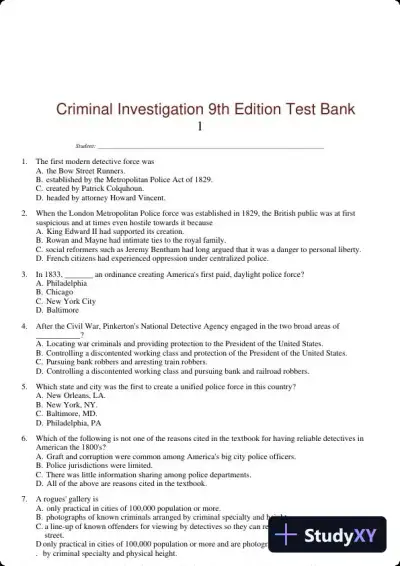 Exam Guides
Criminal Investigation 9th Edition Test Bank
Criminal Justice
344 pages103downloadsFeb 2025 Exam Guides
Test Bank For Forensic Science, 4th Edition
Criminal Justice
370 pages132downloadsFeb 2025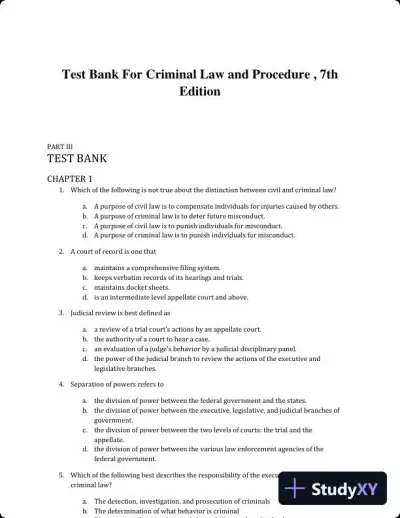 Exam Guides
Test Bank For Criminal Law and Procedure , 7th Edition
Criminal Justice
65 pages96downloadsFeb 2025 Past Exams
2024-2025 TCOLE Basic Jailer Course Practice Exam with Answers (259 Solved Questions)
Criminal Justice
33 pages47downloadsFeb 2025 Class Presentation
The Future Of The Juvenile System
Criminal Justice
11 pagesMay 2025 Class Notes
Lecture Notes For Crime Control In America: What Works, 4th Edition
Criminal Justice
66 pagesMay 2025- Past ExamsPast Exams
Technology in Criminal Justice CJ305-6-0
Criminal Justice
1 pageJun 2025  Solved Assignments
CJA/234 ASSIGNMENT 2: FEDERAL PRISON COMPARISON
Criminal Justice
9 pagesMay 2025
Study this document with CramX
Once it is in your library, every tool can work from it.