

CRJ 311 Narcotic Drugs in Criminal Law
- Criminal Justice
- Ashford University
- 7 pages
- Shared May 2025
This document explores the legal implications and enforcement challenges related to narcotic drugs in criminal law.
Preview 3 of 7 pages
See the first 3 pages exactly as they appear in the document.
Page 1 Read page 1 as text
Narcotic Drugs 1 Narcotic Drugs in Criminal Law Sandy Diaz (Echon) CRJ 311 Jennifer Maloon February 3, 2011 Discuss the classification, effects, and legal implications of narcotic drugs, including the procedures for evidence collection and analysis in criminal cases. Your answer should be 1,500 – 2,000 words.
Page 2 Page 3 Read page 3 as text
Narcotic Drugs 2 Narcotic come from the Greek word narkotikos. This simply means a state of lethargy or sluggishness. A narcotic drug is an analgesic or pain killing substance that can dress vital body functions and produce physical dependency (Saferstein pg. 192). There are many types of narcotics in the world and some more deadly than others. I am going to discuss the many types of narcotics and what they can do. I want to explain how such drugs are or needed to obtain a conviction in a drug case, and the necessity of analysis of drugs in a criminal case. There are many drugs in the world today which have to be classified. The classification goes from Schedule I to Schedule 5 which rates the drugs from High Abuse down to Minor Problems. A Schedule I drug is considered high risk and consist of medical problems, Schedule 2 drugs consist of being high risk with a high dependency rate, Schedule 3 drugs consist of a low abuse with a moderate rate of dependency, Schedule 4 drugs consist of limited abuse with limited dependency risk and finally, Schedule 5 drugs consist of minor problems (http://www.umsl.edu/~keelr/180/classify.html). Narcotic drugs which consist of Opiates. Opiate drugs are analgesics which eliminate pain by depressing the nervous system and are considered a Schedule 2 classification. Heroin is a form of opiate which is injected intravenously and considered a Schedule 1 classification. Another type of opiate is Synthetic Opiates. Synthetic Opiates are derived from opium and have similar physiological effects on the body. A form of synthetic opiates is methadone which is given orally (Saferstein pg. 194). Another drug type is Hallucinogens. Hallucinogens are drugs that can cause marked alterations in mood, attitude, thought processes, and perceptions. In this class of drugs, Marijuana is the most popular. Marijuana is derived from the plant Cannabis. Marijuana has been in use
4 more pages in the full document
Unlock it once and it stays in your library, ready to chat with or turn into flashcards.
Unlock the full documentMore Criminal Justice study materials
See all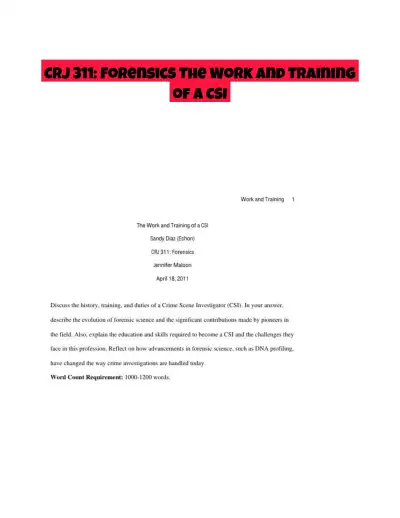 Solved Assignments
CRJ 311: Forensics The Work and Training of a CSI
Criminal Justice
11 pagesMay 2025 Exam Guides
Test Bank For Forensic Science, 4th Edition
Criminal Justice
370 pages132downloadsFeb 2025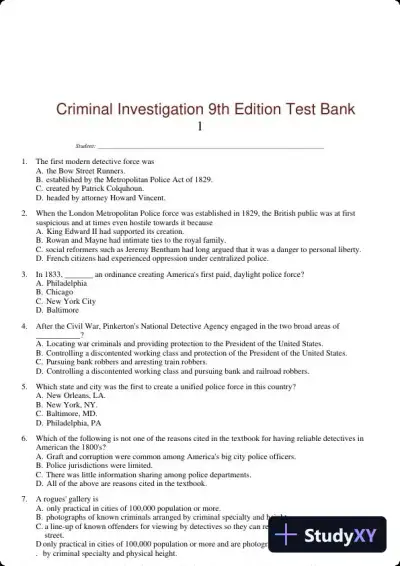 Exam Guides
Criminal Investigation 9th Edition Test Bank
Criminal Justice
344 pages103downloadsFeb 2025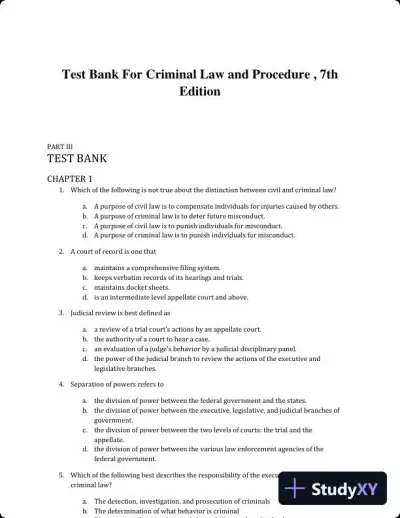 Exam Guides
Test Bank For Criminal Law and Procedure , 7th Edition
Criminal Justice
65 pages96downloadsFeb 2025 Past Exams
2024-2025 TCOLE Basic Jailer Course Practice Exam with Answers (259 Solved Questions)
Criminal Justice
33 pages47downloadsFeb 2025 Class Presentation
The Future Of The Juvenile System
Criminal Justice
11 pagesMay 2025 Class Notes
Lecture Notes For Crime Control In America: What Works, 4th Edition
Criminal Justice
66 pagesMay 2025- Past ExamsPast Exams
Technology in Criminal Justice CJ305-6-0
Criminal Justice
1 pageJun 2025
Study this document with CramX
Once it is in your library, every tool can work from it.