

CRJ301: Criminal Sentencing Juvenile Justice (professor)
- Criminal Justice
- University of Nevada
- 8 pages
- Shared May 2025
This assignment explores criminal sentencing practices and juvenile justice policies.
Preview 3 of 8 pages
See the first 3 pages exactly as they appear in the document.
Page 1 Read page 1 as text
Criminal Sentencing 1 Running head: CRIMINAL SENTENCING Criminal Sentencing Sandy Diaz CRJ301: Juvenile Justice (professor) Instructor: Dianne Williams April 29, 2012 In your analysis of criminal sentencing, you discuss various forms of punishment, such as retribution, incapacitation, and deterrence. Based on the theories presented in the essay, how effective do you believe the current criminal sentencing practices in the United States are in achieving the goals of crime prevention, deterrence, and rehabilitation? Additionally, provide a critical evaluation of whether alternatives to incarceration, such as restorative justice programs, could be more effective in reducing recidivism and improving societal outcomes. Word Count Requirement: 600 - 800 words
Page 2 Page 3 Read page 3 as text
Criminal Sentencing 2 Abstract Criminal sentencing is intended as prevention to future criminality as well as protecting the public and preserving the established values of society. Currently, the main emphasis of criminal sentencing in the United States is that criminals must receive punishments proportionate with the gravity of their offenses. Yet there is little indication that suggests changes in criminal behaviour as an outcome of government - imposed criminal sentencing as numerous past probationers and discharged prisoners constantly perpetrate crimes. Criminal Sentencing Introduction Where there is malicious intent or unjustifiable disregard for safety, a corresponding punishment therefore is justifiable . A judge may sentence a person found guilty of a crime to capital punishment, intermediate sanctions, pr obation, fines, or imprisonment; and along with the judge’s assumption of the specific criminal sentence is the idea that the punishment is useful. However, most sentences in the contemporary societies involve incarceration. The principal intention of criminal sentencing is to punish the lawbreaker. Although rehabilitation is an aspired goal of criminal sentencing, it is only secondary to the purpose of punishment. Currently, the U nited States, as compared to other countries , has the highest percentage of citizen imprisonment. Among the leading industrialized countries, the murder rate of the United States is 3.5 times higher than the second place Italy ( Fauteck, n.d. ). Moreover, the majority of persons discharged from incarceration in the country are expected to be convicted of another crime within five years ( Fauteck, n.d. ). Despite the relentless problem , the country is unmoving that appropriate sentencing practice, laws and regulations of correctional programs,
5 more pages in the full document
Unlock it once and it stays in your library, ready to chat with or turn into flashcards.
Unlock the full documentMore Criminal Justice study materials
See all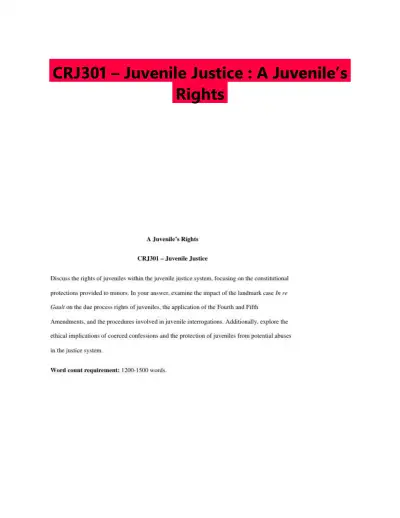 Solved Assignments
CRJ301 � Juvenile Justice : A Juvenile�s Rights
Criminal Justice
8 pagesMay 2025 Exam Guides
Test Bank For Forensic Science, 4th Edition
Criminal Justice
370 pages132downloadsFeb 2025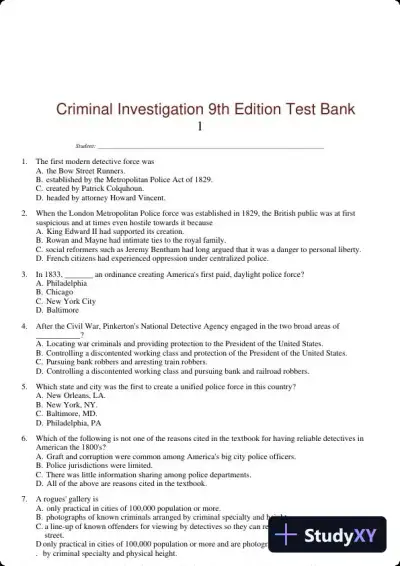 Exam Guides
Criminal Investigation 9th Edition Test Bank
Criminal Justice
344 pages103downloadsFeb 2025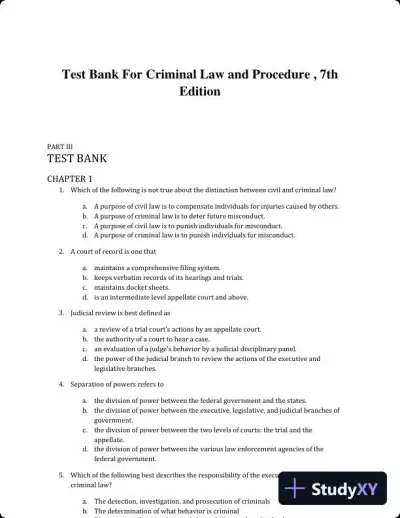 Exam Guides
Test Bank For Criminal Law and Procedure , 7th Edition
Criminal Justice
65 pages96downloadsFeb 2025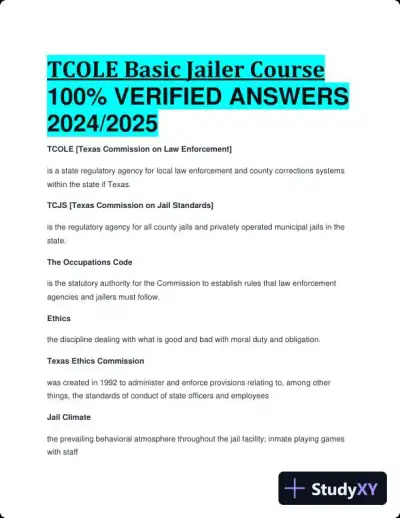 Past Exams
2024-2025 TCOLE Basic Jailer Course Practice Exam with Answers (259 Solved Questions)
Criminal Justice
33 pages47downloadsFeb 2025 Class Presentation
The Future Of The Juvenile System
Criminal Justice
11 pagesMay 2025 Class Notes
Lecture Notes For Crime Control In America: What Works, 4th Edition
Criminal Justice
66 pagesMay 2025- Past ExamsPast Exams
Technology in Criminal Justice CJ305-6-0
Criminal Justice
1 pageJun 2025
Study this document with CramX
Once it is in your library, every tool can work from it.