

Juvenile Statistical Analysis - CRJ 305 Crime Prevention
- Criminal Justice
- Arizona State University
- 12 pages
- Shared May 2025
Download this Homework Presentation to learn how statistical analysis aids in juvenile crime prevention.
Preview 4 of 12 pages
See the first 4 pages exactly as they appear in the document.
Page 1 Read page 1 as text
Juvenile Statistical Analysis Jessica Valentine CRJ 305 Crime Prevention Instructor Jeffrey Cudworth October 28, 2013
Page 2 Page 3 Read page 3 as text
Due Process • According to the Lectric Law Library due process is, “the idea that laws and legal proceedings must be fair and the Constitution guarantees that the government cannot take away a person's basic rights to 'life, liberty or property, without due process of law” (Lectric, par. 1). • Also according to Lectric Law Library, “the Fourteenth Amendment prohibits the deprivation of liberty or property without due process of law and the Sixth Amendment, which is applicable to the states through the Due Process Clause of the Fourteenth Amendment, see In re Oliver, 333 U.S. 257, 273 - 74 (1948), guarantees a criminal defendant a fundamental right to be clearly informed of the nature and cause of the charges against him” (Lectric, par. 1). • Due process is a guaranteed right that each and every individual will be treated with fairness regardless of race, religion, beliefs, height, weight, the crime in which they are accused of committing, and whether they are poor or rich. Equal treatment and fairness is given to each individual under the Due Process Clause. Due process is an extremely important part in the criminal justice system. If it were not for due process, I do not believe there would be a purpose for criminal justice because justice will not have truly taken place. According to the LLS.edu, “there are two Due Process Clauses in the Constitution: the Fifth Amendment states: "No person shall be deprived of life, liberty, or property, without due process of law, and the Fourteenth Amendment provides: "no state shall. deprive any person of life, liberty, or property, without due process of law” (LLS, nd ). • “According to the NCVS, in 1997 juveniles under age 18 were involved in 27% of all serious violent victimizations, including 14% of sexual assaults, 30% of robberies, and 2 7% of aggravated assaults” (OJJDP, 1997).
Page 4 Read page 4 as text
• According to the FBI, “the estimated arrest rate for the United States in 2010 was 4,257.6 arrests per 100,000 inhabitants” (FBI, 2010). • There are several programs that are available to juveniles and the juveniles. The programs that are available to juveniles and their families consist of recreation, Parent - Child Interaction Training Program, Functional Family Therapy (FFT), Prevention Programs in the Juvenile Justice System, Education, Community Involvement, and possibly Boot Camp. • These programs are set into place to help juveniles deter from committing crimes, and decrease the amount of juveniles being arresting. Juveniles tend to commit crimes for various reason and in order to deter these crimes, the behavior traits of the juveniles needs to be learned and this way it can help persuade the juvenile into changing that criminal type behavior into a more positive type behavior that will have positive impacts on the juvenile. Juveniles
8 more pages in the full document
Unlock it once and it stays in your library, ready to chat with or turn into flashcards.
Unlock the full documentMore Criminal Justice study materials
See all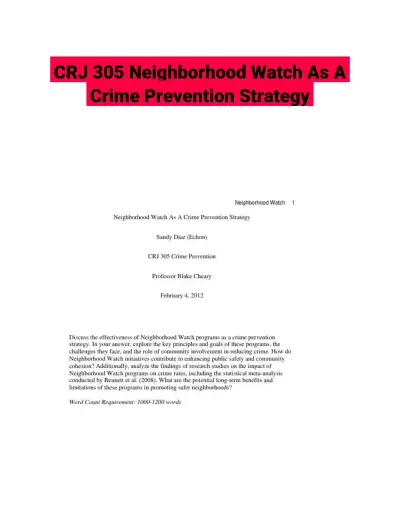 Solved Assignments
CRJ 305 Neighborhood Watch As A Crime Prevention Strategy
Criminal Justice
11 pagesMay 2025 Exam Guides
Test Bank For Forensic Science, 4th Edition
Criminal Justice
370 pages132downloadsFeb 2025 Exam Guides
Criminal Investigation 9th Edition Test Bank
Criminal Justice
344 pages103downloadsFeb 2025 Exam Guides
Test Bank For Criminal Law and Procedure , 7th Edition
Criminal Justice
65 pages96downloadsFeb 2025 Past Exams
2024-2025 TCOLE Basic Jailer Course Practice Exam with Answers (259 Solved Questions)
Criminal Justice
33 pages47downloadsFeb 2025 Class Presentation
The Future Of The Juvenile System
Criminal Justice
11 pagesMay 2025 Class Notes
Lecture Notes For Crime Control In America: What Works, 4th Edition
Criminal Justice
66 pagesMay 2025- Past ExamsPast Exams
Technology in Criminal Justice CJ305-6-0
Criminal Justice
1 pageJun 2025
Study this document with CramX
Once it is in your library, every tool can work from it.