

Managing and Leading Today's Police:Challenges, Best Practices, Case Studies, 4th Edition Test Bank
- Criminal Justice
- 343 pages
- Shared May 2025
Want to excel in your exams? Managing and Leading Today's Police:Challenges, Best Practices, Case Studies, 4th Edition Test Bank gives you the practice and answers you need.
Preview 16 of 343 pages
See the first 16 pages exactly as they appear in the document.
Page 1 Read page 1 as text
Manual and Testbank for Managing and Leading Today’s Police Challenges, Best Practices, & Case Studies Fourth Edition Kenneth J. Peak University of Nevada, Reno Larry K. Gaines California State University, San Bernardino Ronald W. Glensor Reno, Nevada, Police Department
Page 2 Page 3 Read page 3 as text
iii Contents Chapter 1 Leading and Managing Today’s Police: Challenges and Opportunities…………………………………………… 1 Chapter 2 The Dynamics of Police Organizations: Structure and Theories 14 Chapter 3 Leadership and Motivation: What Works…… 27 Chapter 4 Communication, Negotiation, and Conflict Resolution 40 Chapter 5 Human Resource Management: The Foundation for an Effective Police Department 51 Chapter 6 Officers’ Rights, Discipline, and Liability: A Legal and Policy-Driven Framework 63 Chapter 7 Leadership Roles in Labor Relations: “Navigating the Waters” of PoliceUnionization 57 Chapter 8 Financial Administration: “Doing More with Less” Since the Great Recession 89 Chapter 9 Ethics and Accountability: Building a Culture of Integrity and Trust 101 Chapter 10 Community Policing and Problem Solving: Addressing Crime and Disorder 113 Chapter 11 Officer Wellness, Safety, and Stress: Identifying and Managing Harms 126 Chapter 12 Police Productivity: Improving Performance 138 Chapter 13 Managing Homeland Security and Critical Events 151 Chapter 14 Technologies for the Tasks: Tools for Today’s Police Leaders 164
Page 4 Read page 4 as text
iv Contents Testbank Chapter 1 Leading and Managing Today’s Police: Challenges and Opportunities…………………………………………… 177 Chapter 2 The Dynamics of Police Organizations: Structure and Theories 189 Chapter 3 Leadership and Motivation: What Works…… 201 Chapter 4 Communication, Negotiation, and Conflict Resolution 213 Chapter 5 Human Resource Management: The Foundation for an Effective Police Department 223 Chapter 6 Officers’ Rights, Discipline, and Liability: A Legal and Policy-Driven Framework 234 Chapter 7 Leadership Roles in Labor Relations: “Navigating the Waters” of PoliceUnionization 248 Chapter 8 Financial Administration: “Doing More with Less” Since the Great Recession 259 Chapter 9 Ethics and Accountability: Building a Culture of Integrity and Trust 271 Chapter 10 Community Policing and Problem Solving: Addressing Crime and Disorder 282 Chapter 11 Officer Wellness, Safety, and Stress: Identifying and Managing Harms 288 Chapter 12 Police Productivity: Improving Performance 305 Chapter 13 Managing Homeland Security and Critical Events 317 Chapter 14 Technologies for the Tasks: Tools for Today’s Police Leaders 329
Page 5 Read page 5 as text
1 Chapter 1: Leading and Managing Today’s Police: Challenges and Opportunities Chapter Overview: This chapter started with an overview of organizations, which will be explored in more detail in Chapter 2. Police departments are organizations that must provide Services to the public in an effective and efficient manner. Organization theory and structure play an important role in policing. As a part of this discussion, we examined the meaning of leadership and management, two key ingredients in organizations. We provided some context to police leadership and management by briefly examining policing from an historical framework. History is useful in that it provides us with information about how we arrived at our current organizational arrangements. This chapter briefly examined the concept of police goals. Goals are important as they establish standards for performance. We demonstrated how goals often are enumerated in police department mission statements and strategic plans. Finally, we briefly discussed some of the challenges and opportunities confronting American law enforcement. It is important for police leaders to confront the challenges and take advantage of the opportunities. The environment of policing is constantly changing, and police leaders must be forward-thinking and ensure their departments continue to move forward in an effective manner. Student Learning Objectives: • understand what an organization is and how police departments meet the criteria to be called an organization • describe why leadership and management are key components in a police organization and why they are important • understand how and why night watches were created and how they evolved into police departments • know the history of the London Metropolitan Police Department and how it contributed to modern policing in the United States • distinguish between the different phases or periods of American policing • be able to define goals, mission statements, and strategic planning and why they are important to police organizations • list the challenges to police departments and identify other challenges that may be facing law enforcement • know the opportunities that police departments have and why they are opportunities Chapter 1: Multiple-Choice Items 1. Which concept refers to the fact that organizations are composed of people who interact with one another and with people outside the organization? a. relatively identifiable boundary b. consciously coordinated c. social entity d. jurisdictional borders Answer: c
Page 6 Read page 6 as text
2 Objective: Understand what an organization is and how police departments meet the criteria to be called an organization Page Number: 5 Level: Difficult 2. Which concept implies leadership and management? a. relatively identifiable boundary b. consciously coordinated c. social entity d. jurisdictional borders Answer: b Objective: Understand what an organization is and how police departments meet the criteria to be called an organization Page Number: 5 Level: Intermediate 3. Robbery detectives who investigate robberies falls under which concept? a. relatively identifiable boundary b. consciously coordinated c. social entity d. jurisdictional borders Answer: a Objective: Understand what an organization is and how police departments meet the criteria to be called an organization Page Number: 5 Level: Intermediate 4. Which concept consists of tools by which to put leadership into action? a. leadership b. community policing c. management d. problem solving Answer: c Objective: Describe why leadership and management are key components in a police organization and why they are important Page Number: 6 Level: Basic 5. In a medium size police agency, who are the first-line management? a. police chief b. sergeant c. captain d. officer Answer: b Objective: Describe why leadership and management are key components in a police organization and why they are important
Page 7 Read page 7 as text
3 Page Number: 7 Level: Intermediate 6. Which concept consists of ensuring that tasks are accomplished, and goals are reached? a. leadership b. community policing c. management d. problem solving Answer: a Objective: Describe why leadership and management are key components in a police organization and why they are important Page Number: 6 Level: Intermediate 7. After the Industrial Revolution, which city in England utilized night watchman in an effort to reduce crime? a. London b. Glasgow c. Manchester d. Liverpool Answer: a Objective: Understand how and why night watches were created and how they evolved into police departments Page Number: 8 Level: Intermediate 8. After the Industrial Revolution, what led to the use of night watchman? a. increase in population b. decrease in population c. increase in immigration d. decrease in immigration Answer: a Objective: Understand how and why night watches were created and how they evolved into police departments Page Number: 8 Level: Basic 9. Who were the forerunner of today’s sheriffs? a. Roman army b. night watchmen c. shire-reeves d. thief takers
Page 8 Read page 8 as text
4 Answer: c Objective: Know the history of the London Metropolitan Police Department and how it contributed to modern policing in the United States Page Number: 8 Level: Intermediate 10. Who introduced a bill in Parliament, the Act for Improving the Police in and near the Metropolis, creating the first modern police department? a. Henry Fielding b. Sir Walter Scott c. King John of England d. Sir Robert Peel Answer: d Objective: Know the history of the London Metropolitan Police Department and how it contributed to modern policing in the United States Page Number: 9 Level: Intermediate 11. Who employed a group of “thief takers” who investigated crimes in the area and brought criminals to justice? a. Henry Fielding b. Sir Walter Scott c. King John of England d. Sir Robert Peel Answer: a Objective: Know the history of the London Metropolitan Police Department and how it contributed to modern policing in the United States Page Number: 9 Level: Intermediate 12. Which king was forced to sign the Magna Carta? a. King Henry VIII b. King John of England c. King Edward I d. King James II Answer: b Objective: Know the history of the London Metropolitan Police Department and how it contributed to modern policing in the United States Page Number: 8 Level: Intermediate 13. Police departments were able to hire a number of veterans as officers after which war? a. Civil War b. World War I c. World War II d. Cold War
Page 9 Read page 9 as text
5 Answer: c Objective: Distinguish between the different phases or periods of American policing Page Number: 10 Level: Intermediate 14. What did many police departments create to help deal with the disorder during the 1960s? a. police-community relations units b. bureaucratic policing c. intelligence-led policing (ILP) d. evidence-based policing Answer: a Objective: Distinguish between the different phases or periods of American policing Page Number: 11 Level: Intermediate 15. Which method of policing became prevalent as a result of the 9/11 attacks? a. police-community relations units b. bureaucratic policing c. intelligence-led policing (ILP) d. evidence-based policing Answer: c Objective: Distinguish between the different phases or periods of American policing Page Number: 11 Level: Intermediate 16. Which method of policing is a method where decisions about practices and strategies are based on what works or is effective and efficient? a. police-community relations units b. bureaucratic policing c. intelligence-led policing (ILP) d. evidence-based policing Answer: d Objective: Distinguish between the different phases or periods of American policing Page Number: 12 Level: Intermediate 17. What method of policing is a method where decisions about practices and strategies are based on what works or is effective and efficient? a. police-community relations units b. bureaucratic policing c. intelligence-led policing (ILP) d. evidence-based policing Answer: d Objective: Distinguish between the different phases or periods of American policing Page Number: 12 Level: Intermediate
Page 10 Read page 10 as text
6 18. What are specific results or achievements toward which police departments direct their efforts? a. goals b. mission statements c. strategic planning d. order maintenance Answer: a Objective: Be able to define goals, mission statements, and strategic planning and why they are important to police organizations Page Number: 13 Level: Basic 19. The statement “to safeguard the lives and property of the people we serve, to reduce the incidence and fear of crime, and to enhance public safety while working with diverse communities to improve their quality of life” is likely an example ________. a. a goal b. a mission statement c. a strategic planning document d. a provision of services Answer: b Objective: Be able to define goals, mission statements, and strategic planning and why they are important to police organizations Page Number: 13 Level: Difficult 20. Black Lives Matter likely traces its roots to the shooting of which individual? a. Keith Scott b. Trayvon Martin c. Michael Brown d. Jordan Davis Answer: b Objective: List the challenges to police departments and identify other challenges that may be facing law enforcement Page Number: 15 Level: Difficult 21. What essentially is the right for officers to use power to enforce the law? a. police legitimacy b. procedural justice c. strategic planning d. a mission statement Answer: a Objective: List the challenges to police departments and identify other challenges that may be facing law enforcement Page Number: 16 Level: Intermediate
Page 11 Read page 11 as text
7 22. Which of the following is a recent innovation used by law enforcement? a. use of thief-takers b. fingerprinting c. night watches d. use of thief-takers Answer: d Objective: Know the opportunities that police departments have and why they are opportunities Page Number: 17 Level: Intermediate 23. Which of the following is not a benefit of body-worn cameras used by police? a. document actions with citizens b. calming effect c. privacy d. training opportunities Answer: c Objective: Know the opportunities that police departments have and why they are opportunities Page Number: 17 Level: Intermediate Chapter 1: True-False Items 1. Organizations are entities consisting of two or more people who cooperate to accomplish an objective or objectives. a. True b. False Answer: True Objective: Understand what an organization is and how police departments meet the criteria to be called an organization Page Number: 4 Level: Basic 2. Social entity refers the organization’s goals and the public served. a. True b. False Answer: False Objective: Understand what an organization is and how police departments meet the criteria to be called an organization Page Number: 5 Level: Intermediate 3. The term consciously coordinated implies leadership and management. a. True
Page 12 Read page 12 as text
8 b. False Answer: True Objective: Understand what an organization is and how police departments meet the criteria to be called an organization Page Number: 5 Level: Basic 4. Patrol officers generally are lieutenants and captains who are responsible for units within a Police department. a. True b. False Answer: False Objective: Describe why leadership and management are key components in a police organization and why they are important Page Number: 6 Level: Intermediate 5. Leadership is getting things done through other people. a. True b. False Answer: True Objective: Describe why leadership and management are key components in a police organization and why they are important Page Number: 6 Level: Basic 6. Early night watches involved citizens who patrolled the streets at night to deter and observe for crime. a. True b. False Answer: True Objective: Understand how and why night watches were created and how they evolved into police departments Page Number: 8 Level: Basic 7. Early night watchman had a significant impact on reducing crime. a. True b. False Answer: False Objective: Understand how and why night watches were created and how they evolved into police departments Page Number: 9 Level: Intermediate
Page 13 Read page 13 as text
9 8. The Magna Carta served as the foundation of the United States Constitution. a. True b. False Answer: True Objective: Know the history of the London Metropolitan Police Department and how it contributed to modern policing in the United States Page Number: 8 Level: Basic 9. The first policing system to evolve in England was the frankpledge system. a. True b. False Answer: True Objective: Know the history of the London Metropolitan Police Department and how it contributed to modern policing in the United States Page Number: 8 Level: Basic 10.The night watchmen were the forerunner of today’s sheriffs. a. True b. False Answer: False Objective: Know the history of the London Metropolitan Police Department and how it contributed to modern policing in the United States Page Number: 8 Level: Intermediate 11.Sir Robert Peel believed that the military provided the best management structure for a modern police department. a. True b. False Answer: True Objective: Know the history of the London Metropolitan Police Department and how it contributed to modern policing in the United States Page Number: 9 Level: Intermediate 12. Henry Fielding was an early reformer who wrote about crime and poverty in London in an effort to draw attention to the crime problem. a. True b. False Answer: True Objective: Know the history of the London Metropolitan Police Department and how it contributed to modern policing in the United States Page Number: 9 Level: Basic
Page 14 Read page 14 as text
10 13. Early police departments were inefficient and rife with corruption. a. True b. False Answer: True Objective: Distinguish between the different phases or periods of American policing Page Number: 9 Level: Basic 14. Police scandals often resulted in reform political candidates to be elected and brought changes to the police departments. a. True b. False Answer: True Objective: Distinguish between the different phases or periods of American policing Page Number: 10 Level: Basic 15. As a result of the 9/11 attacks, Congress passed the Omnibus Crime Control and Safe Streets Act. a. True b. False Answer: False Objective: Distinguish between the different phases or periods of American policing Page Number: 11 Level: Intermediate 16. A mission statement a document that details specific goals that a police department is committed to accomplish and the specific strategies the department deploys to accomplish the goals. a. True b. False Answer: False Objective: Be able to define goals, mission statements, and strategic planning and why they are important to police organizations Page Number: 14 Level: Intermediate 17. Goals are specific results or achievements toward which police departments direct their efforts. a. True b. False Answer: True Objective: Be able to define goals, mission statements, and strategic planning and why they are important to police organizations Page Number: 13 Level: Basic
Page 15 Read page 15 as text
11 18. Black Lives Matter is a national movement that is a reaction to the police shooting black men. a. True b. False Answer: True Objective: List the challenges to police departments and identify other challenges that may be facing law enforcement Page Number: 15 Level: Basic 19. Police legitimacy is how citizens evaluate police performance. a. True b. False Answer: False Objective: List the challenges to police departments and identify other challenges that may be facing law enforcement Page Number: 16 Level: Intermediate 20. Body-worm cameras by police can increase transparency and citizens’ views of procedural justice. a. True b. False Answer: True Objective: Know the opportunities that police departments have and why they are opportunities Page Number: 17 Level: Intermediate 21. Privacy is one concern with body-worm cameras. a. True b. False Answer: True Objective: Know the opportunities that police departments have and why they are opportunities Page Number: 16 Level: Basic
Page 16 Read page 16 as text
12 Chapter 1 Discussion Questions: 1. What is leadership and how does it affect the police organization? Answer: Leadership is getting things done through other people. Leaders ensure that tasks are accomplished and goals are reached. Administrators in a police organization guide and lead the department by setting an overall direction and are at the highest levels within a police department. Administrators by working with governing officials and citizens identify priorities or goals. 2. What is management and what are the levels of management in a police department? Answer: Management consists of tools by which to put leadership into action. These tools include decision making, planning, providing direction, making decisions about staffing, communicating, organizing, and budgeting. Police chiefs are the primary conduits for the public to provide input into a police department. Middle managers are also involved in managing; they manage their individual units to ensure that their officers’ activities contribute to accomplishing the goals as set by the department’s administrators. Supervisors, generally sergeants, manage their officers by monitoring their subordinate’s activities on a regular basis. 3. Explain how English policing affected the creation of policing in the United States. Answer: Modern policing began or has its roots in England. There were several important historical events that led up to the creation of the first modern police department in London in 1829. The first policing system to evolve in England was the frankpledge system, which was present in medieval England. The night watch program developed after the Industrial Revolution. Early reformed include Henry Fielding was Sir Robert Peel. Peel introduced a bill in Parliament, the Act for Improving the Police in and near the Metropolis. This bill created the first modern police department. Large cities in America such as New York, Boston, and Philadelphia followed London’s lead and created watchman systems. 4. What are police legitimacy and procedural justice? Explain how they affect policing and why they are important. Answer: Police legitimacy essentially is the right for officers to use power to enforce the law. However, some people and some neighborhoods question police officers’ legitimate right to exercise police powers. Procedural justice, on the other hand, is how citizens evaluate police performance. Singular encounters with the public matter. They can cumulatively and over time negatively affect people’s perception of the police. Procedural justice can be enhanced when police officers listen and explain their actions to citizens, treat them in a fair manner, show them dignity and respect, and have a trustworthy motive when dealing with citizens. 5. What is an organization? How do police departments meet the three criteria that describe an organization? Answer: An organization may be formally defined as a consciously coordinated social entity, with a relative identifiable boundary, that functions on a relatively continuous basis to achieve a common goal or set of goals. Organizations consist of many pieces that must be coordinated. Large and medium-sized police departments will have patrol, traffic, detective, training units, and so on. All of these units must be coordinated so that they work together ensuring that the
327 more pages in the full document
Unlock it once and it stays in your library, ready to chat with or turn into flashcards.
Unlock the full documentMore Criminal Justice study materials
See all Exam Guides
Test Bank For Forensic Science, 4th Edition
Criminal Justice
370 pages132downloadsFeb 2025 Exam Guides
Criminal Investigation 9th Edition Test Bank
Criminal Justice
344 pages103downloadsFeb 2025 Exam Guides
Test Bank For Criminal Law and Procedure , 7th Edition
Criminal Justice
65 pages96downloadsFeb 2025 Past Exams
2024-2025 TCOLE Basic Jailer Course Practice Exam with Answers (259 Solved Questions)
Criminal Justice
33 pages47downloadsFeb 2025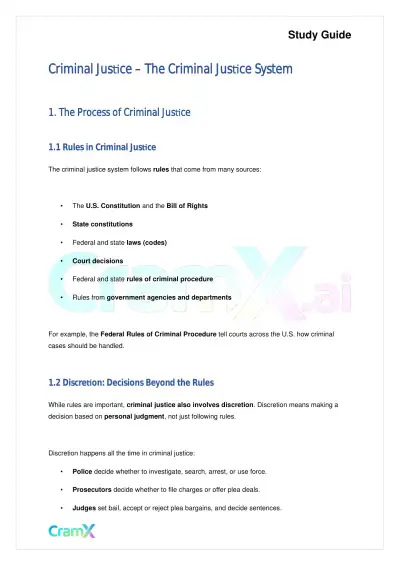 Quick Guides
Criminal Justice - The Criminal Justice System
Criminal Justice
12 pagesMar 2026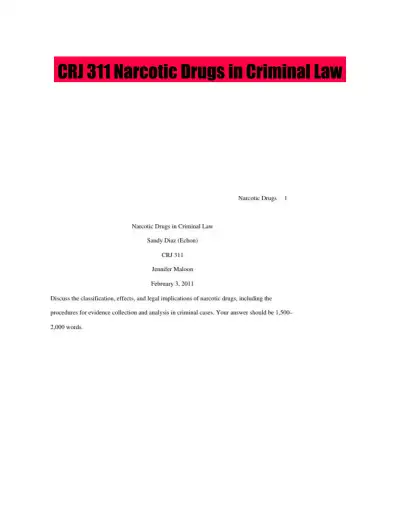 Solved Assignments
CRJ 311 Narcotic Drugs in Criminal Law
Criminal Justice
7 pagesMay 2025- Past ExamsPast Exams
3-3 Module Three Quiz
Criminal Justice
1 pageJun 2025 - Solved AssignmentsSolved Assignments
Levels of Law Enforcement in the United States
Criminal Justice
1 pageJun 2025
Study this document with CramX
Once it is in your library, every tool can work from it.