

Scientific Evaluation in Crime Prevention: Challenges, Methods, and Theoretical Approaches
- Criminal Justice
- 8 pages
- Shared May 2025
Discussion of scientific methods used in crime prevention and their challenges.
Preview 3 of 8 pages
See the first 3 pages exactly as they appear in the document.
Page 1 Read page 1 as text
Scientific Evaluation in Crime Prevention: Challenges, Methods, and Theoretical Approaches Based on the readings, evaluate the importance of scientific evaluation in crime prevention, discussing the challenges and benefits it presents for improving policy and practice. In your answer, consider the role of theory, the mechanisms of crime prevention, and the need for context sensitivity in evaluation. Additionally, reflect on how different evaluation methods, such as experimental designs and qualitative assessments, contribute to understanding the effectiveness of crime prevention strategies. Provide specific examples from the text to support your argument. Word Count Requirement: 1500 - 2000 words.
Page 2 Page 3 Read page 3 as text
Evaluation in crime prevention is almost universally called for. It is widely required by funding bodies, and, as a result, it is almost as widely attempted. It is technically very tricky both in relation to specific initiatives (Ekblom, 1990) and in relation to the sorts of partnership approach that are now widely promoted (Rosenbaum, this volume). Critics are agreed that standards are generally very low (Sherman et al., 1997; Ekblom and Pease, 1995; HMIC, 2000; Scott, 2001). There are some fundamenta l debates about how evaluation should be construed and conducted (Pawson and Tilley, 1997). There are also diverse stakeholders in evaluation, and a range of uses to which evaluations can be put. The papers in this volume are concerned primarily with the design and conduct of evaluations that are intended to help improve crime prevention policy and practice. Other possible purposes — for example to justify programs, to account for public expenditure, to celebrate achievement, or to encourage greater partici pation in crime prevention — are not much at issue here. Much literature on crime prevention has stressed the importance of evaluation for program improvement. The preventive process described by Ekblom (1988), the action research approach advocated by Clarke (1997), and the SARA (scanning, analysis, response, assessment) steps developed by Eck and Spelman (1987) to help operationalise Goldstein's (1979) problem - oriented policing all include evaluation as a key element. The purpose of evaluation in all case s is to provide feedback that will generate corrections to and refinements in crime prevention theory, policy and practice. The University of Maryland report to the United States Congress on evaluations in crime prevention (Sherman et al., 1997) and the British Home Office Crime Prevention Studies, volume 14, pp. 1 - 10. Nick Tilley report on findings of evaluation studies (Goldblatt and Lewis, 1998) were both designed to inform improvements in what was done in an effort to reduce crime. Likewise, the emergin g international Campbell Collaboration has a strong criminal justice stream, which promises systematic reviews of crime prevention with the aim of improving the choice of interventions (Farrington and Petrosino, 2001). The bottom line in evaluation for crime prevention, is of course, crucial. Evaluation results should allow us more effectively and efficiently to lessen crime and its effects, and we need to measure outcomes in these terms. A number of tricky technical challenges confront the measurement of o utcome effectiveness. These include, for example, discounting regression - to - the - mean effects, establishing a secure counterfactual, attributing responsibility for observed changes to the measures introduced, identifying active ingredients in packages of measures, identifying short and long - term effects, identifying significant side - effects, and attaching figures to costs and benefits of interventions. Though these technical challenges need to be met adequately if evaluations are to be useful, that is not su fficient. Evaluations need, preferably at
5 more pages in the full document
Unlock it once and it stays in your library, ready to chat with or turn into flashcards.
Unlock the full documentMore Criminal Justice study materials
See all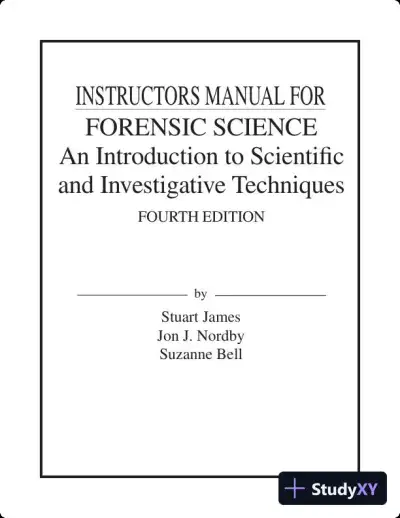 Exam Guides
Test Bank For Forensic Science, 4th Edition
Criminal Justice
370 pages132downloadsFeb 2025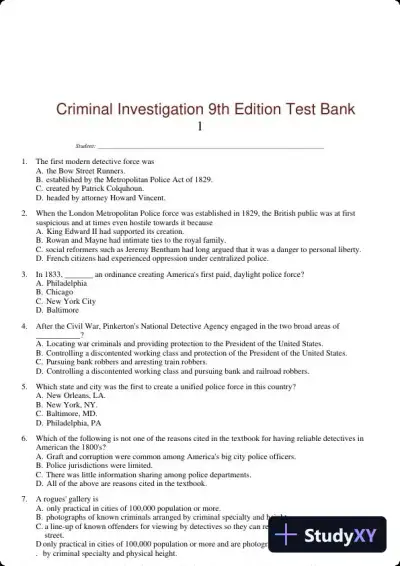 Exam Guides
Criminal Investigation 9th Edition Test Bank
Criminal Justice
344 pages103downloadsFeb 2025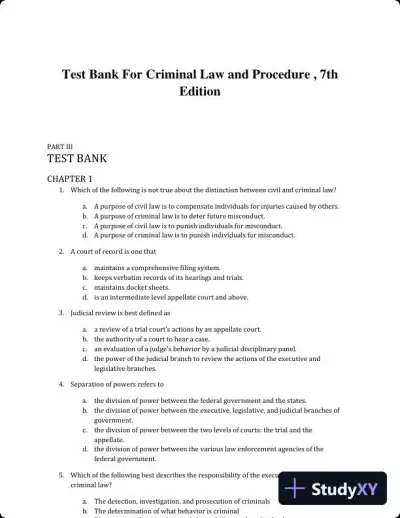 Exam Guides
Test Bank For Criminal Law and Procedure , 7th Edition
Criminal Justice
65 pages96downloadsFeb 2025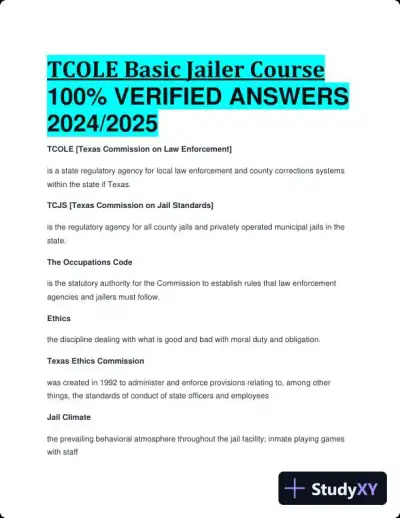 Past Exams
2024-2025 TCOLE Basic Jailer Course Practice Exam with Answers (259 Solved Questions)
Criminal Justice
33 pages47downloadsFeb 2025 Class Presentation
The Future Of The Juvenile System
Criminal Justice
11 pagesMay 2025 Class Notes
Lecture Notes For Crime Control In America: What Works, 4th Edition
Criminal Justice
66 pagesMay 2025- Past ExamsPast Exams
Technology in Criminal Justice CJ305-6-0
Criminal Justice
1 pageJun 2025  Solved Assignments
CJA/234 ASSIGNMENT 2: FEDERAL PRISON COMPARISON
Criminal Justice
9 pagesMay 2025
Study this document with CramX
Once it is in your library, every tool can work from it.