

Solution Manual for Practical Crime Scene Processing and Investigation, 2nd Edition
- Criminal Justice
- 132 pages
- Shared May 2025
Get accurate solutions for your textbook problems with Solution Manual for Practical Crime Scene Processing and Investigation, 2nd Edition, your go-to guide for textbook answers.
Preview 16 of 132 pages
See the first 16 pages exactly as they appear in the document.
Page 1 Read page 1 as text
MANUAL FOR by Practical Crime Scene Processing and Investigation Second Edition Ross Gardner TEXTBOOK GUIDE
Page 2 Page 3 Read page 3 as text
iii Table of Contents Preface Section 1- Chapter Support Chapter 1 – Introduction Learning Objectives Chapter Questions and Answers Suggested Practical Exercises Suggested Exam Questions and Answers Chapter 2 Understanding the Nature of Physical Evidence Learning Objectives Chapter Questions and Answers Suggested Practical Exercises Suggested Exam Questions and Answers C hapter 3 Actions of the Initial Responding Officer Learning Objectives Chapter Questions and Answers Suggested Practical Exercises Suggested Exam Questions and Answers Chapter 4 Processing Methodology Learning Objectives Chapter Questions and Answers Suggested Practical Exercises Suggested Exam Questions and Answers Chapter 5 Assessing the Scene Learning Objectives Chapter Questions and Answers Suggested Practical Exercises Suggested Exam Questions and Answers Chapter 6 Crime Scene Photography Learning Objectives Chapter Questions and Answers Suggested Practical Exercises Suggested Exam Questions and Answers
Page 4 Read page 4 as text
iv Chapter 7 Crime Scene Sketching and Mapping Learning Objectives Chapter Questions and Answers Suggested Practical Exercises Suggested Exam Questions and Answers Chapter 8 Narrative Descriptions: Crime Scene Notes and Reports Learning Objectives Chapter Questions and Answers Suggested Practical Exercises Suggested Exam Questions and Answers Chapter 9 Basic Skills for Crime Scene Processing Learning Objectives Chapter Questions and Answers Suggested Practical Exercises Suggested Exam Questions and Answers Chapter 10 Shooting Scene Documentation and Reconstruction Learning Objectives Chapter Questions and Answers Suggested Practical Exercises Suggested Exam Questions and Answers Chapters 11 Applying Bloodstain Pattern Analysis in the Crime Scene Learning Objectives Chapter Questions and Answers Suggested Practical Exercises Suggested Exam Questions and Answers Chapter 12 The Body as a Crime Scene Learning Objectives Chapter Questions and Answers Suggested Exam Questions and Answers Chapters 13 Special Scene Considerations Learning Objectives Chapter Questions and Answers Suggested Practical Exercises Suggested Exam Questions and Answers Chapters 14 The Role of Crime Scene Analysis and Reconstruction Learning Objectives Chapter Questions and Answers Suggested Practical Exercises Suggested Exam Questions and Answers
Page 5 Read page 5 as text
v Section 2 – Practical Exercises Practical 2-3 Glass Fractures Practical 5-1 Choosing a Crime Scene Search Pattern \ Practical 7-1 Interior Crime Scene Mapping Methods Practical 7-2 Exterior Crime Scene Mapping Methods Practical 8-3 Narrative Descriptions Practical 11-2 Recognizing Bloodstain Patterns
Page 6 Read page 6 as text
vi Chapter 1 - Introduction Learning Objectives • Identify the purpose of crime scene processing. • Identify the five basic objectives of policing. • Identify and discuss which of these objectives affect crime scene investigation. • Define and discuss what is meant by “the interpretive value of evidence”. • Identify and discuss the five basic ingredients of good crime scene processing. • Identify and provide an example of each of the three basic threats to crime scene integrity. • Discuss the importance of investigative ethics to the criminal justice system. Chapter Questions and Answers 1. What is the basic goal of crime scene processing? Answer: To recover physical evidence and document the scenes condition and context in as pristine a condition as is possible. 2. The police utilize five basic objectives in seeking their goals of preventing crime and disorder and protecting the life and liberty of their citizens. Which two of the five objectives are more closely related to the crime scene investigation and why? Answer: Crime repression and the protection of personal liberties. Police
Page 7 Read page 7 as text
vii investigators are charged with establishing the truth in an effort to identify and apprehend criminals. Their methods however must be consistent with the law. 3. Why is physical evidence more objective than testimonial evidence such as eye- witness accounts? Answer: Physical evidence will never lie. It can be misinterpreted, misunderstood, but unlike testimonial evidence it is real and tangible. People however, may testify with personal, criminal or unconscious agendas. 4. The interpretive value of evidence is a function of what? Answer: The interpretive value of evidence is a function of time and the item’s surroundings. It is the context in which we find the evidence. 5. Rynearson and Chisum identified five ways in which context manifests itself in the crime scene, what are they? Answer: Predictable effects, unpredictable effects, transitory effects, relational detail and functional detail. 6. Bevel and Gardner defined four questions that the investigator should ask about evidence, what are they?
Page 8 Read page 8 as text
viii Answer: What is it? What function did it serve? What does it tell us about timing and sequencing aspects? What interrelationships does it hold to other evidence. 7. Describe and explain the forensic linkage triangle. Answer: The forensic linkage triangle consists of the suspect(s), victim(s) and scene(s). Physical evidence serves to connect or show a link between any two of these components. 8. Any good crime scene examination requires five key ingredients, what are they? Answer: The knowledge of what the crime scene technician is attempting to do. The skills and tools necessary to do that. The application of a methodical approach, combined with both flexibility and coordination between all parties involved. 9. Describe and explain the three crime scene integrity issues which the investigator considers. Answer: The addition of material in the scene. This is the creation of post incident artifacts, which if unrecognized may create false leads and conclusions.
Page 9 Read page 9 as text
ix The destruction of material in the scene. This is the complete loss of an item’s evidentiary value. The movement of material in the scene. This results in changing the context in which we fid the evidence, resulting in false conclusions. 10. What is the standard that the investigator uses when pursuing a solution to crime and why is this standard necessary? Answer: The investigators goal is to investigate to a standard of beyond a reasonable doubt. Suggested Practical Exercises 1. Ethics in Forensics. Have students research the names Fred Zane and Joyce Gilchrist on the Internet and then lead a discussion on the ethical issues related to the controversy surrounding each individual. 2. Testimonial versus Physical Evidence. Have students look for examples from local papers or national news in which physical evidence played a significant role in refuting testimonial evidence. Discuss the cases in class to highlight the differences between the two types of evidence. 3. Crime Scene Threats. Look for video examples from reality police television shows where the crime scene is disturbed, then have students identify instances where the three scene threats appear.
Page 10 Read page 10 as text
x From Crime Scene Processing and Investigation Workbook , by C. Ramirez and C. Parish-Fisher. 4. Exercise 1-1 CSI Effect 5. Exercise 1-2 Evaluating the Interpretive Value of Evidence. Suggested Exam Questions and Answers 1. True or False? The analysis and evaluation of physical evidence is flawless when compared to testimonial evidence. Answer: False. Physical evidence does not lie, but it can be misinterpreted. 2. Fill in the blank. The interpretive value of evidence is a function of and the item’s surroundings. Answer: Time. 3. Multiple Choice. A stove burner that is on in a crime scene is an example of: a. A predictable effect. b. A functional detail. c. A relational detail. d. None of the above. Answer: A functional detail. 4. Multiple Choice. The three scene integrity issues are: a. Addition, destruction and loss of material in the scene. b. Addition, destruction and movement of material in the scene. c. Addition, creation of post incident artifacts and corruption of material in the scene. d. None of the above. Answer: B. Addition, destruction and movement of material in the scene. 5. True of False. The only agenda a crime scene investigator has is the desire to determine the truth regarding what transpired in the scene and who was involved.
Page 11 Read page 11 as text
xi Answer. True 6. True or False. An example of an unpredictable effect is the movement of a weapon in the crime scene by a first responder, which remains unreported and unrecognized by the crime scene team. Answer: True. 7. True or False. Flexibility, as an ingredient of good crime scene examination means the ability to confront odd or unique situations with novel ideas or to handle contradictory and competing needs at the scene without reverting to mere arbitrary compliance with a checklist. Answer: True. 8. Multiple Choice. The forensic linkage triangle considers evidence in relation to which of the following? a. Suspect(s), victim(s) and motive(s). b. Suspect(s), victim(s) and scene(s). c. Scene(s), opportunity and motive(s). d. None of the above. Answer: B. Suspect(s), victim(s) and scene(s). Essay Questions: What master does the crime scene investigator serve and why is this so important to the administration of justice? Major Points: • The crime scene investigator serves his community and has only one master, the truth. • If they allow other agendas to take precedence, then justice can become subjective. Describe the primary attributes that make physical evidence and testimonial evidence different. Major Points:
Page 12 Read page 12 as text
xii • No matter how well meaning it may be when offered, testimonial evidence is based on perceptions by individuals. • Perceptions can color the testimony without the individual knowing it. • Individuals can also alter testimony with specific purpose. • Physical evidence is tangible and real, no one can argue its existence. • Physical evidence can certainly be misinterpreted, but because it is real, other can view it, re-evaluate it and recognize associated interpretation issues.
Page 13 Read page 13 as text
xiii Chapter 2 – Understanding the Nature of Physical Evidence Learning Objectives • Identify and discuss the major forensic evidence disciplines. • Describe the differences between class and individual characteristic evidence. • Define and give an example of mechanical fit. • Describe the interrelationship and interdependency of crime scene processing and forensic analysis at the crime laboratory. Chapter Questions and Answers 1. Describe the differences between class and individual characteristics of evidence. Answer: A class characteristic allows an item to be compared to a group of items and either included or excluded from the group. An individual characteristic allows an item to be compared to another item and excluded or identified as having come from the item. 2. Of the available methods for DNA analysis, which is the best for individualization in forensic work and why? Answer: Small Tandem Repeats (STR). STR technology allows high discrimination with small stains.
Page 14 Read page 14 as text
xiv 3. Describe how tape is used to collect hair and fiber evidence at the crime scene. Answer: The investigator removes a strip of wide tape, 8 -10 inches in length. Using a repetitive dabbing motion, they collect loose fibers and hairs from a surface by placing the adhesive side of the tape in contact with the surface. 4. When evaluating glass fractures for direction of force, which fragments can be used in the evaluation? Answer: Fragments associated to primary radial fractures found with in the inner concentric fracture. 5. How is paint layering used to differentiate two paint samples, such as when comparing a paint sample from a hit and run to a suspect vehicle? Answer: The specific layers and sequence of paint, the depth of the layers (e.g. various primers, color, clear coat layers) allow at the very least a class comparison and in some instances may offer the opportunity for an individual comparison. 6. Comparison of soil samples is based on environmental variations from one sample to the next. What are some of the most significant forms of environmental variation?
Page 15 Read page 15 as text
xv Answer: Plant pollens allow the most significant form of environmental variation for soil sample comparison. 7. How would evaluating crime scene evidence involving a pistol differ from that involving a revolver? Answer: The presence or absence of casings in and of itself may suggest the nature of the weapon (pistol versus revolver), since pistols eject casings into the scene and revolvers do not. The casings then provide additional information pertaining to the nature of the weapon that fired them. 8. Rifling refers to what two manufactured components of a barrel? Answers: The lands and grooves manufactured into the barrel of a rifle or handgun are referred to as rifling. 9. How are bullets marked for evidence and why? Answer: To prevent inadvertently damaging microscopic marks on the surface of the bullet which might lead to individualization, bullet and bullet fragments are not marked. They are containerized and the container marked.
Page 16 Read page 16 as text
xvi 10. Of the two methods used to collect tool mark evidence (collection of the entire item or casting of the mark) which is better and why? Answer: Seizing the original evidence by either taking the item or by cutting the area containing the tool mark is the best method of recovery. Casting of the mark is a viable and functional method of recovery, but does not always result in recovering all of the microscopic variations present in the tool mark. 11. What is the most significant class characteristic in shoe mark examinations and why? Answer: Tread design is the most significant class characteristic in shoe mark examinations. The level of variation present from one shoe to the next is significant. Databases exist from which the shoe mark examiner can often identify not only the brand but in some cases the specific model of the shoe. 12. What containers are used to collect fire scene evidence, in which accelerants are believed to be present? Answer: Unlined clean paint cans and arson bags. 13. In terms of a forensic analysis, what is the difference between a forged writing and a traced writing?
116 more pages in the full document
Unlock it once and it stays in your library, ready to chat with or turn into flashcards.
Unlock the full documentMore Criminal Justice study materials
See all Exam Guides
Test Bank For Forensic Science, 4th Edition
Criminal Justice
370 pages132downloadsFeb 2025 Exam Guides
Criminal Investigation 9th Edition Test Bank
Criminal Justice
344 pages103downloadsFeb 2025 Exam Guides
Test Bank For Criminal Law and Procedure , 7th Edition
Criminal Justice
65 pages96downloadsFeb 2025 Past Exams
2024-2025 TCOLE Basic Jailer Course Practice Exam with Answers (259 Solved Questions)
Criminal Justice
33 pages47downloadsFeb 2025 Class Presentation
The Future Of The Juvenile System
Criminal Justice
11 pagesMay 2025 Class Notes
Lecture Notes For Crime Control In America: What Works, 4th Edition
Criminal Justice
66 pagesMay 2025- Past ExamsPast Exams
Technology in Criminal Justice CJ305-6-0
Criminal Justice
1 pageJun 2025 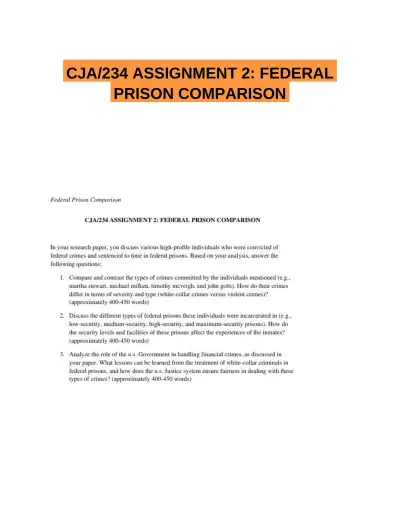 Solved Assignments
CJA/234 ASSIGNMENT 2: FEDERAL PRISON COMPARISON
Criminal Justice
9 pagesMay 2025
Study this document with CramX
Once it is in your library, every tool can work from it.