

Test Bank for Criminology Today: An Integrative Introduction, 10th Edition
- Criminal Justice
- 363 pages
- Shared May 2025
Test Bank for Criminology Today: An Integrative Introduction, 10th Edition is packed with helpful insights, covering everything from basic concepts to advanced problem-solving techniques.
Preview 16 of 363 pages
See the first 16 pages exactly as they appear in the document.
Page 1 Read page 1 as text
Test Bank for Criminology Today An Integrative Introduction Tenth Edition Frank Schmalleger Distinguished Professor Emeritus, The University of North Carolina at Pembroke Instructor’s Manual and Test Bank prepared by Ellen G. Cohn, Ph.D.
Page 2 Page 3 Read page 3 as text
iv Chapter 5 274 Chapter 6 293 Chapter 7 317 Chapter 8 341 Chapter 9 364 Chapter 10 388 Chapter 11 413 Chapter 12 434 Chapter 13 454 Chapter 14 477 Chapter 15 496 Chapter 16 516 Test Bank Chapter 1 178 Chapter 2 200 Chapter 3 227 Chapter 4 250
Page 4 Read page 4 as text
178 Test Bank Criminology Today, 10e (Schmalleger) Chapter 1 What Is Criminology? 1.1 Multiple Choice Questions 1) The view of crime as human conduct that violates the criminal law is drawn from a ________ perspective. A) political B) sociological C) psychological D) legalistic Answer: C Page Ref: 2 Objective: What is crime? What is the definition of crime that the author of this text has chosen to use? Level: Basic 2) “Human conduct that is in violation of the criminal laws of a state, the federal government, or a local jurisdiction that has the power to make such laws” is a definition of ________. A) criminology B) crime C) criminal D) deviance Answer: B Page Ref: 3 Objective: What is crime? What is the definition of crime that the author of this text has chosen to use? Level: Basic 3) The belief that crime is an antisocial act of such a nature that repression is necessary to preserve the existing system of society is the basis of the ________ perspective on crime A) legal B) political C) sociological D) psychological Answer: C Page Ref: 3-4 Objective: What is crime? What is the definition of crime that the author of this text has chosen to use? Level: Basic
Page 5 Read page 5 as text
179 4) The psychological perspective sees crime primarily as ________. A) a violation of a law B) an offense against human relationships C) an antisocial act D) problem behavior Answer: D Page Ref: 5 Objective: What is crime? What is the definition of crime that the author of this text has chosen to use? Level: Basic 5) Which of the following statements about deviance and crime is true? A) All deviant behavior is criminal. B) All criminal behavior is deviant. C) Deviant behavior and criminal behavior overlap. D) Deviant behavior and criminal behavior are mutually exclusive categories. Answer: C Page Ref: 5-6 Objective: What is deviance? How are crime and deviance similar? How do they differ? Level: Intermediate 6) You are running late to class and there is an exam today. To get to class on time, you drive about 10 miles about the speed limit. This is an example of behavior that is ________. A) deviant but not criminal B) criminal but not deviant C) both deviant and criminal D) neither deviant nor criminal Answer: B Page Ref: 6 Objective: What is deviance? How are crime and deviance similar? How do they differ? Level: Intermediate 7) Which of the following behaviors are criminal only when committed by a child or youth? A) Shoplifting a candy bar B) Drinking alcohol C) Speeding D) Joyriding Answer: B Page Ref: 7 Objective: What is deviance? How are crime and deviance similar? How do they differ? Level: Intermediate
Page 6 Read page 6 as text
180 8) The ________ perspective says that laws should be enacted to criminalize certain behaviors when members of society generally agree that such laws are necessary? A) consensus B) sociological C) pluralistic D) legalistic Answer: A Page Ref: 7 Objective: Who decides what should be criminal? How are such decisions made? Level: Basic 9) The pluralistic perspective suggests that behaviors are typically criminalized through ________. A) a political process B) the general agreement of most members of society C) the existence of shared norms and values D) consensus Answer: A Page Ref: 7 Objective: Who decides what should be criminal? How are such decisions made? Level: Basic 10) The gun control debate is an example of the ________ perspective. A) consensus B) sociological C) conflict D) pluralistic Answer: D Page Ref: 7 Objective: Who decides what should be criminal? How are such decisions made? Level: Intermediate 11) ________ is the field of study that is concerned primarily with the causes and consequences of crime. A) Criminal justice B) Criminology C) Criminality D) Criminalistics Answer: B Page Ref: 9 Objective: Who decides what should be criminal? How are such decisions made? Level: Basic
Page 7 Read page 7 as text
181 12) Criminal justice focuses on ________. A) the control of lawbreaking B) the causes of crime C) the consequences of crime D) the victim Answer: A Page Ref: 10 Objective: What is criminology? What are its many roots? Level: Basic 13) A ________ studies crime, criminals, and criminal behavior. A) scientist B) criminal justice professional C) criminologist D) criminalist Answer: C Page Ref: 10-11 Objective: What do criminologists do? Level: Basic 14) Which of the following individuals would most likely be considered a criminalist? A) A victims’ advocate B) A polygraph operator C) A computer crime investigator D) A correctional officer Answer: B Page Ref: 11-12 Objective: What do criminologists do? Level: Intermediate 15) A(n) ________ theory of crime attempts to explain all or most forms of criminal conduct through a single, overarching approach. A) complete B) unicausal C) integrated D) general Answer: D Page Ref: 12 Objective: What do criminologists do? Level: Basic
Page 8 Read page 8 as text
182 16) The general theory of crime suggests that all types of criminal and deviant behavior can be explained by a single factor: a lack of self-control. This is an example of a(n) ________ theory. A) integrated B) unicausal C) bicameral D) complete Answer: B Page Ref: 12 Objective: What do criminologists do? Level: Intermediate 17) ________ criminology emphasizes the use of social scientific techniques to develop knowledge in the field of criminology. A) Evidence-based B) Translational C) Theoretical D) Policy-based Answer: A Page Ref: 13 Objective: What is evidence-based criminology? How does it complement theoretical criminology? Level: Basic 18) ________ criminology involves taking the results of criminological research and converting it into workable social policy and practice. A) Experimental B) Translational C) Theoretical D) Policy-based Answer: B Page Ref: 14 Objective: What is evidence-based criminology? How does it complement theoretical criminology? Level: Basic 19) The ________ perspective holds that crime manifests from underlying social issues such as poverty, discrimination, and pervasive family violence. A) evidence-based B) individual responsibility C) social deviance D) social problems
Page 9 Read page 9 as text
183 Answer: D Page Ref: 15 Objective: What is the theme of this text? Upon what two contrasting viewpoints does it build? Level: Basic 20) Which of the following statements about the individual responsibility perspective is true? A) It suggests that crime is a symptom of underlying social problems such as poverty and discrimination. B) It emphasizes the development of social and educational opportunities as a way of dealing with the crime problem. C) It emphasizes crime prevention efforts such as harsher sentences and the development of rehabilitation programs. D) It sees crime as a public health problem as well as a criminal justice problem. Answer: C Page Ref: 15-16 Objective: What is the theme of this text? Upon what two contrasting viewpoints does it build? Level: Intermediate 21) Which of the following crime reduction or prevention strategies is most characteristic of the social problems perspective? A) A government-funded initiative to enhance educational opportunities among low-income individuals B) A move to broaden police powers by increasing the number of exceptions to the Exclusionary Rule C) Rewriting state statutes to increase the severity of punishment for violent offenders, such as three-strikes laws D) Allocating federal funds to help states build and operate more prisons Answer: A Page Ref: 16 Objective: What is the theme of this text? Upon what two contrasting viewpoints does it build? Level: Intermediate 22) Which of the following recent developments in national crime control policy is most likely to have been influenced by the social problems perspective? A) The increase in the number of federal capital crimes B) The enactment of a federal three-strikes law C) The abolition of federal parole D) The creation of the Job Corps to reduce unemployment by encouraging the development of job skills
Page 10 Read page 10 as text
184 Answer: D Page Ref: 17 Objective: What is the theme of this text? Upon what two contrasting viewpoints does it build? Level: Intermediate 23) Crime is not an isolated individual activity but a(n) ________ event. A) social B) economic C) deviant D) political Answer: A Page Ref: 18 Objective: What is the social context of crime? What are crime’s consequences? Level: Intermediate 24) An American visitor witnessing a crime in Japan may interpret the events differently than someone born within the Japanese culture. This is an example of ________. A) intercultural perspective B) social relativity C) deviant perception D) politicization Answer: B Page Ref: 19 Objective: What is the social context of crime? What are crime’s consequences? Level: Intermediate 25) Which of the following is a background contribution by the offender? A) A genetic inventory B) A peculiar motivation C) A specific intent D) A drug-induced state of mind Answer: A Page Ref: 19 Objective: What is the social context of crime? What are crime’s consequences? Level: Intermediate 26) The ________ contributes to a criminal event by failing to prevent criminal activity. A) victim B) offender C) criminal justice system D) general public
Page 11 Read page 11 as text
185 Answer: C Page Ref: 19 Objective: What is the social context of crime? What are crime’s consequences? Level: Basic 27) Ultimately, crime is a result of the coming together of inputs provided by all but which of the following? A) The victim B) The criminal justice system C) Society D) The media Answer: D Page Ref: 20 Objective: What is the social context of crime? What are crime’s consequences? Level: Intermediate 28) Victims may actively contribute to their own victimization through the appearance of ________. A) defensiveness B) exposure C) defenselessness D) precipitation Answer: C Page Ref: 20 Objective: What is the social context of crime? What are crime’s consequences? Level: Basic 29) ________ is the process by which one acquires the cultural values of one’s society. A) Socialization B) Integration C) Social relativity D) Criminalistics Answer: A Page Ref: 20 Objective: What is the social context of crime? What are crime’s consequences? Level: Basic
Page 12 Read page 12 as text
186 30) Many modern criminologists operate from a(n) ________ perspective. A) psychological B) political C) economic D) sociological Answer: D Page Ref: 23 Objective: What social science has traditionally provided a central theoretical basis for criminology? Why? Level: Basic
Page 13 Read page 13 as text
187 1.2 True/False Questions 1) The legalistic perspective defines crime as a violation of the criminal law. Answer: TRUE Page Ref: 2-3 Objective: What is crime? What is the definition of crime that the author of this text has chosen to use? Level: Basic 2) Adopting the psychological perspective of crime would greatly expand the scope of criminology. Answer: TRUE Page Ref: 3-4 Objective: What is crime? What is the definition of crime that the author of this text has chosen to use? Level: Basic 3) All criminal behavior is deviant. Answer: FALSE Page Ref: 6 Objective: What is deviance? How are crime and deviance similar? How do they differ? Level: Basic 4) Some behaviors are considered to be criminal only if they are committed by a child. Answer: TRUE Page Ref: 7 Objective: What is deviance? How are crime and deviance similar? How do they differ? Level: Intermediate 5) The pluralistic perspective is most applicable to societies characterized by a shared belief system. Answer: FALSE Page Ref: 7 Objective: Who decides what should be criminal? How are such decisions made? Level: Intermediate 6) The difficulty in reaching agreement regarding legalizing marijuana is an example of social consensus. Answer: FALSE Page Ref: 7-8 Objective: Who decides what should be criminal? How are such decisions made? Level: Intermediate
Page 14 Read page 14 as text
188 7) Criminology is an interdisciplinary field. Answer: TRUE Page Ref: 9-10 Objective: What is criminology? What are its many roots? Level: Basic 8) Criminal justice focuses on questions about the causes of crime. Answer: FALSE Page Ref: 10 Objective: What is criminology? What are its many roots? Level: Basic 9) A correctional officer is a criminalist. Answer: FALSE Page Ref: 11 Objective: What do criminologists do? Level: Intermediate 10) There is a growing tendency to apply the term criminologist to anyone who works in the criminal justice field. Answer: FALSE Page Ref: 10 Objective: What do criminologists do? Level: Basic 11) A theory that attempts to explain all types of criminal behavior is a general theory of crime. Answer: TRUE Page Ref: 12 Objective: What do criminologists do? Level: Basic 12) An integrated theory is one that proposes a single identifiable cause for all serious criminal behavior. Answer: FALSE Page Ref: 13 Objective: What do criminologists do? Level: Basic 13) Translational criminology focuses on taking research findings and converting them into social policy. Answer: TRUE Page Ref: 14
Page 15 Read page 15 as text
189 Objective: What is evidence-based criminology? How does it complement theoretical criminology? Level: Basic 14) A social program that encourages teenagers to stay in school and graduate is typical of the social problems perspective. Answer: TRUE Page Ref: 16-17 Objective: What is the theme of this text? Upon what two contrasting viewpoints does it build? Level: Intermediate 15) The individual responsibility perspective considers people to be responsible for their own behavior. Answer: TRUE Page Ref: 16-17 Objective: What is the theme of this text? Upon what two contrasting viewpoints does it build? Level: Basic 16) The abolition of federal parole and the creation of the federal three-strikes law were influenced by the social problems perspective. Answer: FALSE Page Ref: 17 Objective: What is the theme of this text? Upon what two contrasting viewpoints does it build? Level: Intermediate 17) Because crime is a social event, it can have more than one interpretation. Answer: TRUE Page Ref: 18 Objective: What is the social context of crime? What are crime’s consequences? Level: Intermediate 18) Social relativity means that the offender and the victim interpret crime in a similar way. Answer: FALSE Page Ref: 19 Objective: What is the social context of crime? What are crime’s consequences? Level: Basic
Page 16 Read page 16 as text
190 19) The consequences of crime include both outputs and interpretations. Answer: TRUE Page Ref: 19 Objective: What is the social context of crime? What are crime’s consequences? Level: Basic 20) The primacy of sociology should not prevent criminologists from recognizing contributions from other perspectives. Answer: TRUE Page Ref: 23 Objective: What social science has traditionally provided a central theoretical basis for criminology? Why? Level: Intermediate
347 more pages in the full document
Unlock it once and it stays in your library, ready to chat with or turn into flashcards.
Unlock the full documentMore Criminal Justice study materials
See all Class Notes
Lecture Notes For Criminology Today: An Integrative Introduction, 10th Edition
Criminal Justice
186 pagesMay 2025 Exam Guides
Test Bank For Forensic Science, 4th Edition
Criminal Justice
370 pages132downloadsFeb 2025 Exam Guides
Criminal Investigation 9th Edition Test Bank
Criminal Justice
344 pages103downloadsFeb 2025 Exam Guides
Test Bank For Criminal Law and Procedure , 7th Edition
Criminal Justice
65 pages96downloadsFeb 2025 Past Exams
2024-2025 TCOLE Basic Jailer Course Practice Exam with Answers (259 Solved Questions)
Criminal Justice
33 pages47downloadsFeb 2025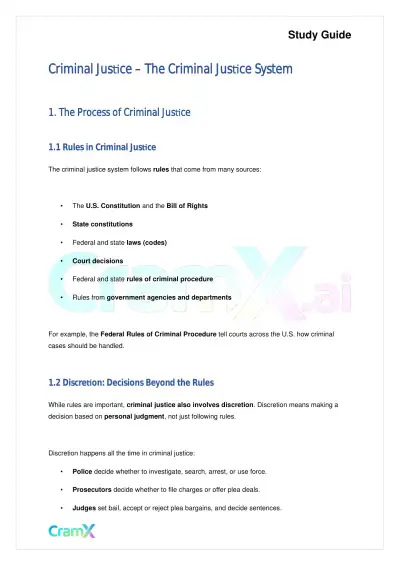 Quick Guides
Criminal Justice - The Criminal Justice System
Criminal Justice
12 pagesMar 2026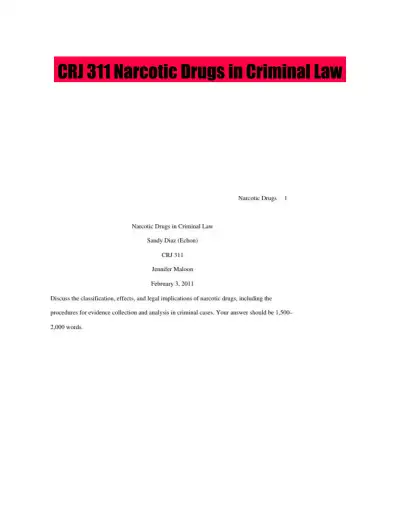 Solved Assignments
CRJ 311 Narcotic Drugs in Criminal Law
Criminal Justice
7 pagesMay 2025- Past ExamsPast Exams
3-3 Module Three Quiz
Criminal Justice
1 pageJun 2025
Study this document with CramX
Once it is in your library, every tool can work from it.