

Test Bank for Organizational Behavior And Management In Law Enforcement, 4th Edition
- Criminal Justice
- 148 pages
- Shared May 2025
Test Bank for Organizational Behavior And Management In Law Enforcement, 4th Edition is an easy-to-use exam guide, packed with the most commonly asked test questions.
Preview 16 of 148 pages
See the first 16 pages exactly as they appear in the document.
Page 1 Read page 1 as text
Chapter 1 Dynamics of Management: Managers and Organizational Behavior TRUE/FALSE. Write 'T' if the statement is true and 'F' if the statement is false. 1) Management is a continuing process that involves activities focusing on the identification, refinement, and attainment of objectives by the effective application of resources. 1) 2) The primary function of all managers is to command and control their officers. 2) 3) Senior police department administrators function at the technical and operational level of the organization. 3) 4) Middle managers are responsible for the translation of departmental goals into the day - to - day tasks of operational units. 4) 5) Staff managers assist and advise line managers in the accomplishment of organizational goals and objectives. 5) 6) Human skills help managers take a systems view of their department's mission and goals. 6) 7) As an individual moves up in the hierarchy of a police department, conceptual skills become more important than technical skills. 7) 8) All police organizations expect managers to act and make decisions on their behalf. 8) 9) CompStat is a management system developed during the professional reform movement of the early 20th century. 9) 10) If police managers are to be effective, they must pay increasing attention to the interpersonal aspects of the managerial role. 10) MULTIPLE CHOICE. Choose the one alternative that best completes the statement or answers the question. 11) Police chief executives and their management teams provide organizational direction by all of the following methods EXCEPT ________. 11) A) development of mission, vision, goals, and objectives B) providing special assignments and favors for political supporters C) controlling and assessing departmental activities D) creation of strategic, operational, procedural, tactical, and budgetary plans 12) Managers will enhance their effectiveness at achieving organizational objectives by ________. 12) A) understanding the impact of human behavior in the work setting B) increasing the size of their departments C) providing as little direction as possible D) maintaining strict discipline when managing the officers 1
Page 2 Page 3 Read page 3 as text
13) Management is all of the following EXCEPT ________. 13) A) focused on attainment of objectives B) continuing process C) effective application of resources D) focused on command, control, and discipline of workers 14) The four primary functions of management include all of the following EXCEPT ________. 14) A) planning B) managing C) organizing D) controlling 15) The control function involves ________. 15) A) task analysis B) influencing community leaders C) monitoring performance activities D) developing plans 16) The managerial functions are influenced by ________. 16) A) managerial knowledge and competence B) nature and type of activity C) changing environmental demands D) all of the above 17) What level of management is concerned with strategically how the goals and objectives interrelate with the needs of government and community? 17) A) operational level B) executive level C) supervisory level D) middle management level 18) One of the more demanding requirements is that police chief executives ________. 18) A) supervise the day - to - day department activities B) accomplish short term goals C) interpret policy and procedures D) prepare the department to meet present and future needs 19) Police managers who function as police trainers are ________. 19) A) staff managers B) tactical managers C) line managers D) temporary managers 20) Effective organizations are characterized by a ________. 20) A) blending of line and staff managers B) threatening environment C) centralized command and control system D) positive working environment 21) Skills that are based on craft experience, training, knowledge, operational procedures, laws, and techniques of policing are known as ________. 21) A) conceptual skills B) tactical skills C) technical skills D) human skills 22) Supervisory managers will find that ________ are exceedingly important and will dominate their working environment. 22) A) planning skills B) conceptual skills C) technical skills D) human skills 23) Police managers often find that they are caught between the conflicting expectations of the ________. 23) A) organization and its police employees B) technical and conceptual C) union and managers D) executives and middle managers 2
Page 4 Read page 4 as text
24) The characteristics of an effective organization include all of the following EXCEPT ________. 24) A) skill at creating, acquiring, and transferring knowledge B) behavior is modified to reflect new knowledge and insights C) organizational direction is created by the middle managers D) people work at their full potential 25) The characteristics of the CompStat process involve all of the following EXCEPT ________. 25) A) the use of operational resources to control crime B) strategy used to control management and employees C) identification and focus on emerging crime trends D) maximizing every asset of the organization and each employee 26) CompStat requires that all police commanders be accountable for ________. 26) A) operational training B) employee discipline C) the quality of their efforts toward crime reduction D) rule development 27) In the CompStat process creative problem solving takes place and is acted upon at the ________. 27) A) technical level B) crime strategy meetings C) operational level D) police academy 28) All of the following statements about "organizational behavior" are true EXCEPT ________. 28) A) managers should develop and utilize motivational skills B) officers' identities are often obtained from their work C) the achievement of work related goals is not considered important by police officers D) more police agencies develop strategies that depend upon other individuals to be effective 29) The types of behavior in an organization include all of the following EXCEPT ________. 29) A) interpersonal B) individual C) operational D) group 30) The study of organizational behavior enables one to ________. 30) A) understand the complexities of the organization B) categorize employees C) develop technical skills D) define the span of control 31) Organizational behavior is concerned with ________ behavior. 31) A) group B) conforming C) deviant D) exceptional 32) Interpersonal behavior involves ________. 32) A) influence B) effectiveness C) perception D) motivation 33) Frederick Herzberg was responsible for the creation of a two - factor theory of worker ________. 33) A) adjustment B) motivation C) relationships D) acceptance 34) Abraham H. Maslow, in arriving at his motivational theory, analyzed ________. 34) A) the average worker B) the self - actualized individual C) baby boomers D) the power hungry individual 3
Page 5 Read page 5 as text
35) Fred Fiedler's contingency approach emphasized ________. 35) A) concern for arrests B) optimal motivational factors C) task oriented leadership D) situational response 36) What three types of essential skills does a manager need to possess? 36) A) Operational, alien, and group B) Technical, human, and conceptual C) Interpersonal, historical, and popular D) Managerial, learning, and organizational 37) Theory Y managers see workers as inherently ________. 37) A) stubborn B) dissatisfied C) intelligent D) lazy 38) Theory X managers see workers as ________. 38) A) imaginative B) seeking responsibility C) creative D) lazy and unambitious 39) Abraham Maslow built his theory of motivation around the ________. 39) A) average individual B) younger individual C) burnout D) self - actualized individual 40) According to Herzberg, adequate pay is a ________. 40) A) satisfier B) motivator C) demotivator D) hygiene factor 4
Page 6 Read page 6 as text
Answer Key Testname: UNTITLED1 1) TRUE 2) FALSE 3) FALSE 4) TRUE 5) TRUE 6) FALSE 7) TRUE 8) TRUE 9) FALSE 10) TRUE 11) B 12) A 13) D 14) B 15) C 16) D 17) B 18) D 19) A 20) D 21) C 22) D 23) A 24) C 25) B 26) C 27) B 28) C 29) C 30) A 31) A 32) A 33) B 34) B 35) D 36) B 37) C 38) D 39) D 40) D 5
Page 7 Read page 7 as text
Chapter 1 Dynamics of Management: Managers and Organizational Behavior TRUE/FALSE. Write 'T' if the statement is true and 'F' if the statement is false. 1) Management is a continuing process that involves activities focusing on the identification, refinement, and attainment of objectives by the effective application of resources. 1) 2) The primary function of all managers is to command and control their officers. 2) 3) Senior police department administrators function at the technical and operational level of the organization. 3) 4) Middle managers are responsible for the translation of departmental goals into the day - to - day tasks of operational units. 4) 5) Staff managers assist and advise line managers in the accomplishment of organizational goals and objectives. 5) 6) Human skills help managers take a systems view of their department's mission and goals. 6) 7) As an individual moves up in the hierarchy of a police department, conceptual skills become more important than technical skills. 7) 8) All police organizations expect managers to act and make decisions on their behalf. 8) 9) CompStat is a management system developed during the professional reform movement of the early 20th century. 9) 10) If police managers are to be effective, they must pay increasing attention to the interpersonal aspects of the managerial role. 10) MULTIPLE CHOICE. Choose the one alternative that best completes the statement or answers the question. 11) Police chief executives and their management teams provide organizational direction by all of the following methods EXCEPT ________. 11) A) development of mission, vision, goals, and objectives B) providing special assignments and favors for political supporters C) controlling and assessing departmental activities D) creation of strategic, operational, procedural, tactical, and budgetary plans 12) Managers will enhance their effectiveness at achieving organizational objectives by ________. 12) A) understanding the impact of human behavior in the work setting B) increasing the size of their departments C) providing as little direction as possible D) maintaining strict discipline when managing the officers 1
Page 8 Read page 8 as text
13) Management is all of the following EXCEPT ________. 13) A) focused on attainment of objectives B) continuing process C) effective application of resources D) focused on command, control, and discipline of workers 14) The four primary functions of management include all of the following EXCEPT ________. 14) A) planning B) managing C) organizing D) controlling 15) The control function involves ________. 15) A) task analysis B) influencing community leaders C) monitoring performance activities D) developing plans 16) The managerial functions are influenced by ________. 16) A) managerial knowledge and competence B) nature and type of activity C) changing environmental demands D) all of the above 17) What level of management is concerned with strategically how the goals and objectives interrelate with the needs of government and community? 17) A) operational level B) executive level C) supervisory level D) middle management level 18) One of the more demanding requirements is that police chief executives ________. 18) A) supervise the day - to - day department activities B) accomplish short term goals C) interpret policy and procedures D) prepare the department to meet present and future needs 19) Police managers who function as police trainers are ________. 19) A) staff managers B) tactical managers C) line managers D) temporary managers 20) Effective organizations are characterized by a ________. 20) A) blending of line and staff managers B) threatening environment C) centralized command and control system D) positive working environment 21) Skills that are based on craft experience, training, knowledge, operational procedures, laws, and techniques of policing are known as ________. 21) A) conceptual skills B) tactical skills C) technical skills D) human skills 22) Supervisory managers will find that ________ are exceedingly important and will dominate their working environment. 22) A) planning skills B) conceptual skills C) technical skills D) human skills 23) Police managers often find that they are caught between the conflicting expectations of the ________. 23) A) organization and its police employees B) technical and conceptual C) union and managers D) executives and middle managers 2
Page 9 Read page 9 as text
24) The characteristics of an effective organization include all of the following EXCEPT ________. 24) A) skill at creating, acquiring, and transferring knowledge B) behavior is modified to reflect new knowledge and insights C) organizational direction is created by the middle managers D) people work at their full potential 25) The characteristics of the CompStat process involve all of the following EXCEPT ________. 25) A) the use of operational resources to control crime B) strategy used to control management and employees C) identification and focus on emerging crime trends D) maximizing every asset of the organization and each employee 26) CompStat requires that all police commanders be accountable for ________. 26) A) operational training B) employee discipline C) the quality of their efforts toward crime reduction D) rule development 27) In the CompStat process creative problem solving takes place and is acted upon at the ________. 27) A) technical level B) crime strategy meetings C) operational level D) police academy 28) All of the following statements about "organizational behavior" are true EXCEPT ________. 28) A) managers should develop and utilize motivational skills B) officers' identities are often obtained from their work C) the achievement of work related goals is not considered important by police officers D) more police agencies develop strategies that depend upon other individuals to be effective 29) The types of behavior in an organization include all of the following EXCEPT ________. 29) A) interpersonal B) individual C) operational D) group 30) The study of organizational behavior enables one to ________. 30) A) understand the complexities of the organization B) categorize employees C) develop technical skills D) define the span of control 31) Organizational behavior is concerned with ________ behavior. 31) A) group B) conforming C) deviant D) exceptional 32) Interpersonal behavior involves ________. 32) A) influence B) effectiveness C) perception D) motivation 33) Frederick Herzberg was responsible for the creation of a two - factor theory of worker ________. 33) A) adjustment B) motivation C) relationships D) acceptance 34) Abraham H. Maslow, in arriving at his motivational theory, analyzed ________. 34) A) the average worker B) the self - actualized individual C) baby boomers D) the power hungry individual 3
Page 10 Read page 10 as text
35) Fred Fiedler's contingency approach emphasized ________. 35) A) concern for arrests B) optimal motivational factors C) task oriented leadership D) situational response 36) What three types of essential skills does a manager need to possess? 36) A) Operational, alien, and group B) Technical, human, and conceptual C) Interpersonal, historical, and popular D) Managerial, learning, and organizational 37) Theory Y managers see workers as inherently ________. 37) A) stubborn B) dissatisfied C) intelligent D) lazy 38) Theory X managers see workers as ________. 38) A) imaginative B) seeking responsibility C) creative D) lazy and unambitious 39) Abraham Maslow built his theory of motivation around the ________. 39) A) average individual B) younger individual C) burnout D) self - actualized individual 40) According to Herzberg, adequate pay is a ________. 40) A) satisfier B) motivator C) demotivator D) hygiene factor 4
Page 11 Read page 11 as text
Answer Key Testname: UNTITLED1 1) TRUE 2) FALSE 3) FALSE 4) TRUE 5) TRUE 6) FALSE 7) TRUE 8) TRUE 9) FALSE 10) TRUE 11) B 12) A 13) D 14) B 15) C 16) D 17) B 18) D 19) A 20) D 21) C 22) D 23) A 24) C 25) B 26) C 27) B 28) C 29) C 30) A 31) A 32) A 33) B 34) B 35) D 36) B 37) C 38) D 39) D 40) D 5
Page 12 Read page 12 as text
Chapter 2 Leadership: The Integrative Variable TRUE/FALSE. Write 'T' if the statement is true and 'F' if the statement is false. 1) There is no singular purpose of leadership. 1) 2) Influence can cause some behavior in some person for a specific purpose based on a power base. 2) 3) Michael LeBoeuf refers to organizational theory, industrial engineering, and behavioral science as the dynamic triangle. 3) 4) Conceptual skills are more operational than managerial. 4) 5) Universal theories search for an explanation of leadership unrelated to follower behavior or the social environment within which it develops. 5) 6) Robert Tannenbaum and Warren Schmidt identified four basic leadership styles. 6) 7) Leaders who are effective can be described as one - dimensional. 7) 8) The Managerial Grid is used as a diagnostic to help individual managers to assess their own leadership style. 8) 9) Situational theory says, in effect, that managerial leadership is linked to adaptability. 9) 10) Contingency theory to understanding leadership effectiveness attempts to combine elements of both trait and situational theory. 10) 11) Paul Whisenand created the Least Preferred Co - Worker (LPC) Scale. 11) 12) Some believe that without follower consent an inspired leader cannot lead. 12) 13) Conceptual skills are used to organize and integrate experience. 13) 14) Francis Galton believed that leadership skills were simply inherited. 14) 15) Leadership style theory focuses on two basic styles. 15) 16) A Level 5 manager can be found to be self - effacing. 16) 17) Lifetime learning is a reality for a police executive. 17) 18) According to Robert Albanese, employee satisfaction and performance depend upon the characteristics of the employee. 18) 19) The path - goal model deals with the interaction between leader behavior and situational factors. 19) 1
Page 13 Read page 13 as text
20) Supportive leadership (path - goal) is similar to the concept of consideration used in the original Ohio State studies. 20) 21) Leaders who have integrity are principled. 21) 22) Trust is a foundation of effectiveness. 22) MULTIPLE CHOICE. Choose the one alternative that best completes the statement or answers the question. 23) Proactive leadership is a ________ transaction. 23) A) power B) trait C) reuniting D) reflective E) behavioral 24) V. A. Leonard and Harry W. More contend that leadership is the critical ________ in police agencies. 24) A) element B) energy C) catalyst D) variable E) method 25) There is a ________ relationship between followers and leaders. 25) A) transaction B) reciprocal C) motivational D) functional E) response 26) Leadership is reflected in a series of social situations orchestrated by ________ relationships. 26) A) focused B) situational C) respondent D) productive E) synergistic 27) Authority is power that is inherent in the ________. 27) A) group B) policy of the agency C) person D) position E) follower 28) If the score on the LPC scale is a score of 64 or above it tends to exhibit a leadership style that is best described as ________ motivated. 28) A) task B) relationship C) supportively D) loyalty E) situationally 2
Page 14 Read page 14 as text
29) Ultimate authority in any organization is vested in the ________ and is ________ through the formal chain of command to all personnel in the organization. 29) A) staff personnel; delegated B) operational personnel; delegated C) middle managers; allocated D) top management; allocated E) chief executive; delegated 30) The parameters within which employees are inclined to do willingly what is asked of them by their superiors can be called the ________ as employees have exerted themselves through increased demands for participatory management. 30) A) zone of rejection B) zone of acquiescence C) zone of collaboration D) zone of compromise E) zone of acceptance 31) Managerial leaders emphasize people - oriented and task - oriented needs ________. 31) A) disjointedly B) interdependently C) separately D) discretely E) none of the above 32) According to Souryal, the essence of managerial leadership lies in an administrator's ability to identify ________. 32) A) the nuances of functional leadership B) a zone of credibility C) areas of compromise D) the needs of people in work groups E) none of the above 33) Organizational humanists believe the role of the managerial leader is to create conditions that allow people to achieve their own goals by directing their productive efforts toward ________ participation. 33) A) mandated B) full C) liberated D) altruistic E) none of the above 34) Effective managerial leaders display ________. 34) A) an assumed role B) idiosyncratic traits C) charismatic qualities D) functionality E) none of the above 3
Page 15 Read page 15 as text
35) The leadership skills associated with good management can be organized under the heading ________. 35) A) human B) specialized C) innate D) proactive E) abstract 36) The managerial leader's capacity to deal effectively with problems even though the lack of information might preclude making a totally informed choice from among the available alternatives is known as ________. 36) A) tolerance for ambiguity B) negative entropy C) anomic adaptability D) a multifaceted phenomenon E) rational tolerance 37) According to Daniel Wren, the System 4 Management is built on ________ principles. 37) A) one B) two C) three D) four E) five 38) Transactional style leadership ________. 38) A) supports creativity B) accepts line personnel as they are C) requires a long - term commitment D) takes on a lot of baggage E) maximizes first line supervisorial input 39) Effective leaders are produced via the synergistic interaction between ________. 39) A) leadership styles B) anomic transactions C) personal traits D) situational factors E) all except B 40) Applied research has failed to discover a definitive or consistent correlation between effective leadership and genetically determined ________. 40) A) personality B) intelligence C) physical stamina D) body type E) all of the above 41) System 2 - Benevolent Authoritative management emphasizes ________. 41) A) the Ohio State studies B) management by exception C) total trust in employees D) the Managerial Grid E) none of the above 4
Page 16 Read page 16 as text
42) Management Systems Models foster ________. 42) A) reactive value analysis B) passive leadership C) fads D) reciprocal relationships E) power equalization 43) Level 5 Leadership includes leaders who are ________. 43) A) reciprocal B) avoiders of obstacles C) reticent D) trait based E) situational 44) Philip Applewhite identified the following leadership category ________. 44) A) charismatic B) democratic laissez - faire C) authoritarian D) bureaucratic E) all of the above 45) The Ohio State studies clearly indicated that good managerial leaders exhibit a great deal of concern for ________. 45) A) control and expressive manners B) consideration and structuring C) a democratic interaction with employees process D) manifestation of charisma E) a contemplative and expressive style 46) Researchers from the University of Michigan formulated their own leadership profile based on leader behavior using the terminology ________. 46) A) structure/consideration B) tell/sell C) employee oriented/production oriented D) concern for people/concern for production E) employee/task 47) According to the Managerial Grid, the least viable form of managerial leadership is represented by a matrix of ________. 47) A) 9,9 B) 1,9 C) 1,1 D) 5,5 E) 9,1 48) In one study of police managers they found that the backup style of management was ________. 48) A) 1,1 B) 5,5 C) 9,9 D) 9,1 E) 1,9 49) Jack Kuykendall and Peter Unsinger found police managers tend to have ________ management style. 49) A) a middle of the road B) an impoverished C) a country club D) no dominant E) a task - oriented 5
132 more pages in the full document
Unlock it once and it stays in your library, ready to chat with or turn into flashcards.
Unlock the full documentMore Criminal Justice study materials
See all Exam Guides
Test Bank For Forensic Science, 4th Edition
Criminal Justice
370 pages132downloadsFeb 2025 Exam Guides
Criminal Investigation 9th Edition Test Bank
Criminal Justice
344 pages103downloadsFeb 2025 Exam Guides
Test Bank For Criminal Law and Procedure , 7th Edition
Criminal Justice
65 pages96downloadsFeb 2025 Past Exams
2024-2025 TCOLE Basic Jailer Course Practice Exam with Answers (259 Solved Questions)
Criminal Justice
33 pages47downloadsFeb 2025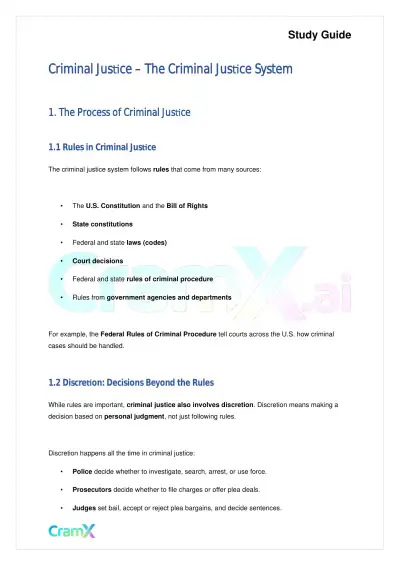 Quick Guides
Criminal Justice - The Criminal Justice System
Criminal Justice
12 pagesMar 2026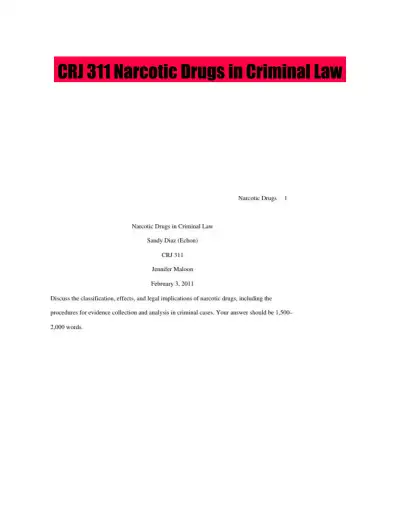 Solved Assignments
CRJ 311 Narcotic Drugs in Criminal Law
Criminal Justice
7 pagesMay 2025- Past ExamsPast Exams
3-3 Module Three Quiz
Criminal Justice
1 pageJun 2025 - Solved AssignmentsSolved Assignments
Levels of Law Enforcement in the United States
Criminal Justice
1 pageJun 2025
Study this document with CramX
Once it is in your library, every tool can work from it.