

Class Notes For Modern Principles: Microeconomics, 4th Edition
- Economics
- 251 pages
- Shared May 2025
With Class Notes For Modern Principles: Microeconomics, 4th Edition, you get expertly crafted notes covering critical concepts, theories, and real-world applications.
Preview 16 of 251 pages
See the first 16 pages exactly as they appear in the document.
Page 1 Read page 1 as text
1 The Big Ideas Learning Objectives After completing this chapter students should: > k now the Ten Big Id eas in economics . > a ppreciate that economics is not just about business and stock markets , but it can help them understand many things they encounter in their everyday lives . > s ee that economics can be fun! Chapter Outline The chapter is organized around 10 “B ig I deas ” : Big Idea One: Incentives Matter Big Idea Two: Good Institutions Align Self - Interest with the Social Interest Big Idea Three: Trade - offs Are Everywhere Opportunity Cost Big Idea Four: Thinking on the Margin Big Idea Five: The Power of Trade Big Idea Six: The Importance of Wealth and Economic Growth Big Idea Seven: Institutions Matter Big Idea Eight: Economic Booms and Busts Cannot Be Avoided but Can Be Moderated Big Idea Nine: Inflation I s Caused by Increases in the Supply of Money Big Idea Ten: Central Banking Is a Hard Job
Page 2 Page 3 Read page 3 as text
CHAPTER 1 • The Big Ideas • 2 The Biggest Idea of All: Economics Is Fun Chapter Narrative This chapter briefly introduces 10 big ideas in economics that the students will learn more thoroughly in later chapters. Each big idea is explained , and then its impor tance is illustrated by showing how it explains some real - world phenomenon that the students should find interesting. The chapter aims to excite students about eco nomics while giving them a quick introduction to the big ideas. The chapter opens by explaining how the British government rewarded ship cap tains for transporting convicts to Australia in the eighteenth century. At first, the cap tains were paid per convict who boarded the ship. The sailors treated the prisoners inhumanely , and their death rates were extraordinarily high. Then, when the government changed the payment system so that it paid cap tains according to how many prisoners walked off their ship in Australia, rather than how many walked on in England, suddenly the prisoners’ survival rate shot up to 99 percent. This illustration leads into the first big idea : incentives matter. Big Idea One : Incentives Matter Incentives are rewards or penalties that influence behavior. Changing the incentives changed how the captains treated their prisoners. Under the first payment system, there was no monetary reward for delivering the prisoners alive. In fact, if they didn’t feed the prisoners , the captain s could sell the prisoners’ rations and earn even more money. Captains’ incentives were to treat prisoners poorly. Once they were paid according to how many healthy passengers they delivered, their in centives and thus their behavior changed for the better. The MRU video Introduction to Economics introduces economics in general and discusses the importance of incentives in particular using the story of British prisoner transports to Australia. This video might provide a nice opening to your first lecture. Monetary rewards are one major incentive in our society. As Adam Smith said, “It is not from the benevolence of the butcher, the brewer, or the baker, that we expect our dinner, but from their regard to their own interest.” Teaching Tip: It’s easy to illustrate this idea to students quickly. Glance around the room and see who just recently purchased something, such as a Coke or coffee. Ask about the transaction. Who sold it? What was the seller’s name? Did the seller know the student’s name? Why was that product available there ? What was the seller’s incentive? Emphasize the number of things that students need from people who have no incentive to help them other than the monetary reward. Not all incentives are monetary — fame, power, reputation, sex, and love are all im portant incentives. Emphasize that economics can explain things motivated by these incentives as well. Students should come away realizing that economics is not lim ited to explaining things that are paid for in money.
Page 4 Read page 4 as text
CHAPTER 1 • The Big Ideas • 3 Big Idea Two: Good Institutions Align Self - Interest with the Social Interest The story of how ships’ captains changed their behavior relates to the second big idea. Incentives are not fixed in stone. Different institutions or rules can engender dif ferent incentives and behaviors. An institution is good when it aligns an individual’s self - interest with society’s interest. An institution is bad, and so are the outcomes, when individuals’ incentives run counter to society’s interest. Under the right conditions, markets align self - interest and social interest. It’s good that business people make money by pleasing consumers. Self - interest on their part can be good for society . Teaching Tip: Ask students if they ever worked overtime at a job. Why did they do it ? Get them to explain that they wanted to earn the extra money. They were acting out of self - interest. But then emphasize how their self - interest made the m provide mor e services to someone else than they would have otherwise. Be sure to point out that self - interest is neither good nor bad because it is how we progress as a species . What is important is the institutions. The captains’ greed led to bad outcomes (poorly treated passengers) when institutions were bad. But that same greed, or desire for self - interest , led to good ou tcomes ( more passengers making it to Australia) when the institutions changed. Greed’s goodness (or usefulness) depends on the institutions. Markets with mutual voluntary interaction make self - interest useful most of the time. Big Idea Three: Trade - offs Are Everywhere Students are first introduced to opportunity cost (without using that term) by the somewhat shocking conclusion that economists worry that pharmaceutical drugs could be too safe. In 2004 , Merck withdrew the arthritis drug Vioxx from the mar ket after a study showed that it could cause heart attacks and strokes. Yet the FDA had approved the drug five years earlier , and millions had used it. Students will be tempted to conclude that the FDA should be more careful studying new drugs so that drugs like Vioxx nev er reach the market. Making drugs safer necessitates a trade - off: fewer companies will develop drugs be cause it would be more costly. This is known as drug loss. It will also take longer for good drugs to make it to market , causing people to miss out on the drug’s beneficial effect in the interim. This is known as drug lag. It takes an average of 12 years and $900 million to bring a new drug to market in the United States. The trade - off society faces for safer drugs is fewer drugs and getting them more slowly. Such trade - offs a re inevitable in a world of scarcity — that is , when there are not enough resources to satisfy all of our wants. How we use our scarce resources to satisfy as many of our wants as possible is what the authors refer to as the “great economic problem.” Scarcity, trade - offs, and the great economic problem bring us to a key concept in economics: opportunity cost. The opportunity cost of a choice is the value of the opportunit ies lost because of that choice. Teaching Tip: Students are used to thinking of costs as monetary costs. Take some time to illustrate opportunity costs with examples that they can relate to . For example, what is the opportunity cost of going to a movie one night? How would that opportunity cost change if you had an exam the next day? The textbook provides another nice example: What is the cost of going to college? Tuition, books, lost wages, room and board. Ask students which of these is not an opportunity cost. Ask them if they considered lost
Page 5 Read page 5 as text
CHAPTER 1 • The Big Ideas • 4 wages when they decided to attend. Then explain why college enrollment is affected by the business cycle. Teaching Tip: You can have some fun with examples of opportunity cost by asking students questions that relate to everyday li fe . Try asking the following : > In a social situation, have you ever walked up to two attractive people, looking for a date? You have to choose who to focus on. The opportunity cost of talking to the person you chose is loss of the opportunity to talk to the other person. (This leads nicely to the joke: an economist was asked how his wife was. He answered, “Compared to whom?”) > Does anyone play basketball? If you’re on a fast break and you pull up for a three - pointer , what is your opportunity cost? > If you weren’t here in my class today, what would you be doing? Keep drilling them with questions until they seem to get it. Big Idea Four: Thinking on the Margin Most choices are made on the margin. Should we do a little more of an activity or a little less? This concept is introduced in the book with a brief discussion of a driver making incremental changes to his speed as he travels down the highway. When he hasn ’t seen a police cruiser in a while, he increases his speed a little more. When he finally spots one as he approaches a big city, he decreases his speed a little. Just like many decisions in life, the driver’s decision about his speed is not made once and for all upon starting his car. Rather, when it is beneficial to do so, he speeds up a little, until the benefits of speeding up a little no longer outweigh the costs (the increased likelihood of a ticket). Teaching Tip: Here is a fun illustration of marginal thinking from students’ everyday lives. Ask if they have ever chosen to go out with their friends instead of with their boyfriend or girlfriend and heard the objec tion, “You care more about them than you do me.” At least one hand will go up. Then explain that they now have an answer: “Not in an absolute sense. You are more important, but given that I already spend so much time with you, seeing them tonight is more important to me only on the margin.” Big Idea Five: The Power of Trade The benefits of trade go much further than the simple benefits of exchange. Through specialization, trade can increase productivity, and higher productivity leads to more output. One way that specialization increases productivity is through the division of knowledge. A producer who specializes in the production of just a few goods can become an expert i n the production of those goods, learning things that would not have been learned if every person produced just a small amount of every good for his or her o wn use. Likewise, specialization allows producers to take advantage of economies of scale, the cost savings that can be achieved when goods are produced in higher quantities. The theory of comparative advantage maintains that special ization and trade can benefit everyone involved . The key is for producers (individuals , firms, or countries) to focus on t he good s they ca n prod uce for the lowest opportunity cost and then trade with each other . The text uses the example of Martha Stewart , who , although likely a very skilled ironer, hires someone to do her ironing. The reason? The opportunity cost of her ironing is
Page 6 Read page 6 as text
CHAPTER 1 • The Big Ideas • 5 running her company (Martha Stewart Living Omnimedia) . If the profits from her company that she for e goes when she spends an hour ironing is greater than the value of ironing, then she should spend time running her company and use those higher profits to pay someone to iron her clothes. Big Idea Six: The Importance of Wealth and Economic Growth Some students will be tempted to discount the importance of wealth and economic growth because they associate it only with material standards of living. Now’s the time to drive home the point that increases in wealth give us more of many of the things we all value. A few quick examples from the text: > In 2007, more than half a billion people around the world contracted malaria , and about 1 million died of it. We think of it as a tropical disease , but people used to get it in the United States frequently until the 1940s. Better drainage, removal of mosquito breeding sites, and insecticides all contributed to wiping malaria out. We needed to grow wealthy enough to pay for these things before malaria could be eradicated. > In the United States , 993 in 1 , 000 children born survive until at least age five years. In Liberia, one of the world’s poorest countries, the survival rate is only 765 in 1 , 000. Most things people care about — like life expectancy, nutrition, and literacy — are all easier to get when you are wealthier. It is also helpful to point out the circular relationship between these ideas. As wealth increases , there is more free time to pursue specialization. This specialization leads to more efficient production methods , which increases economic growth or the ability to produce more goods and service. This increases wealth , further leading to more free time and so on. A good example of this is how better and cheaper sources of light allowed more work past sunset , leading to more efficient forms of light generation. Big Idea Seven: Institutions Matter If wealth is so important , this naturally leads us to ask how to get wealth. This was the focus of much of Adam Smith’s seminal book An Inquiry into the Nature and Causes of the Wealth of Nations. Wealthy countries tend to have lots of physical and human capital and use them with the best technology available to produce goods and services more efficiently. But this still raises the question of why some countries have more than others and why they use it more efficiently. It all comes back to Big Idea One: Incentives Matter. Entrepreneurs, investors, and savers need the right incentives to save and invest in physical and human capital, innovation, and efficient organization. The institutions most important in supporting goo d incentives for these are property rights, political stability, honest government, a dependable legal system, and competitive and open markets. Teaching Tip: Ask the students how many of them came to college because they expect to earn more. How have the institutions in the United States given them
Page 7 Read page 7 as text
CHAPTER 1 • The Big Ideas • 6 the confidence to make that investment in their human capital? North Korea and South Korea provide a striking example of how different insti tutions affect wealth creation. The two countries have a common culture and geo g raphy and were equally poor in 1950. South Korea embraced property rights and markets , while North Korea did not. Today South Korea has more than 10 times the per capita income of North Korea. Teaching Tip: If you have access to the Internet in the classroom , pull up a satellite image of the Korean peninsula at night and show them the differ ence in light emissions between the two countries as an indicator of de velopment. Big Idea Eight: Economic Booms and Busts Cannot Be Avoided but Can Be Moderated Booms and busts are part of the normal response to changing economic conditions. Not all booms and busts are the same, though. The Great Depression was the worst economic downturn the United States has ever had . Output dropped by 30 percent, unemployment rose above 20 percent, and the stock market lost a third of its value. This was not a nor mal rec ession. Most economists believe that if the government had acted differently , the Depression would have been less severe. Monetary and fiscal policies affect the length and severity of eco nomic booms and busts. At one time , economists believed that government policy could be used to end the economy’s boom and bust cycle. B ut most economists no longer believe that , and we’ve learned that when these policies are used poorly , they make recessions worse and the economy more volatile. An example you can use i s ships on the ocean. Waves on the ocean cannot be stopped, they are just part of nature. If you are on a small boat you are c onstantly being tossed by these waves. If you are on a cruise ship you will likely forget you are on the ocean. The waves are still there ; however , the builders of the ship have installed technology to mitigate the impact of the waves on the ship. Monetary and fiscal policy work in much the same way by mitigating the impact of the natural business cycle on the economy . Big Idea Nine: Inflation Is Caused by Increases in the Supply of Money Inflation is an increase in the general level of prices in an economy . Increases in the money supply cause inflation. Milton Friedman famously said, “Inflation is always and everywhere a monetary phenomenon.” Potential Pitfall: Although inflation comes from increases in the money supply, students are likely to think oil or greedy businessmen cause infla tion. It’s worth stressing the monetary causes and how other factors influ ence relative prices but not the general level of prices . Inflation has negative consequences. Emphasize how inflation makes it hard to figure out the real value of goods and services. Most students in the United States have not
Page 8 Read page 8 as text
CHAPTER 1 • The Big Ideas • 7 expe rienced the chaos of serious inflation, whereas Zimbabwe recently had an inflation rate of over 531 billion percent. Money in that situation becomes vir tually worth less and must be spent as soon as it’ s earned, making organized trade harder. In Zimbabwe, people started buying things with prepaid cell phone min utes and gas cards instead of the national currency. You can highlight this idea by having the students assume you hand out envelopes with between one and five dollars in them. Now assume you are holding an auction for something the students want (such as answers to the exam) and ask the students what is the highest price one person can bid. Now assume the envelopes had up to ten dollars in them. Now what is the highest possible bid? Note to the students that the good being auctioned has not changed, only the price because there is more money. Big Idea Ten: Central Banking Is a Hard Job The Fed eral Reserve controls monetary policy in the United States. But there is a lag — often months — from when the Fed makes a decision to when the effects of that decision are known. When it prints too much money , we get inflation . I f it prints too little , we get falling prices . A nd often as prices and wages fall, the adjustment does n o t go smoothly. But because of the lag , the Fed is always shooting at an unknown moving target. Most economists believe the Fed does more good than harm, but when the Fed does its difficult job poorly , it can cause great harm. Biggest Idea of All: Economics Is Fun The whole point of the first chapter, and your first lecture of the semester, is to excite students about economics. We need to show the students that: > economics is all around them in their daily lives . > economics is crucial for understanding the world and how to make it a better place . > these principles of economics hold everywhere across the globe and through time . The motto of the book is “See the Invisible Hand. Understand Your World.” Chap ter 1 and your lectures should arouse a desire in students to do that.
Page 9 Read page 9 as text
2 The Power of Trade and Comparative Advantage Learning Objectives After completing this chapter students should: > understand that trade makes people better off when preferences differ . > know that trade increases productivity through specialization and the division of knowledge . > understand comparative and absolute advantage and how comparative advantage increases productivity . > know that trade improves the welfare of both low - productivity and high - productivity countries . Chapter Outline Trade and Preferences Specialization, Productivity, and the Division of Knowledge Comparative Advantage The Production Possibility Frontier Opportunity Costs and Comparative Advantage Comparative Advantage and Wages Adam Smith on Trade Trade and Globalization Takeaway
Page 10 Read page 10 as text
CHAPTER 2 • The Power of Trade and Comparative Advantage • 2 Chapter Narrative This chapter illustrates how trade promotes cooperation that allows both highly productive countries and less productive countries to gain through trading with each other. The chapter provides examples of trade between individuals and trade between countries. I nclude d is the famous Adam Smith quot ation illustrat ing the link between trade among individuals and trade among countries: “What is prudence in the conduct of every private family can scarce be folly in that of a great kingdom.” It is important to emphasize to students that the same principles explain all trade, whether between countries or individuals. The MRU video The Big Ideas of Trade motivates the importance of trade in economics and explains how trade benefits society. This is a good video to open the discussion of trade. This video is also useful for illustrating the ideas in the next section of the chapter. Trade and Preferences This section tells the story of the founding of eBay. A young computer programmer, Pierre Omidyar, finished the code for what would become eBay in 1995. To test it out , he posted a broken laser pointer to the site and asked for a dollar. It sold for $14.83. He was so surprised that he contacted the buyer to make sure that he understood it was broken. It turns out that the buyer was a collector of broken laser pointers! Trade transformed something that was worthless to Omidyar to something that was valuable t o someone else. Value was increased simply by a swap between people with different preferences. Today eBay operates in more than 30 countries and earns billions of dollars in revenue. When people with different preferences trade with each other on eBay, each person becomes better off , and so does eBay by facilitating the transaction. The short lesson of this section: trade increases value by moving goods from people who value them less to people who value them more. Teaching Tip : It is easy to demonstrate to students how trade can increase value among individuals. Describe (or actually perform) an exercise in which each student randomly draws one item from a box containing a mixture of different candy bars. Students do not know the brand of candy they will receive until it is drawn from the box , and they must keep the first item selected. Once each student has drawn an item from the box, ask them to rate on a scale from one to ten how happy they are with what they rece ived from the random draw. Add up the total rating for the class. The total rating provides a measure of total happiness or value for the class. Then announce that everyone has one minute to trade their candy bar with anyone else in the class , and they may trade as many times as they wish during this time. When the trading has ended, ask students again to rate their happiness , and once again add up the ratings for the class. The rating should be higher after the trading. Explain to the class that the level of happiness , or value , increased through trade, even though no new candy was given. The increase in value simply results from moving the candy around so that it winds up with the people who value it most .
Page 11 Read page 11 as text
CHAPTER 2 • The Power of Trade and Comparative Advantage • 3 Specialization, Productivity, and the Division of Knowledge When people trade, it allows them to specialize in producing one thing rather than trying to produce everything they need. Try asking your students how well they would eat and how well - clothed they would be if they had to produce all their own food and clothing. Specialization increases production in two ways. First, by specializing in farming, for example, farmers learn a lot more about farming than other people , so they become better at it. Second, they can afford to buy large - scale farming machines that are more productive because they are going to produce in far greater quantities than individual s would produce for their own use . Most instructors are used to emphasizing specialization and the division of labor. Modern Principles is different in that this section emphasizes the division of knowledge . The human brain is limited, and if knowledge is divided across many brains and then trade occurs, we can collectively benefit from more knowledge than any one mind could hold. If every person in society produced the same thing as the neighbor s , the combined knowledge of a society of a million people would barely exceed the knowledge of one brain. In a modern economy, trade allows us to harness far more knowledge through specialization. The book considers a Valentine’s Day rose that may have been grown in Kenya, flown to Amsterdam on a re frigerated airplane, and ultimately trucked to Topeka by drivers drinking Columbian coffee. Each person involved understands only a small part the whole process, but because of trade , their collective knowledge is able to deliver the rose. Teaching Tip : To convey the importance of a group of knowledgeable individuals rather than one individual , you can highlight the positive aspect of w iki s s or w eb c ommunities (message boards). Whether it is Wikipdeia.org or a similar w iki for a television show, video game, or even software, it is the collective work of individuals with specific knowledge in certain aspects of subject coming together in a central location to create an authoritative guide on the subject solely via trade. Wikis and w eb c ommunit ies (or message boards) have become the go - to source to troubleshoot problems. You can also see similar ideas in the numerous “How To” video channels on YouTube. Neurosurgeons, heart surgeons, and other medical specialists all have very specialized knowledge and are able to acquire that knowledge only because they can trade with other people. If it weren’t for the cook, housecleaner, and dog walker, these doctors would never be able to acquire their expert skills because they would be too busy performing all of these tasks for themselves . The person who specializes as a dog walker is a vital part of the productive gains from specialization , just as the neurosurgeon is. When trade increases across larger areas and includes more people , it allows society to harness even more knowledge. The opening of the former communist bloc and China brought billions of new minds into the international division of knowledge and makes us all more productive.
Page 12 Read page 12 as text
CHAPTER 2 • The Power of Trade and Comparative Advantage • 4 The MRU video How the Division of Knowledge Saved My Son’s Life provides a real - world example of how the division of knowledge and specialization are intimately related to trade and how we all benefit from the resulting increase in productivity. Comparative Advantage The third reason for trade is to take advantage of people’ s differing abilities relative to each other . The book contrasts absolute advantage with comparative advantage using the example of Martha Stewart. An absolute advantage in production exists when a country or person can produce the same good using fewer inputs than another country or person. But comparative advantage exists when a country or person can produce the same good at a lower opportunity cost. Martha Stewart doesn’t do her own ironing. She m ay be the world’s best ironer. But she can do her ironing only at the expense of time away from running her business. Her blouses might look slightly better if she did them herself, but the gain would be small compared to the losses that would result from having someone else run her business while she irons. She has an absolute advantage in ironing and running a business but a comparative advantage only at running her business. The MRU video Comparative Advantage introduces the idea of comparative advantage in general terms and explains how it makes both parties in a trade better off. The MRU video Another Look at Comparative Advantage provides a more detailed look at comparative advantage. The distinction between comparative advantage and absolute advantage is explained early in the video. The video concludes with a homework problem that students can do for themselves. Production possi bilities frontiers are not used in the video. The MRU video Comparative Advantage Video provides the answer to the homework problem presented at the end of the previous video and illustrates how trade based on comparative advantage makes both parties in the trade better off. The Production Possibility Frontier The production possibilities frontier (PPF) shows all of the combinations of goods that a country can produce given its productivity and supply of inputs. The book plots a PPF for
Page 13 Read page 13 as text
CHAPTER 2 • The Power of Trade and Comparative Advantage • 5 the United States and Mexico in Figure 2.1 . Figure 2.1: Production and Consumption in Mexico and the United States W ithout Trade Potential Pitfall : Students will be confused throughout the discussion of trade if they do not understand the basics of the PPF. Take the time to explain the key points of working with these graphs. Explain that producing combinations of goods outside the PPF is impossible with given resources and technology. Points inside the PPF are inefficient because you are leaving resources unused . Points on the PPF are efficient. Then explain how the slope of the PPF relates to the opportunity costs of producing each good. Do not move on until students can take a PPF and calculate the opportunity costs of producing both goods in both countries, as shown in Table 2.1 in the text. It may be worthwhile to provide your own example for students to work for themselves. Emphasize that even though Mexico is less productive than the United States , it still has a comparative advantage in producing shirts , as shown in Table 2.1. The theory of
Page 14 Read page 14 as text
CHAPTER 2 • The Power of Trade and Comparative Advantage • 6 comparative advantage says that to increase its wealth , a country should produce the goods it can make at low cost and buy the goods that it can make only at high cost relative to other countries . The book illustrates this by supposing that the United States and Mexico each devote 12 units of labor to producing shirts and 12 units to producing computers. Find the spots on their respective PPFs. The book then moves 12 units of Mexico’s labor out of computers and into shirt production and two units of U.S. labor out of shirt production and into computer production. This allows Mexico to trade three shirts to the United States for one computer. You can illustrate that they both reach a point outside of their original PPF. You might want to trace some more points outside of the PPF that Mexico and the United States could achieve with specialization and trade. Teaching Tip: Students sometimes have a hard time understanding that the gains from trade come from the fact that one country is always a lower - cost producer of some good. I like to tell a story from Steven Landsburg’s The Armchair Economist . Suppose there are two ways to make cars. One is the way you are familiar with on an assembly line in Detroit. The other is to grow crops in Iowa and then truck them to this fancy new machine parked in an Oakland, California, harbor. You put the crops in the machine and push it out of view offshore and three months later it pulls back up to the docks and spits out cars. Which method should you use to make cars? Obviously, whichever is less expensive . That fancy machine is a boat that trades the crops to Japan for cars. Trade is just like a production technology that can lower costs. Figure 2.2: Production and Consumption in Mexico and the United States with Trade
Page 15 Read page 15 as text
CHAPTER 2 • The Power of Trade and Comparative Advantage • 7 Teaching Tip: Emphasize to students that consumption must equal production when there is no trade. In other words, when you don’t trade, you can consume only what you produce yourself. But with trade, consumption can exceed production. That is, trade allows a country to move beyond its PPF. You can make a big deal out of this — even refer to it as the “magic” of trade — since it allow s you to reach points that were previously considered out of reach. It is worthwhile to emphasize, however, that we still are not producing be yond the PPF ; we are only consuming at points beyond the PPF. Potential Pitfall: Many students will be concerned that there are no gains from trade for a high - productivity country when it trades with a low - productivity country. Emphasize that unless each country can produce every good at the exact same opportunity costs , there will always be gains from trade. The key is that the difference in opportunity costs allows each country to produce something more cheaply than the other. The same way it makes sense for Martha Stewart to trade with a housekeeper, it makes sense for productive nations to trade with less productive ones. Comparative Advantage and Wages Another common fear is that rich countries can’t compete with poor countries that pay low wages. The book deals with this fear by incorporating wages into the example of trade between the United States and Mexico. Assume a computer sells for $300 and shirts for $100 (consistent with the 3 - to - 1 trade). The value of Mexican consumption is 1 × $300 plus 6 × $100 for $900 total divided by 24 workers , which equals an average wage of $37.50. In the United States, 12 × $300 plus 9 × $100 equals $4,800 divided by 2 4 workers for an average wage of $200. Despite the fact that Mexico is a low - wage nation and the United States a high - wage nation, they both still gain from trade. After trade, the book’s example shows that Mexico gets 1 × $300 plus 9 × $100 for $1,200, or an average wage of $50, while the U.S. wage rises to $216.67. The fact that productivity is lower in Mexico is what causes Mexican wages to be lower. Specialization and trade let all workers improve their wage regardless of their initial level of productivity. Adam Smith on Trade The book briefly introduces students to Adam Smith, who reinforces the concept that specialization and trade make sense for countries for the same reason they make sense for individuals. Trade and Globalization The Roman Empire had plenty of trade. The Dark Ages saw a decrease in long - distance trade , and the Renaissance saw it expand again. Global trade was common in the nineteenth century as well. Technology changes what goods are traded globally, but globalization itself is not new. Global trade isn’t fundamentally different from domestic trade. The book introduces Don Boudreaux’s quote, “Globalization is the advance of human cooperation
Page 16 Read page 16 as text
CHAPTER 2 • The Power of Trade and Comparative Advantage • 8 across national boundaries.” Takeaway Trade makes people better off when their preferences differ. Trade also increases productivity through specialization and the division of knowledge. When countries specialize and trade according to comparative advantage, they produce the goods they can pro duce at low cost and trade for the goods they can produce only at high cost. Everyone and every country ha s a comparative advantage in something, so all can gain from trade. The logic of trade for individuals is relatively easy for students to accept, but they likely have tons of myths in their head when it comes to international trade. It will probably take some time to dispel these myths and help them understand the logic of trade. I suggest one exercise to get you started. In - and Out - of - Class Activities To have your students internalize how trade between two countries benefits both countries and how many misconceptions surround the topic, you can ask each student to bring in a news article critical of international trade. Ask them to identify why the author of the article thinks international trade in the particular case isn’t beneficial. Ask the students to assess the merit of the objection. Then u se each criticism and student response as the basis for a brief class discussion. It may be helpful to provide students with an online resource for finding articles. For students having trouble in the following sections of this chapter, MRU videos are available for additional outside - of - class instruction: For Problems in the Section: Watch the MRU V ideo: Trade and Preferences The Big Ideas of Trade Specialization, Productivity, and the Division of Knowledge How the Division of Knowledge Saved My Son’s Life Comparative Advantage Comparative Advantage Comparative Advantage Another Look at Comparative Advantage Comparative Advantage Comparative Advantage Homework
235 more pages in the full document
Unlock it once and it stays in your library, ready to chat with or turn into flashcards.
Unlock the full documentMore Economics study materials
See all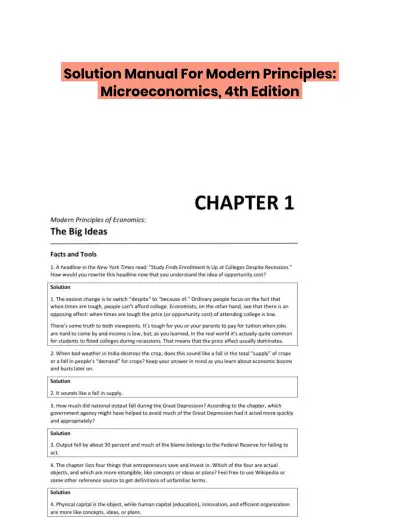 Textbook Guides
Solution Manual For Modern Principles: Microeconomics, 4th Edition
Economics
296 pagesMay 2025 Exam Guides
Test Bank for Principles of Macroeconomics, 12th Edition
Economics
1444 pages154downloadsFeb 2025 Textbook Guides
Solution Manual for International Economics Theory and Policy, 11th Edition
Economics
180 pages147downloadsFeb 2025 Textbook Guides
Solution Manual for Statistics for Business and Economics, 11th Edition
Economics
686 pages147downloadsFeb 2025 Textbook Guides
Solution Manual for Introduction to Agricultural Economics, 7th Edition
Economics
84 pages146downloadsFeb 2025 Textbook Guides
Solution Manual for Prentice Hall's Federal Taxation 2013 Individuals, 26th Edition
Economics
961 pages144downloadsFeb 2025 Textbook Guides
Solution Manual for Microeconomics, 8th Edition
Economics
353 pages139downloadsFeb 2025 Textbook Guides
Solution Manual for The Economics of Health and Health Care, 7th Edition
Economics
47 pages135downloadsFeb 2025
Study this document with CramX
Once it is in your library, every tool can work from it.