

Economics - GDP, Inflation, and Unemployment
- Economics
- Texas A&M University
- 12 pages
- Shared March 2026
Preview 4 of 12 pages
See the first 4 pages exactly as they appear in the document.
Page 1 Read page 1 as text
Study Guide Economics – GDP, Inflation, and Unemployment 1. GDP 1.1 What is GDP? Gross Domestic Product (GDP) is the market value of all final goods and services produced within a country in one year . It is the most important measure of a country’s economic performance because it tells us how much an economy produces. A closely related concept is Gross National Product (GNP) . GNP measures the market value of all final goods and services produced by a nation’s citizens and firms in one year , no matter where the production happens. 1.2 GDP vs GNP: What’s the Difference? The difference between GDP and GNP is mainly about where production takes place and who produces it . • GDP includes : o Goods and services produced inside a country , even if they are made by foreign firms or workers . • GNP includes : o Goods and services produced by a country’s own citizens and firms , even if production happens outside the country . In practice, GDP and GNP values are usually very close , so economists often use GDP to study overall economic activity. For this reason, the rest of this chapter focuses on GDP .
Page 2 Read page 2 as text
Study Guide 1.3 Measuring GDP There are two main ways to measure GDP: 1. The Expenditure Approach 2. The Income Approach Both methods give the same final value of GDP . 1.4 The Expenditure Approach The expenditure approach adds up all spending on final goods and services produced domestically in one year . What are Final Goods? • Final goods and services are bought for final use . • They are not resold or used to make other goods in the same year. Intermediate goods (goods used to produce other goods) are not included to avoid double counting . Their value is already included in the price of final goods. 1.5 The Four Components of GDP (Expenditure Approach) GDP is the sum of four major types of spending : 1.5. 1. Consumption (C) This is the largest part of GDP . It includes: • Nondurable goods : food, clothing • Durable goods : cars, refrigerators, appliances • Services : doctors, barbers, lawyers, mechanics, teachers
Page 3 Read page 3 as text
Study Guide 1.5. 2. Investment (I) Investment means spending on goods that help produce more goods in the future . There are two types: a) Fixed Investment Includes: • New machinery and equipment • Factories and offices • Residential housing • Replacement of old or worn - out equipment The value of goods that must be replaced each year is called depreciation . b) Inventory Investment • Goods that firms produce but have not yet sold • The change in inventory value from one year to the next is counted as investment 1.5. 3. Government Expenditure (G) Includes government spending on: • Salaries of government employees • Construction of roads, bridges, and public buildings • Military and public services Transfer payments (like pensions, welfare, or social security) are not included , because: • No new goods or services are produced in return 1.5. 4. Net Exports (X − M) • Exports (X) : domestically produced goods sold abroad → added • Imports (M) : foreign goods bought domestically → subtracted Net exports = Exports − Imports
Page 4 Read page 4 as text
Study Guide 1.6 The Income Approach The income approach measures GDP by adding all incomes earned in production during the year . These incomes include: • Wages • Profits • Rent • Interest The idea is simple: Money spent on goods and services eventually becomes income for households and firms. 1.7 Why Do We Adjust Income? Two items are included in spending but do not directly become income : 1. Depreciation o Replacing worn - out equipment o Increases income for sellers but reduces profits for buyers o Total income stays unchanged 2. Indirect Business Taxes o Sales tax, excise tax o Collected by firms but paid to the government o Not counted as firm income So, to move from GDP to National Income , we subtract: • Depreciation • Indirect business taxes
8 more pages in the full document
Unlock it once and it stays in your library, ready to chat with or turn into flashcards.
Unlock the full documentMore Economics study materials
See all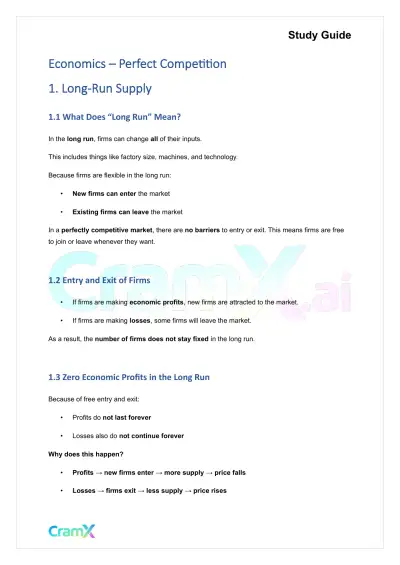 Quick Guides
Economics - Perfect Competition
Economics
18 pagesMar 2026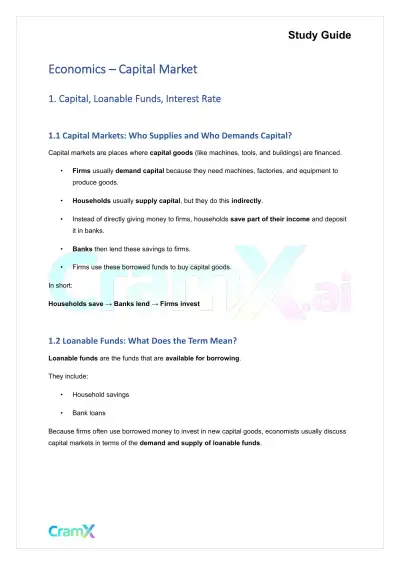 Quick Guides
Economics - Capital Market
Economics
12 pagesMar 2026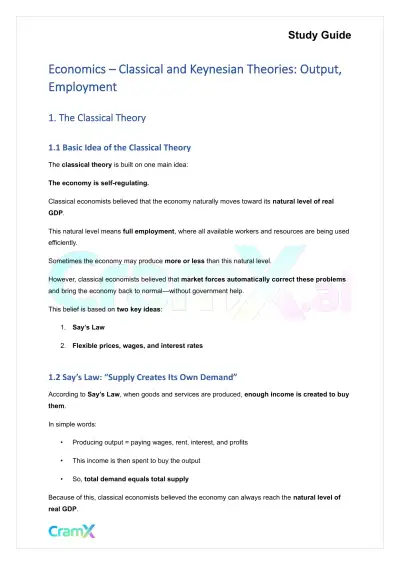 Quick Guides
Economics - Classical and Keynesian Theories Output, Employment
Economics
11 pagesMar 2026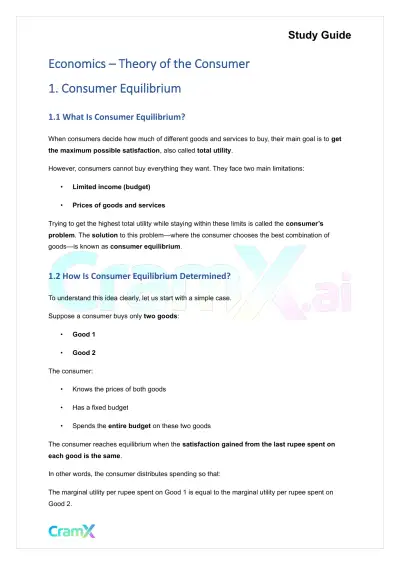 Quick Guides
Economics - Theory of the Consumer
Economics
14 pagesMar 2026 Quick Guides
Economics - Theory of the Firm
Economics
15 pagesMar 2026 Quick Guides
Economics - Labor Market
Economics
12 pagesMar 2026 Quick Guides
Economics - Monopolistic Competition and Oligopoly
Economics
18 pagesMar 2026 Quick Guides
Economics - Introduction
Economics
12 pagesMar 2026
Study this document with CramX
Once it is in your library, every tool can work from it.