

Economics - Theory of the Firm
- Economics
- Texas A&M University
- 15 pages
- Shared March 2026
Preview 5 of 15 pages
See the first 5 pages exactly as they appear in the document.
Page 1 Read page 1 as text
Study Guide Economics – Theory of the Firm 1. Production Costs and Firm Profits 1.1 The Firm’s Goal The main goal of a firm is to maximize profit . Profit depends on two things: • Revenue (money earned from selling output) • Costs (money spent to produce output) Because costs reduce profits, understanding different types of costs is very important for deciding how much output a firm should produce . 1.2 Explicit and Implicit Costs Explicit costs are the direct, out - of - pocket payments made by a firm. These include: • Wages paid to workers • Payments for raw materials • Fees paid to lawyers, bankers, or consultants These costs are easy to see and are recorded in accounting books. 1.3 Implicit Costs Implicit costs are the opportunity costs of using the firm’s own resources without receiving direct payment. Examples: • If the firm uses its own building , it gives up rent it could have earned. • If the owner works in the firm without taking a salary, they give up wages they could earn elsewhere.
Page 2 Read page 2 as text
Study Guide These costs: • Do not appear in accounting records • Are still real economic costs Important idea : Economists always consider both explicit and implicit costs when analyzing firm behavior. 1.4 Accounting Profit, Economic Profit, and Normal Profit Accounting Profit Accounting profit = Total revenue − Explicit costs Economic Profit Economic profit = Total revenue − (Explicit costs + Implicit costs) Or simply: Economic profit = Accounting profit − Implicit costs Normal Profit A firm earns normal profit when: • Economic profit = 0 This does not mean the firm earns nothing. It means: • The firm covers all explicit costs and • Fully compensates the owner for all implicit costs Normal profit is the minimum profit needed to keep the firm operating .
Page 3 Read page 3 as text
Study Guide 1.5 Fixed Costs and Variable Costs (Short Run) In the short run , at least one factor of production is fixed. Fixed Costs (FC) • Fixed costs do not change with output • They must be paid even if output is zero Example: • Cost of machinery or capital 1.6 Variable Costs (VC) • Variable costs change with output • To produce more, the firm must hire more variable inputs Example: • Wages paid to workers 1.7 Numerical Example Assume: • Capital = 1 unit (fixed) • Cost of capital = $100 • Wage per worker = $20
Page 4 Read page 4 as text
Study Guide This table shows labor input, output, fixed cost, variable cost, total cost, and marginal cost. 1.8 Total Cost and Marginal Cost Total Cost (TC) Total cost = Fixed cost + Variable cost From the table: • Fixed cost stays at $100 • Variable cost increases as more workers are hired 1.9 Marginal Cost (MC) Marginal cost measures: The extra cost of producing additional output Formula: Marginal Cost = Change in Total Cost ÷ Change in Output Example: • Output rises from 0 to 5 units
Page 5 Read page 5 as text
Study Guide • Total cost rises from $100 to $120 • MC = $20 ÷ 5 = $4 When output increases from 5 to 15 units : • Total cost rises from $120 to $140 • MC = $20 ÷ 10 = $2 1.10 Marginal Cost and Marginal Product Marginal cost is closely related to marginal product of labor . • When marginal product increases , output rises quickly • → Marginal cost falls • When marginal product declines (law of diminishing returns) • → Marginal cost rises This explains why: • Marginal cost first falls • Then rises as output increases 1.11 Average Costs Costs can also be measured per unit of output . Types of Average Costs • Average Variable Cost (AVC) = VC ÷ Output • Average Fixed Cost (AFC) = FC ÷ Output • Average Total Cost (ATC) = TC ÷ Output
10 more pages in the full document
Unlock it once and it stays in your library, ready to chat with or turn into flashcards.
Unlock the full documentMore Economics study materials
See all Quick Guides
Economics - Perfect Competition
Economics
18 pagesMar 2026 Quick Guides
Economics - Capital Market
Economics
12 pagesMar 2026 Quick Guides
Economics - Classical and Keynesian Theories Output, Employment
Economics
11 pagesMar 2026 Quick Guides
Economics - Theory of the Consumer
Economics
14 pagesMar 2026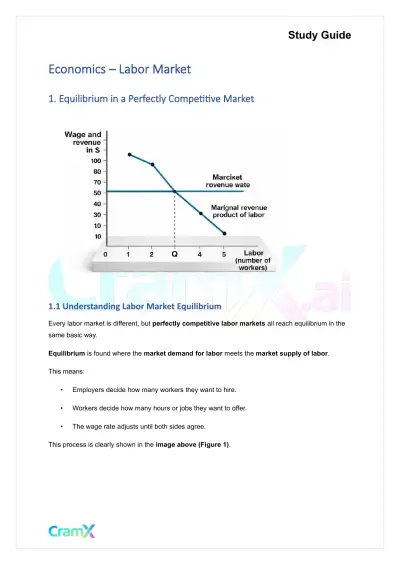 Quick Guides
Economics - Labor Market
Economics
12 pagesMar 2026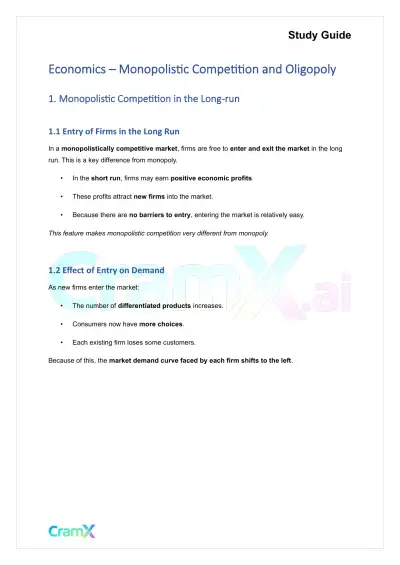 Quick Guides
Economics - Monopolistic Competition and Oligopoly
Economics
18 pagesMar 2026 Quick Guides
Economics - Introduction
Economics
12 pagesMar 2026 Quick Guides
Economics - Aggregate Demand and Aggregate Supply
Economics
15 pagesMar 2026
Study this document with CramX
Once it is in your library, every tool can work from it.