

Economics - Capital Market
- Economics
- Texas A&M University
- 12 pages
- Shared March 2026
Preview 4 of 12 pages
See the first 4 pages exactly as they appear in the document.
Page 1 Read page 1 as text
Study Guide Economics – Capital Market 1. Capital, Loanable Funds, Interest Rate 1. 1 Capital Markets: Who Supplies and Who Demands Capital? Capital markets are places where capital goods (like machines, tools, and buildings) are financed. • Firms usually demand capital because they need machines, factories, and equipment to produce goods. • Households usually supply capital , but they do this indirectly . • Instead of directly giving money to firms, households save part of their income and deposit it in banks. • Banks then lend these savings to firms. • Firms use these borrowed funds to buy capital goods. In short: Households save → Banks lend → Firms invest 1. 2 Loanable Funds: What Does the Term Mean? Loanable funds are the funds that are available for borrowing . They include: • Household savings • Bank loans Because firms often use borrowed money to invest in new capital goods, economists usually discuss capital markets in terms of the demand and supply of loanable funds .
Page 2 Read page 2 as text
Study Guide 1. 3 Interest Rate: The Price of Borrowing and Lending The interest rate plays two important roles: • For borrowers , it is the cost of borrowing money • For lenders , it is the return earned on lending money Interest rates are usually expressed as an annual percentage rate . Example (One - Year Loan) • A firm borrows $20,000 for one year • Interest rate = 5% per year • Interest = $20,000 × 0.05 = $1,000 • Total repayment after one year = $21,000 1. 4 Compound Interest: When Loans Last More Than One Year If a loan lasts more than one year, compound interest applies. Compound interest means: Interest is charged on both the original amount borrowed and the interest that has already accumulated. Example (Two - Year Loan) • Loan amount = $20,000 • Interest rate = 5% per year • After Year 1: Amount owed = $21,000 • In Year 2, interest is charged on $21,000 , not just $20,000 Final repayment after two years: • $21,000 + (21,000 × 0.05) = $22,050
Page 3 Read page 3 as text
Study Guide 1.5 General Formula for Loan Repayment In general, if: • X = amount borrowed • r = annual interest rate • t = number of years Then the total amount repaid is: Amount repaid = X (1 + r) ᵗ For example: • X = $20,000 • r = 0.05 • t = 2 Amount repaid = $20,000 × (1.05)² = $22,050 1.6 Determination of the Equilibrium Interest Rate The equilibrium interest rate is determined in the loanable funds market . This market includes: • Lenders (households and banks) • Borrowers (firms and investors) • The supply of loanable funds comes from lenders. • The demand for loanable funds comes from borrowers.
Page 4 Read page 4 as text
Study Guide 1.7 Loanable Funds Market • The demand curve slopes downward: o Lower interest rates → more borrowing • The supply curve slopes upward: o Higher interest rates → more lending • The equilibrium interest rate is found at the intersection of demand and supply. • At this point, the quantity of loanable funds demanded equals the quantity supplied. 1.8 Rate of Return on Capital and Demand for Loanable Funds The rate of return on capital is the extra income a firm earns by using new capital. • It is usually measured as a percentage per year . • Firms will borrow funds only if : o Rate of return on capital ≥ interest rate If capital becomes more productive : • The rate of return increases • Firms want to borrow more • The demand curve for loanable funds shifts right • The equilibrium interest rate rises , assuming other factors remain the same ( ceteris paribus )
8 more pages in the full document
Unlock it once and it stays in your library, ready to chat with or turn into flashcards.
Unlock the full documentMore Economics study materials
See all Quick Guides
Economics - Perfect Competition
Economics
18 pagesMar 2026 Quick Guides
Economics - Classical and Keynesian Theories Output, Employment
Economics
11 pagesMar 2026 Quick Guides
Economics - Theory of the Consumer
Economics
14 pagesMar 2026 Quick Guides
Economics - Theory of the Firm
Economics
15 pagesMar 2026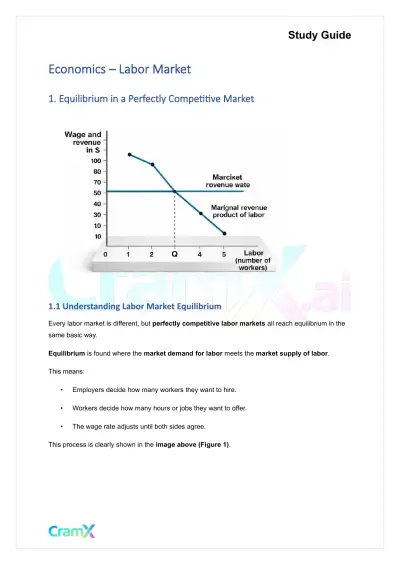 Quick Guides
Economics - Labor Market
Economics
12 pagesMar 2026 Quick Guides
Economics - Monopolistic Competition and Oligopoly
Economics
18 pagesMar 2026 Quick Guides
Economics - Introduction
Economics
12 pagesMar 2026 Quick Guides
Economics - Aggregate Demand and Aggregate Supply
Economics
15 pagesMar 2026
Study this document with CramX
Once it is in your library, every tool can work from it.