

Economics - Demand, Supply, and Elasticity
- Economics
- Texas A&M University
- 20 pages
- Shared March 2026
Preview 6 of 20 pages
See the first 6 pages exactly as they appear in the document.
Page 1 Read page 1 as text
Study Guide Economics – Demand, Supply, and Elasticity 1. Equilibrium Analysis 1. 1 What Is Market Equilibrium? In any market for a good (let’s call it good X ), buyers and sellers interact at the same time. • Buyers decide how much they want to buy (demand). • Sellers decide how much they want to sell (supply). The market is said to be in equilibrium when: • Quantity demanded = Quantity supplied At this point: • The equilibrium price is the price at which the market clears (no shortage or surplus). • The equilibrium quantity is the amount bought and sold at that price. There are two main ways to find equilibrium: 1. Algebraic method (using equations) 2. Graphical method (using demand and supply curves)
Page 2 Read page 2 as text
Study Guide 1. 2 Algebraic Approach to Equilibrium Step 1: Write Demand and Supply Equations • Demand equation: • P = 10 - 2Q • Supply equation: • P = (1/2) Q To make solving easier, rewrite the supply equation in terms of Q : Q = 2P Step 2: Solve the Equations Together P=10−2(2P) P=10−4P 5P=10 , P=2 Equilibrium Price = $2
Page 3 Read page 3 as text
Study Guide Step 3: Find Equilibrium Quantity Substitute ( P = 2 ) into the supply equation: Q = 2(2) Q = 4 Equilibrium Quantity = 4 units of good X 1. 3 Graphical Approach to Equilibrium In the graph: • The downward - sloping line is the demand curve • The upward - sloping line is the supply curve • The intersection point shows equilibrium From the graph: • Equilibrium Price = $2 • Equilibrium Quantity = 4 units This matches the answer from the algebraic method. 1.4 Changes in Equilibrium Equilibrium stays the same only if demand and supply do not change . If either curve shifts, the equilibrium price and quantity will change.
Page 4 Read page 4 as text
Study Guide (a) Changes Due to Demand • Demand shifts left (Dₐ → D ᵦ ): o Equilibrium price falls o Equilibrium quantity falls • Demand shifts right (Dₐ → D 𝒸 ): o Equilibrium price rises o Equilibrium quantity rises ✔ Supply is assumed constant (b) Changes Due to Supply • Supply shifts left (Sₐ → S ᵦ ): o Equilibrium price rises o Equilibrium quantity falls • Supply shifts right (Sₐ → S 𝒸 ): o Equilibrium price falls o Equilibrium quantity rises ✔ Demand is assumed constant
Page 5 Read page 5 as text
Study Guide 2. Elasticity So far, we have learned how equilibrium price and quantity are determined by demand and supply. Now, we go one step further. Economists also want to know how strongly buyers and sellers react when prices or incomes change. This responsiveness is called elasticity . In simple words, elasticity measures how much quantity changes when something else changes , such as price or income. 2. 1 Price Elasticity of Demand Price elasticity of demand tells us how much quantity demanded changes when price changes . Formula Price Elasticity of Demand = Percentage change in quantity demanded ÷ Percentage change in price This formula compares: • Percentage change in quantity demanded • Percentage change in price 2.2 Elastic vs Inelastic Demand • Price elastic demand o Quantity demanded changes more than price o Consumers react strongly to price changes • Price inelastic demand o Quantity demanded changes less than price o Consumers are not very sensitive to price changes
Page 6 Read page 6 as text
Study Guide 2.3 Real - Life Example Imagine a 50% increase in price of: • Candy bars • Prescription medicines People will reduce buying both , but: • Candy bars are not necessities → demand falls a lot • Medicines are necessary → demand falls only a little So: • Demand for candy bars is more elastic • Demand for prescription medicines is more inelastic 2. 4 Price Elasticity of Supply Price elasticity of supply measures how much quantity supplied changes when price changes . Formula Price Elasticity of Supply = Percentage change in quantity supplied ÷ Percentage change in price 2.5 Elastic vs Inelastic Supply • Price elastic supply o Quantity supplied changes more than price • Price inelastic supply o Quantity supplied changes less than price
14 more pages in the full document
Unlock it once and it stays in your library, ready to chat with or turn into flashcards.
Unlock the full documentMore Economics study materials
See all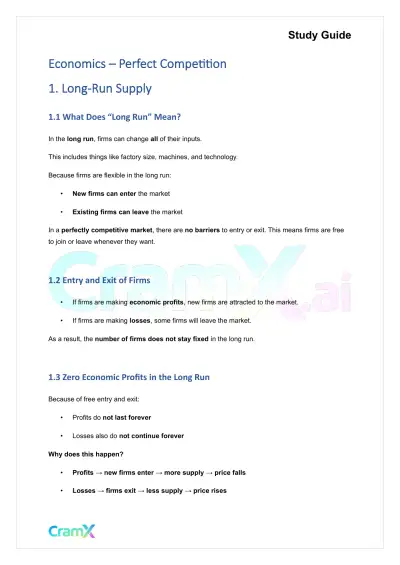 Quick Guides
Economics - Perfect Competition
Economics
18 pagesMar 2026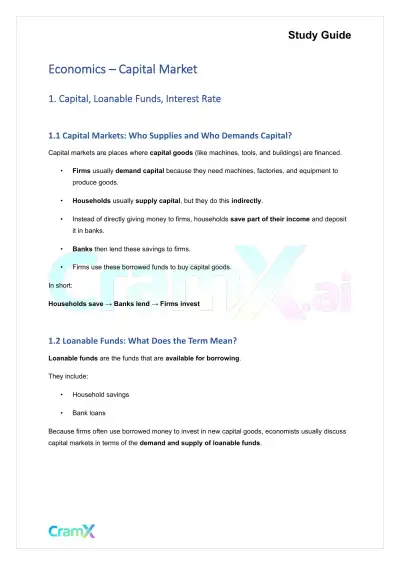 Quick Guides
Economics - Capital Market
Economics
12 pagesMar 2026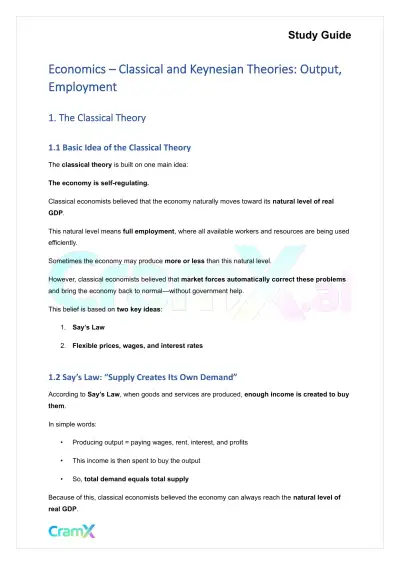 Quick Guides
Economics - Classical and Keynesian Theories Output, Employment
Economics
11 pagesMar 2026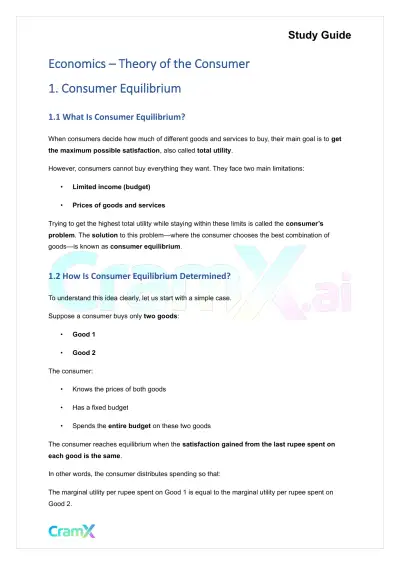 Quick Guides
Economics - Theory of the Consumer
Economics
14 pagesMar 2026 Quick Guides
Economics - Theory of the Firm
Economics
15 pagesMar 2026 Quick Guides
Economics - Labor Market
Economics
12 pagesMar 2026 Quick Guides
Economics - Monopolistic Competition and Oligopoly
Economics
18 pagesMar 2026 Quick Guides
Economics - Introduction
Economics
12 pagesMar 2026
Study this document with CramX
Once it is in your library, every tool can work from it.