

Economics: Understanding Market Failures, Externalities, and Public Goods
- Economics
- 9 pages
- Shared May 2025
A quiz on economic concepts such as market failures, externalities, and public goods, focusing on their impact on society.
Preview 3 of 9 pages
See the first 3 pages exactly as they appear in the document.
Page 1 Read page 1 as text
Economics: Understanding Market Failures, Externalities, and Public Goods Question 1 If some activity creates positive externalities as well as private benefits, then economic theory suggests that the activity ought to be: Answer taxed. prohibited. subsidized. left alone under the idea of laissez faire. Answer: subsidized. 5 points Question 2 Once a government has provided a public good, everyone: Answer pays the cost. can obtain the benefit. experiences positive externalities. experiences negative externalities. Answer: can obtain the benefit. 5 points Question 3 One condition for individual bargaining to occur, according to the Coase theorem, is that there must be:
Page 2 Page 3 Read page 3 as text
Answer clearly defined property rights. many people affected and involved. government intervention to establish bargaining. government creation of a market for externalities. Answer: clearly defined property rights. 5 points Question 4 Consumer surplus: Answer is the difference between the maximum prices consumers are willing to pay for a product and the lower equilibrium price. the difference between the maximum prices consumers are willing to pay for a product and the minimum prices producers are willing to accept. the difference between the minimum prices producers are willing to accept for a product and the higher equilibrium price. rises as equilibrium price rises. Answer: is the difference between the maximum prices consumers are willing to pay for a product and the lower equilibrium price. 5 points Question 5 Suppose the government imposed a carbon tax on firms that emit pollution. Then Answer the firms' marginal cost of production would increase, and the supply curves within the market would shift to the left.
6 more pages in the full document
Unlock it once and it stays in your library, ready to chat with or turn into flashcards.
Unlock the full documentMore Economics study materials
See all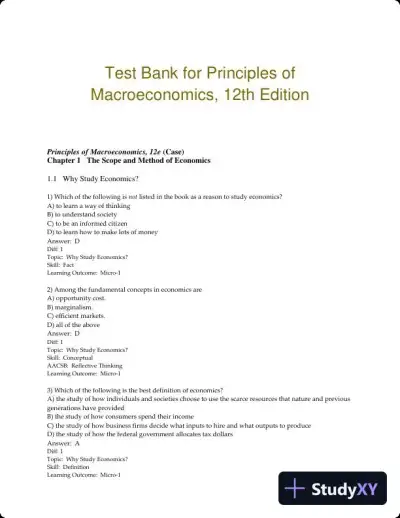 Exam Guides
Test Bank for Principles of Macroeconomics, 12th Edition
Economics
1444 pages154downloadsFeb 2025 Textbook Guides
Solution Manual for Statistics for Business and Economics, 11th Edition
Economics
686 pages147downloadsFeb 2025 Textbook Guides
Solution Manual for International Economics Theory and Policy, 11th Edition
Economics
180 pages147downloadsFeb 2025 Textbook Guides
Solution Manual for Introduction to Agricultural Economics, 7th Edition
Economics
84 pages146downloadsFeb 2025 Textbook Guides
Solution Manual for Prentice Hall's Federal Taxation 2013 Individuals, 26th Edition
Economics
961 pages144downloadsFeb 2025 Textbook Guides
Solution Manual for Microeconomics, 8th Edition
Economics
353 pages139downloadsFeb 2025 Textbook Guides
Solution Manual for The Economics of Health and Health Care, 7th Edition
Economics
47 pages135downloadsFeb 2025 Exam Guides
Test Bank for Engineering Economics Financial Decision Making for Engineers, 6th Edition
Economics
254 pages134downloadsFeb 2025
Study this document with CramX
Once it is in your library, every tool can work from it.