

The Economy Today, 13th Edition Test Bank
- Economics
- 6554 pages
- Shared May 2025
The Economy Today, 13th Edition Test Bank is an essential resource to help you tackle your upcoming exams with confidence. This guide includes key questions and answers to boost your exam preparation.
Preview 16 of 6554 pages
See the first 16 pages exactly as they appear in the document.
Page 1 Read page 1 as text
Chapter 01 Economics: The Core Issues Multiple Choice Questions 1. Which of the following is not one of the three core economic issues that must be resolved? A. How to produce the goods and services we select. B. What to produce with unlimited resources. C. Who should get the goods and services we produce. D. What to produce with limited resources. 2. The fundamental problem of economics is A. The law of increasing opportunity costs. B. The scarcity of resources relative to human wants. C. How to get government to operate efficiently. D. How to create employment for everyone. 3. In economics, scarcity means that A. A shortage of a particular good will cause the price to fall. B. A production possibilities curve cannot accurately represent the trade - off between two goods. C. Society's desires exceed the want - satisfying capability of the resources available to satisfy those desires. D. The market mechanism has failed.
Page 2 Page 3 Read page 3 as text
4. Given that resources are scarce, A. A "free lunch" is possible, but only for a limited number of people. B. Opportunity costs are experienced whenever choices are made. C. Poor countries must make choices, but rich countries with abundant resources do not have to make choices. D. Some choices involve opportunity costs while other choices do not. 5. A consequence of the economic problem of scarcity is that A. Choices have to be made about how resources are used. B. There is never too much of any good or service produced. C. The production of goods and services must be controlled by the government. D. The production possibilities curve is bowed outward. 6. The basic factors of production include A. Land, labor, money, and capital. B. Land, labor, money, and inputs. C. Labor and money. D. Land, labor, capital, and entrepreneurship. 7. Factors of production are A. Scarce in every society. B. Scarce only in advanced countries. C. Scarce only in the poorest countries of the world. D. Unlimited in quantity.
Page 4 Read page 4 as text
8. Which of the following is not a factor of production? A. A psychiatrist. B. The $100,000 used to start a new business. C. A bulldozer. D. Six thousand acres of farmland. 9. With respect to factors of production, which of the following statements is not true? A. Factors of production are also known as resources. B. In order to produce any good or service, it is necessary to have factors of production. C. Factors of production include land, labor, capital, and entrepreneurship. D. Only those resources that are privately owned are counted as factors of production. 10. Which of the following is the best example of land? A. The ethanol refined from corn. B. A factory that produces new goods and services. C. The water used to make a soft drink. D. A barber's chair. 11. Capital, as economists use the term, refers to A. The money needed to start a new business. B. The costs of operating a business. C. Shares of stock issued by businesses. D. Final goods that are used to produce other goods and services.
Page 5 Read page 5 as text
12. Which economist argued that free markets unleashed the "animal spirits" of entrepreneurs, propelling innovation, technology, and growth? A. Lord Kelvin. B. Kenneth Olsen. C. Irving Fisher. D. John Maynard Keynes. 13. The role of the entrepreneur in an economy is to A. Bring the factors of production together and assume the risk of production. B. Work with government planners to determine what goods are produced. C. Arrange bank financing for the owners of new businesses. D. Ensure full employment of labor. 14. Economics can be defined as the study of A. For whom resources are allocated to increase efficiency. B. How society spends the income of individuals. C. How scarce resources are allocated on a macro level to best meet society's goals or on a micro level to best meet an individual's or firm's goals. D. None of the choices are correct. 15. Opportunity cost is A. Measured only in dollars and cents. B. The total dollar cost to society of producing the goods. C. The difficulty associated with using one good in place of another. D. The best alternative that must be given up in order to get something else.
Page 6 Read page 6 as text
16. Opportunity cost may be defined as the A. Goods or services that are forgone in order to obtain something else. B. Dollar prices paid for final goods and services. C. Dollar cost of producing a particular product. D. Difference between wholesale and retail prices. 17. The opportunity cost of studying for an economics test is A. Negative because it may improve your grade. B. Zero because you knew when you registered for the class that studying would be required. C. The money you spent on tuition for the class. D. The best alternative use of your time. 18. The "guns versus butter" dilemma that all nations confront is that A. Guns and butter can be produced using the same resources at the same time. B. An increase in national defense implies more sacrifices of civilian goods and services. C. An increase in national defense is possible only if we produce more butter. D. All of the choices are correct. 19. A production possibilities curve indicates the A. Combinations of goods and services an economy is actually producing. B. Maximum combinations of goods and services an economy can produce given its available resources and technology. C. Maximum combinations of goods and services an economy can produce given unlimited resources. D. Average combinations of goods and services an economy can produce given its available resources and technology.
Page 7 Read page 7 as text
20. Which of the following is an assumption under which the production possibilities curve is drawn? A. Total unemployment is zero. B. The supply of resources is fixed. C. The price level is changing. D. Technology is changing. 21. A point on a nation's production possibilities curve represents A. An undesirable combination of goods and services. B. Combinations of production that are unattainable, given current technology and resources. C. Levels of production that will cause both unemployment and inflation. D. The full employment of resources to achieve a particular combination of goods and services. 22. The production possibilities curve illustrates which two of the following essential principles? A. Factors of production and price signals. B. Scarce resources and opportunity cost. C. Market mechanisms and laissez faire. D. Economic growth and market failure. 23. Which of the following correctly characterizes the shape of a constant opportunity cost production possibilities curve? A. A straight line indicating that the law of increasing opportunity costs applies. B. A straight line when there is constant opportunity costs. C. A line that curves outward when resources are perfectly adaptable in the production of different goods. D. A line that curves inward when resources are perfectly adaptable in the production of different goods.
Page 8 Read page 8 as text
24. The production possibilities curve illustrates A. The limitations that exist because of scarce resources. B. That there is no limit to what an economy can produce. C. That there is no limit to the level of output. D. The existence of unlimited wants and resources. 25. According to the law of increasing opportunity costs, A. The more one is willing to pay for resources, the smaller will be the possible level of production. B. Increasing the production of a particular good will cause the price of the good to remain constant. C. In order to produce additional units of a particular good, it is necessary for society to sacrifice increasingly larger amounts of alternative goods. D. None of the choices are correct. 26. According to the law of increasing opportunity costs, A. Greater production leads to greater inefficiency. B. Greater production means factor prices rise. C. Greater production of one good requires increasingly larger sacrifices of other goods. D. Higher opportunity costs induce higher output per unit of input. 27. If an economy experiences increasing opportunity costs with respect to two goods, then the production possibilities curve between the two goods will be A. Bowed outward or concave from below. B. A straight, downward - sloping line. C. Bowed inward or convex from below. D. Bowed outward until the two goods are equal, and then bowed inward.
Page 9 Read page 9 as text
28. If the United States decides to convert automobile factories to tank production, as it did during World War II, but finds that some auto manufacturing facilities are not well suited to tank production, then A. The production possibilities curve between tanks and automobiles will appear as a straight line. B. The production possibilities curve between tanks and automobiles will shift outward. C. Decreasing opportunity costs will occur with greater automobile production. D. Increasing opportunity costs will occur with greater tank production. 29. If North Korea is currently producing at efficiency, and it proceeds to increase the size of its military, then, as long as nothing else changes, its A. Production possibilities curve will shift outward. B. Production possibilities curve will shift inward. C. Production of nonmilitary goods will increase. D. Production of nonmilitary goods will decrease. 30. When an economy is producing efficiently, it is A. Producing a combination of goods and services beyond the production possibilities curve. B. Getting the most goods and services from the available resources. C. Experiencing decreasing opportunity costs. D. Producing equal amounts of all goods. 31. Which of the following is true when an economy is producing efficiently? A. The economy is producing on the production possibilities curve. B. The economy is producing outside the production possibilities curve. C. The economy is getting the fewest goods and services from the available resources. D. Everyone in the economy is happy.
Page 10 Read page 10 as text
32. The points on a production possibilities curve show A. Desired output. B. Actual output. C. Potential output. D. None of the choices are correct. 33. In terms of the production possibilities curve, inefficiency is represented by A. All points on the curve. B. All points outside the curve. C. All points inside the curve. D. A rightward shift of the curve. 34. If an economy is producing inside the production possibilities curve, then A. There is full employment of resources. B. It is operating efficiently. C. It can produce more of one good without giving up some of another good. D. There are not enough resources available to produce more output. 35. A technological advance would best be represented by A. A shift outward of the production possibilities curve. B. A shift inward of the production possibilities curve. C. A movement from inside the production possibilities curve to a point on the production possibilities curve. D. A movement from the production possibilities curve to a point inside the production possibilities curve.
Page 11 Read page 11 as text
36. Which of the following events would allow the production possibilities curve to shift outward? A. The economy's capital stock declines. B. More teenagers enter the labor force. C. Technology is lost. D. People begin to retire at earlier ages. 37. Economic growth would best be represented by a A. Shift outward of the production possibilities curve. B. Shift inward of the production possibilities curve. C. Movement from inside the production possibilities curve to a point on the production possibilities curve. D. Movement from the production possibilities curve to a point inside the production possibilities curve. 38. Which of the following will cause the production possibilities curve to shift inward? A. An increase in the working - age population. B. A decrease in the size of the labor force. C. A technological advance. D. An increase in knowledge. 39. Which of the following is not a basic decision that all nations must confront? A. Should we have economic growth? B. How should we produce goods and services? C. For whom should goods and services be produced? D. What goods and services should we produce?
Page 12 Read page 12 as text
40. In a market economy, the people who receive the goods and services that are produced are those who A. Need the goods and services the most. B. Have the most political power. C. Want the goods and services the most. D. Are willing to pay the highest price. 41. Adam Smith's invisible hand is now called A. Economic growth. B. The market mechanism. C. Opportunity cost. D. Laissez faire. 42. The market mechanism may best be defined as A. The use of market prices and sales to signal desired output. B. The use of market signals and government directives to select economic outcomes. C. The process by which the production possibilities curve shifts inward. D. Price regulation by government. 43. The market mechanism A. Is not a very efficient means of communicating consumer demand to the producers of goods and services. B. Works through central planning by government. C. Eliminates market failures created by government. D. Works because prices serve as a means of communication between consumers and producers.
Page 13 Read page 13 as text
44. The invisible hand refers to A. Intervention in the economy by the government bureaucrats we do not see and over whom we have no control. B. Undiscovered natural resources. C. The allocation of resources by market forces. D. The person who has the responsibility to coordinate all the markets in a market economy. 45. The doctrine of laissez faire is based on the belief that A. Markets are likely to do a better job of allocating resources than government directives. B. Government directives are likely to do a better job of allocating resources than markets. C. Government failure does not exist. D. Markets result in an unfair distribution of income. 46. A city's decision to limit smoking in public areas is an example of A. The invisible hand at work. B. The market mechanism at work. C. Market success. D. Government intervention. 47. A mixed economy A. Is justified by the superiority of laissez faire over government intervention. B. Utilizes both market and nonmarket signals to allocate goods and services. C. Relies on the use of central planning by private firms rather than the government. D. Is one that allows trade with other countries.
Page 14 Read page 14 as text
48. Which of the following can be used to correct market failure? A. The market mechanism. B. Laws and regulations. C. Laissez faire price policies. D. Government failure. 49. When the invisible hand does not produce optimal outcomes for the economy, there is evidence of A. Market failure. B. Government failure. C. Macroeconomic failure. D. Scarcity. 50. Government intervention may achieve a more optimal outcome than the market mechanism when addressing A. Inefficient bureaucracy. B. Consumption of cigarettes. C. Theme park construction. D. None of the choices are correct. 51. If market signals result in pollution beyond the optimal level, then A. The economy experiences government failure. B. A laissez faire approach will reduce the level of pollution. C. The market mechanism has failed to achieve social efficiency. D. The government is allocating resources inefficiently.
Page 15 Read page 15 as text
52. Which of the following has occurred when government directives do not produce better economic outcomes? A. Government failure. B. Market failure. C. Macroeconomic failure. D. Scarcity. 53. Which of the following is an example of government failure? A. Bureaucratic delays. B. Required use of pollution control technology that is obsolete. C. Inefficient incentives. D. All of the choices are correct. 54. Macroeconomics focuses on the performance of A. Individual consumers. B. Government agencies. C. The overall economy. D. All of the choices are correct. 55. Which of the following is not a macroeconomic statement? A. The unemployment rate for the United States rose to 5 percent in the last quarter. B. The Federal Reserve lowered interest rates at its last meeting. C. Congress increased the minimum wage rate in January. D. Jenny's wage rate rose, and in response, she decided to work more hours.
Page 16 Read page 16 as text
56. The study of microeconomic theory focuses on the A. Structure and performance of individual markets and the operation of the price system. B. Operation of the entire economy. C. Role of the banking system in the economy. D. Interaction of international trade and domestic production of goods and services. 57. Microeconomics is concerned with issues such as A. The demand for bottled water by individuals. B. The level of inflation in the economy. C. Maintaining a strong level of economic growth. D. All of the choices are correct. 58. Economic models are used by economists to A. Predict economic behavior. B. Develop economic policies. C. Explain economic behavior. D. All of the choices are correct. 59. The Latin phrase ceteris paribus means A. The production possibilities curve never shifts. B. Laissez faire. C. Other things remain equal. D. The invisible hand.
6538 more pages in the full document
Unlock it once and it stays in your library, ready to chat with or turn into flashcards.
Unlock the full documentMore Economics study materials
See all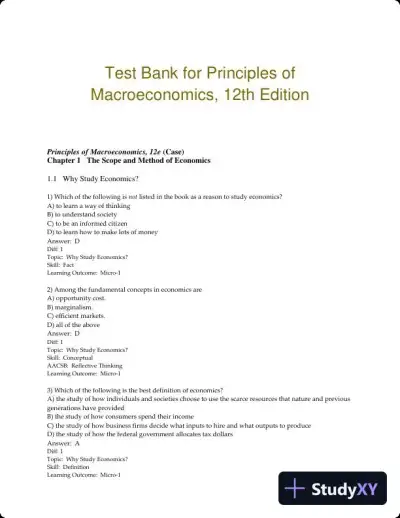 Exam Guides
Test Bank for Principles of Macroeconomics, 12th Edition
Economics
1444 pages154downloadsFeb 2025 Textbook Guides
Solution Manual for Statistics for Business and Economics, 11th Edition
Economics
686 pages147downloadsFeb 2025 Textbook Guides
Solution Manual for International Economics Theory and Policy, 11th Edition
Economics
180 pages147downloadsFeb 2025 Textbook Guides
Solution Manual for Introduction to Agricultural Economics, 7th Edition
Economics
84 pages146downloadsFeb 2025 Textbook Guides
Solution Manual for Prentice Hall's Federal Taxation 2013 Individuals, 26th Edition
Economics
961 pages144downloadsFeb 2025 Textbook Guides
Solution Manual for Microeconomics, 8th Edition
Economics
353 pages139downloadsFeb 2025 Textbook Guides
Solution Manual for The Economics of Health and Health Care, 7th Edition
Economics
47 pages135downloadsFeb 2025 Exam Guides
Test Bank for Engineering Economics Financial Decision Making for Engineers, 6th Edition
Economics
254 pages134downloadsFeb 2025
Study this document with CramX
Once it is in your library, every tool can work from it.