

Student Exploration Circuit Builder Build and Test
- Electrical Engineering & Electronics
- 6 pages
- Shared June 2025
This activity guides students through a circuit simulation, prompting exploration of key concepts like current, open/closed circuits, and components. Students make predictions and observations to build foundational understanding of electricity.
Preview 2 of 6 pages
See the first 2 pages exactly as they appear in the document.
Page 1 Read page 1 as text
•fl Name: Bruhath! Sivalenka Date: 1Q/10/2020 Student Exploration Circuit Builder Directions: Follow the instructions to go through the simulation. Respond to the questions and prompts in the orange boxes. Vocabulary: circuit, closed circuit, conductor, current, electron, fuse, insulator, open circuit, parallel circuit, series circuit, short circuit Prior Knowledge Questions (Do these BEFORE using the Gizmo.) 1. What do a light bulb, a toaster, a radio, and a computer all have in common? They are required to electrically function 2. Suppose you connect a battery to a small light bulb with a single wire. What do you think will happen? Explain your answer. The lightbulb would not light up because it has to have two wires to connect from both sides of the battery. Gizmo Warm-up: Build a circuit 1. Using the Standard components in the upper left of the Gizmo, try to get a light bulb to light up. You can drag as many bulbs, wires, batteries, switches and fuses as you like onto the circuit board. A circuit is a path containing easily moveable charges. When the light bulb lights up, negatively-charged particles called electrons are flawing through the wire and bulb. This flow is called current. Battery Now try to light the bulb with the smallest number of components. 3. Based on what you have seen, what must be true for a circuit to light a bulb?
Page 2 Read page 2 as text
A battery or a source of electrons and conductive wiring to transfer, tfrie electrons are needed for a circuit to light a bulb. Activity A: Closing a circuit Get the Gizmo ready: • Click Clear. • Turn on Show current and select Electron flow. • Set up components as shown to the right. 'l1 • * 1 Introduction: You should have just built an open circuit (shown above). The gap on the left prevents the flow of charges. There are no gaps in a closed circuit so charges can flow. Question: What materials will close a circuit? 1. Predict: Conductors are materials with easily movable charges, allowing current to occur. Insulators do not have easily movable charges, so current is not produced. Look at the nine Materials at lower left. Which do you think are conductions? Same question on the bottom did it there Which are insulators? same question on the bottom i did it there A. Predicted conductors: Iron, silver, brass, copper, pencil lead B. Predicted insulators: Wood, plastic, yam,glass C. How could you use your open circuit to test if a material is a conductor or insulator? Once the material is connected to the open circuit, it should either light the bulb or have no effect at all. if the bulb is lit. the material is conductive. On the other hand the material is an insulator, if it doesn't light up the bulb. 2. Experiment: Drag each material into the gap of the open circuit. If the light bulb lights, the material is a conductor. If not, the material is an insulator. Keep track of your findings below. Conductors Insulators Silver Plastic Iron Yam Pencil Lead Glass Copper Wood Brass 3. Analyze: Look at your list of conductors. A. What kind of material are most conductors?
4 more pages in the full document
Unlock it once and it stays in your library, ready to chat with or turn into flashcards.
Unlock the full documentMore Electrical Engineering & Electronics study materials
See all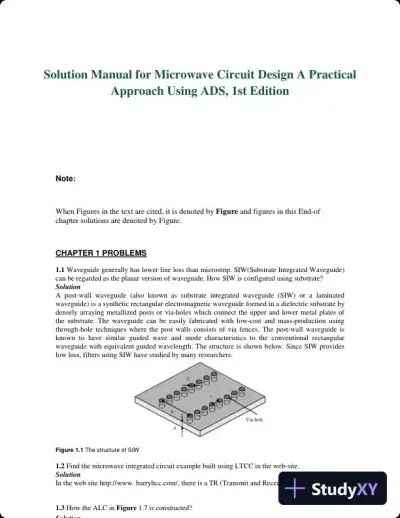 Textbook Guides
Solution Manual for Microwave Circuit Design A Practical Approach Using ADS, 1st Edition
Electrical Engineering & Electronics
121 pages154downloadsFeb 2025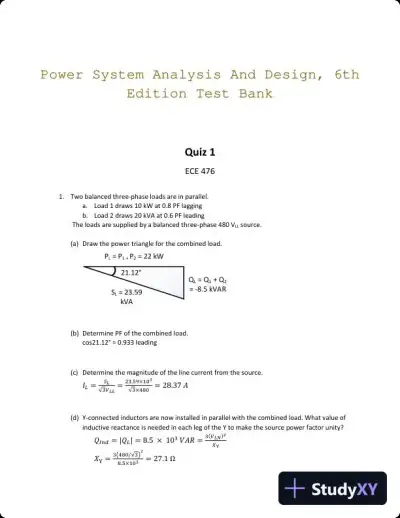 Exam Guides
Power System Analysis And Design, 6th Edition Test Bank
Electrical Engineering & Electronics
40 pages132downloadsFeb 2025 Textbook Guides
Solution Manual For Electronics Fundamentals: A Systems Approach, 1st Edition
Electrical Engineering & Electronics
278 pages93downloadsFeb 2025 Textbook Guides
Electronic Commerce, 12th Edition Solution Manual
Electrical Engineering & Electronics
134 pagesMay 2025 Textbook Guides
Solution Manual for Signals and Systems using MATLAB , 3rd Edition
Electrical Engineering & Electronics
538 pagesMay 2025 Document
HW4_Solution
Electrical Engineering & Electronics
17 pagesFeb 2026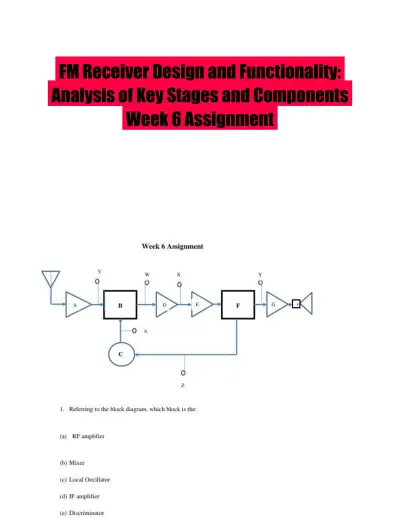 Solved Assignments
FM Receiver Design and Functionality: Analysis of Key Stages and Components Week 6 Assignment
Electrical Engineering & Electronics
5 pagesMay 2025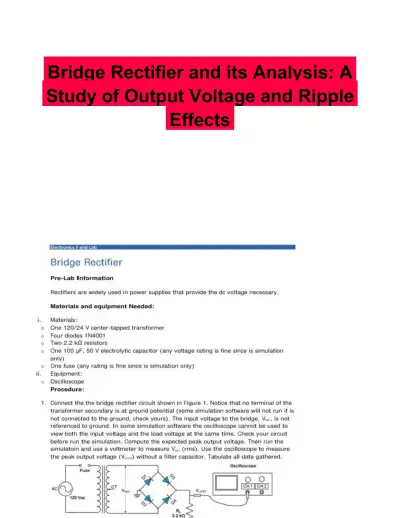 Solved Assignments
Bridge Rectifier and its Analysis: A Study of Output Voltage and Ripple Effects
Electrical Engineering & Electronics
3 pagesMay 2025
Study this document with CramX
Once it is in your library, every tool can work from it.