

Geology - Introduction to Physical Geology
- Geology
- Texas A&M University
- 10 pages
- Shared March 2026
Preview 3 of 10 pages
See the first 3 pages exactly as they appear in the document.
Page 1 Read page 1 as text
Study Guide Geology – Introduc Ɵ on to Physical Geology 1. The Earth’s Exterior The outside of the Earth is always changing. This happens because of external forces such as climate and rainfall. These forces slowly shape the land over time. 1.1 Weathering: Breaking Rocks Apart Rocks on the Earth’s surface do not stay the same forever. Freezing and thawing , along with running water , cause rocks to crack and break down. This process is called weathering . Weathering turns solid rock into very small pieces. 1.2 Erosion: Moving the Pieces Once rocks are broken into tiny particles, they do not stay in one place. Water, ice, and wind carry these particles away. This movement is known as erosion . The tiny rock pieces being moved are called sediment . 1.3 How Landscapes Change Over long periods of time, erosion can greatly change the shape of the land. Tall mountains slowly wear down into hills . Flowing water cuts into the land to form valleys and canyons . Sediment also helps create soil , which is important for plants and life on Earth. 1.4 What Happens to Sediment Large amounts of sediment are deposited in new places by water, wind, or ice. Some of this sediment may be eroded again later. Other times, the sediment stays in place, becomes compacted, and hardens over time. When this happens, it forms sedimentary rock . In this way, weathering and erosion work together to constantly reshape the Earth’s surface.
Page 2 Read page 2 as text
Study Guide 2. Geologic Time The Earth has a very long history — much longer than human history. Scientists who study the Earth, called geoscientists , estimate that our planet is about 4.5 billion years old . To understand such a huge time span, they divide Earth’s history into stages based on major changes. 2.1 The Early Earth When the Earth first formed, its surface was extremely hot. As the crust slowly cooled , early geologic activity was dominated by volcanoes . These volcanic processes helped build the continental crust and released gases that formed a primitive atmosphere . 2.2 The First Life Life began very early in Earth’s history. Simple bacterial life forms have been found in rocks that are billions of years old . These tiny organisms lived mainly in the oceans and were much simpler than most life we see today. 2.3 Life Becomes More Complex Much later, around 600 million years ago , more complex ocean life began to appear. Creatures such as trilobites lived in the seas and are often found as fossils in ancient rocks. 2.4 The Age of Dinosaurs From about 245 million to 66 million years ago , dinosaurs and other reptiles dominated the Earth. They lived on land, in the air, and in the oceans, and they flourished all over the world during this long period. 2.5 Humans: A Very Recent Arrival Compared to Earth’s long history, humans are very new . Human beings have existed for only about the last 3 million years . This is less than one - thousandth of Earth’s age , showing just how small our place is in geologic time.
Page 3 Read page 3 as text
Study Guide Understanding geologic time helps us see how slowly the Earth changes — and how recent human history really is. 3. The Earth Today Even though Earth is almost 5 billion years old , it is far from quiet or finished. Our planet is still very active, and its landscapes are constantly changing. Mountains rise and wear down, rivers shift their paths, and coastlines slowly reshape over time. Over the years, scientists have explored, studied, and collected samples from most of the rocks found on the continents. By examining these rocks, they can learn how Earth has changed and continues to change. 3.1 Understanding Earth Through the Present One key idea that helps scientists understand Earth is called uniformitarianism , often explained as “the present is the key to the past.” This means that the natural processes we see happening today also occurred in the past in similar ways. When scientists look at very old rocks, they often find textures and patterns that are still forming today. These features come from familiar processes such as: • Volcanic eruptions • Earthquakes • Hot springs • Wind and weathering • Flowing rivers • Sediment buildup • Erosion Because these processes are still active, scientists can study them now and use that knowledge to understand ancient rocks.
7 more pages in the full document
Unlock it once and it stays in your library, ready to chat with or turn into flashcards.
Unlock the full documentMore Geology study materials
See all Quick Guides
Geology - Groundwater
Geology
16 pagesMar 2026 Quick Guides
Geology - Earth Resources We Depend On
Geology
16 pagesMar 2026 Quick Guides
Geology - Weathering and Erosion
Geology
11 pagesMar 2026 Quick Guides
Geology - Glaciers and Glaciation
Geology
21 pagesMar 2026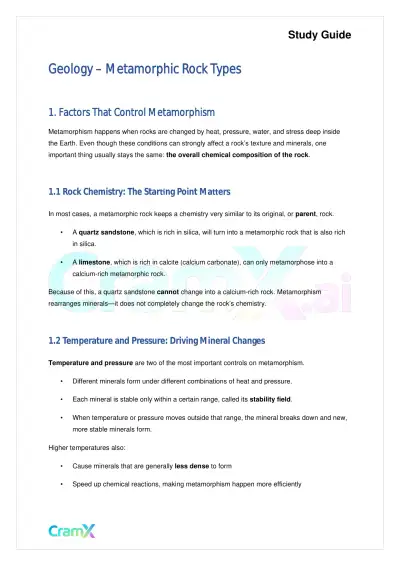 Quick Guides
Geology - Metamorphic Rock Types
Geology
16 pagesMar 2026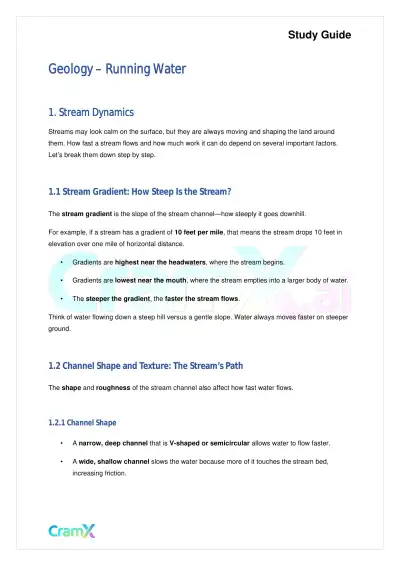 Quick Guides
Geology - Running Water
Geology
19 pagesMar 2026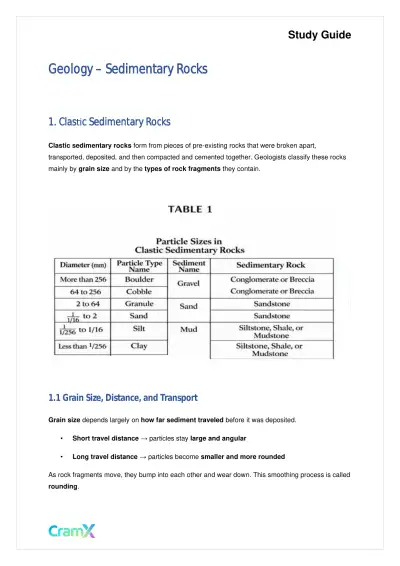 Quick Guides
Geology - Sedimentary Rocks
Geology
15 pagesMar 2026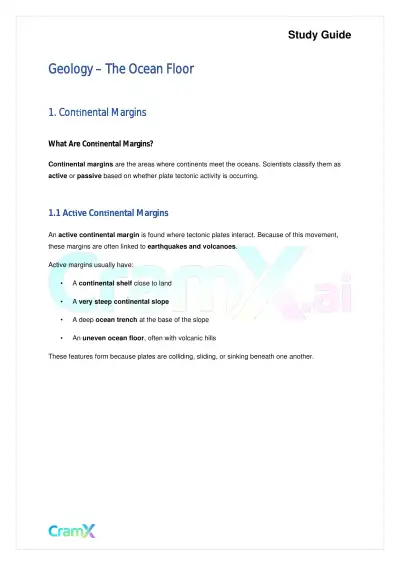 Quick Guides
Geology - The Ocean Floor
Geology
21 pagesMar 2026
Study this document with CramX
Once it is in your library, every tool can work from it.