

2020 HESI Advanced Pathophysiology Practice Exam With Answers (100 Solved Questions)
- Health Education Systems, Inc.
- 61 pages
- Shared May 2025
2020 HESI Advanced Pathophysiology Practice Exam With Answers is a reliable resource for understanding exam expectations.
Preview 16 of 61 pages
See the first 16 pages exactly as they appear in the document.
Page 1 Read page 1 as text
HESI ADVANCED PATHOPHYSIOLOGY V2( 100 PRACTICE QUESTIONS AND ANSWERS) ALL CORRECT . 1. Upon admission assessment, the nurse hears a murmur located at the fifth intercostal space, midclavicular line. The client asks, “What does that mean?” The nurse will base her answer on which of the following physiologic principles? A) “You have been exposed to an infection that went into your blood stream.” B) “You have a heart valve that is diseased.” C) “You heart has been pumping your blood so hard, that the pressure has damaged your valves.” D) “Your heart has enlarged, so naturally your valves had to enlarge as well.” Ans: B Feedback: Turbulence is often accompanied by vibrations of the blood and surrounding cardiovascular structures. Some of these vibrations are in the audible range and can be heard using a stethoscope. For example, a heart murmur results from turbulent flow through a diseased heart valve. The other distractors are not feasible . 2. A client is diagnosed with an abdominal aortic aneurysm that the physician just wants to “watch” for now. When teaching the client about signs/symptoms to watch for, the nurse will base the teaching on which of the following physiological principles? A) Small diameter of this vessel will cause it to rupture more readily. B) The larger the aneurysm, the less tension placed on the vessel. C) As the aneurysm grows, more tension is placed on the vessel wall, which increases the risk for rupture. D) The primary cause for rupture relates to increase in abdominal pressure such as straining to have a bowel movement. Ans: C Feedback: Because the pressure is equal throughout, the tension in the part of the balloon with the smaller radius is less than the tension in the section with the larger radius. The same holds true for an arterial aneurysm in which the tension and risk of rupture increase as the aneurysm grows in size. Wall tension is inversely related to wall thickness, such that the thicker the vessel wall, the lower the tension, and vice versa. Although arteries have a thicker muscular wall than veins, their distensibility allows them to store some of the blood that is ejected from the heart during systole, p roviding for continuous flow through the capillaries as the heart relaxes during diastole.
Page 2 Page 3 Read page 3 as text
3. A client has entered hypovolemic shock after massive blood loss in a car accident. Many of the client's peripheral blood vessels have consequently collapsed. How does the Laplace law account for this pathophysiologic phenomenon? A) Blood pressure is no longer able to overcome vessel wall tension. B) Decreasing vessel radii has caused a decrease in blood pressure. C) Wall thickness of small vessels has decreased due to hypotension. D) Decreases in wall tension and blood pressure have caused a sudden increase in vessel radii. Ans: A Feedback: In circulatory shock, there is a decrease in blood volume and vessel radii, along with a drop in blood pressure. As a result, many of the small vessels collapse as blood pressure drops to the point where it can no longer overcome the wall tension. Decreases in vessel wall radii do not cause the decrease in blood pressure, and wall thickness generally remains static. 4. Which of the following statements about vascular compliance is accurate? A) Arteries are much more distensible than veins. B) Veins can act as a reservoir for storing large quantities of blood. C) Arteries have thick muscular walls that constrict tightly, thereby ejecting blood without storing it for later use. D) A continuous flow through the capillaries occurs primarily during systole. Ans: B Feedback: The most distensible of all vessels are the veins, which can increase their volume with only slight changes in pressure, allowing them to function as a reservoir for storing large quantities of blood that can be returned to the circulation when it is needed. Although arteries have a thicker muscular wall than veins, their distensibility allows them to store some of the blood that is ejected from the heart during systole, providing for continuous flow through the capillaries as the heart relaxes during diastole. 5. In the days following a tooth cleaning and root canal, a client has developed an infection of the thin, three - layered membr ane that lines the heart and covers the valves. What is this client's most likely diagnosis?
Page 4 Read page 4 as text
A) Pericarditis B) Endocarditis C) Myocarditis D) Vasculitis Ans: B Feedback: The endocardium is a thin, three - layered membrane that lines the heart and covers the valves; infection of this part of the heart is consequently referred to as endocarditis. 6. Following several weeks of increasing fatigue and a subsequent diagnostic workup, a client has been diagnosed with mitral valve regurgitation. Failure of this heart valve would have which of the following consequences? A) Backup of blood from the right atrium into the superior vena cava B) Backflow from the right ventricle to the right atrium during systole C) Inhibition of the SA node's normal action potential D) Backflow from the left ventricle to the left atrium Ans: D Feedback: The mitral valve separates the left ventricle from the left atrium; failure of this valve would cause backflow from the former to the latter during systole. Valve function does not directly affect cardiac contractility . 7. Heart muscle differs from skeletal muscle tissue by being able to generate: A) Contractions B) Calcium influx C) Action potentials D) Sarcomere binding Ans: C Feedback:
Page 5 Read page 5 as text
Heart muscle, or the myocardium, is unique among other muscles in that it is capable of generating and rapidly
Page 6 Read page 6 as text
conducting its own electrical impulses or action potentials. These action potentials result in excitation of muscle fibers throughout the myocardium. Similarities to skeletal muscle include contractility, calcium influx, and actin – myosin (sarcomeres) binding. 8. When discussing the AV node's role in the electrical conduction of the heart with a client newly diagnosed with an AV block, which of the following statements are accurate? Select all that apply. A) The AV node offers a two - way conduction area between the atria and the ventricles. B) The velocity of conduction through the AV junctional fibers is very fast, which greatly increases impulse transmission. C) A block at the AV bundle of His interferes with the normal delay of the impulse, thereby interfering with complete ejection of blood from the atria prior to ventricular contraction. D) When there is an AV block, impulses from the atria and ventricles beat independently of each other so, the heart rhythm is usually chaotic and not regular. Ans: C, D Feedback: The AV node connects the atrial and ventricular systems and normally provides for a one - way conduction between the atria and ventricles. The velocity of conduction through the AV junctional fibers is very slow, which greatly delays impulse transmission. A further delay occurs as the impulse travels through the transitional fibers and into the AV bundle, known as the bundle of His. This delay provides a mechanical advantage whereby the atria can complete their ejection of blood before ventricular contraction begins. Under normal circumstances, the AV node provides the only connection between the atrial and ventricular conduction systems. The atria and ventricles would beat independen tly of each other if the transmission of impulses through the AV node were blocked. 9. If the parasympathetic neurotransmitter releases acetylcholine, the nurse should anticipate observing what changes in the ECG pattern? A) Heart rate 150 beats/minute, labeled as supraventricular tachycardia B) Disorganized ventricular fibrillation
Page 7 Read page 7 as text
C) Complete cardiac standstill D) Slowing of heart rate to below 60 beats/minute Ans: D Feedback: Acetylcholine, the parasympathetic neurotransmitter released during vagal stimulation of the heart, slows down the heart rate by decreasing the slope of phase 4. The catecholamines, the sympathetic nervous system neurotransmitters epinephrine and norepinephrine, increase the heart rate by increasing the slope or rate of phase 4 depolarization. Fibrillation is the result of disorganized current flow within the ventricle (ventricular fibrillation). Fibrillation interrupts the normal contraction of the atria or ventricles. In ventricular fibrillation, the ventricles quiver b ut do not contract. Thus, there is no cardiac output, and there are no palpable or audible pulses (i.e., cardiac standstill). 10. When explaining a new diagnosis of complete heart block to a client/family, the nurse should include which of the following statements? A) “This means that your atria are not contracting normally, they are quivering.” B) “One consequence of this type of block is a very slow heart rate that limits circulation to the brain.” C) “This type of arrhythmia requires defibrillation, which will occur in the cardiac catheter lab later today.” D) “It's pretty common for everyone to experience this arrhythmia, especially during times of stress in their lives.” Ans: B Feedback: In complete heart block, the atria and ventricles beat independently of each other. The most serious effect of some forms of AV block is a slowing of heart rate to the extent that circulation to the brain is compromised. Atria fibrillation is where there is interruption of the normal contraction of the atria, and the atria are quivering rather than contracting. Ventricular fibrillation requires immediate defibrillation for the client to survive. Complete heart block is not common. However, PVCs do occur under times of stress.
Page 8 Read page 8 as text
11. As a nurse working in the newborn nursery and in tensive care unit, when an infant has been diagnosed with failure to thrive, which of the following statements about hormones' effect on the body will the nurse explain to the family? A) The catecholamine norepinephrine is primarily responsible for the failure to thrive. B) CRF increases somatostatin levels, which inhibits secretion of growth hormone. C) ACTH release from the pituitary causes babies to not gain weight. D) Antidiuretic hormone is involved in the stress response and can increase water retention. Ans: B Feedback: Although growth hormone is initially elevated with the onset of stress, prolonged presence of cortisol leads to suppression of growth hormone, insulin - like growth factor 1 (IGF - 1), and other growth factors, exerting a chronically inhibitory effect on growth. In addition, CRF directly increases somatostatin, which in turn inhibits growth hormone secretion. Although the connection is speculative, effects of stress on growth hormone may provide one of the vital links to understanding failure to thrive in children. Angiotensin II enhances CRF formation and release, contributes to the release of ACTH from the pituitary, enhances stress - induced release of vasopressin from the posterior pituitary, and stimulates release of norepinephrine f rom the locus ceruleus. Antidiuretic hormone (ADH) released from the posterior pituitary is also involved in the stress response, particularly in hypotensive stress or stress due to fluid volume loss. 12. A nursing student's current clinical placement has been a source of stress due to high client acuity combined with interpersonal conflict with some of the unit staff. At the same time, the student has been fighting a cold for more than 2 weeks and has been unable to regain a normal feeling of health. How might these two phenomena be related? A) Epinephrine and norepinephrine inhibit the release and action of lymphocytes. B) Stress and illness lack a statistical correlation, though they are often thought to coexist. C) The effects of stress on the cerebellum initiate a decrease in immunity.
Page 9 Read page 9 as text
D) Endocrine – immune interactions may suppress the student's immune response. Ans: D Feedback: Although the exact mechanisms of the effects of stress on immunity are not completely understood, it is generally thought that endocrine – immune interactions suppress immunity. The most significant arguments for interaction between the neuroendocrine and immune systems derive from evidence that the immune and neuroendocrine systems share common signal pathways (i.e., m essenger molecules and receptors), that hormones and neuropeptides can alter the function of immune cells, and that the immune system and its mediators can modulate neuroendocrine function. Stress has the capacity to either enhance or suppress immune funct ion. Epinephrine and norepinephrine do not directly inhibit lymphocytes; the cerebellum is not centrally involved in the stress response. 13. A student is participating in an extended fast as part of a charitable fundraising effort. Which of the following is an example of the physiologic reserve that will facilitate the student's adaptation to the stress of this sudden change in diet? A) The student has experience in demonstrating perseverance from previous participation in competitive sports. B) The student's adipose tissue contains large and accessible stores of energy. C) The student is young, is a male, and has no preexisting medical conditions. D) The student is utilizing guided imagery to achieve a sense of “mind over matter.” Ans: B Feedback: The ability of body systems to increase their function given the need to adapt is known as the physiologic reserve, an example of which is the energy stored in fat tissue. Previous experience, health, and relaxation are all likely to foster the student's ability to adapt, but these are not dimensions of physiologic reserve. 14. Which of the following clients will be more able to adapt to a stressor based on an individual's ability to adapt? Select all that apply.
Page 10 Read page 10 as text
A) A Muslim male experiencing abnormal GI bleeding B) An infant with decreased water intake due to diarrhea C) A child living in a crowded apartment with his financially poor, immediate family D) A male client producing increased corticotropin - releasing factor (CRF) E) A client with known CAD, expressing problems affording all his prescribed medication Ans: B, D, E Feedback: An individual's ability to adapt to a stressor is determined by the interplay of numerous variables, including age, gender, and preexisting health status. Ethnicity and socioeconomic status have not been noted to directly influence the adaptation process. 15. A nurse working at nights is constantly complaining of being tired and sick. It seems like she catches every illness that is on the unit. One possible reason for this may relate to: A) She does not contain the “hardiness” gene in her system. B) Alterations in sleep – wake cycle have decreased her immune function. C) She is stressing too much about being tired and sleepy. D) Maybe she should get tested for sleep apnea. Ans: B Feedback: Sleep disorders and alterations in the sleep – wake cycle have been shown to alter immune function, the normal circadian pattern of hormone secretion, and physical and psychological functioning. The concept of hardiness describes a personality characteristic that includes a sense of having control over the environment, a sense of having a purpose in life, and an ability to conceptualize stressors as a challenge rather than a threat. Lower levels of hardiness have been linked with greater reaction to stress. Stress is probably one of the primary factors interfering with sleep. At this time, we do not have enough data to speak to the need for a sleep apnea exam.
Page 11 Read page 11 as text
16. Although clinical manifestations vary with the type of cancer and organs involved, the oncology nurses have observed that the most frequent side effects clients with cancer experience are: Select all that apply. A) Copious lymph flow B) Sleep disturbances C) Involuntary weight gain D) Visceral organ expansion E) Lack of energy Ans: B, E Feedback: Neoplasia is nearly always accompanied by sleep disturbances and fatigue. Cancer - related fatigue is characterized by feelings of tiredness, weakness, and lack of energy and is distinct from the normal tiredness experienced by healthy individuals in that it is not relieved by rest or sleep. Tissue growth often compresses and obstructs lymph flow and compresses visceral organs and adjacent structures. The cachexia of cancer is associated with unplanned rapid weight loss and wasting of body fat as tumor growth demands more caloric energy than the body can supply. 17. Paraneoplastic syndromes are manifestations of cancer that often result from: A) Radiation and chemotherapy B) Compression of area vessels C) Tumor - related tissue necrosis D) Inappropriate hormone release Ans : D Feedback: Paraneoplastic syndromes are manifestations in sites that are not directly affected by the disease; many are caused by excessive or inappropriate peptide hormone synthesis and release by cancer cells. Radiation and chemotherapy are cancer treatments that cause side effects unrelated to the paraneoplastic syndromes. Area vessel compression is a direct result of the tumor's location; area tissue necrosis is a direct result of area tissue destruction and death of healthy cells.
Page 12 Read page 12 as text
18. A client with nonspecific signs/symptoms has gone to the primary health care provider. The client's chief complaints revolve around extreme fatigue, unplanned weight loss, and being so weak in the muscles. The diagnostic workup included a carcinoembryonic antigen (CEA) tumor marker. The CEA result was elevated. The nurse should anticipate the physician will order which of the following diagnostic tests related to the elevated CEA? Select all that apply. A) Testicular ultrasound B) Colonoscopy C) Mammogram D) Thyroid scan E) Brain CT Ans: B, C Feedback: CEA normally is produced by embryonic tissue in the gut, pancreas, and liver and is elaborated by a number of different cancers, including colorectal carcinomas, pancreatic cancers, and gastric and breast tumors. 19. A client is scheduled for a bronchoscopy related to a history of “bronchitis” for the last 3 months that has been unresponsive to antibiotics. The nurse shares with the client that a primary purpose for this bronchoscopy is to help diagnose the problem by: A) Visualizing airways looking for adhesions B) Opening airways looking for any aspirated food C) Flushing out the airway to remove debris and sputum D) Taking tissue biopsy and looking for abnormal cells Ans: D Feedback: Tissue biopsy involves the removal of a tissue specimen for microscopic study. It is of critical importance in designing the treatment plan should cancer cells be found. Biopsies are obtained in a number of ways, including needle biopsy; endoscopic methods, such as bronchoscopy or cystoscopy, which inv olve the passage of an endoscope through an orifice and into the involved structure; and laparoscopic methods.
Page 13 Read page 13 as text
20. A breast cancer client has just learned that her tumor clinical stage is T3, N2, M0. After the physician leaves, the client asks the nurse to explain this to her again. The nurse will use which of the following statements in his or her answer? Your: A) Tumor is very small and has zero number of mitoses. B) Tumor has metastasized to at least three distal sites and you have cancer in your lymph nodes. C) Tumor is large and at least two lymph nodes are positive for cancer cells. D) Extent of disease is unknown, but it looks like your cancer has stayed intact and not spread to the bloodstream. Ans: C Feedback: Tumor staging groups clients according to the extent and spread of the disease, using the TNM (tumor, node, and metastasis) system. In the TNM system, T1, T2, T3, and T4 describe tumor size, N0, N1, N2, and N3, lymph node involvement; and M0 or M1, the absence or presence of metastasis. 21. Which of the following meals would be considered high in folic acid intake? A) Deep - fried mushrooms with creamy horseradish sauce, hot dogs without bun, and potato salad B) Fried chicken, mashed potatoes with gravy, and corn on the cob C) Green leafy salad, beef and bean burrito on whole - wheat shell D) Steak, baked potato with sour cream, and cheesecake Ans: C Feedback: To achieve an adequate intake of folic acid, pregnant women should couple a diet that contains folate - rich foods (e.g., orange juice; dark, leafy green vegetables; and legumes) with sources of synthetic folic acid, such as fortified food products. 22. A first - time pregnant mother asks, “Why do I need an ultrasound? I'm worried that my insurance won't cover
Page 14 Read page 14 as text
it.” The nurse responds that an ultrasonography can diagnose prenatal abnormalities like which of the following? Select all that apply. A) Cytogenic abnormalities B) Skeletal defects like facial structural problems C) Chromosomal deficits D) Abnormal levels of - fetoprotein E) Congenital heart defects Ans: B, E Feedback: Ultrasonography is the primary method for assessing fetal size and screen for structural abnormalities that include the heart, skeleton, face, diaphragm, and gastrointestinal tract. Cytogenic studies and chromosomal an alysis require amniocentesis, chorionic villus sampling, or umbilical cord blood. - Fetoprotein (AFP) requires a maternal blood sample that is analyzed for serum markers associated with neural tube defects. 23. A pregnant client's - fetoprotein (AFP) returns elevated. The couple ask the health care worker to explain what this means. Which of the following is the best response? A) “This means you need to decrease your protein intake to prevent renal problems in your baby.” B) “Elevated levels means your baby is at risk of having a neural tube defect like spina bifida (an opening in the spine).” C) “This means your baby has Down syndrome. We won't know how severe until after you give birth.” D) “This is normal. The problem is if it is low, that means your baby will be born with trisomy 18 and will be retarded.” Ans: B Feedback: Maternal and amniotic fluid levels of AFP are elevated in pregnancies where the fetus has a neural tube defect (i.e., anencephaly and open spina bifida) or certain other malformations such as an anterior abdominal wall defect in which the fetal integument is not intact. Screening of maternal blood samples usually is done between weeks 16 and 18 of gestation. Although neural tube defects
Page 15 Read page 15 as text
have been
Page 16 Read page 16 as text
associated with elevated levels of AFP, decreased levels have been associated with Down syndrome. 24. An older mother (age 41) is worried about having a baby with birth defects. She wants to get tested so she can be prepared for the outcome. Which of the following tests should the clinic nurse prepare the client for? Select all that apply. A) A blood test (circulating cell - free DNA) will tell if the baby is mentally retarded. B) Abdominal x - ray can detect skeletal abnormalities. C) Withdrawing a sample of amniotic fluid will reveal any chromosomal defects. D) Ultrasonography will reveal any single - gene disorders like fragile X syndrome. E) PET scanning to see if there are any areas of accelerated growth of tissue. Ans: A, C Feedback: During pregnancy, there are cf - DNA fragments from both the mother and fetus in maternal circulation. It is possible to analyze cf - DNA from maternal blood to detect common fetal trisomies such as Down syndrome as early as 10 weeks. Amniocentesis involves the withdrawal of a sample of amniotic fluid from the pregnant uterus. The procedure is useful in women older than 35 years of age, who have an increased risk of giving birth to an infant with Down syndrome, and in parents who have another child with chromosomal abnormalities. Ultrasonography allows the visua lization of body structures, revealing such defects as skeletal malformations. It is only able to identify chromosomal disorders, genetic disorders, and neural tube defects by way of their anatomic effects. PET scanning is used to assess for cancer metastasis or inflammatory diseases. It is not used in pregnancy testing. 25. A pregnant mother (16 weeks' gestation) forgot and emptied her cat's litter box without gloves. She is extremely anxious and wants tested right away. Which test would the nurse prepare her for that would give rapid cytogenic analysis? A) Ultrasonography B) Fetal biopsy C) Chorionic villus sampling
45 more pages in the full document
Unlock it once and it stays in your library, ready to chat with or turn into flashcards.
Unlock the full documentMore Health Education Systems, Inc. study materials
See all Past Exams
2023-2024 RN HESI Exit Exam Version 3 with Answers (53 Solved Questions)
Health Education Systems, Inc.
13 pages163downloadsFeb 2025 Past Exams
2024-2025 HESI A2 Biology Entrance Exam with Answers (42 Solved Questions)
Health Education Systems, Inc.
13 pages154downloadsFeb 2025 Past Exams
2024-2025 HESI A2 Anatomy and Physiology V1/V2 Practice Exam with Answers (134 Solved Questions)
Health Education Systems, Inc.
15 pages134downloadsFeb 2025 Past Exams
2024-2025 HESI A2 Entrance Exam with Answers (232 Solved Questions)
Health Education Systems, Inc.
26 pages132downloadsFeb 2025 Past Exams
2024-2025 HESI Milestone Exam 1 with Answers (162 Solved Questions)
Health Education Systems, Inc.
26 pages119downloadsFeb 2025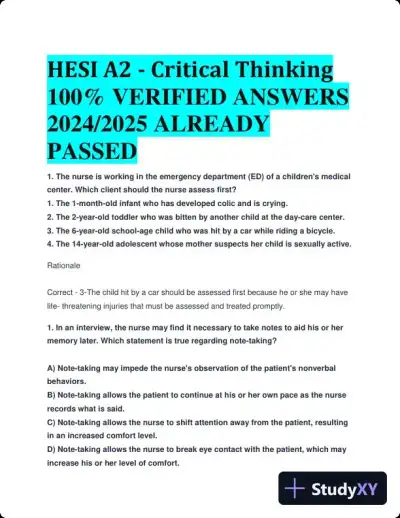 Past Exams
2024-2025 HESI A2 Critical Thinking with Answers (124 Solved Questions)
Health Education Systems, Inc.
114 pages106downloadsFeb 2025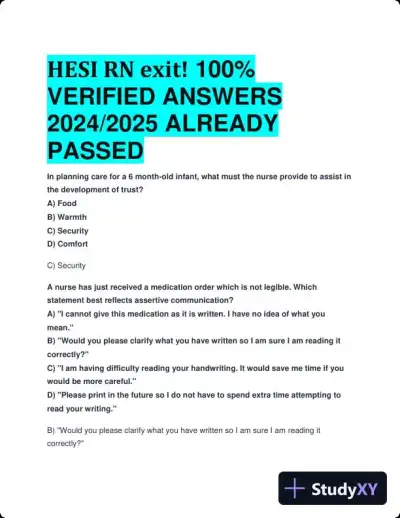 Past Exams
2024-2025 HESI RN Exit Exam with Answers (156 Solved Questions)
Health Education Systems, Inc.
44 pages92downloadsFeb 2025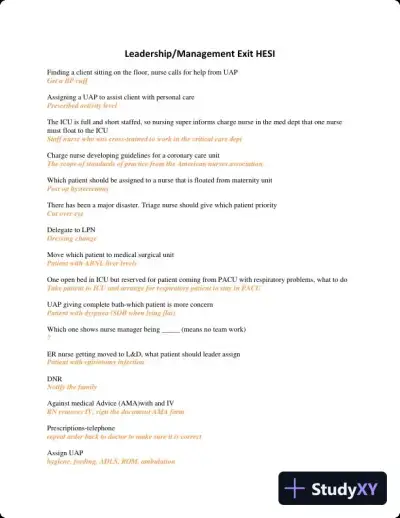 Past Exams
HESI Leadership/Management Exit Exam with Answers (59 Solved Questions)
Health Education Systems, Inc.
4 pages54downloadsFeb 2025
Study this document with CramX
Once it is in your library, every tool can work from it.