

Nursing School Entrance Exams: HESI A2 / NLN PAX-RN / PSB-RN / RNEE / TEAS, 6th Edition (2020)
- Health Education Systems, Inc.
- 592 pages
- Shared May 2025
Nursing School Entrance Exams: HESI A2 / NLN PAX-RN / PSB-RN / RNEE / TEAS, 6th Edition (2020) provides in-depth explanations for correct and incorrect answers to deepen your understanding.
Preview 16 of 592 pages
See the first 16 pages exactly as they appear in the document.
Page 1 Read page 1 as text
The Trusted Name in Test Prep HESI A’ » NLN PAX-RN = PSB-RN = RNEE = TEAS SIXTH EDITION HB Features a multi-part exam with questions that reflect those on the most widely given nursing school entrance exams HB Provides comprehensive review and practice materials for all subject areas Sandra S. Swick, B.S.N., M.S.N., Ed.D. Test names are the property of the respective trademark holders, none of whom endorse or are affiliated with Kaplan.
Page 2 Read page 2 as text
Downloaded from StudyXY.com ® + StudyXY Sd Ye. o> \ | iF ’ pr E \ 3 S Stu dy Anything This ContentHas been Posted On StudyXY.com as supplementary learning material. StudyXY does not endrose any university, college or publisher. Allmaterials posted are under the liability of the contributors. wv 8) www.studyxy.com
Page 3 Read page 3 as text
BARRON'S LS © © © © © © 9 9 9 9 SIXTH EDITION Sandra S. Swick, B.S.N., M.S.N., Ed.D. A © © © © © © © © © 9 9 \
Page 4 Read page 4 as text
© Copyright 2020, 2016, 2011, 2007 by Kaplan, Inc., d/b/a Barron’s Educational Series Previous editions © Copyright 2004, 1998 by Kaplan, Inc., d/b/a Barron’s Educational Series under the title How to Prepare for the Nursing School Entrance Exams All rights reserved under International and Pan-American Copyright Conventions. By payment of the required fees, you have been granted the non-exclusive, non-transferable right to access and read the text of this eBook on screen. No part of this text may be reproduced, transmitted, downloaded, decompiled, reverse engineered, or stored in or introduced into any information storage and retrieval system, in any form or by any means, whether electronic or mechanical, now known or hereinafter invented, without the express written permission of the publisher. Published by Kaplan, Inc., d/b/a Barron’s Educational Series 750 Third Avenue New York, NY 10017 www.barronseduc.com ISBN: 978-1-5062-6948-1 10987654321
Page 5 Read page 5 as text
CONTENTS 1 Introduction Is This Book for You? Nurses and What They Do Is Nursing Right for Me? Selecting a Nursing Program Types of Nursing School Programs Technicians Versus Generalists Graduate Education Why Do I Need to Take a Nursing School Entrance Exam? Getting Into Nursing School Special Testing Considerations Financial Assistance 2 Test-Taking Strategies and Your Personalized Study Plan Preparing for Your Entrance Exam Multiple-Choice Test Questions Test-Taking Strategies Example Questions
Page 6 Read page 6 as text
Diagnostic Test Section 1: Verbal Ability Section 2: Reading Comprehension Section 3: Numerical Ability Section 4: Biology/Chemistry Section 5: Anatomy and Physiology Answer Key Answers Explained 3 Verbal Ability Enhance What You Already Have Etymology Prefixes Suffixes Root Words Medical Terminology Antonyms and Synonyms Antonyms Sample Test One Answer Key Antonyms Sample Test Two Answer Key Synonyms Sample Test One Answer Key Synonyms Sample Test Two Answer Key Analogies Verbal Analogy Format
Page 7 Read page 7 as text
Verbal Analogy Content Verbal Analogy Relationship Patterns Analogies Sample Test One Answer Key and Answers Explained Analogies Sample Test Two Analogies Sample Test Two Answers Explained 4 Reading Comprehension Questions to Ask Yourself About Reading Comprehension Reading Comprehension Sample Test Answer Key Answers Explained 5 Numerical Ability Calculator Use Basic Arithmetic Review Whole Numbers Number Groupings Order of Operations Rounding Numbers Positive and Negative Numbers Fractions Decimals Percentage Exponents and Powers Square Roots and Cube Roots
Page 8 Read page 8 as text
Simple Statistics Basic Arithmetic Sample Test Answer Key and Answers Explained Algebra Review Evaluating Algebraic Expressions Solving Equations with Inverse Operations Ratios and Proportions Algebra Sample Test Answer Key and Answers Explained Geometry Review Lines and Points Geometric Figures Angles Circles Polygons Pythagorean Theorem Cubes, Rectangular Solids, and Cylinders Geometry Sample Test Answer Key and Answers Explained Verbal Problem Review Age Problems Distance Problems Ratio and Proportion Problems Percentage Problems Sales Problems Mixture Problems Tax Problems
Page 9 Read page 9 as text
Geometry Problems Insurance Problems Investment Problems Interest Problems Average Problems Dosage Problems Graphs and Charts Graphs and Charts Sample Test Answer Key and Answers Explained Numerical Ability Sample Test Answer Key and Answers Explained 6 Science BIOLOGY/CHEMISTRY Biology Chemistry Sample Test Answer Key and Answers Explained ANATOMY AND PHYSIOLOGY The Cardiovascular, Blood Vessel, and Lymphatic Systems Sample Test Answer Key and Answers Explained The Endocrine System Sample Test Answer Key and Answers Explained Fluid, Electrolytes, and Acid-Base Balance
Page 10 Read page 10 as text
Sample Test Answer Key and Answers Explained The Gastrointestinal System Sample Test Answer Key and Answers Explained The Hematologic System Sample Test Answer Key and Answers Explained The Immune System Sample Test Answer Key and Answers Explained The Integumentary System Sample Test Answer Key and Answers Explained The Musculoskeletal System Sample Test Answer Key and Answers Explained The Nervous System Sample Test Answer Key and Answers Explained The Renal System Sample Test Answer Key and Answers Explained The Reproductive System Sample Test Answer Key and Answers Explained The Respiratory System
Page 11 Read page 11 as text
Sample Test Answer Key and Answers Explained 7 Practice Tests Numerical Ability Test Answer Key Answers Explained Verbal Ability Test Answer Key Answers Explained Reading Comprehension Test Answer Key Answers Explained Science Test Answer Key Answers Explained Index
Page 12 Read page 12 as text
Introduction 1 IS THIS BOOK FOR YOU? Are you wondering what might be included on a nursing school entrance exam, or does the nursing program you’ve applied to require an entrance exam? If you answered yes to either of these questions, then Nursing School Entrance Exams is the reference you need. Nursing school entrance examinations provide associate, diploma, and baccalaureate nursing programs with specific information relating to an applicant’s or newly admitted individual’s abilities in content areas that provide the foundation for nursing courses such as verbal ability, reading comprehension, numerical or mathematical ability, and life and/or physical sciences. Nursing school entrance examinations generally use a multiple- choice format. Verbal ability includes elements such as vocabulary, antonyms, synonyms, verbal reasoning, and the use of analogy. Included in verbal ability are English usage and grammar, spelling, prefixes, suffixes, and root words. Reading comprehension involves reading sentences, paragraphs, or short articles and answering questions, interpreting, and/or making inferences about the literary material. Prior knowledge of the topic is not requisite for reading comprehension because the examination is asking you to think logically and make decisions based on the information presented. Topics for verbal ability and reading comprehension may address technical or scientific knowledge and/or general, everyday knowledge. Information may come from discipline-specific vocabulary, English grammar, history, geography, literature, art and architecture, humanities, general information, natural sciences, social sciences, and mathematics. Numerical ability encompasses arithmetic, algebra, and geometry. Computation and interpretation of word problems, charts, ratios and proportions, decimals, percentages, and fractions may also be included. Word
Page 13 Read page 13 as text
problems, drawn from common life events, may address such areas as sales, taxation, insurance, distance or travel, geometry, age, mixtures, investments, interest, and averages. Life and/or physical sciences sections focus on basic premises of biology, chemistry, human anatomy, and physiology. Life sciences specifically address human structure and functioning, development, and genetics. This book is intended to assist you to prepare or review for a nursing school entrance examination. This book is not intended to provide sufficient instruction on any topic in which you have little or no previous experience. For example, if you have never taken algebra or geometry, it is doubtful that the algebra and geometry sections found in this book will provide a background that will enable you to be successful on similar sections of a nursing school entrance examination. Nursing School Entrance Exams is not intended to address a specific nursing school entrance examination. Nursing programs using entrance exams have a number of examinations from which to choose. These standardized exams are used nationwide. A brief overview of selected nursing school entrance examinations is presented in the following table: Overview of Selected Nursing School Entrance Examinations*
Page 14 Read page 14 as text
Test | COntont/ATans Number of Time Allowed | Questions (in minutes) so | 2 [Gamma ss | eo so | 2 Chemistry 30 25 Mathematics 55 [ 60 ‘Reading Comprehension I ss 0 NNPAKAN [Mathematics | sa | eo Verbal Skills 80 60 | a | TET a — Part V: Vocational Adjustment Index 90 | a0 | 4 | Reading Skill 45 | TEAS Engish | aa | 2s Reading 53 | 64 Science 53 | 63 “Table information Is subject to change. NURSES AND WHAT THEY DO So you think you want to be a nurse. Nursing is one of the most gratifying careers you'll ever find. But nursing is not what you’ve seen on television or read about in books. Nursing is hard work, and learning to become a nurse requires dedication and long hours of study and preparation. Unlike many disciplines in which the academic curricula has foundation courses with many related subjected areas, nursing courses usually build on
Page 15 Read page 15 as text
one another. Prerequisite courses, such as anatomy and physiology, chemistry, microbiology, and biology, are the foundation for what you will learn in your nursing courses, such as medical-surgical nursing, pharmacology, obstetric nursing, mental health nursing, and community health nursing. When enrolling in prerequisite courses, it should be with the intention of seriously learning information for use as your basic foundation in your nursing courses. Weaknesses in your prerequisite courses may cause problems not only in your nursing coursework, but also on your nursing entrance exam. Remember, nursing courses depend heavily on knowledge learned in prerequisites. Today’s nurses work in numerous roles and settings, and opportunities are virtually unlimited. The following list includes settings in which nurses may practice: Hospitals Cruise ships Clinics Retirement/nursing homes Doctors’ offices Volunteer organizations Business/industry Occupational health programs Community agencies Ambulatory care agencies Schools Hospices Nursing schools (higher education) Federal/state agencies Military Home care Resorts and summer camps What a nurse actually does depends upon the scope of the practice setting. In the majority of institutional or home health settings, nurses provide care to individuals with chronic, acute physical, and/or mental conditions. What a nurse does also depends upon the needs of the individual patient. The nurse may assume total care of a patient who is unable to meet any of his or her needs or may help only in areas where assistance is needed. When working with patients, nurses assume a number of roles. In many cases, these roles overlap and are interdependent in nature. They include: Caregiver Role model
Page 16 Read page 16 as text
Comforter Decision maker Advocate Case manager Teacher Communicator Counselor Researcher When practicing in these various roles, the nurse works to meet, or helps the patient meet, hygiene, elimination, safety, nutritional, spiritual, comfort, activity, sensory, adaptation, and/or mental health needs. The nurse focuses on assessing, analyzing, planning, and resolving actual or potential health problems and evaluates the effectiveness of nursing interventions based on the patient’s responses. Most people think of nurses as working with individuals on a one-to-one basis. In the community setting, however, the patient may not be an individual but a family or group of families, a group of individuals, or an entire community. Educational preparation plays an important role in career planning in nursing. Career opportunities run hand in hand with a nurse’s educational preparation. Simply put, opportunities for advancement increase as education increases. For some levels of practice, an associate degree in nursing is acceptable. For others, a bachelor’s degree, a master’s degree, or a doctoral degree in nursing or education is required. Career opportunities include: Staff nurse Nurse educator Home health nurse Nurse researcher Clinical nurse specialist Nurse consultant Nurse midwife Nurse anesthetist Nurse administrator Nurse practitioner Hospice nurse Public health nurse Successful completion and graduation from a nursing program does not allow you to practice as a registered nurse. A registered nurse license is required. Note that, as per the Texas Board of Nursing, the “new enhanced licensure compact, or eNLC, is the licensure model that allows registered nurses (RNs) to have one multistate license, with the privilege to practice in the home state and in other eNLC states physically, electronically, and/or
576 more pages in the full document
Unlock it once and it stays in your library, ready to chat with or turn into flashcards.
Unlock the full documentMore Health Education Systems, Inc. study materials
See all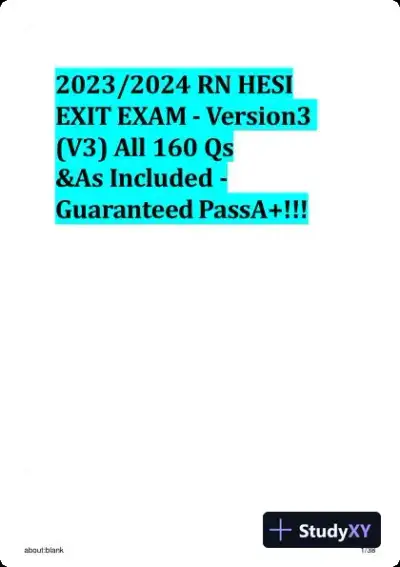 Past Exams
2023-2024 RN HESI Exit Exam Version 3 with Answers (53 Solved Questions)
Health Education Systems, Inc.
13 pages163downloadsFeb 2025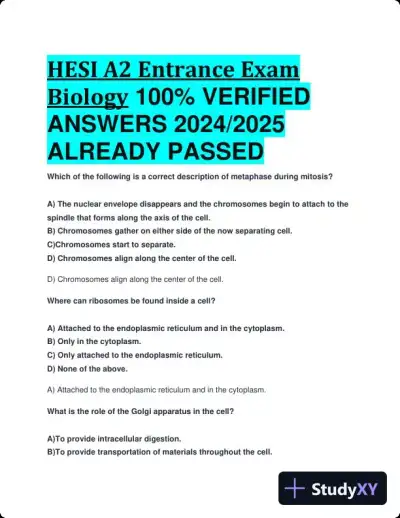 Past Exams
2024-2025 HESI A2 Biology Entrance Exam with Answers (42 Solved Questions)
Health Education Systems, Inc.
13 pages154downloadsFeb 2025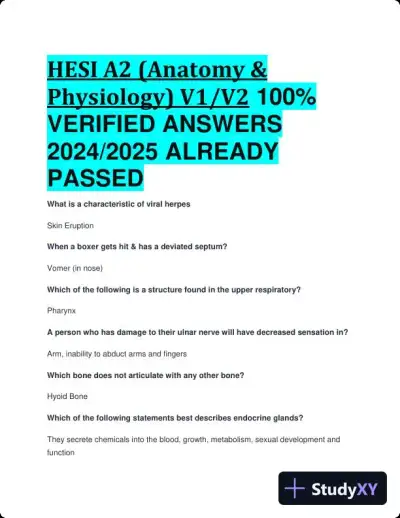 Past Exams
2024-2025 HESI A2 Anatomy and Physiology V1/V2 Practice Exam with Answers (134 Solved Questions)
Health Education Systems, Inc.
15 pages134downloadsFeb 2025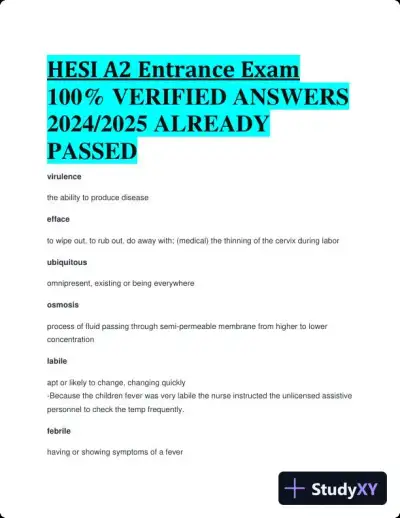 Past Exams
2024-2025 HESI A2 Entrance Exam with Answers (232 Solved Questions)
Health Education Systems, Inc.
26 pages132downloadsFeb 2025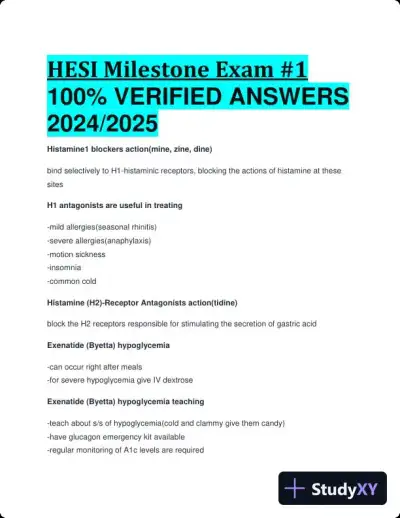 Past Exams
2024-2025 HESI Milestone Exam 1 with Answers (162 Solved Questions)
Health Education Systems, Inc.
26 pages119downloadsFeb 2025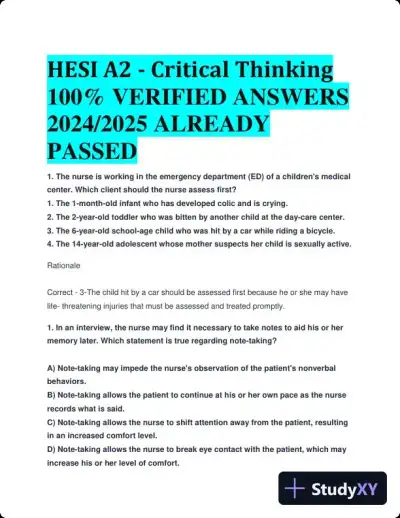 Past Exams
2024-2025 HESI A2 Critical Thinking with Answers (124 Solved Questions)
Health Education Systems, Inc.
114 pages106downloadsFeb 2025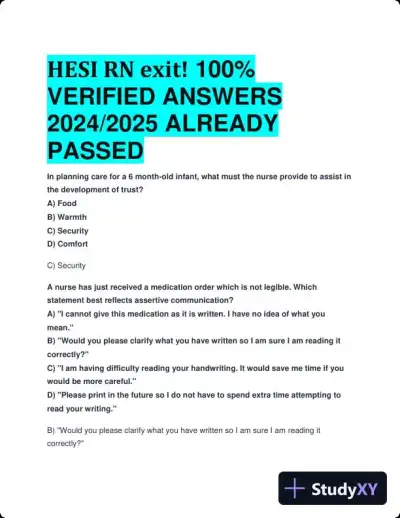 Past Exams
2024-2025 HESI RN Exit Exam with Answers (156 Solved Questions)
Health Education Systems, Inc.
44 pages92downloadsFeb 2025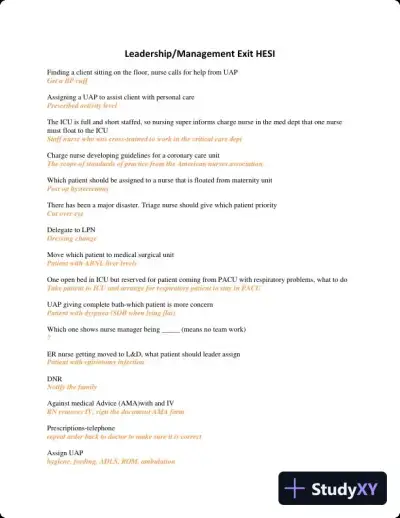 Past Exams
HESI Leadership/Management Exit Exam with Answers (59 Solved Questions)
Health Education Systems, Inc.
4 pages54downloadsFeb 2025
Study this document with CramX
Once it is in your library, every tool can work from it.