

2020 HESI Clinical Analysis Exit Exam Version 3 With Answers (129 Solved Questions)
- Health Education Systems, Inc.
- 12 pages
- Shared May 2025
Get the best results with 2020 HESI Clinical Analysis Exit Exam Version 3 With Answers, covering past exams with structured solutions.
Preview 4 of 12 pages
See the first 4 pages exactly as they appear in the document.
Page 1 Read page 1 as text
1. After placing a 36- week- gestation newborn in an isolette and drying the infant with several blankets, what should the nurse implement next? a. Place erythromycin ophthalmic ointment in both eyes 2. A client in the third trimester of pregnancy complains of frequent nasal stiffness and occasional nosebleeds. Her chest circumference has increased by 5 cm during the pregnancy, and she uses thoracic breathing. Her diaphragm is elevated and she has an increased costal angle. Which intervention should the nurse implement? a. Examine the client for signs of tissue anoxia, such as pallor 3. A terminally ill male hospice client who is at home is showing decreased awareness of his surroundings. His appetite is poor and he often refuses oral intake of solids and liquids. For the past several days he has been unable to get out of bed. Which action should the hospice nurse implement? a. Teach the family how to assist the client to a wheelchair 4. A woman was admitted yesterday afternoon with severe abdominal pain. Her pregnancy test and ultrasound were negative, so an exploratory laparotomy was completed during the night. When coffee ground materials is observed in the drainage from the nasogastric tube (NGT), which intervention should the nurse implement? a. Verify correct placement of the nasogastric tube 5. The nurse is reviewing the laboratory values for a client with acute pancreatitis who reports of the abdominal pain is not as severe as it was on admission. Which laboratory test should the nurse review to evaluate the clients clinical recovery? a. Lipase 6. While assessing a client who had a laparotomy the previous day, the nurse notices that 300 mL of dark red fluid has drained from the nasogastric tube in the last hour. Which action should the nurse take first? a. Assess the clients level of pain 7. The nurse is reviewing the recommended preventative care for clients with asthma, chronic bronchitis, and emphysema. Which health care measure is most important for the nurse to recommend to these clients? a. Avoid large crowded areas during the colder months of the year 8. The mother of a one-moth-old infant calls the clinic to report that the back of her infant’s head is flat. How should the nurse respond? a. Position the infant on the stomach occasionally when awake and active 9. A woman is brought to the labor and delivery unti after delivering a term infant and the placenta in the hospital parking lot 10 minutes ago. Which action should the nurse perform first? a. Place the infant to the breast for bonding 10. A client has a new prescription for the maximum recommended dosage of pipercillin/tazobactam for nosocomial pneumonia. The nurse should report which laboratory finding to the healthcare provider before administering the prescribed dose? a. Presence of gram positive bacteria in the sputum 2020 HESI EXIT V3
Page 2 Page 3 Read page 3 as text
11. A client who is admitted with diabetic ketoacidosis (DKA) is demonstrating Kussmaul breathing and has a severe headache along with nausea. Her arterial blood gases (ABG) are: pH 7.50; PaCO2 30 mmHg; HCO3 24 mEq/L (24mmol/L). Which assessment finding warrants immediate intervention by the nurse? a. Fruity breath 12. When perfomring postural drainage on a client with Chronic Obstructive Pulmonary disease (COPD), which approach should the nurse use? a. Expalin that the client may be placed in five positions 13. A young male client with testicular cancer has a living will that describes his desire that no extraordinary measures be taken to save his life. The healthcare provider knows the client has a good prognosis and refuses to write a “do not resuscitate” (DNR) prescription. Which action should the nurse take? a. Place a DNR bracelet on the clients arm 14. In observing a clients face, which assessment finding requires the most immediate intervention by the nurse? a. Oral mucosa is cyanotic 15. The nurse is assessing a client with cirrhosis and notes that the client has a positive Babinski reflex. Which action should the nurse take in response to the finding? a. Complete a thorough neurological assessment 16. Which action should the nurse take first after obtaining a urine specimen for culture and sensitivity from an indwelling urinary catheter? a. Label the container with the client’s identifiers 17. The home health nurse observes an older client with unilateral weakness place the walker in front of the chair for support while rising to a standing position. Which action should the nurse take? a. Instruct the client to use the arms of the chair for support 18. A client with cancer complains of fever, chills, malaise, and headache following administration of a colony-stimulating factor. Which nursing intervention is most beneficial in helping to reduce the flu-like symptoms? a. Monitor lab values for an increase in WBCs 19. Which laboratory value should the nurse review prior to administering the initial dose of a statin medication? a. Serum liver enzymes 20. Following a lumbar puncture, a client voices several concerns. Which concern indicates to the nurse that the client is experiencing a complication of the procedure? a. I have a headache that gets worse when I sit up 21. The nurse is caring for a client withdrawing from a fentanyl citrate addiction. The client receives a prescription for clonidine 0.2 mg PO taken twice daily. Which action should the nurse take? a. Advise to sit up slowly from a reclining position
Page 4 Read page 4 as text
22. A 7-year-old child is admitted to the hospital with a diagnosis of acute rheumatic fever. In obtaining a health history form the child’s mother, the recent occurrence of what illness is most significant? a. Sore throat 23. Following discharge teaching, a client with a duodenal ulcer tells the nurse of plans to eat plenty of dairy products, such as milk, to help coat and protect their ulcer. Which is the best follow-up action by the nurse? a. Review with the client the need to avoid foods that are rich in milk and cream 24. The nurse assesses a client with cirrhosis and find 4+ pitting edema of the feet and legs, and massive ascites. Which mechanism contributes to edema and ascites in clients with cirrhosis? a. Hypoalbuminemia that results in a decreased colloidal oncotic pressure 25. The nurse is caring for an adolescent client with an intestinal obstruction who presents with severe, colicky abdominal pain, nauseas, vomiting, and abdominal distention. Which pathophysiological mechanism supports the client’s clinical presentation? a. A weakened diaphragm with high abdominal pressure 26. An adult who was recently diagnosed with glaucoma tells the nurse, “it feels like I am driving through a tunnel.” The client expresses great concern about going blind. Which nursing instruction is most important for the nurse to provide to this client? a. Maintain prescribed eye drop regimen 27. The charge nurse is making assignments on a cardiac unit. Which client is best to assign to a new graduate who is orienting to the unit? A client a. With atrial fibrillation whose saline lock is infiltrated 28. Penicillin G procaine 240,000 units intramuscularly is prescribed for a 4- year-old child who has streptococcal respiratory infection. The medication vial is labeled 1,200,000 units/2mL. How many mL should the nurse administer? a. 0.4 29. A client in labor states, “I think my water just broke!” The nurse notes that the umbilical cord is on the perineum. What action should the nurse perform first? a. Place the client in trendelenburg 30. A client who was recently diagnosed with anorexia nervosa collapses at an outpatient clinic. While taking the blood pressure, the client begins to demonstrate cloudy consciousness, stupor, and has slurred speech. The nurse obtains blood glucose of 50 mg/dL, heart rate of 116 beats/minute, and blood pressure of 88/50 mmHg. Which intervention is most important for the nurse to implement? a. Position client with head flat and feet elevated 31. The nurse is planning care for a 16-year-old, who has juvenile idiopathic arthritis (JIA)> the nurse includes activities to strengthen and mobilize the
8 more pages in the full document
Unlock it once and it stays in your library, ready to chat with or turn into flashcards.
Unlock the full documentMore Health Education Systems, Inc. study materials
See all Past Exams
2023-2024 RN HESI Exit Exam Version 3 with Answers (53 Solved Questions)
Health Education Systems, Inc.
13 pages163downloadsFeb 2025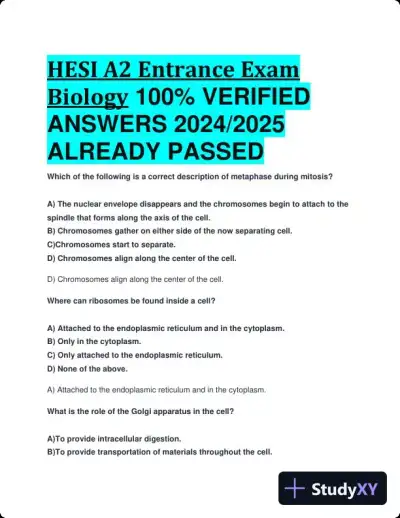 Past Exams
2024-2025 HESI A2 Biology Entrance Exam with Answers (42 Solved Questions)
Health Education Systems, Inc.
13 pages154downloadsFeb 2025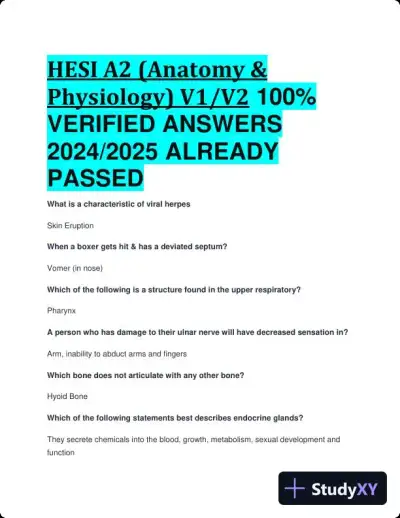 Past Exams
2024-2025 HESI A2 Anatomy and Physiology V1/V2 Practice Exam with Answers (134 Solved Questions)
Health Education Systems, Inc.
15 pages134downloadsFeb 2025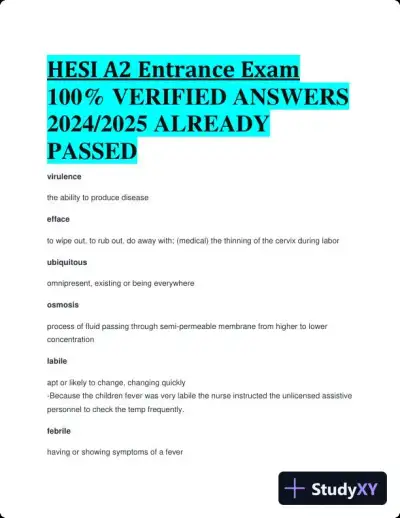 Past Exams
2024-2025 HESI A2 Entrance Exam with Answers (232 Solved Questions)
Health Education Systems, Inc.
26 pages132downloadsFeb 2025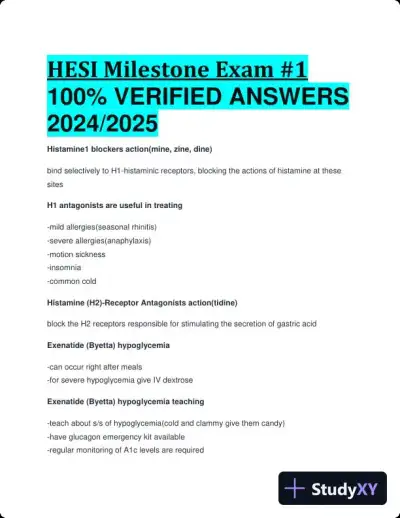 Past Exams
2024-2025 HESI Milestone Exam 1 with Answers (162 Solved Questions)
Health Education Systems, Inc.
26 pages119downloadsFeb 2025 Past Exams
2024-2025 HESI A2 Critical Thinking with Answers (124 Solved Questions)
Health Education Systems, Inc.
114 pages106downloadsFeb 2025 Past Exams
2024-2025 HESI RN Exit Exam with Answers (156 Solved Questions)
Health Education Systems, Inc.
44 pages92downloadsFeb 2025 Past Exams
HESI Leadership/Management Exit Exam with Answers (59 Solved Questions)
Health Education Systems, Inc.
4 pages54downloadsFeb 2025
Study this document with CramX
Once it is in your library, every tool can work from it.