

2021 HESI PN Cardiovascular Exit Exam With Answers (140 Solved Questions)
- Health Education Systems, Inc.
- 48 pages
- Shared May 2025
2021 HESI PN Cardiovascular Exit Exam With Answers offers a step-by-step approach to solving past exam questions.
Preview 15 of 48 pages
See the first 15 pages exactly as they appear in the document.
Page 1 Read page 1 as text
2021 PN Hesi Exit Exam 1) The LPN/LVN is preparing to ambulate a postoperative client after cardiac surgery. The nurse plans to do which to enable the client to best tolerate the ambulation? 1. Provide the client with a walker. 2. Remove the telemetry equipment. 3. Encourage the client to cough and deep breathe. 4. Premedicate the client with an analgesic before ambulating. Correct Answer: 4. Premedicate the client with an analgesic before ambulating. 2) A client is wearing a continuous cardiac monitor, which begins to alarm at the nurse's station. The nurse sees no electrocardiographic complexes on the screen. The nurse should do which first? 1. Call a code blue. 2. Call the health care provider. 3. Check the client status and lead placement. 4. Press the recorder button on the ECG console. Correct Answer: 3. Check the client status and lead placement. 3) The LPN/LVN in a medical unit is caring for a client with heart failure. The client suddenly develops extreme dyspnea, tachycardia, and lung crackles, and the nurse suspects pulmonary edema. The nurse immediately notifies the registered nurse and expects which interventions to be prescribed? Select all that apply. 1. Administering oxygen 2. Inserting a Foley catheter 3. Administering furosemide (Lasix) 4. Administering morphine sulfate intravenously 5. Transporting the client to the coronary care unit
Page 2 Page 3 Read page 3 as text
6. Placing the client in a low-Fowler's side-lying position Correct Answer: 1. Administering oxygen 2. Inserting a Foley catheter 3. Administering furosemide (Lasix) 4) The nurse is monitoring a client following cardioversion. Which observations should be of highest priority to the nurse? 1. Blood pressure 2. Status of airway 3. Oxygen flow rate 4. Level of consciousness Correct Answer: 2. Status of airway 5) The nurse is assisting in caring for the client immediately after insertion of a permanent demand pacemaker via the right subclavian vein. The nurse prevents dislodgement of the pacing catheter by implementing which intervention? 1. Limiting movement and abduction of the left arm 2. Limiting movement and abduction of the right arm 3. Assisting the client to get out of bed and ambulate with a walker 4. Having the physical therapist do active range of motion to the right arm Correct Answer: 2. Limiting movement and abduction of the right arm 6) A client diagnosed with thrombophlebitis 1 day ago suddenly complains of chest pain and shortness of breath, and the client is visibly anxious. The LPN/LVN understands that a life-threatening complication of this condition is which? 1. Pneumonia
Page 4 Read page 4 as text
2. Pulmonary edema 3. Pulmonary embolism 4. Myocardial infarction Correct Answer: 3. Pulmonary embolism 7) A 24-year-old man seeks medical attention for complaints of claudication in the arch of the foot. The nurse also notes superficial thrombophlebitis of the lower leg. The nurse should check the client for which next? 1. Smoking history 2. Recent exposure to allergens 3. History of recent insect bites 4. Familial tendency toward peripheral vascular disease Correct Answer: 1. Smoking history 8) The nurse has reinforced instructions to the client with Raynaud's disease about self-management of the disease process. The nurse determines that the client needs further teaching if the client states which? 1. "Smoking cessation is very important." 2. "Moving to a warmer climate should help." 3. "Sources of caffeine should be eliminated from the diet." 4. "Taking nifedipine (Procardia) as prescribed will decrease vessel spasm." Correct Answer: 2. "Moving to a warmer climate should help." 9) A client with myocardial infarction suddenly becomes tachycardic, shows signs of air hunger, and begins coughing frothy, pink-tinged sputum. The nurse listens to breath sounds, expecting to hear which breath sounds bilaterally?
Page 5 Read page 5 as text
1. Rhonchi 2. Crackles 3. Wheezes 4. Diminished breath sounds Correct Answer: 2. Crackles 10) The LPN/LVN is collecting data on a client with a diagnosis of right- sided heart failure. The nurse should expect to note which specific characteristic of this condition? 1. Dyspnea 2. Hacking cough 3. Dependent edema 4. Crackles on lung auscultation Correct Answer: 3. Dependent edema 11) The LPN/LVN is checking the neurovascular status of a client who returned to the surgical nursing unit 4 hours ago after undergoing an aortoiliac bypass graft. The affected leg is warm, and the nurse notes redness and edema. The pedal pulse is palpable and unchanged from admission. The nurse interprets that the neurovascular status is which? 1. Moderately impaired, and the surgeon should be called 2. Normal, caused by increased blood flow through the leg 3. Slightly deteriorating, and should be monitored for another hour 4. Adequate from an arterial approach, but venous complications are arising Correct Answer: 2. Normal, caused by increased blood flow through the leg 12) A client with a diagnosis of rapid rate atrial fibrillation asks the nurse why the health care provider is going to perform carotid massage. The LPN/LVN responds that this procedure may stimulate which?
Page 6 Read page 6 as text
1. Vagus nerve to slow the heart rate 2. Vagus nerve to increase the heart rate 3. Diaphragmatic nerve to slow the heart rate 4. Diaphragmatic nerve to increase the heart rate Correct Answer: 1. Vagus nerve to slow the heart rate 13) A client is admitted to the hospital with possible rheumatic endocarditis. The LPN/LVN should check for a history of which type of infection? 1. Viral infection 2. Yeast infection 3. Streptococcal infection 4. Staphylococcal infection Correct Answer: 3. Streptococcal infection 14) A client has an Unna boot applied for treatment of a venous stasis leg ulcer. The LPN/LVN notes that the client's toes are mottled, and cool and the client verbalizes some numbness and tingling of the foot. Which interpretation should the nurse make of these findings? 1. The boot has not yet dried. 2. The boot is controlling leg edema. 3. The boot is impairing venous return. 4. The boot has been applied too tightly. Correct Answer: 4. The boot has been applied too tightly. 15) A client with angina complains that the anginal pain is prolonged and severe and occurs at the same time each day, most often in the morning. On further data collection, the nurse notes that the pain occurs in the absence of precipitating factors. How should the LPN/LVN best describe this type of anginal pain?
Page 7 Read page 7 as text
1. Stable angina 2. Variant angina 3. Unstable angina 4. Nonanginal pain Correct Answer: 2. Variant angina 16) The LPN/LVN is monitoring a client with an abdominal aortic aneurysm (AAA). Which finding is probably unrelated to the AAA? 1. Pulsatile abdominal mass 2. Hyperactive bowel sounds in the area 3. Systolic bruit over the area of the mass 4. Subjective sensation of "heart beating" in the abdomen Correct answer: 2. Hyperactive bowel sounds in the area 17) An emergency department client who complains of slightly improved but unrelieved chest pain for 2 days is reluctant to take a nitroglycerin sublingual tablet offered by the nurse. The client states, "I don't need that — my dad takes that for his heart. There's nothing wrong with my heart." Which description best describes the client's response? 1. Angry 2. Denial 3. Phobic 4. Obsessive-compulsive Correct Answer: 2. Denial 18) A client is scheduled for a cardiac catheterization using a radiopaque dye. The LPN/LVN checks which most critical item before the procedure? 1. Intake and output 2. Height and weight
Page 8 Read page 8 as text
3. Peripheral pulse rates 4. Prior reaction to contrast media Correct Answer: 4. Prior reaction to contrast media 19) A client is scheduled for a dipyridamole thallium scan. The LPN/ LVN should check to make sure that the client has not consumed which substance before the procedure? 1. Caffeine 2. Fatty meal 3. Excess sugar 4. Milk products Correct Answer: 1. Caffeine 20) An ambulatory clinic nurse is interviewing a client who is complaining of flulike symptoms. The client suddenly develops chest pain. Which question best assists the nurse to discriminate pain caused by a non cardiac problem? 1. "Can you describe the pain to me?" 2. "Have you ever had this pain before?" 3. "Does the pain get worse when you breathe in?" 4. "Can you rate the pain on a scale of 1 to 10, with 10 being the worst?" Correct Answer: 3. "Does the pain get worse when you breathe in?" 21) A client with myocardial infarction (MI) has been transferred from the coronary care unit (CCU) to the general medical unit with cardiac monitoring via telemetry. The nurse assisting in caring for the client expects to note which type of activity prescribed? 1. Strict bed rest for 24 hours 2. Bathroom privileges and self-care activities 3. Unrestricted activities because the client is monitored
Page 9 Read page 9 as text
4. Unsupervised hallway ambulation with distances less than 200 feet Correct Answer: 2. Bathroom privileges and self-care activities 22) The LPN/LVN is preparing to care for a client who will be arriving from the recovery room after an above-the-knee amputation. The nurse ensures that which priority item is available for emergency use? 1. Surgical tourniquet 2. Dry sterile dressings 3. Incentive spirometer 4. Over-the-bed trapeze Correct Answer:1. Surgical tourniquet 23) A client is diagnosed with thrombophlebitis. The nurse should tell the client that which prescription is indicated? 1. Bed rest, with bathroom privileges only 2. Bed rest, keeping the affected extremity flat 3. Bed rest, with elevation of the affected extremity 4. Bed rest, with the affected extremity in a dependent position Correct Answer: 3. Bed rest, with elevation of the affected extremity 24) A client returns to the nursing unit after an above knee amputation of the right leg. In which position should the nurse place the client? 1. Prone with the head on a pillow 2. With the foot of the bed elevated 3. Reverse Trendelenburg's position 4. With the residual limb flat on the bed Correct Answer: 2. With the foot of the bed elevated
Page 10 Read page 10 as text
25) The LPN/LVN is collecting data from a client about medications being taken, and the client tells the nurse that he is taking herbal supplements for the treatment of varicose veins. The nurse understands that the client is most likely taking which? 1. Bilberry 2. Ginseng 3. Feverfew 4. Evening primrose Correct Answer: 1. Bilberry 26) The LPN/LVN is planning to reinforce instructions to a client with peripheral arterial disease about measures to limit disease progression. The nurse should include which items on a list of suggestions to be given to the client? Select all that apply. 1. Wear elastic stockings. 2. Be careful not to injure the legs or feet. 3. Use a heating pad on the legs to aid vasodilation. 4. Walk each day to increase circulation to the legs. 5. Cut down on the amount of fats consumed in the diet. Correct Answer: 2. Be careful not to injure the legs or feet. 4. Walk each day to increase circulation to the legs. 5. Cut down on the amount of fats consumed in the diet. 27) A client is at risk for developing disseminated intravascular coagulopathy (DIC). The LPN/LVN should become concerned with which fibrinogen level? 1. 90 mg/dL 2. 190 mg/dL 3. 290 mg/dL 4. 390 mg/dL
Page 11 Read page 11 as text
Correct Answer: 1. 90 mg/dL 28) A hospitalized client with a history of angina pectoris is ambulating in the corridor. The client suddenly complains of severe substernal chest pain. The LPN/LVN should take which action first? 1. Check the client's vital signs. 2. Assist the client to sit or lie down. 3. Administer sublingual nitroglycerin. 4. Apply nasal oxygen at a rate of 2 L/min. Correct Answer: 2. Assist the client to sit or lie down. 29) The LPN/LVN notes bilateral 2+ edema in the lower extremities of a client with known coronary artery disease who was admitted to the hospital 2 days ago. Based on this finding, the nurse should implement which action? 1. Reviews the intake and output records for the last 2 days 2. Prescribes daily weights starting on the following morning 3. Changes the time of diuretic administration from morning to evening 4. Requests a sodium restriction of 1 g/day from the health care provider Correct Answer: 1. Reviews the intake and output records for the last 2 days 30) A client brings the following medications to the clinic for a yearly physical. The LPN/LVN realizes which medication has been prescribed to treat heart failure? 1. Digoxin (Lanoxin) 2. Warfarin (Coumadin) 3. Amiodarone (Cordarone) 4. Potassium chloride (K-Dur) Correct Answer: 1. Digoxin (Lanoxin)
Page 12 Read page 12 as text
31) A student nurse is assigned to assist in caring for a client with acute pulmonary edema who is receiving digoxin (Lanoxin) and heparin therapy. The nursing instructor reviews the plan of care formulated by the student and tells the student that which intervention is unsafe? 1. Restricting the client's potassium intake 2. Encouraging the client to rest after meals 3. Administering the heparin with a 25-gauge needle 4. Holding the digoxin for a heart rate less than 60 beats per minute 1. Restricting the client's potassium intake 32) A client has an inoperable abdominal aortic aneurysm (AAA). Which measure should the nurse anticipate reinforcing when teaching the client? 1. Bed rest 2. Restricting fluids 3. Antihypertensives 4. Maintaining a low-fiber diet Correct Answer: 3. Antihypertensives 33) The LPN/LVN finds a client tensing while lying in bed staring at the cardiac monitor. Which is the nurse's best response when the client states, "There sure are a lot of wires around there. I sure hope we don't get hit by lightning!"? 1. "Would you like a mild sedative to help you relax?" 2. "Oh, don't worry, the weather is supposed to be sunny and clear today." 3. "Yes, this equipment is a little scary. Can we talk about how the cardiac monitor works?" 4. "I can appreciate your concerns. Your family can stay with you tonight if you want them to."
Page 13 Read page 13 as text
Correct Answer: 3. "Yes, this equipment is a little scary. Can we talk about how the cardiac monitor works?" 34) The LPN/LVN is asked to assist another health care member in providing care to a client who is placed in a modified Trendelenburg's position. The nurse interprets that the client is likely being treated for which condition? 1. Shock 2. Kidney dysfunction 3. Respiratory insufficiency 4. Increased intracranial pressure 1. Shock 35) A client is seen in the health care provider's office for a physical examination after experiencing unusual fatigue over the last several weeks. Height is 5 feet, 8 inches, with a weight of 220 pounds. Vital signs are temperature 98.6° F oral, pulse 86 beats per minute, respirations 18 breaths per minute, and blood pressure 184/96 mm Hg. Random blood glucose is 110 mg/dL. In order to best collect relevant data, which question should the LPN/LVN ask the client first? 1. "Do you exercise regularly?" 2. "Would you consider losing weight?" 3. "Is there a history of diabetes mellitus in your family?" 4. "When was the last time you had your blood pressure checked?" Correct Answer: 4. "When was the last time you had your blood pressure checked? 36) The client scheduled for a right femoropopliteal bypass graft is at risk for compromised tissue perfusion to the extremity. The LPN/LVN takes which action before surgery to address this risk?
Page 14 Read page 14 as text
1. Having the client void before surgery 2. Completing a preoperative checklist 3. Marking the location of the pedal pulses on the right leg 4. Checking the results of any baseline coagulation studies 3. Marking the location of the pedal pulses on the right leg 37) When preparing a client for a pericardiocentesis, which position does the LPN/LVN place the client in? 1. Supine with slight lowering of the head 2. Lying on the right side with a pillow under the head 3. Lying on the left side with a pillow under the chest wall 4. Supine with the head of bed elevated at a 45- to 60-degree angle Correct Answer: 4. Supine with the head of bed elevated at a 45- to 60- degree angle 38) For a client diagnosed with pulmonary edema, the LPN/LVN establishes a goal to have the client participate in activities that reduce cardiac workload. Which client activities will contribute to achieving this goal? 1. Elevating the legs when in bed 2. Sleeping in the supine position 3. Using a bedside commode for stools 4. Seasoning beef with a meat tenderizer Correct Answer: 3. Using a bedside commode for stools 39) The LPN/LVN is caring for a client who is developing pulmonary edema. The client exhibits respiratory distress, but the blood pressure is unchanged from the client's baseline. As an immediate action before help arrives, the nurse should perform which action? 1. Suction the client vigorously. 2. Place the client in high-Fowler's position.
Page 15 Read page 15 as text
3. Begin assembling medications that are anticipated to be given. 4. Call the respiratory therapy department to request a ventilator. 2. Place the client in high-Fowler's position. 40) The LPN/LVN has reinforced home care instructions to a client who had a permanent pacemaker inserted. Which educational outcome has the greatest impact on the client's long-term cardiac health? 1. Knowledge of when it is safe to resume sexual activity 2. The ability to take an accurate pulse in either the wrist or neck 3. An understanding of the importance of proper microwave oven usage 4. An understanding of why vigorous arm and shoulder movement must be avoided initially 2. The ability to take an accurate pulse in either the wrist or neck 41) The clinic nurse is obtaining cardiovascular data on a client. The LPN/LVN prepares to check the client's apical pulse and places the stethoscope in which position? 1. Midsternum equal with the nipple line 2. At the midaxillary line on the left side of the chest 3. At the midline of the chest just below the xiphoid process 4. At the midclavicular line at the fifth left intercostal space Correct Answer: 4. At the midclavicular line at the fifth left intercostal space 42) The LPN/LVN is caring for a client who has been admitted to the hospital with a diagnosis of angina pectoris. The client is receiving oxygen via nasal cannula at 2 L. The client asks the nurse why the oxygen is necessary. The LPN/LVN bases the response on which information? 1. Oxygen assists in calming the client. 2. Oxygen prevents the development of any thrombus formation. 3. Deficient oxygenation to heart cells results in angina pectoris pain.
33 more pages in the full document
Unlock it once and it stays in your library, ready to chat with or turn into flashcards.
Unlock the full documentMore Health Education Systems, Inc. study materials
See all Past Exams
2023-2024 RN HESI Exit Exam Version 3 with Answers (53 Solved Questions)
Health Education Systems, Inc.
13 pages163downloadsFeb 2025 Past Exams
2024-2025 HESI A2 Biology Entrance Exam with Answers (42 Solved Questions)
Health Education Systems, Inc.
13 pages154downloadsFeb 2025 Past Exams
2024-2025 HESI A2 Anatomy and Physiology V1/V2 Practice Exam with Answers (134 Solved Questions)
Health Education Systems, Inc.
15 pages134downloadsFeb 2025 Past Exams
2024-2025 HESI A2 Entrance Exam with Answers (232 Solved Questions)
Health Education Systems, Inc.
26 pages132downloadsFeb 2025 Past Exams
2024-2025 HESI Milestone Exam 1 with Answers (162 Solved Questions)
Health Education Systems, Inc.
26 pages119downloadsFeb 2025 Past Exams
2024-2025 HESI A2 Critical Thinking with Answers (124 Solved Questions)
Health Education Systems, Inc.
114 pages106downloadsFeb 2025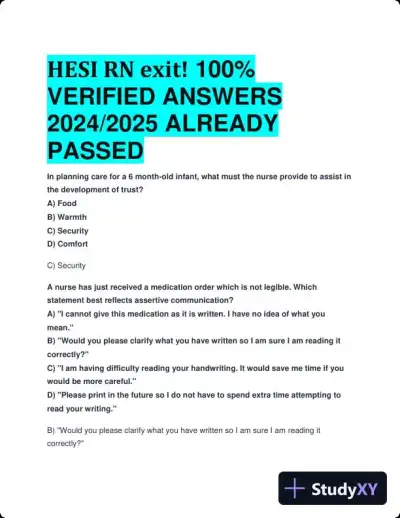 Past Exams
2024-2025 HESI RN Exit Exam with Answers (156 Solved Questions)
Health Education Systems, Inc.
44 pages92downloadsFeb 2025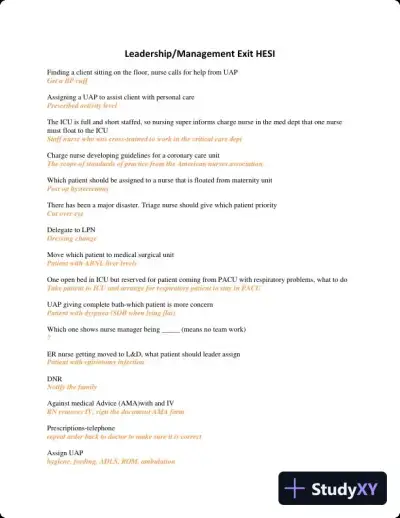 Past Exams
HESI Leadership/Management Exit Exam with Answers (59 Solved Questions)
Health Education Systems, Inc.
4 pages54downloadsFeb 2025
Study this document with CramX
Once it is in your library, every tool can work from it.