

2024-2025 HESI A2 Critical Thinking with Answers (124 Solved Questions)
- Health Education Systems, Inc.
- 114 pages
- Shared February 2025
- 106 downloads
2024-2025 HESI A2 Critical Thinking with Answers is the perfect way to get a feel for your upcoming test.
Preview 31 of 114 pages
See the first 31 pages exactly as they appear in the document.
Page 1 Read page 1 as text
HESI A2 - Critical Thinking 100% VERIFIED ANSWERS 2024/2025 ALREADY PASSED 1. The nurse is working in the emergency department (ED) of a children's medical center. Which client should the nurse assess first? 1. The 1 - month - old infant who has developed colic and is crying. 2. The 2 - year - old toddler who was bitten by another child at the day - care center. 3. The 6 - year - old school - age child who was hit by a car while riding a bicycle. 4. The 14 - year - old adolescent whose mother suspects her child is sexually active. Rationale Correct - 3 - The child hit by a car should be assessed first because he or she may have li fe - threatening injuries that must be assessed and treated promptly. 1. In an interview, the nurse may find it necessary to take notes to aid his or her memory later. Which statement is true regarding note - taking? A) Note - taking may impede the nurse's obs ervation of the patient's nonverbal behaviors. B) Note - taking allows the patient to continue at his or her own pace as the nurse records what is said. C) Note - taking allows the nurse to shift attention away from the patient, resulting in an increased comfo rt level. D) Note - taking allows the nurse to break eye contact with the patient, which may increase his or her level of comfort.
Page 2 Page 3 Read page 3 as text
A) Note - taking may impede the nurse's observation of the patient's nonverbal behaviors. Page: 31 Some use of history forms and note - taking may be unavoidable. But be aware that note - taking during the interview has disadvantages. It breaks eye contact too often, and it shifts attention away from the patient, which diminishes his or her sense of importance. It also may interrupt th e patient's narrative flow, and it impedes the observation of the patient's nonverbal behavior. 2. The 8 - year - old client diagnosed with a vaso - occlusive sickle cell crisis is complaining of a severe headache. Which intervention should the nurse implement f irst? 1. Administer 6 L of oxygen via nasal cannula. 2. Assess the client's neurological status. 3. Administer a narcotic analgesic by intravenous push (IVP). 4. Increase the client's intravenous (IV) rate. Rationale Correct - 2 - Because the client is compl aining of a headache, the nurse should first rule out cerebrovascular accident (CVA) by assess - ing the client's neurological status and then determine whether it is a headache that can be treated with medication. 2. During an interview, the nurse states, "You mentioned shortness of breath. Tell me more about that." Which verbal skill is used with this statement? A) Reflection B) Facilitation C) Direct question D) Open - ended question D) Open - ended question Page: 32 The open - ended question asks for narrati ve information. It states the topic to
Page 4 Read page 4 as text
be discussed but only in general terms. The nurse should use it to begin the interview, to introduce a new section of questions, and whenever the person introduces a new topic. 3. The 6 - year - old client who has undergo ne abdominal surgery is attempting to make a pinwheel spin by blowing on it with the nurse's assistance. The child starts crying because the pinwheel won't spin. Which action should the nurse implement first? 1. Praise the child for the attempt to make the pinwheel spin. 2. Notify the respiratory therapist to implement incentive spirometry. 3. Encourage the child to turn from side to side and cough. 4. Demonstrate how to make the pinwheel spin by blowing on it. Rationale Correct - 1. The nurse should always praise the child for attempts at cooperation even if the child did not accomplish what the nurse asked. 3. A nurse is taking complete health histories on all of the patients attending a wellness workshop. On the history form, one of the written questions asks, "You don't smoke, drink, or take drugs, do you?" This question is an example of: A) talking too much. B) using confrontation. C) using biased or leading questions. D) using blunt language to deal with distasteful topics. C) using biased or leading q uestions. Page: 36 This is an example of using leading or biased questions. Asking, "You don't smoke, do you?" implies that one answer is "better" than another. If the person wants to please someone, he or she is either forced to answer in a way correspon ding to their implied values or is made to feel guilty when admitting the other answer.
Page 5 Read page 5 as text
4. The nurse is caring for clients on the pediatric medical unit. Which client should the nurse assess first? 1. The child diagnosed with type 1 diabetes who has a bloo d glucose level of 180 mg/dL. 2. The child diagnosed with pneumonia who is coughing and has a temperature of 100°F. 3. The child diagnosed with gastroenteritis who has a potassium (K+) level of 3.9 mEq/L. 4. The child diagnosed with cystic fibrosis who has a pulse oximeter reading of 90%. Rationale Correct - 4. A pulse oximeter reading of less than 93% is significant and indicates hypoxia, which is life threatening; therefore, this child should be assessed first. 4. During an interview, a parent of a hospi talized child is sitting in an open position. As the interviewer begins to discuss his son's treatment, however, he suddenly crosses his arms against his chest and crosses his legs. This would suggest that the parent is: A) just changing positions. B) mor e comfortable in this position. C) tired and needs a break from the interview. D) uncomfortable talking about his son's treatment. D) uncomfortable talking about his son's treatment. Page: 37 Note the person's position. An open position with the extension of large muscle groups shows relaxation, physical comfort, and a willingness to share information. A closed position with the arms and legs crossed tends to look defensive
Page 6 Read page 6 as text
and anxious. Note any change in posture. If a person in a relaxed position suddenly tenses, it suggests possible discomfort with the new topic. 5. The nurse has received the a.m. shift report for clients on a pediatric unit. Which medication should the nurse administer first? 1. The third dose of the aminoglycoside antibiotic to the chil d diagnosed with methicillin - resistant Staphylococcus aureus (MRSA). 2. The IVP steroid methylprednisolone (Solu - Medrol) to the child diagnosed with asthma. 3. The sliding scale insulin to the child diagnosed with type 1 diabetes mellitus. 4. The stimulant methylphenidate (Ritalin) to a child diagnosed with attention deficit - hyperactivity disorder (ADHD). Rationale Correct - 3 - Sliding scale insulin is ordered ac, which is before meals; therefore, this medication must be administered first after receiving t he a.m. shift report. 4 - Routine medications have a 1 - hour leeway before and after the scheduled time; therefore, this medication does not have to be adminis - tered first. 5. The nurse is interviewing a patient who has a hearing impairment. What techniques would be most beneficial in communicating with this patient? A) Determine the communication method he prefers. B) Avoid using facial and hand gestures because most hearin g - impaired people find this degrading. C) Request a sign language interpreter before meeting with him to help facilitate the communication. D) Speak loudly and with exaggerated facial movement when talking with him because this helps with lip reading. A) D etermine the communication method he prefers.
Page 7 Read page 7 as text
Pages: 40 - 41 The nurse should ask the deaf person the preferred way to communicate — by signing, lip reading, or writing. If the person prefers lip reading, then the nurse should be sure to face him or her squar ely and have good lighting on the nurse's face. The nurse should not exaggerate lip movements because this distorts words. Similarly, shouting distorts the reception of a hearing aid the person may wear. The nurse should speak slowly and should supplement his or her voice with appropriate hand gestures or pantomime. 6. The nurse enters the client's room and realizes the 9 - month - old infant is not breath - ing. Which interventions should the nurse implement? Prioritize the nurse's actions from first (1) to las t (5). 1. Perform cardiac compression 30:2. 2. Check the infant's brachial pulse. 3. Administer two puffs to the infant. 4. Determine unresponsiveness. 5. Open the infant's airway. Rationale Correct Answer: 4, 5, 3, 2, 1 4. The nurse must first determine t he infant's responsiveness by thumping the baby's feet. 5. The nurse should then open the child's airway using the head - tilt chin - lift tech - nique, with care taken not to hyperextend the neck. Then the nurse should look, listen, and feel for respirations. 3. The nurse then administers quick puffs of air while covering the child's mouth and nose, preferably with a rescue mask. 2. The nurse should determine whether the infant has a pulse by checking the brachial artery. 1. If the infant has no pulse, the nurs e should begin chest compressions using two fingers at a rate of 30:2.
Page 8 Read page 8 as text
6. The nurse is performing a health interview on a patient who has a language barrier, and no interpreter is available. Which is the best example of an appropriate question for the nurs e to ask in this situation? A) "Do you take medicine?" B) "Do you sterilize the bottles?" C) "Do you have nausea and vomiting?" D) "You have been taking your medicine, haven't you?" A) "Do you take medicine?" Page: 46 In a situation where there is a lang uage barrier and no interpreter available, use simple words avoiding medical jargon. Avoid using contractions and pronouns. Use nouns repeatedly and discuss one topic at a time. 7. A female patient does not speak English well, and the nurse needs to choose an interpreter. Which of the following would be the most appropriate choice? A) A trained interpreter B) A male family member C) A female family member D) A volunteer college student from the foreign language studies department A) A trained interpreter Page: 46 whenever possible, the nurse should use a trained interpreter, preferably one who knows medical terminology. In general, an older, more mature interpreter is preferred to a younger, less experienced one, and the same gender is preferred when possi ble. 7. The 3 - year - old client has been admitted to the pediatric unit. Which task should the nurse instruct the unlicensed assistive personnel (UAP) to perform first? 1. Orient the parents and child to the room.
Page 9 Read page 9 as text
2. Obtain an admission kit for the child. 3. Post the child's height and weight at the HOB. 4. Provide the child with a meal tray. Rationale Correct - 1.The first intervention after the child is ad - mitted to the unit is to orient the parents and child to the room, the call system, and the hospital rules, such as not leaving the child alone in the room. 8. The clinic nurse is preparing to administer an intramuscular (IM) injection to the 2 - year - old toddler. Which intervention should the nurse implement first? 1. Immobilize the child's leg. 2. Explai n the procedure to the child. 3. Cleanse the area with an alcohol swab. 4. Administer the medication in the thigh. Rationale Correct - 2 - The nurse must explain any procedure in words the child can understand. It does not matter how old the child is. 8. The nurse is conducting an interview. Which of these statements is true regarding open - ended questions? Select all that apply. A) They elicit cold facts. B) They allow for self - expression. C) They build and enhance rapport. D) They leave interactions neutral . E) They call for short one - to two - word answers. F) They are used when narrative information is needed. B) They allow for self - expression. C) They build and enhance rapport.
Page 10 Read page 10 as text
F) They are used when narrative information Page: 32 Open - ended questions allow for self - expression, build rapport, and obtain narrative information. These features enhance communication during an interview. The other statements are appropriate for closed or direct questions. 9. The nurse is writing a care plan for the 5 - year - old chi ld diagnosed with gastroenteritis. Which client problem is priority? 1. Imbalanced nutrition. 2. Fluid volume deficit. 3. Knowledge deficit. 4. Risk for infection. Rationale Correct - 2 - The child diagnosed with gastroenteritis is at high risk for hypovolem ic shock resulting from vomiting and diarrhea; therefore, maintaining fluid and elec - trolyte homeostasis is priority. 9. The nurse is conducting an interview in an outpatient clinic and is using a computer to record data. Which is the best use of the comp uter in this situation? Select all that apply. A) Collect the patient's data in a direct, face - to - face manner. B) Enter all the data as the patient states it. C) Ask the patient to wait as the nurse enters data. D) Type the data into the computer after th e narrative is fully explored. E) Allow the patient to see the monitor during typing. A) Collect the patient's data in a direct, face - to - face manner. D) Type the data into the computer after the narrative is fully explored. E) Allow the patient to see the monitor during typing. Page: 32 The use of a computer can become a barrier. The nurse should begin the interview as usual by greeting the patient, establishing rapport, and collecting the
Page 11 Read page 11 as text
patient's narrative story in a direct face - to - face manner. Only aft er the narrative is fully explored should the nurse type data into the computer. When typing, the nurse should position the monitor so that the patient can see it. 10. Which data would warrant immediate intervention from the pediatric nurse? 1. Proteinuria for the child diagnosed with nephrotic syndrome. 2. Petechiae for the child diagnosed with leukemia. 3. Drooling for a child diagnosed with acute epiglottitis. 4. Elevated temperature in a child diagnosed with otitis media. Rationale Correct - 3 - Drooling indicates the child is having trouble swallowing, and the epiglottis is at risk of completely occluding the air - way. This warrants immediate interven - tion. The nurse should notify the HCP and obtain an emergency tracheostomy tray for the bedside. 10. Dur ing an assessment, the nurse notices that a patient is handling a small charm that is tied to a leather strip around his neck. Which action by the nurse is appropriate? A) Ask the patient about the item and its significance. B) Ask the patient to lock the item with other valuables in the hospital's safe. C) Tell the patient that a family member should take valuables home. D) No action is necessary. A) Ask the patient about the item and its significance. Page: 21 The nurse should inquire about the amulet's meaning. Amulets, such as charms, are often seen as an important means of protection from "evil spirits" by some cultures. 11. Which client should the pediatric nurse assess first after receiving the a.m. shift report? 1. The 6 - month old child diagnosed w ith bacterial meningitis who is
Page 12 Read page 12 as text
irritable and crying. 2. The 9 - month old child diagnosed with tetralogy of Fallot (TOF) who has edema of the face. 3. The 11 - month old child diagnosed with Reye syndrome who is lethargic and vomiting. 4. The 13 - month - old chi ld diagnosed with diarrhea who has sunken eyeballs and decreased urine output. Rationale Correct - 4. Sunken eyeballs and decreased urine out - put are signs of dehydration, which is a life - threatening complication of diarrhea; therefore, this child should be assessed first. 11. In the majority culture of America, coughing, sweating, and diarrhea are symptoms of an illness. For some individuals of Mexican - American origin, however, these symptoms are a normal part of living. The nurse recognizes that this is true, probably because Mexican - Americans: A) have less efficient immune systems and are often ill. B) consider these symptoms a part of normal living, not symptoms of ill health. C) come from Mexico and coughing is normal and healthy there. D) are usually in a lower socioeconomic group and are more likely to be sick. B) consider these symptoms a part of normal living, not symptoms of ill health. Page: 27 The nurse needs to identify the meaning of health to the patient, remembering that concepts are derive d, in part, from the way in which members of the cultural group define health. 12. The pediatric clinic nurse is triaging telephone calls. Which client's parent should the nurse call first?
Page 13 Read page 13 as text
1. The 4 - month - old child who had immunizations yesterday and the p arent is report - ing a high - pitched cry and a 103°F fever. 2. The 8 - month - old whose parent is reporting the child is pulling on the right ear and has a fever. 3. The 2 - year - old child who has patent ductus arteriosis whose parent reports running out of digo xin. 4. The 3 - year - old child whose mother called and reported her daughter may have chickenpox. Rationale Correct 1 - A high fever and high - pitched crying may indicate a reaction to the immunizations; therefore, this parent needs to be called first to bring the child to the clinic. 12. Among many Asians there is a belief in the yin/yang theory, rooted in the ancient Chinese philosophy of Tao. The nurse recognizes which statement that most accurately reflects "health" in an Asian with this belief? A) A person is able to work and produce. B) A person is happy, stable, and feels good. C) All aspects of the person are in perfect balance. D) A person is able to care for others and function socially. C) All aspects of the person are in perfect balance. Page: 21 Many Asians believe in the yin/yang theory, in which health is believed to exist when all aspects of the person are in perfect balance. The other statements do not describe this theory. 13. The parent of a 12 - year - old male child with a left below - the - knee cast calls the pedi - atric clinic nurse and tells the nurse, "My son's foot is cold and he told me it feels like his foot is asleep." Which action should the nurse implement first? 1. Prepare to bifurcate the left below - the - knee cast.
Page 14 Read page 14 as text
2. Tell the parent to bring the child to the office. 3. Instruct the parent to elevate the left leg on two pillows. 4. Notify the child's orthopedist of the situation. Rationale Correct - 3. The nurse should first take care of the client's body by having the parent el evate the left leg. 13. An individual who takes the magicoreligious perspective of illness and disease is likely to believe that his or her illness was caused by: A) germs and viruses. B) supernatural forces. C) eating imbalanced foods. D) an imbalance wi thin his or her spiritual nature. B) supernatural forces. Page: 21 The basic premise of the magicoreligious perspective is that the world is seen as an arena in which supernatural forces dominate. The fate of the world and those in it depends on the actio ns of supernatural forces for good or evil. The other answers do not reflect the magicoreligious perspective. 14. If an American Indian has come to the clinic to seek help with regulating her diabetes, the nurse can expect that she: A) will comply with th e treatment prescribed. B) has obviously given up her beliefs in naturalistic causes of disease. C) may also be seeking the assistance of a shaman or medicine man. D) will need extra help in dealing with her illness and may be experiencing a crisis of fait h.
Page 15 Read page 15 as text
C) may also be seeking the assistance of a shaman or medicine man. Page: 23 When self - treatment is unsuccessful, the individual may turn to the lay or folk healing systems, to spiritual or religious healing, or to scientific biomedicine. In addition to seeking help from a biomedical or scientific health care provider, patients may also seek help from folk or religious healers. 14. Which child requires the nurse to notify the healthcare provider? 1. The 1 - year - old child with iron deficiency anemia who ha s dark - colored stool. 2. The 3 - year - old child with phenylketonuria (PKU) whose parent does not feed the child any meat or milk products. 3. The 5 - year - old child with rheumatic heart fever who is having difficulty breathing. 4. The 7 - year - old child diagnose d with acute glomerulonephritis who has dark "tea" - colored urine. Rationale Correct - 3 - A complication of rheumatic heart disease is valvular disorders that may be mani - fested by respiratory problems; therefore, the nurse should notify the child's health - care provider. 15. The pediatric nurse on the surgical unit has just received a.m. shift report. Which client should the nurse assess first? 1. The 3 - week - old child 1 day postoperative with surgical repair of a myelomeningo - cele who has bulging fontanels . 2. The 3 - month - old child 2 days postoperative temporary colostomy secondary to Hirschsprung's disease who has a moist, pink stoma. 3. The 9 - month - old child with a cleft palate repair who is spitting up formula and refusing to eat. 4. The 4 - year - old child 1 day postoperative for repair of hypospadias who has
Page 16 Read page 16 as text
clear amber urine draining from indwelling catheter. Rationale Correct - 1 - Bulging fontanels is a sign of increased intracranial pressure, which is a compli - cation of neurological surgery; therefore, this child should be assessed first. 15. An elderly Mexican - American woman with traditional beliefs has been admitted to an inpatient care unit. A culturally - sensitive nurse would: A) contact the hospital administrator about the best course of action. B) automatically get a curandero for her because it is not culturally appropriate for her to request one. C) further assess the patient's cultural beliefs and offer the patient assistance in contacting a curandero or priest if she desires. D) ask the family w hat they would like to do because Mexican - Americans traditionally give control of decisions to their families. C) further assess the patient's cultural beliefs and offer the patient assistance in contacting a curandero or priest if she desires. Pages: 22 - 23 In addition to seeking help from the biomedical/scientific health care provider, patients may also seek help from folk or religious healers. Some people, such as those of Mexican - American or American Indian origins, may believe that the cure is incomple te unless the body, mind, and spirit are also healed (although the division of the person into parts is a Western concept). 16. The charge nurse has assigned a staff nurse to care for an 8 - year - old client diagnosed with cerebral palsy. Which nursing action by the staff nurse would warrant immediate intervention by the charge nurse? 1. The staff nurse performs gentle range - of - motion (ROM) exercises to extremities. 2. The staff nurse puts the client's bed in the lowest position possible.
Page 17 Read page 17 as text
3. The staff nurse ta kes the client in a wheelchair to the activity room. 4. The staff nurse places the child in semi - Fowler's position to eat lunch. Rationale Correct - 4 - The child should be positioned upright to prevent aspiration during meals; there - fore, this action would require the charge nurse to intervene. 16. The nurse is reviewing concepts of cultural aspects of pain. Which statement is true regarding pain? A) All patients will behave the same way when in pain. B) Just as patients vary in their perceptions of pain, so will they vary in their expressions of pain. C) Cultural norms have very little to do with pain tolerance, because pain tolerance is always biologically determined. D) A patient's expression of pain is largely dependent on the amount of tissue injury as sociated with the pain. B) Just as patients vary in their perceptions of pain, so will they vary in their expressions of pain. Page: 25 In addition to expecting variations in pain perception and tolerance, the nurse should expect variations in the express ion of pain. It is well known that individuals turn to their social environment for validation and comparison. The other statements are incorrect. 17. The nurse and the unlicensed assistive personnel (UAP) are caring for clients on the pediatric unit. Whic h action by the nurse indicates appropriate delegation? 1. The nurse requests the UAP to check the circulation on the child with a cast. 2. The nurse asks the UAP to feed an infant who has just had a cleft palate repair. 3. The nurse has the UAP demonstrat e a catheterization for a child with a neurogenic bladder.
Page 18 Read page 18 as text
4. The nurse checks to make sure the UAP's delegated tasks have been completed. Rationale Correct - 4. The last step of delegating to a UAP is for the nurse to evaluate and determine whether the de legated tasks have been completed and performed correctly. This indicates the nurse has delegated appropriately. 17. The nurse recognizes that working with children with a different cultural perspective may be especially difficult because: A) children hav e spiritual needs that are influenced by their stages of development. B) children have spiritual needs that are direct reflections of what is occurring in their homes. C) religious beliefs rarely affect the parents' perceptions of the illness. D) parents a re often the decision makers, and they have no knowledge of their children's spiritual needs. A) children have spiritual needs that are influenced by their stages of development. Page: 20. Illness during childhood may be an especially difficult clinical s ituation. Children, as well as adults, have spiritual needs that vary according to the child's developmental level and the religious climate that exists in the family. The other statements are not correct. 18. The nurse on a pediatric unit has received the a.m. shift report and tells the unli - censed assistive personnel (UAP) to keep the 2 - year - old child NPO for a procedure. At 0830, the nurse observes the mother feeding the child. Which action should the nu rse implement first? 1. Determine what the UAP did not understand about the instruction. 2. Tell the HCP the UAP did not follow the nurse's direction.
Page 19 Read page 19 as text
3. Ask the mother why she was feeding her child if the child was NPO. 4. Notify the dietary department to hold the child's meal trays. Rationale Correct - 1.Communication to the UAP must be clear, concise, correct, and complete. The nurse must determine why there was a lack of communication, which resulted in the child receiving food; therefore, this action s hould be implemented first. 18. When providing culturally competent care, nurses must incorporate cultural assessments into their health assessments. Which statement is most appropriate to use when initiating an assessment of cultural beliefs with an elder ly American Indian patient? A) "Are you of the Christian faith?" B) "Do you want to see a medicine man?" C) "How often do you seek help from medical providers?" D) "What cultural or spiritual beliefs are important to you?" D) "What cultural or spiritual b eliefs are important to you?" Page: 17. The nurse needs to assess the cultural beliefs and practices of the patient. American Indians may seek assistance from a medicine man or shaman, but the nurse should not assume this. An open - ended question regarding cultural and spiritual beliefs is best used initially when performing a cultural assessment. 19. The charge nurse on the six - bed pediatric burn unit is making shift assignments and has one registered nurse (RN), one scrub technician, one unlicensed assist ive personnel (UAP), and a unit secretary. Which client care assignment indicates the best use of the hospital personnel? 1. The RN performs daily whirlpool dressing changes. 2. The unit secretary transcribes the HCP's orders. 3. The scrub technician medic ates the client prior to dressing changes. 4. The UAP places the current laboratory results on the chart.
Page 20 Read page 20 as text
1 - The scrub technician is assigned to perform daily whirlpool dressing changes, which is a lengthy procedure. Therefore, assigning the one RN to this task would be inappropriate because he or she cannot be unavailable for an extended period of time. **2 - One of the responsibilities of the unit secretary is to transcribe the HCP's orders, but the licensed nurse retains total responsibility for the correct ness and accuracy of the transcribed orders. 3 - The scrub technician cannot administer medications. 4 - The unit secretary and laboratory personnel are responsible for posting laboratory data into the client's charts. The UAP should be on the unit taking care of the clients. 19. When planning a cultural assessment, the nurse should include which component? A) Family history B) Chief complaint C) Medical history D) Health - related beliefs D) Health - related beliefs Pages: 19 - 20. Health - related beliefs and practices are one component of a cultural assessment. The other items reflect other aspects of the patient's history. 20. The RN and the UAP are caring for clients on a pediatric surgical unit. Which tasks would be most appropriate to delegate to the UAP? Select all that apply. 1. Pass dietary trays to the clients. 2. Obtain routine vital signs on the clients. 3. Complete the preoperative checklist. 4. Change linens on the clients' beds. 5. Document the clients' inta ke and output. 1, 2, 4, and 5 are correct. 1. The UAP can pass the dietary trays to
Page 21 Read page 21 as text
the clients because it does not require judgment. 2. One of the responsibilities of the UAP is taking routine vital signs on clients. 3. The nurse must complete the preoper ative checklist because it requires nursing judg - ment to determine whether the client is ready for surgery. 4. One of the responsibilities of the UAP is changing bed linens. 5. The UAP can document the client's in - take and output, but the UAP cannot eval uate the numbers. 20. When the nurse is evaluating the reliability of a patient's responses, which of these statements would be correct? The patient: A. has a history of drug abuse and therefore is not reliable. B. provided consistent information and ther efore is reliable. C. smiled throughout interview and therefore is assumed reliable. D. would not answer questions concerning stress and therefore is not reliable. B. provided consistent information and therefore is reliable. Page: 50. A reliable person a lways gives the same answers, even when questions are rephrased or are repeated later in the interview. The other statements are not correct. 21. Which client should the charge nurse on the pediatric unit assign to the most experienced nurse? 1. The 4 - year - old child diagnosed with hemophilia receiving factor VIII. 2. The 8 - year - old child with headaches who is scheduled for a CT scan. 3. The 6 - year - old child recovering from a sickle cell crisis. 4. The 11 - year - old child newly diagnosed with rheumatoid arthri tis. 1 - The administration of blood products does not require the most experienced nurse. 2 - Preparing a child for a routine procedure does not require the most experienced nurse.
Page 22 Read page 22 as text
3 - The child recovering from a sickle cell crisis would not require the most ex perienced nurse. **4 - The child newly diagnosed with a chronic disease, which will have acute exacerba - tions, requires extensive teaching; there - fore, the most experienced nurse should be assigned to this child and family. 21. In recording the childhood i llnesses of a patient who denies having had any, which note by the nurse would be most accurate? A. Patient denies usual childhood illnesses. B. Patient states he was a "very healthy" child. C. Patient states sister had measles, but he didn't. D. Patient denies measles, mumps, rubella, chickenpox, pertussis, and strep throat. D. Patient denies measles, mumps, rubella, chickenpox, pertussis, and strep throat. Page: 51. Childhood illnesses include measles, mumps, rubella, chickenpox, pertussis, and strep th roat. Avoid recording "usual childhood illnesses" because an illness common in the person's childhood may be unusual today (e.g., measles). 22. The charge nurse is making shift assignments on a pediatric oncology unit. Which delegation/assignment would be most appropriate? 1. Delegate the unlicensed assistive personnel (UAP) to obtain routine blood work from the central line. 2. Instruct the licensed practical nurse (LPN) to contact the leukemia support group. 3. Assign the chemotherapy - certified RN to admi nister chemotherapeutic medication. 4. Have the dietitian check the meal trays for the amount eaten. 1 - Only an RN can withdraw blood from a central line.
Page 23 Read page 23 as text
2. The social worker or case manager is respon - sible for referring clients to support groups. This is not an expected responsibility of a floor nurse/LPN. **3. Only chemotherapy - certified RNs can administer antineoplastic, chemothera - peutic medications. This is a national minimal standard of care according to the Oncology Nursing Society. 4. The dieticia n is responsible for ensuring that the proper food is provided along with evalu - ating the child's nutritional intake, not checking the amount of food eaten — this is the responsibility of the nursing staff. 22. The mother of a 16 - month - old toddler tells the nurse that her daughter has an earache. What would be an appropriate response? A. "Maybe she is just teething." B. "I will check her ear for an ear infection." C. "Are you sure she is really having pain?" D. "Please describe what she is doing to indicate she is having pain." D. "Please describe what she is doing to indicate she is having pain." Page: 60. With a very young child, ask the parent, "How do you know the child is in pain?" Pulling at ears alerts parent to ear pain. The statements about teethin g and questioning whether the child is really having pain do not explore the symptoms, which should be done before a physical examination. 23. The nurse observes the unlicensed assistive personnel (UAP) bringing a cartoon video to a 6 - year - old female child on bed rest so that she can watch it on the television. Which action should the nurse take? 1. Tell the UAP that the child should not be watching videos. 2. Explain that this is the responsibility of the child life therapist. 3. Praise the UAP for providi ng the child with an appropriate activity. 4. Notify the charge nurse that the UAP gave the child videos to watch.
Page 24 Read page 24 as text
1. A 6 year old child on best rest needs an appropriate activity to help with distraction; a cartoon video would be an age appropriate activi ty. 2. The child life therapist is responsible for recreational and developmental activity for the hospitalized child, but any staff member should address the child's psychosocial needs. **3. Part of the delegation process is to evaluate the UAP's performa nce of duties, and the nurse should praise any initiative on the part of the UAP in being a client advocate. 4. Videos are one of the few age - appropriate activities to occupy a 6 - year - old on bed rest; therefore, there is no reason to notify the charge nurs e. 23. A 5 - year - old boy is being admitted to the hospital to have his tonsils removed. Which information should the nurse collect before this procedure? A. The child's birth weight B. The age at which he crawled C. Whether he has had the measles D. Reacti ons to previous hospitalizations D. Reactions to previous hospitalizations Assess how the child reacted to hospitalization and any complications. If the child reacted poorly, he or she may be afraid now and will need special preparation for the examinatio n that is to follow. The other items are not significant for the procedure. 24. Which newborn should the nurse in the neonatal intensive care unit (NICU) assign to a new graduate who has just completed an NICU internship? 1. The 1 - day - old infant diagnosed with a myelomeningocele. 2. The 2 - week - old infant who was born 6 weeks premature. 3. The 3 - hour - old infant who is being evaluated for esophageal atresia. 4. The 1 - week - old infant diagnosed with tetralogy of Fallot. 1 - The newborn with the myelomeningocele h as a portion of the spinal cord and mem - branes protruding through the back and is at risk for hydrocephalus and meningitis; this
Page 25 Read page 25 as text
client should be assigned to a more experi - enced nurse. **2 - The new graduate who has completed the NICU internship should be able to care for a premature infant because care is primarily supportive. 3 - Esophageal atresia, a congenital anomaly in which the esophagus does not completely develop, is a clinical and surgical emergency. It puts the newborn at risk for aspiration be - ca use the upper esophagus ends in a blind pouch with the lower part of the esophagus connected to the trachea. This newborn should be assigned to a more experienced nurse. 4 - Tetralogy of Fallot is a cyanotic, congenital anomaly. It includes a combination of four defects of the heart, all of which result in unoxygenated blood being pumped into the systemic circulation. This newborn must be assigned to an experienced nurse. 24. The nurse is preparing to do a functional assessment. Which statement best describes the purpose of a functional assessment? A. It assesses how the individual is coping with life at home. B. It determines how children are meeting developmental milestones. C. It can identify any problems with memory the individual may be experiencing. D. It helps to determine how a person is managing day - to - day activities. D. It helps to determine how a person is managing day - to - day activities. Page: 67. The functional assessment measures how a person manages day - to - day activities. The other answers do no t reflect the purpose of a functional assessment. 25. The newly hired nurse is working on a pediatric unit and needs the unlicensed assistive personnel (UAP) to obtain a urine specimen on an 11 - month - old infant. Which statement made to the UAP indicates th e nurse understands the delegation process? 1. "Be sure to weigh the diaper when obtaining the urine specimen." 2. "Do you know how to apply the urine collection bag?"
Page 26 Read page 26 as text
3. "Use a small indwelling catheter when obtaining the urine specimen." 4. "I need for y ou to get a urine specimen on the infant." 1 - Weighing the diaper is the procedure for de - termining the infant's urinary output and is not part of the procedure for obtaining a urine specimen. **2 - The NCSBN position paper in 1995 defined delegation as tran sferring to a competent individual the authority to perform a selected nursing task in a se - lected situation. The nurse retains the accountability for the delegation. The nurse must determine whether the UAP has the ability and knowledge to perform a task . This question clarifies whether the UAP has the ability to obtain a urine specimen. 3 - Obtaining a urine specimen with an in - dwelling catheter on an 11 - month - old infant would require more expertise than a UAP would have on the pediatric unit. Furthermore , it does not determine whether the UAP understands how to do the procedure. 4. This statement does not determine whether the UAP understands how to perform the procedure of obtaining a urine specimen from an 11 - month - old infant. 25. The nurse is performin g a functional assessment on an 82 - year - old patient who recently had a stroke. Which of these questions would be most important to ask? A. "Do you wear glasses?" B. "Are you able to dress yourself?" C. "Do you have any thyroid problems?" D. "How many time s a day do you have a bowel movement?" B. "Are you able to dress yourself?" Page: 67. Functional assessment measures how a person manages day - to - day activities. For the older person, the meaning of health becomes those activities that they can or cannot d o. The other responses do not relate to functional assessment.
Page 27 Read page 27 as text
26. Which task is most appropriate for the pediatric nurse to delegate to the unlicensed assistive personnel (UAP)? 1. Ask the UAP to orient the parents and child to the room. 2. Tell the UAP t o prepare the child for an endoscopy. 3. Request the UAP to log roll the client who had a spinal surgery. 4. Instruct the UAP to assess the child's developmental level. **1 - The UAP can orient the parents and child to the room, and demonstrate how to use th e call light, how the bed works, or how the television works. 2 - The UAP cannot prepare a child for en - doscopy; this requires assessment and evaluation to determine if the child is ready for the procedure. 3 - There must be at least two people to log roll a child, and the UAP cannot do this procedure alone. 4 - The nurse cannot delegate assessment to the UAP. 26. The nurse is conducting a developmental history on a 5 - year - old child. Which questions are appropriate to ask the parents for this part of the assessment? Select all that apply. A. "How much junk food does your child eat?" B. "How many teeth has he lo st, and when did he lose them?" C. "Is he able to tie his shoelaces?" D. "Does he take a children's vitamin?" E. "Can he tell time?" F. "Does he have any food allergies?" B. "How many teeth has he lost, and when did he lose them?" C. "Is he able to tie his shoelaces?" E. "Can he tell time?" Page: 61. Questions about tooth loss, ability to tell time, and ability to tie shoelaces are appropriate questions for a developmental assessment. Questions about junk food
Page 28 Read page 28 as text
intake and vitamins are part of a nutritional history. Questions about food allergies are not part of a developmental history. 27. Which behavior by the unlicensed assistive personnel (UAP) warrants intervention by the nurse? 1. The UAP weighs the child's diaper on a scale and records the urine output on the intake & output (I&O) sheet. 2. The UAP sits with the child while the parent goes down to the cafeteria to get something to eat. 3. The UAP bathes the child with congenital dislocated hip with the Pavlik harness on the child. 4. The UAP applies wri st restraints on the 7 - month - old who is 1 day postoperative cleft palate repair. 1 - The UAP can weigh the diapers and obtain urine output. The nurse must evaluate the output. 2 - A child under 12 years of age cannot be left alone in the room, and the UAP coul d stay with the child while the parent gets some - thing to eat. 3 - The Pavlik harness should not be removed, so bathing the child in the harness is appro - priate and does not warrant intervention. **4 - The 7 - month - old should have elbow restraints, not wrist restraints. Elbow restraints prevent the child from putting fingers into the mouth, but allow the child to move the arms. 27. During an examination, the nurse can assess mental status by which activity? A) Examining the patient's electroencephalogram B) Observing the patient as he or she performs an IQ test C) Observing the patient and inferring health or dysfunction D) Examining the patient's response to a specific set of questions C) Observing the patient and inferring health or dysfunction
Page 29 Read page 29 as text
Page: 71. M ental status cannot be scrutinized directly like the characteristics of skin or heart sounds. Its functioning is inferred through assessment of an individual's behaviors, such as consciousness, language, mood and affect, and other aspects. 28. The nurse is assessing a 75 - year - old man. As the nurse begins the mental status portion of the assessment, the nurse expects that this patient: A) will have no decrease in any of his abilities, including response time. B) will have difficulty on tests of remote memor y because this typically decreases with age. C) may take a little longer to respond, but his general knowledge and abilities should not have declined. D) will have had a decrease in his response time because of language loss and a decrease in general knowl edge. C) may take a little longer to respond, but his general knowledge and abilities should not have declined. Page: 72. The aging process leaves the parameters of mental status mostly intact. There is no decrease in general knowledge and little or no lo ss in vocabulary. Response time is slower than in youth. It takes a bit longer for the brain to process information and to react to it. Recent memory, which requires some processing is somewhat decreased with aging, but remote memory is not affected. 28. T he nurse is caring for pediatric clients. Which tasks are most appropriate to assign to an unlicensed assistive personnel (UAP) and/or a licensed vocational nurse (LPN)? Select all that apply. 1. Instruct the LPN to teach the parent of a child new diagnose d with type 1 diabetes. 2. Tell the UAP to apply an ice collar to the child who is 1 day postoperative tonsillectomy. 3. Ask the UAP to place ointment on a child's diaper rash around the anal area.
Page 30 Read page 30 as text
4. Request the LPN to double - check the medication dose for the child receiving an antibiotic. 5. Tell the LPN to transcribe the healthcare provider's orders for the child with cystic fibrosis. 2, 3, 4, and 5 are correct. 1. The nurse cannot assign teaching to the LPN. 2. The UAP can apply an ice collar since the client is stable. 3. The UAP can apply ointment to a diaper rash — it is a medication but it can be applied by the UAP. 4. The LPN can double - check a dose of medication. The nurse can assign med - ication administration to an LPN. 5. The LPN can transcribe a healthcare provider's orders. 29. The nurse is discharging a 4 - month - old child with a temporary colostomy. Which intervention should the nurse implement? 1. Request the UAP to complete the discharge written documentation. 2. Tell the LPN to show the parent how to irrigate the colostomy. 3. Ask the UAP to remove the child's intravenous catheter. 4. Request the UAP to escort the parent and child to the car. 1 - The nurse cannot delegate teaching to the UAP. 2 - The LPN could teach a client how to irrigate a colos tomy, but a 4 - month - old is inconti - nent of stool; therefore, irrigating the colostomy is not done. 3 - The LPN or nurse should remove the IV catheter of a 4 - month - old child, not the UAP. **4 - The UAP can escort the child and parents to the car.
Page 31 Read page 31 as text
29. The nurse is preparing to do a mental status examination. Which statement is true regarding the mental status examination? A) A patient's family is the best resource for information about the patient's coping skills. B) It is usually sufficient to gather mental st atus information during the health history interview. C) It takes an enormous amount of extra time to integrate the mental status examination into the health history interview. D) It is usually necessary to perform a complete mental status examination to g et a good idea of the patient's level of functioning. B) It is usually sufficient to gather mental status information during the health history interview. Page: 73. The full mental status examination is a systematic check of emotional and cognitive functi oning. The steps described here, though, rarely need to be taken in their entirety. Usually, one can assess mental status through the context of the health history interview. 30. The unlicensed assistive personnel (UAP) tells the nurse the child with Down syndrome who is 2 days postoperative appendectomy is having pain. Which intervention should the nurse implement first? 1. Tell the UAP to check the child's vital signs. 2. Assess the child's abdominal dressing and pain immediately. 3. Notify the healthcare provider. 4. Check the MAR for last time pain medication was administered. 1 - The UAP can take vital signs but the nurse should assess the child to determine whether this is routine postoperative pain (expected), or whether a complication is occurring. **2 . A rule of thumb — if anyone else gives the nurse information about a client, the
83 more pages in the full document
Unlock it once and it stays in your library, ready to chat with or turn into flashcards.
Unlock the full documentMore Health Education Systems, Inc. study materials
See all Past Exams
2023-2024 RN HESI Exit Exam Version 3 with Answers (53 Solved Questions)
Health Education Systems, Inc.
13 pages163downloadsFeb 2025 Past Exams
2024-2025 HESI A2 Biology Entrance Exam with Answers (42 Solved Questions)
Health Education Systems, Inc.
13 pages154downloadsFeb 2025 Past Exams
2024-2025 HESI A2 Anatomy and Physiology V1/V2 Practice Exam with Answers (134 Solved Questions)
Health Education Systems, Inc.
15 pages134downloadsFeb 2025 Past Exams
2024-2025 HESI A2 Entrance Exam with Answers (232 Solved Questions)
Health Education Systems, Inc.
26 pages132downloadsFeb 2025 Past Exams
2024-2025 HESI Milestone Exam 1 with Answers (162 Solved Questions)
Health Education Systems, Inc.
26 pages119downloadsFeb 2025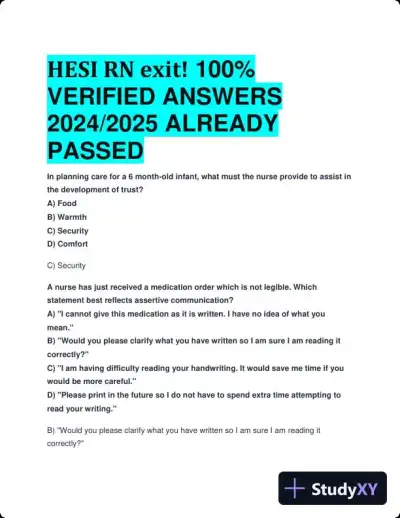 Past Exams
2024-2025 HESI RN Exit Exam with Answers (156 Solved Questions)
Health Education Systems, Inc.
44 pages92downloadsFeb 2025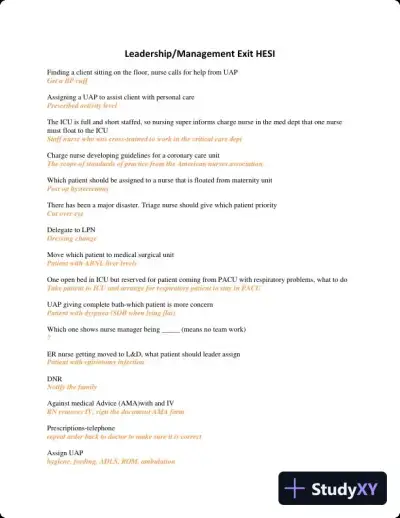 Past Exams
HESI Leadership/Management Exit Exam with Answers (59 Solved Questions)
Health Education Systems, Inc.
4 pages54downloadsFeb 2025 Certification Guides
4 HESI A2 Practice Tests (2020)
Health Education Systems, Inc.
434 pages50downloadsFeb 2025
Study this document with CramX
Once it is in your library, every tool can work from it.