

2021 HESI PN Medical surigical Proctored Exam Versions 3 With Answers (102 Solved Questions)
- Health Education Systems, Inc.
- 47 pages
- Shared May 2025
2021 HESI PN Medical surigical Proctored Exam Versions 3 With Answers provides an in-depth look at past exam trends.
Preview 15 of 47 pages
See the first 15 pages exactly as they appear in the document.
Page 1 Read page 1 as text
VERSION 3 ATI MED-SURG PROCTORED EXAM PRACTICE QUESTIONS WITH ANSWERS (100 Q/A) 1. A nurse is caring for a client who has a closed head injury and has an intraventricular catheter placed. Which of the following findings indicates that the client is experiencing increased ICP? a. Flat jugular veins b. GCS score of 15 c. Sleepiness exhibited by the client d. Widening pulse pressure e. Decerebrate posturing f. Flat jugular veins is incorrect. With increased ICP, the jugular veins are typically distended. A Glasgow Coma Scale score of 15 is incorrect. A Glasgow Coma Scale score of 15 indicates neurological functioning within the expected reference range for eye
Page 2 Page 3 Read page 3 as text
opening, motor, and verbal response. Sleepiness exhibited by the client is correct. Sleepiness or difficulty arousing the client from sleep is an indication of increased ICP. Widening pulse pressure is correct. A widening pulse pressure (increase in systolic with concurrent decrease in diastolic blood pressure) is an indication of increased ICP. Decerebrate posturing is correct. Both decerebrate and decorticate posturing indicate increased ICP. 2. A nurse is preparing a client who has supraventricular tachycardia for elective cardioversion. Which of the following prescribed medications should the nurse instruct the clients to withhold for 48hr prior to cardioversion? a. Enoxaparin b. Metformin c. Diazepam d. Digoxin e. Anticoagulants can be beneficial during cardioversion due to their ability to prevent blood clots that can be released into the client's circulatory system after cardioversion. This medication should not be withheld. f. Metformin g. Metformin might be withheld for a client scheduled for cardiac catheterization or other procedures involving contrast dye in order to prevent damage to the kidneys. However, metformin should not be withheld prior to cardioversion. h. Diazepam i. Sedatives are generally administered to clients prior to cardioversion to reduce anxiety and minimize the discomfort associated with the procedure. This medication should not be withheld. j. Digoxin: ANSWER k. Cardiac glycosides, such as digoxin, are withheld prior to cardioversion. These medications can increase ventricular irritability and put the client at risk for ventricular fibrillation after the synchronized countershock of cardioversion. 3. A nurse is assessing a client who has acute cholecystitis. which of the following findings is the nurse’s priority? a. Anorexia b. Abdominal pain radiating to the right shoulder c. Tachycardia d. Rebound abdominal tenderness
Page 4 Read page 4 as text
i. Anorexia ii. Anorexia is nonurgent because it is an expected finding for a client who has acute cholecystitis. Therefore, there is another finding that is the nurse's priority. iii. Abdominal pain radiating to the right shoulder iv. MY ANSWER v. Abdominal pain radiating to the right shoulder is nonurgent because it is an expected finding for a client who has acute cholecystitis. Therefore, there is another finding that is the nurse's priority. vi. Tachycardia vii. When using the urgent vs. nonurgent approach to client care, the nurse should determine that the priority finding is tachycardia. Tachycardia is a manifestation of biliary colic, which can lead to shock. The nurse should position the head of the client's bed flat and report this finding immediately to the provider. viii. Rebound abdominal tenderness ix. Rebound abdominal tenderness is nonurgent because it is an expected finding for a client who has acute cholecystitis. Therefore, there is another finding that is the nurse's priority. 4. A nurse is preparing to admit a client who has dysphagia. The nurse should plant to place which of the following items at the client’s bedside? a. Suction machine b. Wire cutters c. Padded clamp d. Communication board e. Suction machine: ANSWERThe nurse should ensure that a suction machine is at the bedside of a client who has dysphagia to clear the client's airway as needed and reduce the risk for aspiration. f. Wire cutters: The nurse should ensure wire cutters are at the bedside of a client who has an inner maxillary fixation to cut the wires in case the client vomits. This enables the client to clear their airway and reduce the risk for aspiration. g. Padded clamp: The nurse should ensure a padded clamp is at the bedside of a client who has a chest tube to clamp the tube and prevent air from entering the client's chest if there is an interruption in the sealed drainage system. h. Communication board: The nurse should ensure a communication board is at the bedside of a client who has aphasia to assist the client with communicating.
Page 5 Read page 5 as text
5. A nurse is caring for a client who is having a seizure. Which of the following intervention is the nurse’s priority? a. Loosen the clothing around the client’s neck b. Check the client’s pupillary response c. Turn the client to the side. d. Move furniture away from the client i. Loosen the clothing around the client's neck: The nurse should loosen any restrictive clothing the client is wearing to prevent injury to the client. However, another action is the priority. ii. Check the client's pupillary response: The nurse should perform neurologic checks after the seizure to monitor the client's recovery. However, another action is the priority. iii. Turn the client to the side.: The greatest risk to this client is hypoxia from an impaired airway. Therefore, the priority intervention the nurse should take is to place the client in a side-lying position to prevent aspiration. iv. Move furniture away from the client.: AThe nurse should move furniture away from the client to prevent self-injury. However, another action is the priority. 6. A nurse is providing teaching to aclient who has hypothyroidism and is receiving levothyroxine. The nurse should instruct the client that which of the following supplements can interfere with the effectiveness of the medication? a. Ginkgo biloba b. Glucosamine c. Calcium d. Vitamin C i. Ginkgo biloba ii. Ginkgo biloba reduces the pain associated with peripheral vascular disease by promoting vasodilation. It can interact with medications that have anticoagulant properties, but it is not known to interfere with the absorption of levothyroxine. iii. Glucosamine: Glucosamine treats osteoarthritis by decreasing inflammation and stimulating the body's production of synovial fluid and cartilage. It can interact with medications that have antiplatelet or anticoagulant properties, but it is not known to interfere with the absorption of levothyroxine. iv. Calcium:NSWER
Page 6 Read page 6 as text
v. Calcium limits the development of osteoporosis in clients who are postmenopausal and works as an antacid. Calcium supplements can interfere with the metabolism of a number of medications, including levothyroxine. The nurse should instruct the client to avoid taking calcium within 4 hr of levothyroxine administration. vi. Vitamin C: Vitamin C promotes wound healing. It can cause a false negative in fecal occult blood tests, but it is not known to interfere with the absorption of levothyroxine. 7. A nurse is planning to irrigate and dress a clean, granulation wound for a client who has a pressure injury. Which of the following actions should the nurse take? a. Apply a wet-to-dry gauze dressing b. Irrigate with hydrogen peroxide solution c. Use a 30-ml syringe d. Attach a 24-gauge angiocatheter to the syringe. 8. a. Apply a wet-to-dry gauze dressing.: The nurse should not apply wet-to-dry dressings to clean, granulating wounds as they interrupt viable, healing tissues when they are removed. Appropriate dressings for a wound that is developing granulation tissue include a hydrocolloid dressing and a transparent film dressing. b. Irrigate with hydrogen peroxide solution: the nurse should use hydrogen peroxide to clean contaminated surfaces. Hydrogen peroxide should not be used on a pressure injury wound because it destroys newly granulated tissue. Instead, the nurse should use solutions specifically designed as wound cleansers or 0.9% sodium chloride irrigation to irrigate the wound. c. Use a 30-mL syringe: NSWERThe nurse should use a 30-mL to 60-mL syringe with an 18- or 19-gauge catheter to deliver the ideal pressure of 8 pounds per square inch (psi) when irrigating a wound. To maintain healthy granulation tissue, the wound irrigation should be delivered at between 4 and 15 psi. d. Attach a 24-gauge angiocatheter to the syringe:the nurse should use an 18- or 19- gauge catheter that will apply the appropriate irrigation pressure. A 24-gauge angiocatheter delivers solutions at a higher pressure than necessary for irrigation and a can potentially damage the developing granulation tissues. 1. a nurse Is assessing a client who has Graves’ disease. Thich of the collowing images should undicate to the nurse that the client has exophthalmos:
Page 7 Read page 7 as text
o o This image depicts entropion, which occurs when the skin of the eyelids turns inward, causing the eyelids to rub the eye. Entropion is caused by spasms of the eyelid muscle or trauma and occurs most often in older adult clients due to the loss of supportive tissue. o o This image depicts ectropion, which occurs when the skin of the eyelids turns outward, causing sagging of the lower lids due to muscle weakness. Ectropion occurs with aging and can cause drying of the cornea and ulceration. o o This image depicts ptosis, which occurs when excess skin of the upper eyelid drops down over the eye. Ptosis can occur due to aging or at any age due to diabetes, myasthenia gravis, or stroke.
Page 8 Read page 8 as text
o o MY ANSWER o The nurse should identify an outward protrusion of the eyes as exophthalmos, a common finding of Graves' disease. An overproduction of the thyroid hormone causes edema of the extraocular muscle and increases fatty tissue behind the eye, which results in the eyes protruding outward. Exophthalmos can cause the client to experience problems with vision, including focusing on objects, as well as pressure on the optic nerve. 11.the nurse is providing teaching to a female client who has a history of UTI’s. which of the following information should the nurse include in the teaching? a. Avoid foods that are high in ascorbic acid b. Add oatmeal to the water when taking a tub bath c. Urinate every 6 hours d. Take daily cranberry supplements? 12. A nurse is providing teaching to a client who has esophageal cancer and is to undergo radiation therapy. Which off the following statements should the nurse identify as an indication that the client understands the teaching? a. “ I will wash the ink markings off the radiation area after each treatment.” b. “I will use my hands rather than a washcloth to clean the radiation area.” c. “I will be able to be out in the sun 1 month after my radiation treatments are over.” d. “I will use a heating pad on my neck it if becomes sore during the radiation therapy.” i. "I will wash the ink markings off the radiation area after each treatment." ii. The ink markings designate the exact radiation area. The client should not remove these markings until they complete the entire radiation treatment. iii. "I will use my hands rather than a washcloth to clean the radiation area." iv. MY ANSWER v. The client should gently wash the radiation area with their hands using warm water and mild soap to protect the skin from further irritation.
Page 9 Read page 9 as text
vi. "I will be able to be out in the sun 1 month after my radiation treatments are over." vii. Radiation therapy causes skin to become sensitive to the effects of sun exposure and increases the risk for developing skin cancer. The client should avoid direct sunlight during the radiation treatments and for at least 1 year following the conclusion of the therapy. viii. "I will use a heating pad on my neck if it becomes sore during the radiation therapy." ix. The client should avoid exposing the treatment area to heat as this can cause further irritation to the skin. 13.A nurse is caring for a client 1 hr following a cardiac catheterization. The nurse notes the formation of a hematoma at the insertion site and a decreased pulse rate in the affected extremity. Which of the following interventions is the nurse’s priority? a. Initiate oxygen at 2 L via nasal cannula b. Apply firm pressure to the insertion site c. Take the client’s vital signs d. Obtain a stat order for an aPTT i. Initiate oxygen at 2 L/min via nasal cannula.: The nurse can apply oxygen to promote adequate tissue oxygenation. However, another intervention is the priority. ii. Apply firm pressure to the insertion site.: MY ANSWERThe greatest risk to the client is bleeding. Therefore, the priority intervention is for the nurse to apply firm pressure to the hematoma to stop the bleeding. iii. Take the client's vital signs.: The nurse should take the client's vital signs to further determine the client's status. However, another intervention is the priority. iv. Obtain a stat order for an aPTT.: The nurse can request laboratory data to provide information about the client's coagulation status. However, another intervention is the priority. 14.A nurse is caring for a client who has emphysema and is receiving mechanical ventilation. The client appears anxious and restless, and the high-pressure alarm is sounding. Which of the following actions should the nurse take first? a. Obtain ABGs b. Administer propofol to the client c. Instruct the client to allow the machine to breathe for them d. Disconnect the machine and manually ventilate the client. i. Obtain ABGs. The nurse should monitor ABG results to determine the effectiveness of mechanical ventilation, but this is not the first action the nurse should take.
Page 10 Read page 10 as text
ii. Administer propofol to the client.: The nurse might need to administer propofol to provide sedation and increase the client's tolerance of mechanical ventilation, but this is not the first action the nurse should take. iii. Instruct the client to allow the machine to breathe for them.: When providing client care, the nurse should first use the least restrictive intervention. Therefore, the first action the nurse should take is to provide verbal instructions and emotional support to help the client relax and allow the ventilator to work. Clients can exhibit anxiety and restlessness when trying to "fight the ventilator." iv. Disconnect the machine and manually ventilate the client.: Many factors can cause a high-pressure alarm to sound. The nurse might have to disconnect the machine and manually ventilate the client if the ventilator fails or the client experiences respiratory distress, but this is not the first action the nurse should take. 15.A nurse is reviewing the lab results of a client who has cirrhosis. Which of the following laboratory values should the nurse expect? a. Decreased prothrombin time b. Elevated bilirubin level c. Decreased ammonia level d. Elevated albumin level i. Decreased prothrombin time: liver disease and severe liver cell damage causes the liver cells to produce less prothrombin, which prolongs prothrombin time. ii. Elevated bilirubin level: Bilirubin levels reflect the liver's ability to conjugate and excrete bilirubin, a byproduct of the hemolysis of red blood cells. Bilirubin levels rise with liver disease and clinically reflect the client's degree of jaundice. iii. Decreased ammonia level: The liver converts ammonia to urea. When this process is interrupted, as it is with liver disease or liver failure, ammonia levels rise. iv. Elevated albumin level: Albumin forms in the liver. When liver function is impaired, as it is with cirrhosis, albumin levels decrease. 16.A nurse is teaching a client who has venous insufficiency about self-care. Which of the following statements should the nurse identify as an indication that the client understands the teaching? a. “ I should avoid walking as much as possible.” b. “I should sit down and read for several hours a day” c. “I will wear clean graduatied compression stockings every day.” d. “I will keep my legs level with my body when I sleep at night.”
Page 11 Read page 11 as text
i. "I should avoid walking as much as possible.": A client who has venous insufficiency should maintain an exercise regimen, such as routine walking, to decrease venous stasis. ii. "I should sit down and read for several hours a day.": A client who has venous insufficiency should avoid sitting or standing for prolonged periods of time due to the risk of developing deep-vein thrombosis or skin breakdown. iii. "I will wear clean graduated compression stockings every day.": Y ANSWERThe client should apply a clean pair of graduated compression stockings each day and clean soiled stockings with mild detergent and warm water by hand. iv. "I will keep my legs level with my body when I sleep at night.": A client who has venous insufficiency should elevate the legs above heart level while in bed to facilitate venous return and avoid venous stasis. 17.A nurse is caring for a client who is postoperative following a total hip arthroplasty. Which of the following laboratory values should the nurse report to the provider? a. Potassium 4 mEq/L b. WBC count 10,000/mm3 c. Hct 45% d. Hgb 8 g/dL i. Potassium 4 mEq/L: A potassium level of 4 mEq/L is within the expected reference range. ii. WBC count 10,000/mm 3: A WBC count of 10,000/mm 3 is within the expected reference range. iii. Hct 45%: An Hct level of 45% is within the expected reference range. iv. Hgb 8 g/dL: Y ANSWERThe nurse should report an Hgb level of 8 g/dL, which is below the expected reference range and is an indicator of postoperative hemorrhage or anemia. 18.A nurse is caring for a client who has a stage III pressure injury. Which of the following findings contributes to delayed would healing? a. WBC count 6K b. BMI 24 c. Urine output 25ml/hr d. Albumin 4 WBC count 6,000/mm 3: ANSWERWBCs fight infection and respond to foreign bodies. Increased amounts are seen in clients who have an infectious process, and decreased amounts are seen in clients who are immunocompromised. A WBC count of 6,000/mm 3 is within the expected reference range.
Page 12 Read page 12 as text
BMI 24: BMI readings provide a means of determining a client's nutritional status. Clients who have a BMI less than 18.5 are considered at risk for complications, such as poor wound healing. Urine output 25 mL/hr: Urinary output reflects fluid status. Inadequate urine output can indicate dehydration, which can delay wound healing. Albumin 4 g/dL: Albumin reflects nutritional status. A low level can indicate malnutrition, which would impair wound healing. An albumin level of 4 g/dL is within the expected reference range and indicates adequate nutritional status. i. 19.A nurse is caring for a client who is undergoing hemodialysis to treat ESKD. The client reports muscle cramps and a tingling sensation in their hands. Which of the following medications should the nurse plan to administer? i. Epoetin alfa: A client who has ESKD is at risk for anemia manifested by malaise, fatigue, and activity intolerance. The nurse should plan to administer an erythrocyte-stimulating agent, such as epoetin alfa, to a client who has anemia. ii. Furosemide: A client who has ESKD can develop pulmonary edema manifested by restlessness, shortness of breath, crackles, and blood-tinged sputum. The nurse should plan to administer a loop diuretic, such as furosemide, to a client who has pulmonary edema. iii. Captopril: A client who has ESKD often is hypertensive, which can further damage renal function. The nurse should plan to administer an antihypertensive medication, such as captopril, to a client who is hypertensive. iv. Calcium carbonate: ANSHypocalcemia is a manifestation of ESKD and an adverse effect of dialysis. Often occurring late in the dialysis session, hypocalcemia can cause the client to experience muscle cramping and tingling to extremities. The nurse should plan to administer a calcium supplement, such as calcium carbonate, as a calcium replacement. 22.a nurse is planning care for a client who is undergoing brachytherapy via a sealed vaginal implant to treat endometrial cancer. Which of the following actions should the nurse include in the client’s plan of care? a. Collect and place the client’s urine or feces in a biohazard bag b. Limit the client’s ambulation to their own room c. Wear a lead apron while providing care to the client d. Limit each visitor to 1 hr per day. i. Collect and place the client's urine or feces in a biohazard bag.
Page 13 Read page 13 as text
ii. With sealed implants, the client's excretions are not radioactive. Standard precautions require gloves when handling body fluids or waste, but there are no special precautions required for this client's excreta. iii. Limit the client's ambulation to their own room. iv. Not only does the client require bedrest in a private room while the radiation implant is in place, but the nurse must also discourage the client from any excessive movements while in bed to prevent dislodging the implant. v. Wear a lead apron while providing care to the client. vi. MY ANSWER vii. The nurse should wear a lead apron when providing direct care to provide protection from the radiation source and not turn their back toward the client, because the apron only shields the front of the body. The nurse should also wear a dosimeter film badge to measure radiation exposure. viii. Limit each visitor to 1 hr per day.: The nurse should limit each of the client's visitors to 30 min per day and instruct them to remain at least 1.8 m (6 ft) from the client at all times. 23.A nurse is preparing to administer a unit of PRBCs to a client. Which of the following actions should the nurse take? i. Remain with the client for the first 15 min of the infusion.: Y ANSWER ii. The nurse should remain with the client for the first 15 to 30 min of the infusion because hemolytic reactions usually occur during the infusion of the first 50 mL of blood. iii. Prime the blood administration IV tubing with lactated Ringer's solution. iv. The nurse should use 0.9% sodium chloride when transfusing blood to prevent clotting or hemolysis of the RBCs. v. Verify the client's identity by using the client's room number prior to starting the transfusion. vi. The client's room number is not an acceptable client identifier. The nurse should ensure that the name and number on the client's identification band matches the name and identification number on the blood label. The client's identification, the blood compatibility, and the expiration date of the blood should be verified by two nurses. vii. Infuse the unit of packed RBCs within 8 hr.: The nurse should transfuse the packed RBCs within 2 to 4 hr based upon the client's age and
Page 14 Read page 14 as text
cardiovascular status. Longer infusion times increase the risk for bacterial contamination of the blood product. 26.a nurse is caring for a client who presents to a clinic for a 1-week follow-up visit after hospitalization for heart failure. Based on the information in the client’s chart, which of the following findings should the nurse report to the provider? a. Potassium 4.1 mEq/L : The client's potassium level of 4.1 mEq/L is within the expected reference range. b. Heart rate 55/min: The client's heart rate of 55/min is a decrease from the client's baseline of 74/min, and it can indicate the development of digoxin toxicity. The nurse should report this finding to the provider. c. SaO 2 92%: Y ANSWERThe nurse should ensure that the client's SaO 2 level remains at or above 90%. This finding is within the expected reference range. d. Weight 67.1 kg (148 lb): The nurse should report a client's weight gain of 1.4 kg (3 lb) in a day or 2.3 kg (5 lb) or more in a week. 27.A nurse is caring for a client who has a potassium level of 3 mEq/L/ Whichh of the following assessment findings should the nurse expect? a. Positive trousseaus sign b. 4+ deep tendon reflexes c. Deep respirations d. Hypoactive bowel sounds i. Positive Trousseau's sign: positive Trousseau's sign indicates altered calcium levels. ii. 4+ deep tendon reflexes: Deep tendon reflexes are used to monitor magnesium levels. iii. Deep respirations: Shallow respirations occur with hypokalemia due to respiratory muscle weakness. iv. hypoactive bowel sounds: Y ANSWERHypokalemia decreases smooth muscle contraction in the gastrointestinal tract leading to decreased peristalsis. 28.A nurse is providing dietary teaching to a client who is postoperative following a thyroidectomy with removal of the parathyroid glands. The nurse shouldinstruct the client to include which of the following foods that has the greatest amount of calcium in her diet. i. 12 almonds: Y ANSWERThe nurse should determine that almonds are the best source of calcium to recommend because 12 almonds contain 36 mg of calcium. Removal of the parathyroid glands, which regulate calcium in the body, can result in hypocalcemia.
Page 15 Read page 15 as text
ii. One small banana: The nurse should recommend a different food because there is another choice that contains more calcium. One small banana contains 5 mg of calcium. iii. 1 tbsp peanut butter: The nurse should recommend a different food because there is another choice that contains more calcium. One tbsp of peanut butter contains 8 mg of calcium. iv. 1/2 cup tomato juice: The nurse should recommend a different food because there is another choice that contains more calcium. A half cup of tomato juice contains 12 mg of calcium. v. 29.A nurse in a community clinic is caring for a client who reports an increase in the frequency of migraine headaches. To reduce the risk for migraine headaches, which of the following foods should the nurse recommend the client avoid? a. Shellfish b. Aged cheese: Aged cheese 30.MY ANSWER i. Foods that contain tyramine, such as aged cheese and sausage, can trigger migraine headaches. b. Peppermint candy c. Enriched pasta 31.A nurse in an emergency department is caring for a client who reports vomiting and diarrhea for the past 3 days. Which of the following findings should indicate to the nurse that the client is experiencing FVD? a. HR 110/min b. BP 138/90 c. Urine Specific Gravity 1.020 d. BUN 15 mg/dL i. Heart rate 110/min client who has a 3-day history of vomiting and diarrhea is likely to have fluid volume deficit and an elevated heart rate. ii. Blood pressure 138/90 mm Hg: A blood pressure of 138/90 mm Hg is within the expected reference range. A client who has a 3-day history of vomiting and diarrhea is likely to have fluid volume deficit and hypotension. iii. Urine specific gravity 1.020: A urine specific gravity of 1.020 is within the expected reference range. A client who has a 3-day history of vomiting and diarrhea is likely to have fluid volume deficit, which is indicated by a urine specific gravity greater than 1.030.
32 more pages in the full document
Unlock it once and it stays in your library, ready to chat with or turn into flashcards.
Unlock the full documentMore Health Education Systems, Inc. study materials
See all Past Exams
2023-2024 RN HESI Exit Exam Version 3 with Answers (53 Solved Questions)
Health Education Systems, Inc.
13 pages163downloadsFeb 2025 Past Exams
2024-2025 HESI A2 Biology Entrance Exam with Answers (42 Solved Questions)
Health Education Systems, Inc.
13 pages154downloadsFeb 2025 Past Exams
2024-2025 HESI A2 Anatomy and Physiology V1/V2 Practice Exam with Answers (134 Solved Questions)
Health Education Systems, Inc.
15 pages134downloadsFeb 2025 Past Exams
2024-2025 HESI A2 Entrance Exam with Answers (232 Solved Questions)
Health Education Systems, Inc.
26 pages132downloadsFeb 2025 Past Exams
2024-2025 HESI Milestone Exam 1 with Answers (162 Solved Questions)
Health Education Systems, Inc.
26 pages119downloadsFeb 2025 Past Exams
2024-2025 HESI A2 Critical Thinking with Answers (124 Solved Questions)
Health Education Systems, Inc.
114 pages106downloadsFeb 2025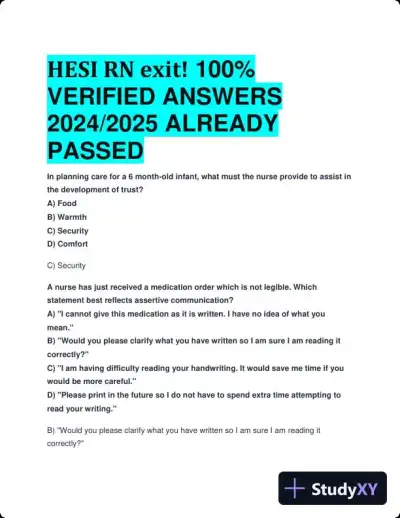 Past Exams
2024-2025 HESI RN Exit Exam with Answers (156 Solved Questions)
Health Education Systems, Inc.
44 pages92downloadsFeb 2025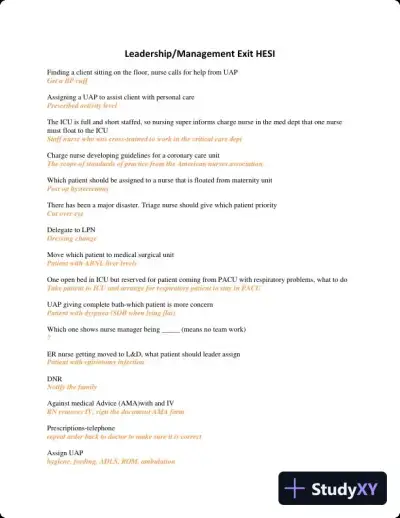 Past Exams
HESI Leadership/Management Exit Exam with Answers (59 Solved Questions)
Health Education Systems, Inc.
4 pages54downloadsFeb 2025
Study this document with CramX
Once it is in your library, every tool can work from it.