

2023 HESI Fundamentals Practice Question With Answers (72 Solved Questions)
- Health Education Systems, Inc.
- 34 pages
- Shared May 2025
Get access to a wide selection of past exams with 2023 HESI Fundamentals Practice Question With Answers, covering all major topics.
Preview 11 of 34 pages
See the first 11 pages exactly as they appear in the document.
Page 1 Read page 1 as text
EVOLVE HESI FUNDAMENTALS PRACTICE QUESTIONS AND CORRECT ANSWERS GRADED A+ 2023 LATEST UPDATE Urinary catheterization is prescribed for a postoperative female client who has been unable to void for 8 hours. The nurse inserts the catheter, but no urine is seen in the tubing. Which action will the nurse take next? • Clamp the catheter and recheck it in 60 minutes. • Pull the catheter back 3 inches and redirect upward. • Leave the catheter in place and reattempt with another catheter. • Notify the health care provider of a possible obstruction. - Answer: C It is likely that the first catheter is in the vagina, rather than the bladder. Leaving the first catheter in place will help locate the meatus when attempting the second catheterization (C). The client should have at least 240 mL of urine after 8 hours. (A) does not resolve the problem. (B) will not change the location of the catheter unless it is completely remo ved, in which case a new catheter must be used. There is no evidence of a urinary tract obstruction if the catheter could be easily inserted (D). The nurse is teaching an obese client, newly diagnosed with arteriosclerosis, about reducing the risk of a heart attack or stroke. Which health promotion brochure is most important for the nurse to provide to this client? • "Monitoring Your Blood Pressure at Home" • "Smoking Cessation as a Lifelong Commitment" • "Decreasing Cholesterol Levels Through Diet" • "Stress Management for a Healthier You" - Answer: C
Page 2 Page 3 Read page 3 as text
A health promotion brochure about decreasing cholesterol (C) is most important to provide this client, because the most significant risk factor contributing to development of arteriosclerosis is excess dietary fat, particularly saturated fat and cholesterol. (A) does not address the underlying causes of arteriosclerosis. (B and D) are also important factors for reversing arteriosclerosis but are not as important as lowering cholesterol (C). Ten minutes after signing an operative permit for a fractured hip, an older client states, "The aliens will be coming to get me soon!" and falls asleep. Which action should the nurse implement next? • Make the client comfortable and allow the client to sleep. • Assess the client's neurologic status. • Notify the surgeon about the comment. • Ask the client's family to co - sign the operative permit. - Answer: B This statement may indicate that the client is confused. Informed consent must be provided by a mentally competent individual, so the nurse should further assess the client's neurologic status (B) to be sure that the client understands and can legally provide consent for surgery. (A) does not provide sufficient follow - up. If the nurse determines that the client is confused, the surgeon must be notified (C) and permission obtained from the next of kin (D). The nurse - manager of a skilled nursing (chronic care) unit is instructing UAPs on ways to prevent complications of immobility. Which intervention should be included in this instruction? • Perform range - of - motion exercises to prevent contractures. • Decrease the client's fluid intake to prevent diarrhea. • Massage the client's legs to reduce embolism occurrence. • Turn the client from side to back every shift. - Answer: A
Page 4 Read page 4 as text
Performing range - of - motion exercises (A) is beneficial in reducing contractures around joints. (B, C, and D) are all potentially harmful practices that place the immobile client at risk of complications. The nurse is assisting a client to the bathroom. When the client is 5 feet from the bathroom door, he states, "I feel faint." Before the nurse can get the client to a chair, the client starts to fall. Which is the priority action for the nurse to take? • Check the client's carotid pulse. • Encourage the client to get to the toilet. • In a loud voice, call for help. • Gently lower the client to the floor. - Answer: D (D) is the most prudent intervention and is the priority nursing action to prevent injury to the client and the nurse. Lowering the client to the floor should be done when the client cannot support his own weight. The client should be placed in a bed or chair only when sufficient help is available to prevent injury. (A) is important but should be done after the client is in a safe position. Because the client is not supporting himself, (B) is impractical. (C) is likely to cause chaos on the unit and might alarm the other clients. A female nurse is assigned to care for a close friend, who says, "I am worried that friends will find out about my diagnosis." The nurse tells her friend that legally she must protect a client's confidentiality. Which resource describes the nurse's legal responsibilities? • Code of Ethics for Nurses • State Nurse Practice Act • Patient's Bill of Rights • ANA Standards of Practice - Answer: B The State Nurse Practice Act (B) contains legal requirements for the protection of client confidentiality and the consequences for breaches in confidentiality. (A) outlines ethical standards
Page 5 Read page 5 as text
for nursing care but does not include legal guidelines. (C and D) describe expectations for nursing practice but do not address legal implications. The nurse is teaching a client how to perform progressive muscle relaxation techniques to relieve insomnia. A week later the client reports that he is still unable to sleep, despite following the same routine every night. Which action should the nurse take first? • Instruct the client to add regular exercise as a daily routine. • Determine if the client has been keeping a sleep diary. • Encourage the client to continue the routine until sleep is achieved. • Ask the client to describe the routine that the client is currently following. - Answer: D The nurse should first evaluate whether the client has been adhering to the original instructions (D). A verbal report of the client's routine will provide more specific information than the client's written diary (B). The nurse can then determine which changes need to be made (A). The routine practiced by the client is clearly unsuccessful, so encouragement alone is insufficient (C). A 65 - year - old client who attends an adult daycare program and is wheelchair - mobile has redness in the sacral area. Which instruction is most important for the nurse to provide? A. Take a vitamin supplement tablet once a day. B. Change positions in the chair at least every hour. C. Increase daily intake of water or other oral fluids. D. Purchase a newer model wheelchair. - Answer: B The most important teaching is to change positions frequently (B) because pressure is the most significant factor related to the development of pressure ulcers. Increased vitamin and fluid intake (A and C) may also be beneficial promote healing and reduce further risk. (D) is an intervention of last resort because this will be very expensive for the client. When turning an immobile bedridden client without assistance, which action by the nurse best ensures client safety?
Page 6 Read page 6 as text
• Securely grasp the client's arm and leg. • Put bed rails up on the side of bed opposite from the nurse. • Correctly position and use a turn sheet. • Lower the head of the client's bed slowly. - Answer: B Because the nurse can only stand on one side of the bed, bed rails should be up on the opposite side to ensure that the client does not fall out of bed (B). (A) can cause client injury to the skin or joint. (C and D) are useful techniques while turning a client but have less priority in terms of safety than use of the bed rails. A female client with frequent urinary tract infections (UTIs) asks the nurse to explain her friend's advice about drinking a glass of juice daily to prevent future UTIs. Which response is best for the nurse provide? • Orange juice has vitamin C that deters bacterial growth. • Apple juice is the most useful in acidifying the urine. • Cranberry juice stops pathogens' adherence to the bladder. • Grapefruit juice increases absorption of most antibiotics. - Answer: C Cranberry juice (C) maintains urinary tract health by reducing the adherence of Escherichia coli bacteria to cells within the bladder. (A, B, and D) have not been shown to be as effective as cranberry juice (C) in preventing UTIs. The nurse is aware that malnutrition is a common problem among clients served by a community health clinic for the homeless. Which laboratory value is the most reliable indicator of chronic protein malnutrition? • Low serum albumin level • Low serum transferrin level
Page 7 Read page 7 as text
• High hemoglobin level • High cholesterol level - Answer: A Long - term protein deficiency is required to cause significantly lowered serum albumin levels (A). Albumin is made by the liver only when adequate amounts of amino acids (from protein breakdown) are available. Albumin has a long half - life, so acute protein loss does not significantly alter serum levels. (B) is a serum protein with a half - life of only 8 to 10 days, so it will drop with an acute protein deficiency. Neither (C or D) are clinical measures of protein malnutrition. The nurse identifies a potential for infection in a patient with partial - thickness (second - degree) and full - thickness (third - degree) burns. What intervention has the highest priority in decreasing the client's risk of infection? • Administration of plasma expanders • Use of careful hand washing technique • Application of a topical antibacterial cream • Limiting visitors to the client with burns - Answer: B Careful hand washing technique (B) is the single most effective intervention for the prevention of contamination to all clients. (A) reverses the hypovolemia that initially accompanies burn trauma but is not related to decreasing the proliferation of infective organisms. (C and D) are recommended by various burn centers as possible ways to reduce the chance of infection. (B) is a proven technique to prevent infection. Which serum laboratory value should the nurse monitor carefully for a client who has a nasogastric (NG) tube to suction for the past week? • White blood cell count • Albumin • Calcium • Sodium - Answer: D
Page 8 Read page 8 as text
Monitoring serum sodium levels (D) for hyponatremia is indicated during prolonged NG suctioning because of loss of fluids. Changes in levels of (A, B, or C) are not typically associated with prolonged NG suctioning. In completing a client's preoperative routine, the nurse finds that the operative permit is not signed. The client begins to ask more questions about the surgical procedure. Which action should the nurse take next? • Witness the client's signature to the permit. • Answer the client's questions about the surgery. • Inform the surgeon that the operative permit is not signed and the client has questions about the surgery. • Reassure the client that the surgeon will answer any questions before the anesthesia is administered. - Answer: C The surgeon should be informed immediately that the permit is not signed (C). It is the surgeon's responsibility to explain the procedure to the cliesxnt and obtain the client's signature on the permit. Although the nurse can witness an operative permit (A), the procedure must first be explained by the health care provider or surgeon, including answering the client's questions (B). The client's questions should be addressed before the permit is signed (D). The nurse is preparing an older client for discharge. Which method is best for the nurse to use when evaluating the client's ability to perform a dressing change at home? • Determine how the client feels about changing the dressing. • Ask the client to describe the procedure in writing. • Seek a family member's evaluation of the client's ability to change the dressing. • Observe the client change the dressing unassisted. - Answer: D Observing the client directly (D) will allow the nurse to determine if mastery of the skill has been obtained and provide an opportunity to affirm the skill. (A) may be therapeutic but will not provide an
Page 9 Read page 9 as text
opportunity to evaluate the client's ability to perform the procedure. (B) may be threatening to an older client and will not determine his ability. (C) is not as effective as direct observation by the nurse. A client in a long - term care facility reports to the nurse that he has not had a bowel movement in 2 days. Which intervention should the nurse implement first? • Instruct the caregiver to offer a glass of warm prune juice at mealtimes. • Notify the health care provider and request a prescription for a large - volume enema. • Assess the client's medical record to determine the client's normal bowel pattern. • Instruct the caregiver to increase the client's fluids to five 8 - ounce glasses per day. • Answer: C This client may not routinely have a daily bowel movement, so the nurse should first assess this client's normal bowel habits before attempting any intervention (C). (A, B, or D) may then be implemented, if warranted . The nurse is instructing a client with cholecystitis regarding diet choices. Which meal best meets the dietary needs of this client? • Steak, baked beans, and a salad • Broiled fish, green beans, and an apple • Pork chops, macaroni and cheese, and grapes • Avocado salad, milk, and angel food cake • Answer: B When bathing an uncircumcised boy older than 3 years, which action should the nurse take? • Remind the child to clean his genital area. • Defer perineal care because of the child's age.
Page 10 Read page 10 as text
• Retract the foreskin gently to cleanse the penis. • Ask the parents why the child is not circumcised. • Answer: C The foreskin (prepuce) of the penis should be gently retracted to cleanse all areas that could harbor bacteria (C). The child's cognitive development may not be at the level at which (A) would be effective. Perineal care needs to be provided daily regardless of the client's age (B). (D) is not indicated and may be perceived as intrusive . The nurse who is preparing to give an adolescent client a prescribed antipsychotic medication notes that parental consent has not been obtained. Which action should the nurse take? • Review the chart for a signed consent for hospitalization. • Get the health care provider's permission to give the medication. • Do not give the medication and document the reason. • Complete an incident report and notify the parents. • Answer: C The nurse should not give the medication and should document the reason (C) because the client is a minor and needs a guardian's permission to receive medications. Permission to give medications is not granted by a signed hospital consent (A) or a health care provider's permission (B), unless conditions are met to justify coerced treatment. (D) is not necessary unless the medication had previously been administered. A nurse is working in an occupational health clinic when an employee walks in and states that he was struck by lightning while working in a truck bed. The client is alert but reports feeling faint. Which assessment will the nurse perform first? • Pulse characteristics • Open airway • Entrance and exit wounds E. Cervical spine injury –
Page 11 Read page 11 as text
Answer: A Lightning is a jolt of electrical current and can produce a "natural" defibrillation, so assessment of the pulse rate and regularity (A) is a priority. Because the client is talking, he has an open airway (B), so that assessment is not necessary. Assessing for (C and D) should occur after assessing for adequate circulation. The mental health nurse plans to discuss a client's depression with the health care provider in the emergency department. There are two clients sitting across from the emergency department desk. Which nursing action is best? A. Only refer to the client by gender. B. Identify the client only by age. C. Avoid using the client's name. D. Discuss the client another time. - Answer: D The best nursing action is to discuss the client another time (D). Confidentiality must be observed at all times, so the nurse should not discuss the client when the conversation can be overheard by others. Details can identify the client when referring to the client by gender (A) or age (B), and even when not using the client's name (C). The nurse is assessing several clients prior to surgery. Which factor in a client's history poses the greatest threat for complications to occur during surgery? • Taking birth control pills for the past 2 years • Taking anticoagulants for the past year • Recently completing antibiotic therapy • Having taken laxatives PRN for the last 6 months - Answer: B Anticoagulants (B) increase the risk for bleeding during surgery, which can pose a threat for the development of surgical complications. The health care provider should be informed that the client is taking these drugs. Although clients who take birth co ntrol pills (A) may be more susceptible to the development of thrombi, such problems usually occur postoperatively. A client with (C or D) is at less of a surgical risk than (B). When assisting a client from the bed to a chair, which procedure is best for the nurse to follow?
23 more pages in the full document
Unlock it once and it stays in your library, ready to chat with or turn into flashcards.
Unlock the full documentMore Health Education Systems, Inc. study materials
See all Past Exams
2023-2024 RN HESI Exit Exam Version 3 with Answers (53 Solved Questions)
Health Education Systems, Inc.
13 pages163downloadsFeb 2025 Past Exams
2024-2025 HESI A2 Biology Entrance Exam with Answers (42 Solved Questions)
Health Education Systems, Inc.
13 pages154downloadsFeb 2025 Past Exams
2024-2025 HESI A2 Anatomy and Physiology V1/V2 Practice Exam with Answers (134 Solved Questions)
Health Education Systems, Inc.
15 pages134downloadsFeb 2025 Past Exams
2024-2025 HESI A2 Entrance Exam with Answers (232 Solved Questions)
Health Education Systems, Inc.
26 pages132downloadsFeb 2025 Past Exams
2024-2025 HESI Milestone Exam 1 with Answers (162 Solved Questions)
Health Education Systems, Inc.
26 pages119downloadsFeb 2025 Past Exams
2024-2025 HESI A2 Critical Thinking with Answers (124 Solved Questions)
Health Education Systems, Inc.
114 pages106downloadsFeb 2025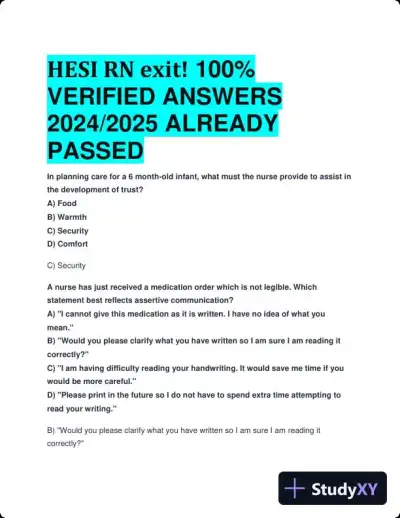 Past Exams
2024-2025 HESI RN Exit Exam with Answers (156 Solved Questions)
Health Education Systems, Inc.
44 pages92downloadsFeb 2025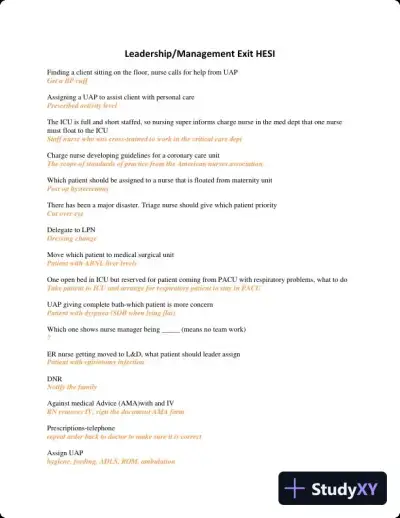 Past Exams
HESI Leadership/Management Exit Exam with Answers (59 Solved Questions)
Health Education Systems, Inc.
4 pages54downloadsFeb 2025
Study this document with CramX
Once it is in your library, every tool can work from it.