

2023 HESI Pharmacology Final Exam With Answers (155 Solved Questions)
- Health Education Systems, Inc.
- 31 pages
- Shared May 2025
2023 HESI Pharmacology Final Exam With Answers boosts your confidence by providing real exam experience.
Preview 10 of 31 pages
See the first 10 pages exactly as they appear in the document.
Page 1 Read page 1 as text
HESI PHARMACOLOGY FINAL EXAM (155 Terms) Quizzes & A ns La test Review 2023 Best Graded A+ What are the 5 rights of medication administration? - Answer: Right Patient Right Drug Right Route Right Time Right Dose How do you safely prepare medication? - Answer: Have good lighting & work alone. Check medication label 3 times (When you grab the medication, before dispensing medication, & When you replace medication.) Don't use anything without a label. Bottles with bad labels need to be returned to the pharmacy. Never transfer medication into another bottle. Check expiration date. Inspect & throw away decomposing medications. How would you administer medication via IM? - Answer: Injecting at 90° using the Z - Track method. How would you administer medication via IV? - Answer: Assess for allergies. Assess the IV site for complications. Clean the port closest to the IV site with alcohol swab. Administer medication.
Page 2 Page 3 Read page 3 as text
How would you administer medication via SubQ? - Answer: Injecting 45° (Skinny Patient) or 90° (Average Patie nt) into the fatty tissue. How would you administer medication via oral route? - Answer: Assist the patient into an upright or side lying position. Ask patient if they would like the medications in his/her hand or in the cup. Offer water. Remain with the pa tient until each medication is swallowed. Never leave the patient's bedside. How would you instill ear medications? - Answer: Warm the medication to prep it before entering the patient's room. Clean any ear drainage. Place the patient on his/her unaffected side or have the patient sit up with head titled to the unaffected side. Straighten the ear canal by pulling up & back for adults or down & back for children. Administer the medication and allow the drops to fall on the side of the canal. Avoid instilling in the middle of the canal or the tympanic membrane. Instruct patient to remain in this position for 5 minutes. Gently press on the tragus to facilitate the medication to travel towards the tympanic membrane.
Page 4 Read page 4 as text
If ordered loosely place a cotton ball into the ear canal. If you have to administer drops in both ear wait 5 minutes between each side. How would you instill eye medications? - Answer: Offer the patient a tissue. Cleanse each eye from the inner area to the outer area. If the patient does not have cervical spine injury instruct the patient to tilt his/her head back. Gently apply pressure with fingers at the edge of the lower eyelid to expose the conjunctival sac. Ad minister the medication & release the lower eyelid. Instruct patient to close eyes gently. Apply gentle pressure on the inner canthus to prevent the medication from flowing into the tear ducts. Instruct patient not to rub eyes. How would you apply a trans dermal patch? - Answer: Wear gloves! Remove the old patch & fold it close on itself. Clean the old site to remove residue. Document date, time, & initials on the new patch. Rotate site. Clean the new site. Apply the patch.
Page 5 Read page 5 as text
How would you apply an ointment me dication? - Answer: Wear gloves! Clean the area. If the medication is not powder, never administer the ointment straight from the container! Squeeze the ointment into a disposable cup. Spread over the area as prescribed. Observe for allergic reaction. Name the 5 injection sites for subcutaneous. - Answer: Abdomen Upper Arm Back Buttocks Thighs Name the 5 injection sites for intramuscular. - Answer: Dorsogluteal Ventrogluteal Rectus Femoris Vastus Lateralis Deltoid Which IM injection site is used mainly on infants? - Answer: Rectus femoris. Which IM injection site do you use for children and adults? - Answer: Ventrogluteal
Page 6 Read page 6 as text
Which IM injection site is used on infants, children, and patients with poorly developed butt mus cles? - Answer: Vastus lateralis. Name the 4 injection sites for intradermal. - Answer: Inner Forearm Upper Chest Back Upper Back Arm Where should you place a transdermal patch? - Answer: Upper Arm & Back Chest Forearm Butt Stomach What is the peak time for r apid acting insulin? - Answer: 30 - 60 minutes What is the peak time for regular insulin? - Answer: 2 - 4 hours What is the peak time for intermediate acting insulin? - Answer: 4 - 12 hours What is the peak time for long acting insulin? - Answer: 8 - 10 hours
Page 7 Read page 7 as text
What are the signs and symptoms of hypoglycemia? - Answer: Cool and clammy skin, confused, weakness, palpitations, irritable, and hunger. Blood glucose: < 60 mg/dL Numbness or tingling of l ips or tongue What are the signs and symptoms of hyperglycemia? - Answer: The 3 Ps: Polyphagia, polydipsia, polyuria, weakness, headache, and blurred vision. Later signs include pruritus, dry mouth, confusion, fruity odor of the breath, abdominal pain, or c oma (DKA). Blood glucose: > 200 mg/dL Acetone breath Which medication would a nurse anticipate to administer to a patient before administering a blood transfusion? - Answer: diphenhydramine (Benadryl) What are the allergic reactions to a blood transfusio n? - Answer:
Page 8 Read page 8 as text
What are isotonic IV fluids? - Answer: A solution used to replace or maintain fluid and electrolyte levels. Examples: 0.9% NS, Lactated Ringers, and D5W What are hypotonic IV fluids? - Answer: A solution with lower concentration of stuff on the outside of the cell causing the fluids to move into the cell causing the cell to swell. This type of solution is used to rehydrate the patient. 0.45% NS, 0.25% NS, 2.5% Dextrose What are hypertonic IV fluids? - Answer: A solution with higher concentration of stuff on the outside of the cell causing the fluids to leave the cell and causing the cell to shrink. This type of solutions is used to reduce swelling. D5 0.5% NS, D10W How would you safely administer narcotics? - Answer: Ask about allergies. Obtain baseline vitals.
Page 9 Read page 9 as text
Assess respiratory functions. Ask about any constipation issues. Needs 2 people to verify and waste. What is the antidote for overdose of opioids? - Answer: Naloxone (Narcan) What is the antidote for overdose of acetaminophen? - Answer: Acetylcysteine (Mucomyst) What is the antidote for overdose of heparin (? - Answer: Protamine Sulfate What is the antidote for overdose of warfarin (Coumadin)? - Answer: Vitamin K (Phyton adione) What is the antidote for overdose of digitalis (Digoxin)? - Answer: Digoxin Immune Fab Toxicity Level: > 2.0 ng/mL What is the antidote for overdose of insulin? - Answer: Glucose D50
Page 10 Read page 10 as text
What is the antidote for overdose of theophylline? - Answer: Esmolo l it's also the antidote for caffeine overdose. Toxicity Level: 20 mcg/mL What is the antidote for extrapyramidal symptoms? - Answer: Benztropine (Cogentin) or Diphenhydramine (Benadryl) What is the antidote for neuroleptic malignant syndrome? - Answer: Lorazepam (Ativan) What is the antidote for cholinergic crisis? - Answer: Donepe zil (Aricept) What is a PCA pump? - Answer: Patient Controlled Analgesic - delivers set amount of pain medication with push of a button Why would a patient be put on a PCA pump? - Answer: PCA pumps provide a more constant blood serum level of the drug compar ed to conventional analgesia. Which medication is most common administered via PCA pump? - Answer: morphine
21 more pages in the full document
Unlock it once and it stays in your library, ready to chat with or turn into flashcards.
Unlock the full documentMore Health Education Systems, Inc. study materials
See all Past Exams
2023-2024 RN HESI Exit Exam Version 3 with Answers (53 Solved Questions)
Health Education Systems, Inc.
13 pages163downloadsFeb 2025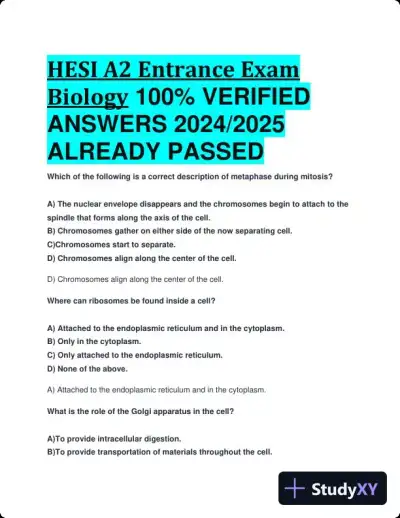 Past Exams
2024-2025 HESI A2 Biology Entrance Exam with Answers (42 Solved Questions)
Health Education Systems, Inc.
13 pages154downloadsFeb 2025 Past Exams
2024-2025 HESI A2 Anatomy and Physiology V1/V2 Practice Exam with Answers (134 Solved Questions)
Health Education Systems, Inc.
15 pages134downloadsFeb 2025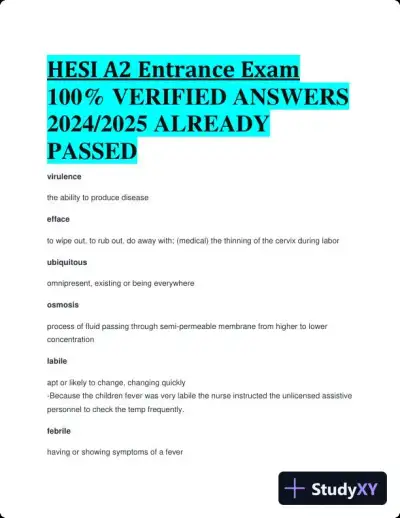 Past Exams
2024-2025 HESI A2 Entrance Exam with Answers (232 Solved Questions)
Health Education Systems, Inc.
26 pages132downloadsFeb 2025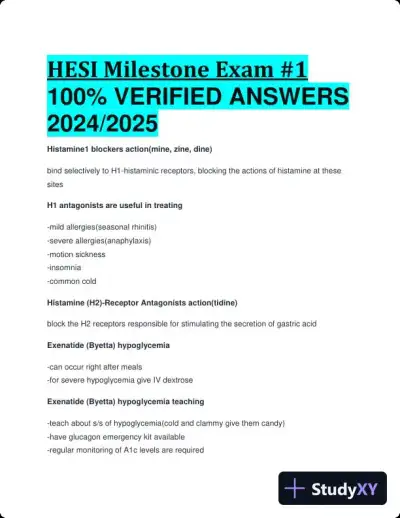 Past Exams
2024-2025 HESI Milestone Exam 1 with Answers (162 Solved Questions)
Health Education Systems, Inc.
26 pages119downloadsFeb 2025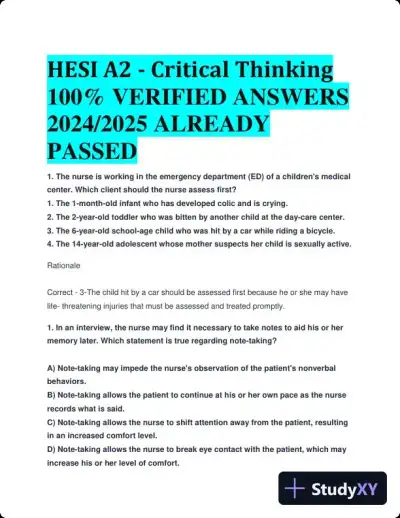 Past Exams
2024-2025 HESI A2 Critical Thinking with Answers (124 Solved Questions)
Health Education Systems, Inc.
114 pages106downloadsFeb 2025 Past Exams
2024-2025 HESI RN Exit Exam with Answers (156 Solved Questions)
Health Education Systems, Inc.
44 pages92downloadsFeb 2025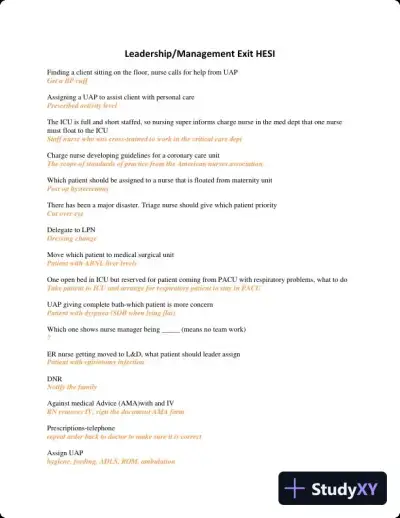 Past Exams
HESI Leadership/Management Exit Exam with Answers (59 Solved Questions)
Health Education Systems, Inc.
4 pages54downloadsFeb 2025
Study this document with CramX
Once it is in your library, every tool can work from it.