

2023-2024 HESI Maternity OB Exit Exam Version 1 With Answers (100 Solved Questions)
- Health Education Systems, Inc.
- 21 pages
- Shared May 2025
Learn from past exams with 2023-2024 HESI Maternity OB Exit Exam Version 1 With Answers, featuring a collection of authentic test papers.
Preview 7 of 21 pages
See the first 7 pages exactly as they appear in the document.
Page 1 Read page 1 as text
2023/2024 HESI Maternity OB Specialty Exam 55 Q&A (V1) Updated Questions with 100 Correct Answers • A patient is admitted to the labor and delivery unit with contractions that are 3 - 5 minutes apart, lasting 60 - 70 seconds. She reports that she is leaking fluid. A vaginal exam reveals that her cervix is 80 percent effaced and 4 cm dilated and a - 1 station. The LPN/LVN knows that the patient is in which phase and stage of labor? • Latent phase, First Stage • Active Phase of First Stage • Latent phase of Second Stage • Transition Ans: B) Active Phase of First Stage Second stage = full dilation until birth • To assess uterine contractions the LPN/LVN would • Asses duration from the beginning of the contraction to the peak of the same contraction, frequency by measuring the time between the beginning of one contraction to the beginning of the next contraction. • Assess frequency as the time between the end of one contraction and the beginning of the next contraction, duration as the length of time from the beginning to the end of contractions, and palpate the uterus for strength • Assess duration from beginning to end of each contraction. Assess the strength of the contraction by the external fetal monitor reading. Measure frequency by measuring the beginning of one contraction to another.
Page 2 Page 3 Read page 3 as text
• Assess duration from beginning to end of each contraction., frequency by measuring the time between the beginnings of contractions, and palpate the fundus of the uterus for strength. Ans: D) Assess duration from beginning to end of each contraction., frequency by measuring the time between the beginnings of contractions, and palpate the fundus of the uterus for strength. • Which basic type of pelvis includes the correct description and percentage of occurrence in women? • Platypelloid: flattened, wide, shallow; 3% • Anthropoid: resembling the ape; narrower; 10% • Android: resembling the male; wider oval; 15% • Gynecoid: classic female; heart shaped; 75% Ans: A) Platypelloid: flattened, wide, shallow; 3% • What position would be least effective when gravity is desired to assist in fetal descent? • Lithotomy • Walking • Kneeling • Sitting Ans: A) Lithotomy • The factors that affect the process of labor and birth, known commonly as the five Ps, include all EXCEPT: • Passageway. • Powers. • Passenger. • Pressure.
Page 4 Read page 4 as text
D) Pressure. Ans: :: The 5 P's are: • Powers (contractions) • Passengers (fetus & placenta) • Passageway (birth canal) • Position (of the mother) • Psychological Response • While evaluating an external monitor tracing of a woman in active labor, the nurse notes that the fetal heart rate (FHR) for five sequential contractions begins to decelerate late in the contraction, with the nadir of the decelerations occurring after the peak of the contraction. The LPN/LVN first priority is to: • Notify the care provider. • Assist with amnioinfusion • Change the woman's position • Insert a scalp electrode. Ans: C) Change the woman's position • During labor a fetus with an average heart rate of 175 beats/min over a 15 - minute period would be considered to have: • A normal baseline heart rate. • Bradycardia. • Hypoxia. • Tachycardia. Ans: D) Tachycardia.
Page 5 Read page 5 as text
• As a perinatal LPN/LVN you realize that a fetal heart rate that is tachycardic, is bradycardic, or has late decelerations with loss of variability is nonreassuring and is associated with • Cord compression • Hypotension • Hypoxemia/acidemia • Maternal drug use. Ans: C) Hypoxemia/acidemia • The LPN/LVN providing care for the laboring woman should understand that amnioinfusion is used to treat: • Fetal tachycardia. • Fetal bradycardia. • Variable decelerations • Late decelerations. Ans: C) Variable decelerations • The most common cause of decreased variability in the fetal heart rate (FHR) that lasts 30 minutes or less is: • Fetal hypoxemia • Fetal sleep cycles • Altered cerebral blood flow. • Umbilical cord compression. Ans: B) Fetal sleep cycles • While evaluating an external monitor tracing of a woman in active labor whose labor is being induced, the nurse notes that the fetal heart rate (FHR) begins to decelerate in a slow curve at the onset of several contractions and returns to baseline before each contraction ends. The
Page 6 Read page 6 as text
LPN/LVN should: • Insert an internal monitor • Document the finding in the patient's record. • Discontinue the oxytocin infusion • Change the woman's position Ans: B) Document the finding in the patient's record. • What three measures should the nurse implement to provide intrauterine resuscitation? Select the response that best indicates the priority of actions that should be taken. • Reposition the mother, increase intravenous (IV) fluid, and provide oxygen via face mask. • Perform a vaginal examination, reposition the mother, and provide oxygen via face mask. • Administer oxygen to the mother, increase IV fluid, and notify the care provider. • Call the provider, reposition the mother, and perform a vaginal examination Ans: A) Reposition the mother, increase intravenous (IV) fluid, and provide oxygen via face mask. • When using intermittent auscultation (IA) to assess uterine activity, LPN/LVN should be aware that: • The resting tone between contractions is described as either placid or turbulent • The examiner's hand should be placed over the fundus before, during, and after contractions. • The frequency and duration of contractions is measured in seconds
Page 7 Read page 7 as text
for consistency • Contraction intensity is given a judgment number of 1 to 7 by the nurse and patient together. Ans: B) The examiner's hand should be placed over the fundus before, during, and after contractions. • Perinatal LPN/LVN are legally responsible for: • Applying the external fetal monitor and notifying the care provider. • Correctly interpreting fetal heart rate (FHR) patterns, initiating appropriate nursing interventions, and documenting the outcomes. • Greeting the patient on arrival, assessing her, and starting an intravenous line. • Making sure that the woman is comfortable. Ans: B) Correctly interpreting fetal heart rate (FHR) patterns, initiating appropriate nursing interventions, and documenting the outcomes. • The LPN/LVN providing care for the laboring woman should understand that late fetal heart rate (FHR) decelerations are caused by: • Altered cerebral blood flow • Spontaneous rupture of membranes • Uteroplacental insufficiency • Umbilical cord compression Ans: C) Uteroplacental insufficiency • The LPN/LVN providing care for the laboring woman should understand that variable fetal heart rate (FHR) decelerations are caused by: • Umbilical cord compression.
14 more pages in the full document
Unlock it once and it stays in your library, ready to chat with or turn into flashcards.
Unlock the full documentMore Health Education Systems, Inc. study materials
See all Past Exams
2023-2024 RN HESI Exit Exam Version 3 with Answers (53 Solved Questions)
Health Education Systems, Inc.
13 pages163downloadsFeb 2025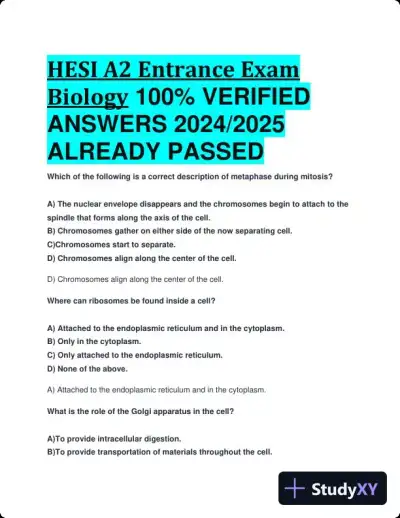 Past Exams
2024-2025 HESI A2 Biology Entrance Exam with Answers (42 Solved Questions)
Health Education Systems, Inc.
13 pages154downloadsFeb 2025 Past Exams
2024-2025 HESI A2 Anatomy and Physiology V1/V2 Practice Exam with Answers (134 Solved Questions)
Health Education Systems, Inc.
15 pages134downloadsFeb 2025 Past Exams
2024-2025 HESI A2 Entrance Exam with Answers (232 Solved Questions)
Health Education Systems, Inc.
26 pages132downloadsFeb 2025 Past Exams
2024-2025 HESI Milestone Exam 1 with Answers (162 Solved Questions)
Health Education Systems, Inc.
26 pages119downloadsFeb 2025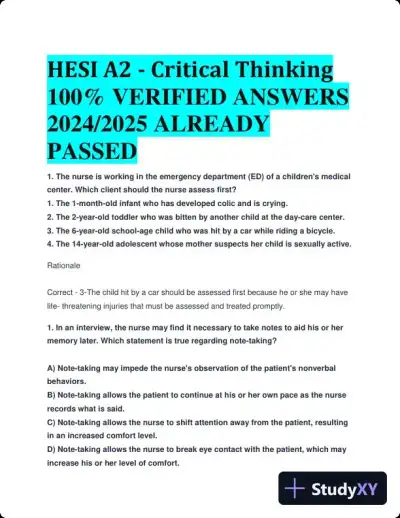 Past Exams
2024-2025 HESI A2 Critical Thinking with Answers (124 Solved Questions)
Health Education Systems, Inc.
114 pages106downloadsFeb 2025 Past Exams
2024-2025 HESI RN Exit Exam with Answers (156 Solved Questions)
Health Education Systems, Inc.
44 pages92downloadsFeb 2025 Past Exams
HESI Leadership/Management Exit Exam with Answers (59 Solved Questions)
Health Education Systems, Inc.
4 pages54downloadsFeb 2025
Study this document with CramX
Once it is in your library, every tool can work from it.