

2024 HESI Medical Surgical Nursing Practice Exam With Answers (233 Solved Questions)
- Health Education Systems, Inc.
- 66 pages
- Shared May 2025
Prepare strategically with 2024 HESI Medical Surgical Nursing Practice Exam With Answers, covering all essential past exam topics.
Preview 16 of 66 pages
See the first 16 pages exactly as they appear in the document.
Page 1 Read page 1 as text
MED SURGE HESI EXAM 2 WITH NGN (LATEST UPDATED 2024) 1. The nurse is providing teaching to a client with Type 2 diabetes mellitus and peripheral neuropathy. Which information should the nurse provide? a. Family members can help with regular foot exams b. Heating pads are useful if on the low setting c. Aching feet may be soaked in lukewarm water for one hour or more d. Shoes should be worn outside the house, but it is fine to be barefoot inside - a. Family members can help with regular foot exams 2. A client in the operating room received succinylcholine. The client is experiencing muscle rigidity and has an extremely high temperature. What action should the nurse implement? a. Hold a prescription for dantrolene until fever is reduced b. Prepare ice packs for placement in the clients axillary area c. Call the PACU nurse to prepare for prolonged ventilator support d. Determine if prescribed antibiotics were administered preoperatively - b. Prepare ice packs for placement in the clients axillary area 3. The nurse is developing a plan of care for a client who reports blurred vision and who is newly diagnosed with cardiovascular disease. Which outcome should the nurse include in the plan of care for this client? a. The nurse will encourage the client to walk thirty minutes every day b. The clients family will state signs and symptoms about the disease c. The clients daily blood pressure will be less than 140/80 this month d. The client blood pressure readings will be less than 160/90 - c. The clients daily blood pressure will be less than 140/80 this month
Page 2 Page 3 Read page 3 as text
4. The family suspects that acquired immune deficiency syndrome (AIDS) dementia is occuring in their son who is human immunodeficiency virus (HIV) positive. Which symptoms confirm their suspicions? a. He has begun to sleep 18 out of 24 hours b. A change has recently occurred in his handwriting c. He refuses to see any of his friends or to return their phone calls d. He exhibits angry outburst when the subject of dying is approached - b. A change has recently occurred in his handwriting 5. A hospitalized client with peripheral arterial disease (PAD) is instructed regarding leg and foot care. Which statement by the client indicates to the nurse that learning has occurred? a. "Whenever I am sitting in a chair I will keep my legs up to reduce swelling" b. "I can use a mirror to check the bottoms of my feet for any signs of breakdown" c. "I will try to keep moving if leg pain occurs to help promote good circulation" d. "I will use my swimming pool early in the day while the water is still very cool" - b. "I can use a mirror to check the bottoms of my feet for any signs of breakdown" 6. While completing a health assessment for a client with migraine headaches, the nurse assesses bilateral weakness in the client's hand grips. The client reports joint pain and trouble twisting a door knob due to weakness. Which action should the nurse take in response to these findings? a. Explain that relief of the migraine pain will reduce related symptoms b. Gather additional assessment data about the pain and weakness c. Implement fall precautions to reduce the client's risk for injury d. Consult with the occupational therapist for a functional assessment - d. Consult with the occupational therapist for a functional assessment 7. A client with Cushing's syndrome is recovering from an elective laparoscopic procedure. Which assessment finding warrant's immediate intervention by the nurse?
Page 4 Read page 4 as text
a. Purple marks on skin of the abdomen b. Irregular apical pulse c. Quarter size blood spot on dressing d. Pitting ankle edema - b. Irregular apical pulse 8. A client with lung cancer who wears a subcutaneous morphine sulfate patch for pain is short of breath and is difficult to arouse. When performing a head to toe assessment, the nurse discovers four analgesic patches on the clients body. Which intervention should the nurse implement first? a. Remove all of the morphine patches b. Administer a narcotic antagonist c. Apply oxygen per face mask d. Measure the client's blood pressure - b. Administer a narcotic antagonist 9. A client receives prescriptions for a multidrug regimen for the treatment of tuberculosis. Which information should the nurse prioritize? a. Adherence to the regimen is imperative b. Medications should be taken with food c. Serum liver panels are collected regularly d. Enhanced sun protection measures will be needed - a. Adherence to the regimen is imperative 10. The nurse is preparing a client for surgery who was admitted to the emergency center following a motor vehicle collision. The client has an open fracture of the femur and is bleeding moderately from the bone protrusion site. During the prescriptive assessment, the nurse determines that the client currently receives heparin sodium 5,000 units subcutaneously daily. What is the priority nursing action? a. Notify the healthcare provider of the client's medication history b. Observe the heparin injections sites for signs of bruising c. Have the client sign the surgical and transfusion permits
Page 5 Read page 5 as text
d. Ensure that the potential for bleeding is explained to the client - a. Notify the healthcare provider of the client's medication history 11. A client with orthopnea expresses concern about the ability to "get enough air" during a scheduled thoracentesis. On which information should the nurse's response be based? a. A thoracentesis is a brief process that has minimal discomfort b. Orthopnea is frequently caused by a client's uncontrolled anxiety c. The procedure is performed with the client in an upright position d. Extra pillows can be used if needed to elevate the client's head - c. The procedure is performed with the client in an upright position 12. What information should the nurse include in the teaching plan of a client diagnosed with gastroesophageal reflux disease (GERD)? a. Sleep without pillows at night to maintain neck alignment b. Adjust food intake to three full meals per day and no snacks c. Minimize symptoms by wearing loose, comfortable clothing d. Avoid participation in any aerobic exercise programs - c. Minimize symptoms by wearing loose, comfortable clothing 13. The nurse is caring for a client in the post anesthesia care unit (PACU) who underwent a thoracotomy two hours ago. The nurse observes the following vital signs: heart rate 140 bpm, respirations 26 breaths/minute and blood pressure 140/90. Which intervention is most important for the nurse to implement? a. Medicate for pain and monitor vital signs according to protocol b. Adminsted intravenous fluid bolus as prescribed by the HCP c. Apply oxygen at 10 L via non-rebreather mask and monitor pulse oximeter. d. Encourage the client to splint the incision with a pillow to cough and deep breathe - a. Medicate for pain and monitor vital signs
Page 6 Read page 6 as text
14. An adult is diagnosed with restless leg syndrome and is referred to the sleep clinic. The HCP prescribed ferrous sulfate 325 PO daily. Which laboratory values should the nurse monitor ? a. Platelet count and hematocrit b. Serum electrolytes c. Serum iron and ferritin d. Neutrophils and eosinophils - c. Serum iron and ferritin 15. While caring for a client with a full thickness burn covering 40% of the body, the nurse observes purulent drainage at the wound. Before reporting this finding to the HCP , the nurse should review which of the client's laboratory values? a. White blood cell count b. Platelet count c. Blood pH level d. Hematocrit - a. White blood cell count 16. A client with a history of type 1 diabetes mellitus (DM) and asthma is readmitted to the unit for the third time in two months with a current fasting blood sugar of 325 mg/dl. The client describes to the nurse of not understanding why the blood glucose level continues to be out of control. Which interventions should the nurse implement? Select all that apply. a. Have the client describe a typical day at work, home, and social activities b. Determine if the client is using a new insulin needle each administration c. Evaluate the clients asthma medications that can elevate the blood glucose d. Ask the client if they want a different manufactures glucose monitoring device e. Have the client demonstrate techniques used to monitor blood glucose levels - a. Have the client describe a typical day at work, home, and social activities e. Have the client demonstrate techniques used to monitor blood glucose levels 17. The nurse assesses a client with cirrhosis and finds 4+ pitting edema of the feet and legs, and massive ascites. Which mechanism contributes to edema and ascites in clients with cirrhosis?
Page 7 Read page 7 as text
a. Hyperaldosteronism causing an increased sodium reabsorption in renal tubules b. Decreased portcaval pressure with greater collateral circulation c. Decreased renin-angiotensin response related to an increase in renal blood flow d. Hypoalbuminemia that results in a decreased colloid oncotic pressure - d. Hypoalbuminemia that results in a decreased colloid oncotic pressure 18. An older client with long term type 2 diabetes mellitus (DM) is seen in the clinic for a routine health assessment. Which assessments would the nurse complete if a patient with type 2 diabetes mellitus (DM) is experiencing long term complications? Select all that apply. a. Signs of respiratory tract infection b. Sensation in feet and legs c. Skin condition of lower extremities d. Serum creatinine and BUN e. Visual acuity - b. Sensation in feet and legs c. Skin condition of lower extremities e. Visual acuity 19. The nurse is caring for a client who is receiving teletherapy radiation for a malignant tumor. Which instructions regarding skin of the portal site should the nurse provide? a. Protect the skin of the radiation portal site from sunlight exposure b. Apply moisture lotions daily to the radiation portal site c. Avoid washing the skin inside the radiation portal site d. Remove the ink marks of the portal after each radiation treatment - a. Protect the skin of the radiation portal site from sunlight exposure 20. When conducting discharge teaching for a client diagnosed with diverticulitis, which diet instruction should the nurse include? a. Have a small frequent meals and sit up for at least two hours after meals b. Eat a bland diet and avoid spicy foods c. Eat a high-fiber diet and increase fluid intake
Page 8 Read page 8 as text
d. Eat a soft diet with increased intake of milk and milk products - c. Eat a high-fiber diet and increase fluid intake 21. An adult who was recently diagnosed with glaucoma tells the nurse, "it feels like I am driving through a tunnel". The client expresses great concern about going blind. Which nursing instruction is most important for the nurse to provide this client? a. Maintain prescribed eye drop regimen b. Avoid frequent eye pressure measurements c. Wear a prescription glasses d. Eat a diet high in carotene - a. Maintain prescribed eye drop regimen 22. Which client has the highest risk for developing skin cancer? a. A 70-year-old fair-skinned client who works as a secretary b. A 65-year-old fair-skinned lenient who is a construction worker c. A 16-year-old dark skinned client who tans in tanning beds once a week d. A 25-year-old dark skinned client whose mother had skin cancer - b. A 65-year-old fair- skinned lenient who is a construction worker 23. During spring break, a young adult presents to the urgent care clinic reports a stiff neck, a fever for the past 6 hours, and a headache. Which intervention is most important for the nurse to implement first? a. Initiate isolation precautions b. Administer an antipyretic c. Draw blood cultures d. Prepare for a lumbar puncture - a. Initiate isolation precautions 24. The nurse assesses a client with petechiae and ecchymosis scattered across the arms and legs. Which laboratory results should the nurse review? a. Red blood cell count b. Platelet count
Page 9 Read page 9 as text
c. Hemoglobin levels d. White blood cell count - b. Platelet count 25. An older adult client with a long history of chronic obstructive pulmonary disease (COPD) is admitted with progressive shortness of breath and a persistent cough. The client is anxious and is complaining of a dry mouth. Which intervention should the nurse implement? a. Assist client to an upright position b. Administer a prescribed sedative c. Apply a high-flow venturi mask d. Encourage client to drink water - a. Assist client to an upright position 26. The nurse is providing discharge instructions to a client who is receiving prednisone 5 mg PO daily for a rash due to contact with poison ivy. Which symptoms should the nurse tell the client to report to the HCP? a. Rapid weight gain b. Abdominal striae c. Moon faces d. Gastric irritation - a. Rapid weight gain 27. A client with cholithiasis is admitted with jaundice due to obstruction of the common bile duct. Which finding is most important for the nurse to report to the HCP? a. Distended, hard, and rigid abdomen b. Clay-colored stool c. Radiating, sharp pain in right shoulder d. Bile-stained emesis - a. Distended, hard, and rigid abdomen 28. A client with chronic kidney disease is started on hemodialysis. During the first dialysis treatment, the client's blood pressure drops from 150/90 to 80/30. Which action should the nurse take first? a. Stop the dialysis treatment
Page 10 Read page 10 as text
b. Adminster 5% albumin IV c. Monitor blood pressure Q45M d. Lower the head of the chair and elevate feet - a. Stop the dialysis treatment 29. The nurse is collecting information from a client with chronic pancreatitis who reports persistent gnawing abdominal pain. To help the client manage the pain, which assessment data is most important for the nurse to obtain? a. Presence and activity of bowel sounds b. Color and consistency of feces c. Eating patterns and dietary intake d. Level and amount of physical activity - c. Eating patterns and dietary intake 30 A client who had a C-5 spinal cord injury 2 years ago is admitted to the emergency department with the diagnosis of autonomic dysreflexia secondary to full bladder. Which assessment finding should the nurse expect this client to exhibit? a. Complaints of chest pain and shortness of breath b. Hypotension and venous pooling in the extremities c. Profuse diaphoresis and severe, pounding headache d. Pain and a burning sensation upon urination and hematuria - d. Pain and a burning sensation upon urination and hematuria 31. The nurse is obtaining a health history from a new client who has a history of kidney stones. Which statement by the client indicates an increased risk for renal calculi? a. Eats a vegetarian diet with cheese 2 to 3 times a day b. Experiences additional stress since adopting a child c. Jogs more frequently than usual daily routine d. Drinks several bottles of carbonate water daily - a. Eats a vegetarian diet with cheese 2 to 3 times a day
Page 11 Read page 11 as text
32. A client tells the clinic nurse about expericing burning on uriantion, and assssment reveals that the client had sexual intercourse four days ago with a person who was casually met. Which action should the nurse implement? a. Observe the perineal area for a chancroid-like lesion b. Obtain specimen of urethral drainage for culture c. Assess for perineal itching, erythema, and excoriation d. Identify all sexual paterns in the last four days - b. Obtain specimen of urethral drainage for culture 33. An adult client is admitted with flank pain and is diagnosed with acute pyelonephritis. What is the priority nursing action? a. Monitor hemoglobin and hematocrit b. Encourage turning and deep breathing c. Administer IV antibiotics as prescribed d. Auscultate for presence of bowel sounds - c. Administer IV antibiotics as prescribed 34. Which food is most important for the nurse to encourage a client with osteomalacia to include in a daily diet? a. Fortified milk and cereals b. Citrus fruits and juices c. Green leafy vegetables d. Red meats and eggs - a. Fortified milk and cereals 35. A client with Herpes zoster (shingles) on the thorax tells the nurse of having difficulty sleeping. Which is the probable etiology of this problem? a. Frequent cough b. Pain c. Nocturia d. Dyspnea - b. Pain
Page 12 Read page 12 as text
36. A client with cholelithiasis has a gallstone lodged in the common bile duct and is unable to eat or drink without becoming nauseated and vomiting. Which finding should the nurse report to the healthcare provider a. Belching b. Amber urine c. Yellow sclera d. Flatulence - c. Yellow sclera 37. While caring for a client with Amyotrophic Lateral Sclerosis (ALS), the nurse performs a neurological assessment every four hours. Which assessment finding warrants immediate intervention by the nurse a. Inappropriate laughter b. Increasing anxiety c. Weakened cough effort d. Asymmetrical weakness - c. Weakened cough effort 38. The nurse is caring for a client who is postoperative for a femoral head fracture repair. Which intervention(s) should the nurse plan to administer for deep vein thrombosis prophylaxis? Select all that apply. a. Pneumatic compression devices b. Incentive spirometry c. Assisted ambulation d. Patient-controlled analgesic e. Calf-pump exercises f. Prescribed anticoagulant therapy - a. Pneumatic compression devices e. Calf-pump exercises f. Prescribed anticoagulant therapy 39. A client with gouty arthritis reports tenderness and swelling of the right right ankle and great toe. The nurse observes the area of inflammation extends above the ankle area. The
Page 13 Read page 13 as text
client receives prescriptions for colchicine and indomethacin. Which instruction should the nurse include in the discharge teaching? a. Eat a high protein foods to achieve ideal body weight b. Drink a least 8 cups (1920) mL of water per day c. Use electric heating pad when pain is at its worse d. Encourage active range of motion to limit stiffness - b. Drink a least 8 cups (1920) mL of water per day 40. A client with a history of peptic ulcer disease (PUD) is admitted after vomiting bright red blood several times over the course of 2 hours. In reviewing the laboratory results, the nurse finds the clients hemoglobin is 12 g/dL and the hematocrit is 35%. Which action should the nurse prepare to take? a. Continue to monitor for blood loss b. Administer 1,000 mL normal saline c. Transfuse 2 units of platelets d. Prepare for client for emergency surgery - b. Administer 1,000 mL normal saline 41. An obese client with emphysema who smokes at least a pack of cigarettes daily is admitted after experiencing a sudden increase in dyspnea and activity intolerance. Oxygen therapy is initiated and it is determined that the client will be discharged with oxygen. Which information is most important for the nurse to emphasize in the discharge teaching plan? a. Methods for weight loss b. Guidelines for oxygen use c. Approaches to conserve energy d. Strategies for smoking cessation - b. Guidelines for oxygen use 42. A client arrives at the medical-surgical unit 4 hours after a transurethral resection of the prostate. A triple-lumen catheter for a continuous bladder irrigation with normal saline is infused and the nurse observes dark, pink tinged outflow with blood clots in the tubing and collection bag. Which action should the nurse take?
Page 14 Read page 14 as text
a. Monitoring catheter drainage b. Decreasing the flow rate c. Irrigating the catheter manually d. Discounting infusing solution - a. Monitoring catheter drainage 43. The nurse is planning care for an older adult client who experienced a cerebrovascular accident several weeks ago. The client has expressive aphasia and often becomes frustrated with the nursing staff. Which intervention should the nurse implement? a. Teach the client use of basic sign language b. Speak slowly to the client c. Encourage clients use of picture charts d. Ask the client simple questions - c. Encourage clients use of picture charts 44. After three days of persistent epigastric pain, a female client presents to the clinic. She has been taking oral antacids without relief. Her visit signs are heart rate 122 beats/minute, respirations 16 breaths/minute, oxygen saturation 96%, and blood pressure 116/70. The nurse obtains a 12-lead electrocardiogram (ECG). Which assessment finding is most critical? a. Irregular pulse rate b. Bile colored emesis c. ST elevation in three leads d. Complaint of radiating jaw pain - c. ST elevation in three leads 45. A client with acute renal injury (AKI) weighs 50kg and has a potassium level of 6.7 is admitted to the hospital. Which prescribed medication should the nurse administer first? a. Calcium acetate one tablet by mouth b. Sodium polystyrene sulfonate 15 grams by mouth c. Epostein alfa, recombinant 2,500 units subcutaneously d. Sevelamer one tablet by mouth - b. Sodium polystyrene sulfonate 15 grams by mouth
Page 15 Read page 15 as text
46. The nurse observes an increased number of blood clots in the drainage tubing of a client with continuous bladder irrigation following a trans-rethral resection of the prostate (TURP). What is the best initial nursing action? a. Provide additional oral fluid intake b. Measure the client's intake and output c. Increase the flow of the bladder irrigation d. Administer a PRN dose of an antispasmodics agent - c. Increase the flow of the bladder irrigation 47. A cardiac catheterization of a client with heart disease indicates the following blockages: 95% proximal left anterior descending (LAD), 99% proximal circumflex, and ? % proximal right coronary artery (RCA). The client later asks the nurse "what does all this mean for me?" What information should the nurse provide? a. Blood supply to the heart is diminished by artherosclerotic lesions, which necessitate lifestyle changes b. Blood vessels supplying the pumping chamber have blockages indicating a past heart attack c. Three main arteries have major blockages, with only 1 to 5% of blood flow getting through to the heart muscle d. The heart is not receiving enough blood, so there is a risk of heart failure and fluid retention - c. Three main arteries have major blockages, with only 1 to 5% of blood flow getting through to the heart muscle 48. Four days following an abdominal aortic aneurysm repair, the client is exhibiting edema of both lower extremities, and pedal pulses are not palpable. Which action should the nurse implement first? a. Elevate extremities on pillows b. Evaluate edema for pitting c. Assess pulses with a vascular doppler d. Wrap the feet with warmed blankets - c. Assess pulses with a vascular doppler
Page 16 Read page 16 as text
49. A client who was involved in a motor vehicle collision is admitted with a fractured left femur which is immobilized using a fracture traction splint in preparation for an open reduction internal fraction (ORIF). The nurse determines that the clients distal pulses are diminished in the left foot. Which interventions should the nurse implement? Select all that apply. a. Verify pedal pulses using a doppler pulse pulse device b. Evaluate the application of the splint to the left leg c. Offer ice chips and oral clear liquids d. Monitor left leg for pain, pallor, parenthesis, paralysis, pressure e. Administer oral antispasmodics and narcotic analgesics - a. Verify pedal pulses using a doppler pulse pulse device b. Evaluate the application of the splint to the left leg d. Monitor left leg for pain, pallor, parenthesis, paralysis, pressure 50. The nurse is caring for a client with a lower left lobe pulmonary abscess. Which position should the nurse instruct the client to maintain? a. Left lateral b. Supine, knees flexed c. Dorsal recumbent d. Knee-chest - a. Left lateral 51. The healthcare provider prescribes diagnostic tests for a client whose chest x-ray indicates pneumonia. Which diagnostic test should the nurse review for implementation in the most therapeutic treatment of pneumonia? a. Sputum culture and sensitivity b. Blood cultures c. Arterial blood gasses (ABG) d. Computerized tomography (CT) of the chest - a. Sputum culture and sensitivity 52. A male client with heart failure (HF) calls the clinic and reports that he cannot put his shoes on because they are too tight. Which additional information should the nurse obtain?
50 more pages in the full document
Unlock it once and it stays in your library, ready to chat with or turn into flashcards.
Unlock the full documentMore Health Education Systems, Inc. study materials
See all Past Exams
2023-2024 RN HESI Exit Exam Version 3 with Answers (53 Solved Questions)
Health Education Systems, Inc.
13 pages163downloadsFeb 2025 Past Exams
2024-2025 HESI A2 Biology Entrance Exam with Answers (42 Solved Questions)
Health Education Systems, Inc.
13 pages154downloadsFeb 2025 Past Exams
2024-2025 HESI A2 Anatomy and Physiology V1/V2 Practice Exam with Answers (134 Solved Questions)
Health Education Systems, Inc.
15 pages134downloadsFeb 2025 Past Exams
2024-2025 HESI A2 Entrance Exam with Answers (232 Solved Questions)
Health Education Systems, Inc.
26 pages132downloadsFeb 2025 Past Exams
2024-2025 HESI Milestone Exam 1 with Answers (162 Solved Questions)
Health Education Systems, Inc.
26 pages119downloadsFeb 2025 Past Exams
2024-2025 HESI A2 Critical Thinking with Answers (124 Solved Questions)
Health Education Systems, Inc.
114 pages106downloadsFeb 2025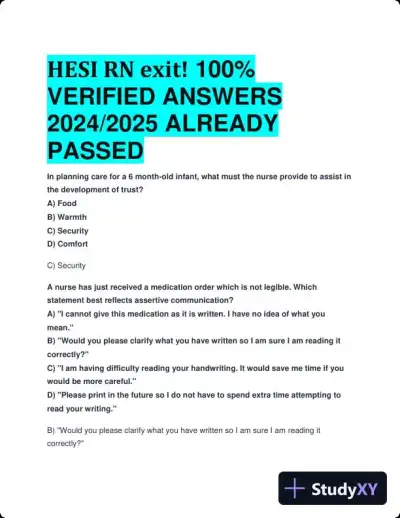 Past Exams
2024-2025 HESI RN Exit Exam with Answers (156 Solved Questions)
Health Education Systems, Inc.
44 pages92downloadsFeb 2025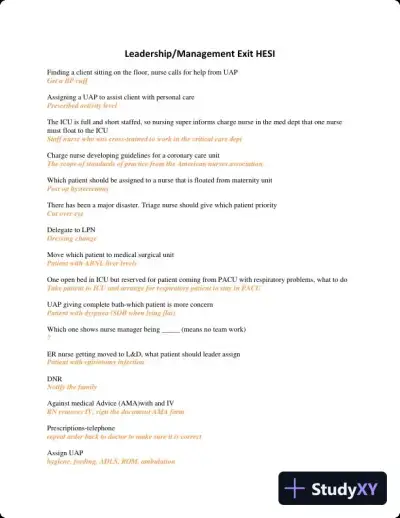 Past Exams
HESI Leadership/Management Exit Exam with Answers (59 Solved Questions)
Health Education Systems, Inc.
4 pages54downloadsFeb 2025
Study this document with CramX
Once it is in your library, every tool can work from it.