

4 HESI A2 Practice Tests (2020)
- Health Education Systems, Inc.
- 434 pages
- Shared February 2025
- 50 downloads
4 HESI A2 Practice Tests (2020) helps you pass with expert-reviewed materials and study tips.
Preview 31 of 434 pages
See the first 31 pages exactly as they appear in the document.
Page 1 Page 2 Read page 2 as text
Downloaded from StudyXY.com [= Ww + StudyXY oi as . Za \ Rr ' BE \ Stu dy Anything This ContentHas been Posted On StudyXY.com as supplementary learning material. StudyXY does not endrose any university, college or publisher. Allmaterials posted are under the liability of the contributors. | 8) www.studyxy.com
Page 3 Page 4 Page 5 Read page 5 as text
Copyright © 2020, 2018, 2013 by McGraw Hill. All rights reserved. Except as permitted under the United States Copyright Act of 1976, no part of this publication may be reproduced or distributed in any form or by any means, or stored in a database or retrieval system, without the prior written permission of the publisher. ISBN: 978-1-26-046222-7 MHID: 1-26-046222-6 The material in this eBook also appears in the print version of this title: ISBN: 978-1-26-046221-0, MHID: 1-26-046221-8. eBook conversion by codeMantra Version 1.0 All trademarks are trademarks of their respective owners. Rather than put a trademark symbol after every occurrence of a trademarked name, we use names in an editorial fashion only, and to the benefit of the trademark owner, with no intention of infringement of the trademark. Where such designations appear in this book, they have been printed with initial caps. McGraw-Hill Education eBooks are available at special quantity discounts to use as premiums and sales promotions or for use in corporate training programs. To contact a representative, please visit the Contact Us page at www.mhprofessional.com. TERMS OF USE This is a copyrighted work and McGraw-Hill Education and its licensors reserve all rights in and to the work. Use of this work is subject to these terms. Except as permitted under the Copyright Act of 1976 and the right to store and retrieve one copy of the work, you may not decompile, disassemble, reverse engineer, reproduce, modify, create derivative works based upon, transmit, distribute, disseminate, sell, publish or sublicense the work or any part of it without McGraw-Hill Education’s prior consent. You may use the work for your own noncommercial and personal use; any other use of the work is strictly prohibited. Your right to use the work may be terminated if
Page 6 Read page 6 as text
you fail to comply with these terms. THE WORK IS PROVIDED “AS IS.” McGRAW-HILL EDUCATION AND ITS LICENSORS MAKE NO GUARANTEES OR WARRANTIES AS TO THE ACCURACY, ADEQUACY OR COMPLETENESS OF OR RESULTS TO BE OBTAINED FROM USING THE WORK, INCLUDING ANY INFORMATION THAT CAN BE ACCESSED THROUGH THE WORK VIA HYPERLINK OR OTHERWISE, AND EXPRESSLY DISCLAIM ANY WARRANTY, EXPRESS OR IMPLIED, INCLUDING BUT NOT LIMITED TO IMPLIED WARRANTIES OF MERCHANTABILITY OR FITNESS FOR A PARTICULAR PURPOSE. McGraw-Hill Education and its licensors do not warrant or guarantee that the functions contained in the work will meet your requirements or that its operation will be uninterrupted or error free. Neither McGraw-Hill Education nor its licensors shall be liable to you or anyone else for any inaccuracy, error or omission, regardless of cause, in the work or for any damages resulting therefrom. McGraw-Hill Education has no responsibility for the content of any information accessed through the work. Under no circumstances shall McGraw-Hill Education and/or its licensors be liable for any indirect, incidental, special, punitive, consequential or similar damages that result from the use of or inability to use the work, even if any of them has been advised of the possibility of such damages. This limitation of liability shall apply to any claim or cause whatsoever whether such claim or cause arises in contract, tort or otherwise.
Page 7 Read page 7 as text
Dedicated to the extraordinary nurses at Memorial Sloan-Kettering. + Studyxy
Page 8 Read page 8 as text
Contents Chapter 1 Introduction to the A2 A2 Versus Other Nursing School Exams Planning to Take the A2 Scoring the A2 Parts of the Test Chapter 2 Tips and Strategies for Test Takers How to Use This Book Strategies for Top Scores A2 Training Schedule Chapter 3 A2 Practice Test 1 Reading Comprehension Vocabulary and General Knowledge Grammar Basic Math Skills Biology Chemistry Anatomy and Physiology Physics Answer Key Explanatory Answers Chapter 4 A2 Practice Test 2 Reading Comprehension Vocabulary and General Knowledge Grammar Basic Math Skills Biology Chemistry
Page 9 Read page 9 as text
Anatomy and Physiology Physics Answer Key Explanatory Answers Chapter 5 A2 Practice Test 3 Reading Comprehension Vocabulary and General Knowledge Grammar Basic Math Skills Biology Chemistry Anatomy and Physiology Physics Answer Key Explanatory Answers Chapter 6 A2 Practice Test 4 Reading Comprehension Vocabulary and General Knowledge Grammar Basic Math Skills Biology Chemistry Anatomy and Physiology Physics Answer Key Explanatory Answers
Page 10 Read page 10 as text
CHAPTER 1 Introduction to the A2 his book contains four practice tests for the HESI A2 (Admission Assessment Exam). They follow the format used in the A2 online exam. ing these practice tests will give you a good idea of what you’ll encounter when you take the real exam. As you complete the tests, you’ll become familiar with the directions, structure, and content that you’re likely to see at the testing site. A2 VERSUS OTHER NURSING SCHOOL EXAMS Who Takes the A2 Exam? The A2 Exam is used for admission to certain nursing schools. It is a product of Evolve Learning Systems, a division of Elsevier Publishing. Different nursing programs require different exams; for example, some schools expect applicants to take the Nursing Entrance Test (NET) or the Test of Essential Academic Skills (TEAS). Other schools give you a variety of entrance exams from which to choose. Still others require the A2 exclusively. How Do I Know Whether I Should Take the A2 Exam? To know whether the school or schools of your choice require the A2, visit their websites or call their admissions offices. They may call this particular test the HESI A2 test, the Evolve Reach A2 test, or the Admission Assessment Exam. Before you begin to study, make sure that you are studying for the correct test. You may need to use McGraw-Hill Education 5 TEAS Practice Tests or Nursing School Entrance Exams instead.
Page 11 Read page 11 as text
PLANNING TO TAKE THE A2 When Is the A2 Given, and How Do I Register for It? The exam is given at a variety of sites, often at nursing schools or community colleges. The dates of the exam may depend on the application dates for the nursing school where you take the test. Some schools offer the test every few weeks throughout the year. You may also take the exam at one of more than 350 Prometric™ testing sites around the country. To register for an exam, first set up an Evolve account at evolve.elsevier.com/cs. Once you successfully create an account, you should see the HESI Assessment-Student Access link under "My Content." Choose a test date and pay your fee. To take the exam at the nursing school or community college of your choice, log on to that school’s website to learn how to sign up for the next available test. To take the exam at a Prometric site, start by setting up an account on the Evolve Elsevier site listed above. Submit a registration to take a distance exam. Use the confirmation information you receive to log on to http://www.prometric.com/Elsevier. Clicking on “Admission Assessment,” typing your zip code, and listing a range of dates lets you locate the testing site and date that best suit your needs. From there, you may follow the directions to schedule the test at a time convenient for you. You will pay for the test online when you set up your test date. You will need your credit or debit card and your school's ID number. Use your school- related email address if you have one. When Should I Take the A2? Check with your chosen nursing programs to find out when they need score transcripts. Then work backward from that date to determine when you should take the test. If you take the test at the nursing school that you hope to attend, the date of the test will be designed to mesh with that school’s application dates.
Page 12 Read page 12 as text
Which Modules of the A2 Must I Take? The A2 contains several modules in the areas of English language, mathematics, and science. Not all nursing programs require every module. If you take the test at a nursing school or community college, the school will probably only test you on the modules that its nursing program requires. For example, some programs do not require any of the science modules. Some require Reading Comprehension and Grammar, but not Vocabulary and General Knowledge. If you wish to send transcripts to several schools, visit their websites to learn which modules they require. Then make sure that the site where you are taking the test offers all of those modules. What Do I Need on the Day of the Test? The A2 is only available online. You must present one form of government- issued identification. Passports, driver’s licenses, or green cards are fine; credit cards or student IDs are not. You may need your payment or a copy of your payment receipt. You will definitely need the username and password assigned to you by Elsevier when you registered for the test. You may not use any resources such as calculators or reference books. A basic calculator is included in the software. You may not carry in a cell phone, tablet, or other electronic device. You may not bring food or beverages into the testing site. SCORING THE A2 How Is the A2 Scored? The A2 consists of eight academic modules. Your scores may be reported in three ways—as a percentage score for each module administered; as a subject-area composite score (for all science modules, for example); and as a composite score (the average score for all the modules you complete). When Will I Receive My Score? As soon as you complete your online test, you will receive a printed score
Page 13 Read page 13 as text
report from the proctor. How Do I Submit My Score to Nursing Programs? Your testing fee automatically includes the submission of scores to the school where you took the test. If you took the test at a Prometric center, or if you want your transcript sent to additional schools, order transcripts from Elsevier via its website or by calling 1-800-950-2728. Elsevier will charge a processing fee for each transcript sent. Is My Score Good Enough? Whether your score is acceptable depends on the program to which you are applying. Some nursing programs have specific cutoff points for each module. Others require a certain composite score. Some nursing programs allow you to take the A2 two or three times if your first scores are unacceptable. They may require you to wait several weeks or months between exams. Again, the rules vary from program to program. PARTS OF THE TEST The A2 is divided into eight academic modules within three broad content areas: English language, mathematics, and science. In addition, the A2 may include a section on critical thinking, which may be graded or ungraded, plus one or two ungraded tests under the heading “Learner Profile.” This chart shows the number of items (which may vary year to year) and time suggested for each section. Notice that ungraded pilot items are included in most modules. These are used to build tests in future years. Because the test is given online, the times given are only suggestions that will allow you to complete the entire test within a reasonable time.
Page 14 Read page 14 as text
FORMAT TIP Rarely will anyone be administered every module on the A2. Check with your preferred nursing program to see which modules it requires. Depending on the modules required, the typical test may run from three to four hours. Reading Comprehension Reading items test your comprehension of informational reading passages. You will be asked to read a short, multiparagraph passage and answer a variety of questions about it. Some of the most common skills tested involve the following: » Main idea «Supporting details * Meanings of words in context « Author’s purpose + Fact and opinion
Page 15 Read page 15 as text
« Drawing conclusions and making inferences + Summarizing + Author’s tone The passages used for A2 all have a science or health theme and may be typical of the type of reading you will do in your professional life. FORMAT TIP With the exception of some math questions, all questions on the A2 are multiple choice and give you four possible choices from which to pick. Here is an example of an A2 reading comprehension question. On the test itself, most reading passages will be longer than this one. Counterfeit medicine may be contaminated, or it may contain the wrong or no active ingredient. Counterfeit medicine is illegal and may be dangerous. The quality, safety, and efficacy of counterfeit medicines are not known. Counterfeit medicine is often sold illegally over the Internet or by illegal operators posing as licensed pharmacies. 1. What is the author’s primary purpose in writing this passage? A. To inform B. To persuade C. To entertain D. To analyze Explanatory Answer: This question tests your understanding of the author’s purpose or intent. This author defines counterfeit medicine and presents some facts about it, which indicates that the purpose is to inform (choice A). The author makes no judgments or calls to action, as might take place in a persuasive essay (choice B), and there is no analysis or in-depth investigation of the topic (choice D). Vocabulary and General Knowledge This section of the test includes vocabulary terms that appear regularly in
Page 16 Read page 16 as text
health care contexts as well as in general and academic use. You may be asked to select a word or phrase that defines an underlined word in a sentence or to identify a synonym for a given word. Here are two examples of A2 vocabulary questions. 1. Select the correct definition of the underlined word. The patient received a potent dose of sleeping medication. A. Average B. Invasive C. Powerful D. Initial Explanatory Answer: Potent means “strong,” so a potent dose is a strong, or powerful, dose (choice C). 2. A person who is compliant is . A. flexible B. obedient C. whiny D. appreciative Explanatory Answer: To comply is to act in accordance with a rule or request, so someone who is compliant is obedient (choice B). Grammar The grammar section requires you to locate sentences that are grammatically correct, words or phrases that are not used correctly, and words that best complete a sentence to make it grammatically correct. Questions might focus on any of the following topics, among others: + Subject-verb agreement + Pronoun-antecedent agreement + Misplaced modifiers « Pronoun case Serial commas + Studyxy
Page 17 Read page 17 as text
+ Sentence fragments * Run-on sentences » Troublesome word pairs (between/among, good/well, fewerl/less, its/it’s, lie/lay, etc.) Here are two examples of A2 grammar questions. 1. Select the word or phrase that makes this sentence grammatically correct. Could you please hand the tongue depressors? A. myself B. me C. I D. ourselves Explanatory Answer: The pronoun required is an object pronoun (it receives the action of the verb), so only me (choice B) completes the sentence correctly. 2. Select the correct order of words to fit the sentence structure. The students placed finished essays over ; glad to be done. A. there, their, they’re B. they're, there, their C. their, there, they’re D. their, they’re, there Explanatory Answer: The essays belong to the students and thus are their essays. They placed them in that spot, there. They are (they’re) glad to be done. The correct answer is choice C. FORMAT TIP For questions with multiple answers like the preceding one, all answers must be correct. There is no partial credit.
Page 18 Read page 18 as text
Basic Math Skills The mathematics section of the A2 focuses on the sort of math you may need to use on the job. For that reason, there is an unusual emphasis on measurements and fractions. Here are some of the subskills that you might see on the test: » Computation (addition, subtraction, multiplication, division) with whole numbers » Computation with decimals » Computation with fractions « Fractions, decimals, and percentages + Ratios and proportions * Money + Military time + Roman numerals * Measurement conversions FORMAT TIP A few items in the math section may be short answer—you must compute the answer rather than choosing from four possible responses. Here are two examples of A2 basic math questions. 1. Multiply: (4.3)(3.4) = A. 146.2 B. 14.62 C. 12.12 D. 7.7 Explanatory Answer: Many questions of this sort may be easily answered by estimating. 4.3 x 3.4 will be somewhere midway between 4 x 3 and 4 x 4, so choices A and D are clearly incorrect. The answer is choice B. 2. How many fluid ounces are in a pint? (Enter numeric value only.)
Page 19 Read page 19 as text
Explanatory Answer: There are 8 ounces in a cup and 2 cups in a pint, so the answer is 16. TIPS FROM TEST TAKERS Know your conversions, especially liquid measurements. Study a chart of metric-to-standard conversions, too! No conversion chart appears with the test, so you must have these memorized. Biology The biology tested on the A2 is basic, which does not mean that it is easy. Expect to see questions on any of these topics: * Scientific method » Taxonomy » Molecules » Cells » Photosynthesis Cellular reproduction * Genetics Here are two examples of A2 biology questions. 1. What is the result of meiosis II? A. Two secondary sex cells B. Four haploid daughter cells C. Two primary sex cells D. Duplication of primary sex cells Explanatory Answer: Mitosis results in two primary sex cells (choice C), and meiosis I leads to two secondary sex cells (choice A). In meiosis 11, the resulting four cells have half the chromosomes of the parent cell. The answer is choice B.
Page 20 Read page 20 as text
2. Which organelle in animal cells is most similar in function to the chloroplast in plant cells? A. Cell membrane B. Vacuole C. Ribosome D. Mitochondrion Explanatory Answer: Chloroplasts are the site of photosynthesis, or energy conversion, in plants. Mitochondria are the site of respiration, or energy conversion, in animals. The answer is choice D. Chemistry Organic and inorganic chemistry are tested on the A2. All health professionals should have a basic understanding of chemistry. You may find questions on any of these topics: «States of matter «Atomic structure * Chemical equations + Chemical reactions + Acids and bases » Radioactivity + Chemical bonds * Molarity + Stoichiometry * Reaction rates » Redox reactions «Electron configurations TIPS FROM TEST TAKERS Review the periodic table of elements, and know the basics! Unlike some tests, the A2 doesn’t show you the table. Here are two examples of A2 chemistry questions.
Page 21 Read page 21 as text
1. What is the expected pH of orange juice? A. Between 3.0 and 4.0 B. Between 6.0 and 7.0 C. Between 8.0 and 9.0 D. Between 11.0 and 12.0 Explanatory Answer: Orange juice is fairly acidic, meaning that it would fall toward the lower end of the pH scale. The answer is A. 2. Sodium’s ground state electron configuration may be represented as 15225%2p83s. How many energy levels does sodium have? Al B. 2 C. 3 D. 6 Explanatory Answer: The first energy level of any atom contains just an s subshell. The second may include an s and a p subshell. Looking at sodium in table form may make this easier to solve: 1s? 2s? 2p 3s Sodium, in other words, has electrons in three energy levels, so the answer is C. In the first level, it has two electrons in subshell s. In the second level, it has two electrons in subshell s and six electrons in subshell p. In the third level, it has one electron in subshell s. Adding up the electrons, 2 + 2 + 6 + 1, gives you the total number of electrons in sodium, or sodium’s atomic number, 11. Anatomy and Physiology This is the part of biological sciences that applies specifically to nursing—the human body and its systems, organs, and processes. You may see any of these topics on the A2:
Page 22 Read page 22 as text
+ Cells and tissues * Body planes and directions «Skeletal system * Muscular system » Nervous system « Endocrine system « Circulatory system » Respiratory system « Digestive system » Urinary system » Reproductive system TIPS FROM TEST TAKERS Review basic anatomical directions (proximal, distal, and so on) and know your organs and functions! Here are two examples of A2 anatomy and physiology questions. 1. Which arm bone is most proximal to the shoulder? A. Radius B. Ulna C. Humerus D. Carpal Explanatory Answer: To be proximal is to be close to the point of attachment. The radius (choice A) and ulna (choice B) are forearm bones, and the carpal (choice D) is in the wrist. Of the four bones listed, the humerus (choice C) is the arm bone that is closest to the shoulder. 2. Somatotropin is secreted by the . A. pituitary gland B. adrenal glands C. hypothalamus D. thyroid
Page 23 Read page 23 as text
Explanatory Answer: Somatotropin is also known as growth hormone. It is secreted by the pituitary, which regulates growth. The answer is choice A. Physics This section of the test focuses specifically on those skills a radiologist or other imaging scientist might need. Most of the physics section is set up as problems. Tested topics may include: » Speed and acceleration + Momentum + Linear and rotational motion + Newton’s laws «+ Kinetic and potential energy + Gravitation » Wave classification and theory « Optics « Static electricity » Coulomb’s law «Electric fields and charges + Currents, voltage, and resistance + Ohm’s law Here are two examples of A2 physics questions. 1. A go-kart is set into motion with an initial speed of 5 m/sec. It moves for 20 seconds. At the end of that time, its speed is 25 m/sec. What is the magnitude of the go-kart’s acceleration? A. 1.0 m/sec? B. 2.5 m/sec? C. 15 m/sec? D. 20 m/sec? Explanatory Answer: Find acceleration by dividing the change in velocity by the length of time the object is in motion:
Page 24 Read page 24 as text
The answer is A. 2. In one minute, 15 waves break onto the shore. What is the frequency of the waves? A. 0.15Hz B. 0.2 Hz C. 0.25 Hz D. 0.4 Hz Explanatory Answer: To find frequency, first find period, the time in seconds between one crest and the next. In this case, Frequency is the reciprocal of period, expressed in seconds ~!, or Hertz. The answer is choice C. TIPS FROM TEST TAKERS Review all your basic formulas—especially those for motion, force and work, power, gravitation, and electricity. Most physics questions will be problems that require those equations. Critical Thinking You have not yet worked as a nurse, but your program administrators may want to know how well you are able to apply common sense and critical thinking to specific nursing situations. This section may set up scenarios and ask you to choose among four strategies to triage patients or to deal with a specific medical or ethical situation. It looks at your ability to solve
Page 25 Read page 25 as text
problems, to prioritize, to dissect arguments, to interpret data, and to overcome biases. Some nursing programs use the Critical Thinking section as a pre- and posttest to see how well students improve over the course of training. Others require a particular score for entry. There is no way to study for this section, although some students recommend reading through a practical nursing guide if you know that your chosen nursing program requires a high score on this section. Learning Style This part of the test, which is not graded, assesses your preferred learning style and provides you with study tips based on your responses. Because you cannot study for this part of the test, which is purely subjective, we will not cover it in this book. Personality Profile This ungraded part of the A2 determines your level of introversion or extroversion and classifies your personality type. It is primarily to be used by your teachers in your chosen nursing program. We will not discuss this part of the test in this book.
Page 26 Read page 26 as text
CHAPTER 2 Tips and Strategies for Test Takers HOW TO USE THIS BOOK Preparing for the A2 ahead of time is worth the effort. This book will help you to do the following: + Familiarize yourself with the test format « Recognize the skills tested on the A2 «Practice your test-taking skills using sample A2 exams Here is a practical study program that will help you make the best use of this book. The amount of study and review you do between tests will depend on what weaknesses you discover as you assess your responses and compare them to the explanatory answers that follow each test. Step 1: Think About Your Weaknesses If it has been a long time since you took biology or thought about parts of speech or algebraic equations, you might want to brush up on those long-lost skills. Chapter 1 of this book lists the major skills that are covered on the A2. If your preferred nursing program requires some of the science sections of the A2, you may need to review formulas, anatomy, the periodic table, and so on —even before you take your first practice test. Build some review time into your test-prep schedule. Pull out your old textbooks, go to the library, or do some online review. McGraw-Hill Education offers a study guide specifically focused on A2 skills and concepts: McGraw-Hill Education HESI A2 Review. Step 2: Take the Practice Tests There are three practice tests, and each contains eight modules, just as the
Page 27 Read page 27 as text
real A2 does. If you know which modules are required by your chosen school or schools, focus on those and ignore the others. As you take each test, try to simulate actual test conditions. Sit in a quiet room, time yourself, and work through as much of the test as time allows. If you wish, take a break after each section of the test. When you are done, check your answers against the explanatory answers that follow the test you took. Use the explanatory answers to figure out where you went wrong on any questions you did not answer correctly. The practice tests in this book are parallel. This means that in most cases, similarly numbered questions on tests 1, 2, and 3 will measure the same sort of skill. This fact will help you to determine where your problem areas are. For example, if you consistently miss question number 3 in the Basic Math Skills section of practice tests 1, 2, and 3, you will know that you need to study up on the concept of ratios. Keep in mind that you will be taking the real test online. That may affect the speed with which you read questions or respond. Step 3: Review and Improve Each time you take a practice test, review the explanatory answers. Give yourself a break of a few days. Then take the next practice test and see whether you do better. Look for patterns. Did you miss the same kinds of questions on practice tests 1 and 2? Make a list of skills to review, and do some serious studying before you take practice test 3. If you have kept track of your weaknesses and studied those skills in depth, you should see a noticeable improvement in your score. TIPS FROM TEST TAKERS No review book or sample test will provide you with all the material you need to study, especially when it comes to the Anatomy and Physiology (A&P) section of the test. Pull out your old anatomy books and spend some time reviewing before you take a practice test. STRATEGIES FOR TOP SCORES
Page 28 Read page 28 as text
As with any test, you can use certain strategies to improve your A2 score. You already know whether you are better at math or at science, or whether you understand grammar well enough to score high on that part of the test. STUDY STRATEGIES * Get to know the format of the exam. The practice tests in this book are designed to be similar to what you will see on the A2. * Get to know the test directions. The A2 is not different from other multiple-choice tests you have taken over the years. There are always four choices, and most questions are stand-alone or refer to a given passage or problem. Only in the math section are there occasional short-answer questions where choices are not given. * Get to know what topics are covered. Chapter 1 lists the major skills that are covered on the A2. « Test and review. If possible, give yourself time to take each of the practice tests in this book. These are long tests, so you will need to map out big chunks of time with breaks in between. Do not plan to take more than one test in a day. Study the answers, look for patterns, and review those skills that consistently cause problems for you. TEST-TAKING STRATEGIES «Answer all the questions! Your time is limited across the entire test, but depending on where you take the exam, you may be able to spend more time on chemistry and less on reading comprehension if you prefer. Unfortunately, the A2 is given in a format that does not allow you to go back and review questions you may have had trouble on, so do your best with each question as it is presented. « Use the process of elimination. Even if you feel completely stumped, you will probably be able to eliminate one or more choices simply by using common sense. That improves your odds of getting the right answer. * When in doubt, guess. On the A2, every question has the same value, and no points are taken off for guessing. Use the process of elimination, but if you’re baffled, go ahead and guess. On multiple-choice questions with four possible responses, you have a 25 percent chance of getting the answer right by guessing. If you leave the answer blank, your
Page 29 Read page 29 as text
chance drops to zero. » Beware of answer choices that look reasonable but are not correct. Because most questions on the A2 are multiple choice, the test makers have many chances to mislead you with tricky distracters (wrong answers). Focus, use scratch paper to solve problems if it is allowed, and use the process of elimination to help narrow your choices. TIPS FOR TEST DAY + Get a good night’s sleep. You need energy to face a test that is more than three hours long, and you won’t have energy if you're exhausted from worry or from excessive last-minute review. If you have taken all three practice tests, reviewed those skills that troubled you, and improved your scores on your final test, you have done what you need to do to succeed. Arriving at the test site well rested and alert will improve your chances dramatically. * Be careful as you indicate your answers. The computer-based A2 does not allow you to go back and fix questions. Make sure that you answer questions as they are presented. If you use the calculator provided in the software, double-check your answers. TIPS FROM TEST TAKERS Buttons on the online calculator can occasionally “stick,” so be sure to estimate your answers and not rely entirely on the calculator. » Watch the time. Wear a watch and check yourself from time to time. If you have timed yourself on the practice tests, you should be pretty good at estimating the time you have left as you progress through the A2. Individual sections may not be timed, but you may have an overall time deadline; you will be told this as you begin the exam. A2 TRAINING SCHEDULE Are you ready to get started? Use this sample schedule to plan your attack.
Page 30 Page 31 Read page 31 as text
CHAPTER 3 A2 Practice Test 1 READING COMPREHENSION 50 items | Suggested time: 55 minutes High Fructose Corn Syrup Lately, there has been a lot of discussion—within the medical community as well as across the kitchen table—about the supposed harmful effects that high fructose corn syrup (HFCS) has on the human body. Many people wonder if its use as a sweetener is contributing to the population’s overall rate of obesity. In the late 1970s, many of the largest food manufacturers in the United States shifted away from using refined table sugar to using the much cheaper HFCS. Soon HFCS was used to sweeten many products including cereal, steak sauce, soft drinks, bread, baked beans, and yogurt. Table sugar and HFCS share a similar biochemical structure: both contain the simple sugars glucose and fructose, though HFCS is produced from corn and undergoes additional processing to increase the amount of fructose. The American Medical Association does not take the view that one sweetener is better or worse than another. However, researchers at Princeton University have recently released a study showing that rats who consumed HFCS gained more weight, especially in the abdominal area, than rats who consumed table sugar. Other medical professionals say that more research is needed before conclusive results can be drawn. Meanwhile, nearly everyone can agree that both table sugar and HFCS are high in calories—nearly 50 per tablespoon— and that neither form of sweetener provides any measurable nutritional value. 1. What is the main idea of the passage? A. The American Medical Association has identified preferred
403 more pages in the full document
Unlock it once and it stays in your library, ready to chat with or turn into flashcards.
Unlock the full documentMore Health Education Systems, Inc. study materials
See all Past Exams
2023-2024 RN HESI Exit Exam Version 3 with Answers (53 Solved Questions)
Health Education Systems, Inc.
13 pages163downloadsFeb 2025 Past Exams
2024-2025 HESI A2 Biology Entrance Exam with Answers (42 Solved Questions)
Health Education Systems, Inc.
13 pages154downloadsFeb 2025 Past Exams
2024-2025 HESI A2 Anatomy and Physiology V1/V2 Practice Exam with Answers (134 Solved Questions)
Health Education Systems, Inc.
15 pages134downloadsFeb 2025 Past Exams
2024-2025 HESI A2 Entrance Exam with Answers (232 Solved Questions)
Health Education Systems, Inc.
26 pages132downloadsFeb 2025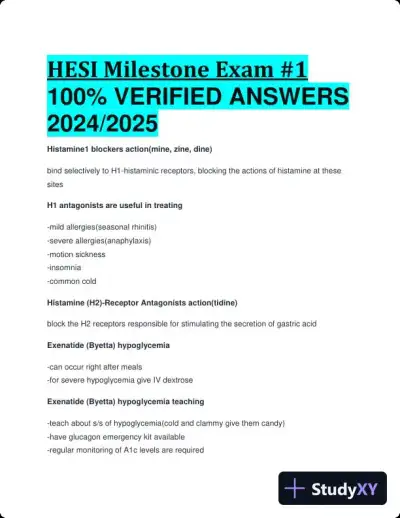 Past Exams
2024-2025 HESI Milestone Exam 1 with Answers (162 Solved Questions)
Health Education Systems, Inc.
26 pages119downloadsFeb 2025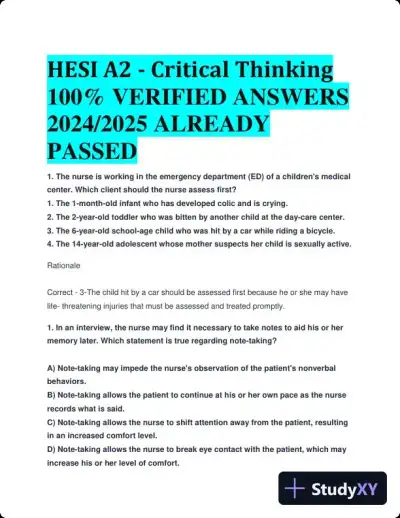 Past Exams
2024-2025 HESI A2 Critical Thinking with Answers (124 Solved Questions)
Health Education Systems, Inc.
114 pages106downloadsFeb 2025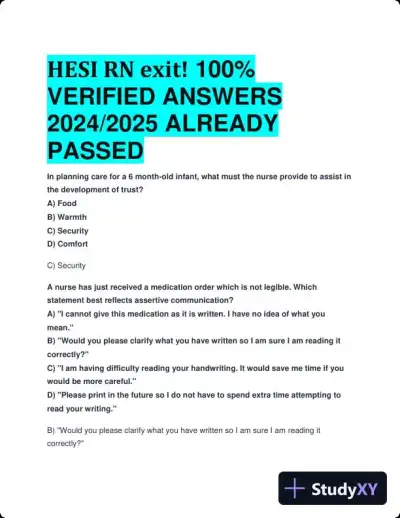 Past Exams
2024-2025 HESI RN Exit Exam with Answers (156 Solved Questions)
Health Education Systems, Inc.
44 pages92downloadsFeb 2025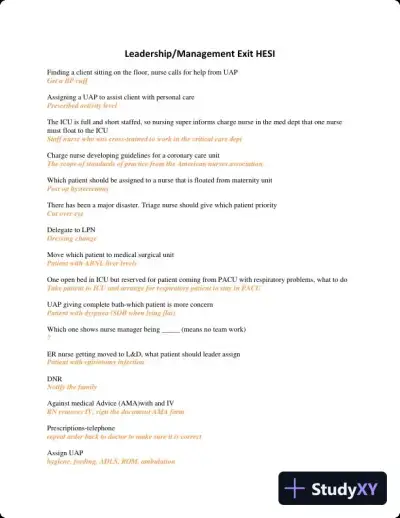 Past Exams
HESI Leadership/Management Exit Exam with Answers (59 Solved Questions)
Health Education Systems, Inc.
4 pages54downloadsFeb 2025
Study this document with CramX
Once it is in your library, every tool can work from it.