

HESI Child Care Exit Practice Exam Version 1 With Answers (160 Solved Questions)
- Health Education Systems, Inc.
- 41 pages
- Shared May 2025
Sharpen your test-taking skills with HESI Child Care Exit Practice Exam Version 1 With Answers, packed with past exam questions.
Preview 13 of 41 pages
See the first 13 pages exactly as they appear in the document.
Page 1 Read page 1 as text
HESI EXIT EXAM V1 1. Which information is a priority for the RN to reinforce to an older client after intravenous pylegraphy? A) Eat a light diet for the rest of the day B) Rest for the next 24 hours since the preparation and the test is tiring. C) During waking hours drink at least 1 8-ounce glass of fluid every hour for the next 2 days D) Measure the urine output for the next day and immediately notify the health care provider if it should decrease. The correct answer is D: Measure the urine output for the next day and immediately notify the health care provider if it should decrease. 2. A client has altered renal function and is being treated at home. The nurse recognizes that the most accurate indicator of fluid balance during the weekly visits is A) difference in the intake and output B) changes in the mucous membranes C) skin turgor D) weekly weight The correct answer is D: weekly weight 3. A client has been diagnosed with Zollinger-Ellison syndrome.Which information is most important for the nurse to reinforce with the client? A) It is a condition in which one or more tumors called gastrinomas form in the pancreas or in the upper part of the small intestine (duodenum) B) It is critical to report promptly to your health care provider any findings of peptic ulcers c)Treatment consists of medications to reduce acid and heal any peptic ulcers and, if possible, surgery to remove any tumors D)With the average age at diagnosis at 50 years the peptic ulcers may occur at unusual areas of the stomach or intestine lOMoARcPSD|13778330
Page 2 Page 3 Read page 3 as text
The correct answer is B: It is critical to report promptly to your health care provider any findings of peptic ulcers . 4. A primigravida in the third trimester is hospitalized for preeclampsia. The nurse determines that the client’s blood pressure is increasing. Which action should the nurse take first? A) Check the protein level in urine B) Have the client turn to the left side C) Take the temperature D) Monitor the urine output The correct answer is B: Have the client turn to the left side 5. The nurse is caring for a client in atrial fibrillation. The atrial heart rate is 250 and the ventricular rate is controlled at 75. Which of the following findings is cause for the most concern? A) Diminished bowel sounds B) Loss of appetite C) A cold, pale lower leg D) Tachypnea The correct answer is C: A cold, pale lower leg 6. The client with infective endocarditis must be assessed frequently by the home health nurse. Which finding suggests that antibiotic therapy is not effective, and must be reported by the nurse immediately to the healthcare provider? A) Nausea and vomiting B) Fever of 103 degrees Fahrenheit (39.5 degrees Celsius) C) Diffuse macular rash D) Muscle tenderness The correct answer is B: Fever of 103 degrees F (39.5 degrees C) 7. A client who had a vasectomy is in the post recovery unit at an outpatient clinic. Which of these points is most important to be reinforced by the nurse? A) Until the health care provider has determined that your ejaculate doesn't contain sperm, continue to use another form of contraception. B) This procedure doesn't impede the production of male hormones or the production of
Page 4 Read page 4 as text
sperm in the testicles. The sperm can no longer enter your semen and no sperm are in your ejaculate. C) After your vasectomy, strenuous activity needs to be avoided for at least 48 hours. If your work doesn't involve hard physical labor, you can return to your job as soon as you feel up to it. The stitches generally dissolve in seven to ten days. D) The health care provider at this clinic recommends rest, ice, an athletic supporter or over-the-counter pain medication to relieve any discomfort. The correct answer is A: Until the health care provider has determined that your ejaculate doesn't contain sperm, continue to use another form of contraception. 8. A client who is to have antineoplastic chemotherapy tells the nurses of a fear of being sick all the time and wishes to try acupuncture. Which of these beliefs stated by the client would be incorrect about acupuncture? A) Some needles go as deep as 3 inches, depending on where they're placed in the body and what the treatment is for. The needles usually are left in for 15 to 30 minutes. B) In traditional Chinese medicine, imbalances in the basic energetic flow of life 4 known as qi or chi 4 are thought to cause illness. C) The flow of life is believed to flow through major pathways or nerve clusters in your body. D) By inserting extremely fine needles into some of the over 400 acupuncture points in various combinations it is believed that energy flow will rebalance to allow the body's natural healing mechanisms to take over. The correct answer is C: The flow of life is believed to flow through major pathways or nerve clusters in your body. 9. The nurse is discussing with a group of students the disease Kawasaki. What statement made by a student about Kawasaki disease is incorrect?
Page 5 Read page 5 as text
A)It also called mucocutaneous lymph node syndrome because it affects the mucous membranes (inside the mouth, throat and nose), skin and lymph nodes. B)In the second phase of the disease, findings include peeling of the skin on the hands and feet with joint and abdominal pain C) Kawasaki disease occurs most often in boys, children younger than age 5 and children of Hispanic descent D) Initially findings are a sudden high fever, usually above 104 degrees Fahrenheit, which lasts 1 to2 weeks The correct answer is C: Kawasaki disease occurs most often in boys, children younger than age 5 and children of Hispanic descent 10. A client has viral pneumonia affecting 2/3 of the right lung. What would be the best position to teach the client to lie in every other hour during first 12 hours after admission? A) Side-lying on the left with the head elevated 10 degrees B) Side-lying on the left with the head elevated 35 degrees C) Side-lying on the right wil the head elevated 10 degrees D) Side-lying on the right with the head elevated 35 degrees The correct answer is A: Side-lying on the left with the head elevated 10 degrees 11. A client has an indwelling catheter with continuous bladder irrigation after undergoing a transurethral resection of the prostate (TURP) 12 hours ago. Which finding at this time should be reported to the health care provider? A) Light, pink urine B) occasional suprapubic cramping C) minimal drainage into the urinary collection bag D) complaints of the feeling of pulling on the urinary catheter The correct answer is C:minimal drainage into the urinary collection bag 12. A nurse is performing CPR on an adult who went into cardiopulmonary arrest. Another nurse enters the room in response to the call. After checking the client’s pulse and respirations, what should be the function of the second nurse?
Page 6 Read page 6 as text
A) Relieve the nurse performing CPR B) Go get the code cart C) Participate with the compressions or breathing D) Validate the client's advanced directive The correct answer is C: Participate with the compressions or breathing 13. The nurse assesses a 72 year-old client who was admitted for right sided congestive heart failure. Which of the following would the nurse anticipate finding? A) Decreased urinary output B) J u g u l a r ve i n d i sten ti o n C) Pleural effusion D) Bibasilar crackles T h e c o rr ec t answ er i s B : J u g u l a r ve i n d i sten ti o n 14. A client with heart failure has a prescription for digoxin. The nurse is aware that sufficient potassium should be included in the diet because hypokalemia in combination with this medication A) Can predispose to dysrhythmias B) May lead to oliguria C) May cause irritability and anxiety D) Sometimes alters consciousness The correct answer is A: Can predispose to dysrhythmias 15. A nurse assesses a young adult in the emergency room following a motor vehicle accident. Which of the following neurological signs is of most concern? A) Flaccid paralysis B) Pupils fixed and dilated C) Diminished spinal reflexes D) Reduced sensory responses The correct answer is B: Pupils fixed and dilated 16. A 14 year-old with a history of sickle cell disease is admitted to the hospital with a diagnosis of vaso-occlusive crisis. Which statements by the client would be most indicative of the etiology of this crisis? A) =I knew this would happen. I've been eating too much red meat lately." B) =I really enjoyed my fishing trip yesterday. I caught 2 fish." C) =I have really been working hard practicing with the debate team at school."
Page 7 Read page 7 as text
D) =I went to the health care provider last week for a cold and I have gotten worse." The correct answer is D: "I went to the doctor last week for a cold and I have gotten worse." 17. Which these findings would the nurse more closely associate with anemia in a 10 month-old infant? A) Hemoglobin level of 12 g/dI B) Pale mucosa of the eyelids and lips C) Hypoactivity D) A heart rate between 140 to 160 The correct answer is B: Pale mucosa of the eyelids and lips 18. The nurse is caring for a client in hypertensive crisis in an intensive care unit. The priority assessment in the first hour of care is A) Heart rate B) Pedal pulses C) Lung sounds D) Pupil responses The correct answer is D: Pupil responses 19. Which of these clients who are all in the terminal stage of cancer is least appropriate to suggest the use of patient controlled analgesia (PCA) with a pump? A) A young adult with a history of Down's syndrome B) A teenager who reads at a 4th grade level C) An elderly client with numerous arthritic nodules on the hands D) A preschooler with intermittent episodes of alertness The correct answer is D: A preschooler with intermittent episodes of alertness 20. The nurse is about to assess a 6 month-old child with nonorganic failure-to thrive (NOFTT). Upon entering the room, the nurse would expect the baby to be A) Irritable and "colicky" with no attempts to pull to standing B) Alert, laughing and playing with a rattle, sitting with support C) Skin color dusky with poor skin turgor over abdomen D) Pale, thin arms and legs, uninterested in surroundings The correct answer is D: Pale, thin arms and legs, uninterested in surroundings 21. As the nurse is speaking with a group of teens which of these side effects of
Page 8 Read page 8 as text
chemotherapy for cancer would the nurse expect this group to be more interested in during the discussion? A) Mouth sores B) Fatigue C) Diarrhea D) Hair loss The correct answer is D: Hair loss 22. While caring for a client who was admitted with myocardial infarction (MI) 2 days ago, the nurse notes today's temperature is 101.1 degrees Fahrenheit (38.5 degrees Celsius). The appropriatenursing intervention is to A) Call the health care provider immediately B) Administer acetaminophen as ordered as this is normal at this time C) Send blood, urine and sputum for culture D) Increase the client's fluid intake The correct answer is B: Administer acetaminophen as ordered as this is normal at this time 23. A client is admitted for first and second degree burns on the face, neck, anterior chest and hands. The nurse's priority should be A) Cover the areas with dry sterile dressings B) Assess for dyspnea or stridor C) Initiate intravenous therapy D) Administer pain medication The correct answer is B: Assess for dyspnea or stridor 24. Which of these clients who call the community health clinic would the nurse ask to come in that day to be seen by the health care provider? A) I started my period and now my urine has turned bright red. B) I am an diabetic and today I have been going to the bathroom every hour. C) I was started on medicine yesterday for a urine infection. Now my lower belly hurts when I go to the bathroom. D) I went to the bathroom and my urine looked very red and it didn’t hurt when I went. The correct answer is D: I went to the bathroom and my urine looked very red and it
Page 9 Read page 9 as text
didn’t hurt when I went. 25. A middle aged woman talks to the nurse in the health care provider’s office about uterine fibroids also called leiomyomas or myomas. What statement by the woman indicates more education is needed? A) I am one out of every 4 women that get fibroids, and of women my age 3 between the 30s or 40s, fibroids occurs more frequently. B) My fibroids are noncancerous tumors that grow slowly. C) My associated problems I have had are pelvic pressure and pain, urinary incontinence, frequent urination or urine retention and constipation. D) Fibroids that cause no problems still need to be taken out. The correct answer is D: Fibroids that cause no problems still need to be taken out. 26. An elderly client admitted after a fall begins to seize and loses consciousness. What action by the nurse is appropriate to do next? A) Stay with client and observe for airway obstruction B) Collect pillows and pad the side rails of the bed C) Place an oral airway in the mouth and suction D) Announce a cardiac arrest, and assist with intubation The correct answer is A: Stay with client and observe for airway obstruction 27. A nurse is providing care to a primigravida whose membranes spontaneously ruptured (ROM) 4 hours ago. Labor is to be induced. At the time of the ROM the vital signs were T-99.8 degrees F, P-84, R-20, BP-130/78, and fetal heart tones (FHT) 148 beats/min. Which assessment findings taken now may be an early indication that the client is developing a complication of labor? A) FHT 168 beats/min B) Temperature 100 degrees Fahrenheit. C) Cervical dilation of 4 D) BP 138/88 The correct answer is A: FHT 168 beats/min 28. A client with pneumococcal pneumonia had been started on antibiotics 16 hours ago.
Page 10 Read page 10 as text
During the nurse’s initial evening rounds the nurse notices a foul smell in the room. The client makes all of these statements during their conversation. Which statement would alert the nurse to a complication? A) "I have a sharp pain in my chest when I take a breath." B) "I have been coughing up foul-tasting, brown, thick sputum." C) "I have been sweating all day." D) "I feel hot off and on." The correct answer is B: "I have been coughing up foul tasting, brown, thick sputum." 29. The nurse is performing an assessment on a client in congestive heart failure. Auscultation of the heart is most likely to reveal A) S3 ventricular gallop B) Apical click C) Systolic murmur D) Split S2 The correct answer is A: S3 ventricular gallop 30. Which of these observations made by the nurse during an excretory urogram indicate a complicaton? A) The client complains of a salty taste in the mouth when the dye is injected B) The client’s entire body turns a bright red color C) The client states <I have a feeling of getting warm.= D) The client gags and complains < I am getting sick.= The correct answer is B: The client’s entire body turns a bright red color 31. A client is diagnosed with a spontaneous pneumothorax necessitating the insertion of a chest tube. What is the best explanation for the nurse to provide this client? A) "The tube will drain fluid from your chest." B) "The tube will remove excess air from your chest." C) "The tube controls the amount of air that enters your chest." D) "The tube will seal the hole in your lung." The correct answer is B: "The tube will remove excess air from your chest." 32. The nurse is reviewing laboratory results on a client with acute renal failure. Which one of the following should be reported immediately? A) Blood urea nitrogen 50 mg/dl B) Hemoglobin of 10.3 mg/dl C) Venous blood pH 7.30
Page 11 Read page 11 as text
D) Serum potassium 6 mEq/L The correct answer is D: Serum potassium 6 mEq/L 33. The nurse is caring for a client undergoing the placement of a central venous catheter line. Which of the following would require the nurse’s immediate attention? A) Pallor B) Increased temperature C) Dyspnea D) Involuntary muscle spasms The correct answer is C: Dyspnea 34. The nurse is performing a physical assessment on a client who just had an endotracheal tube inserted. Which finding would call for immediate action by the nurse? A) Breath sounds can be heard bilaterally B) Mist is visible in the T-Piece C) Pulse oximetry of 88 D) Client is unable to speak The correct answer is C: Pulse oximetry of 88 35. A nurse checks a client who is on a volume-cycled ventilator. Which finding indicates that the client may need suctioning? A) drowsiness B) complaint of nausea C) pulse rate of 92 D) restlessness The correct answer is D: restlessness 36. The most effective nursing intervention to prevent atelectasis from developing in a post operative client is to A) Maintain adequate hydration B) Assist client to turn, deep breathe, and cough C) Ambulate client within 12 hours D) Splint incision The correct answer is B: Assist client to turn, deep breathe, and cough 37. When caring for a client with a post right thoracotomy who ha s undergone an upper lobectomy, the nurse focuses on pain management to promote A) Relaxation and sleep B) Deep breathing and coughing C) Incisional healing D) Range of motion exercises The correct answer is B: Deep breathing and coughing
Page 12 Read page 12 as text
38. A nurse is to collect a sputum specimen for acid-fast bacillus (AFB) from a client. Which action should the nurse take first? A) Ask client to cough sputum into container B) Have the client take several deep breaths C) Provide a appropriate specimen container D) Assist with oral hygiene The correct answer is D: Assist with oral hygiene 39. The nurse is caring for a child immediately after surgical correction of a ventricular septal defect. Which of the following nursing assessments should be a priority? A) Blanch nail beds for color and refill B) Assess for post operative arrhythmias C) Auscultate for pulmonary congestion D) Monitor equality of peripheral pulses The correct answer is B: Assess for post operative arrhythmias 40. A client has a history of chronic obstructive pulmonary disease (COPD). As the nurse enters the client's room, his oxygen is running at 6 liters per minute, his color is flushed and his respirations are 8 per minute. What should the nurse do first? A) Obtain a 12-lead EKG B) Place client in high Fowler's position C) Lower the oxygen rate D) Take baseline vital signs The correct answer is C: Lower the oxygen rate 41. A 4 year-old has been hospitalized for 24 hours with skeletal traction for treatment of a fracture of the right femur. The nurse finds that the child is now crying and the right foot is pale with the absence of a pulse. What should the nurse do first? A) Notify the health care provider B) Readjust the traction C) Administer the ordered prn medication D) Reassess the foot in fifteen minutes The correct answer is A: Notify the health care provider 42. The nurse is assessing a client 2 hours postoperatively after a femoral popliteal bypass. The upper leg dressing becomes saturated with blood. The nurse's first action should be to A) Wrap the leg with elastic bandages B) Apply pressure at the bleeding site
Page 13 Read page 13 as text
C) Reinforce the dressing and elevate the leg D) Remove the dressings and re-dress the incision The correct answer is C: Reinforce the dressing and elevate the leg 43. A client is receiving external beam radiation to the mediastinum for treatment of bronchial cancer. Which of the following should take priority in planning care? A) Esophagitis B) Leukopenia C) Fatigue D) Skin irritation Review Information: The correct answer is B: Leukopenia 44. A client has a chest tube in place following a left lower lobectomy inserted after a stab wound to the chest. When repositioning the client, the nurse notices 200 cc of dark, red fluid flows into the collection chamber of the chest drain. What is the most appropriate nursing action? A) Clamp the chest tube B) Call the surgeon immediately C) Prepare for blood transfusion D) Continue to monitor the rate of drainage The correct answer is D: Continue to monitor the rate of drainage 45. A client has returned from a cardiac catheterization. Which one of the following assessments would indicate the client is experiencing a complication from the procedure? A) Increased blood pressure B) Increased heart rate C) Loss of pulse in the extremity D) Decreased urine output The correct answer is C: Loss of pulse in the extremity 46. A 60 year-old male client had a hernia repair in an outpatient surgery clinic. He is awake and alert, but has not been able to void since he returned from surgery 6 hours ago. He received 1000 mL of IV fluid. Which action would be most likely to help him void? A) Have him drink several glasses of water B) Crede’ the bladder from the bottom to the top C) Assist him to stand by the side of the bed to void D) Wait 2 hours and have him try to void again The correct answer is C: Assist him to stand by the side of the bed to void
28 more pages in the full document
Unlock it once and it stays in your library, ready to chat with or turn into flashcards.
Unlock the full documentMore Health Education Systems, Inc. study materials
See all Past Exams
2023-2024 RN HESI Exit Exam Version 3 with Answers (53 Solved Questions)
Health Education Systems, Inc.
13 pages163downloadsFeb 2025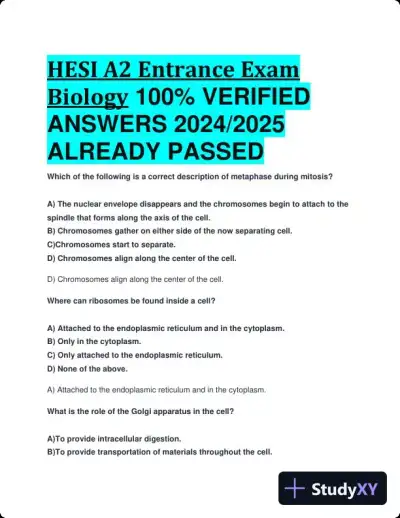 Past Exams
2024-2025 HESI A2 Biology Entrance Exam with Answers (42 Solved Questions)
Health Education Systems, Inc.
13 pages154downloadsFeb 2025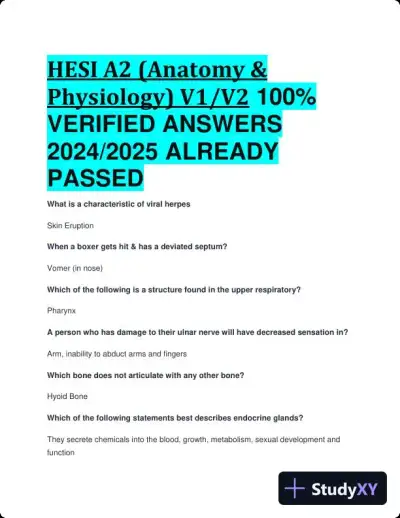 Past Exams
2024-2025 HESI A2 Anatomy and Physiology V1/V2 Practice Exam with Answers (134 Solved Questions)
Health Education Systems, Inc.
15 pages134downloadsFeb 2025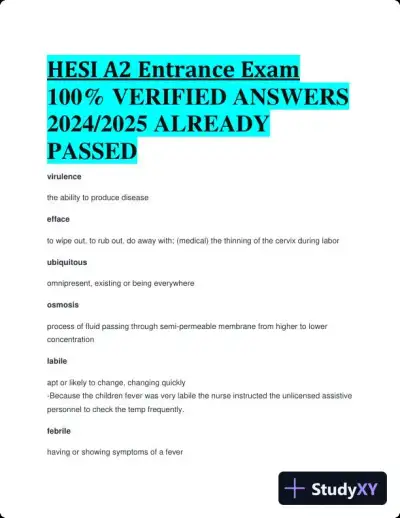 Past Exams
2024-2025 HESI A2 Entrance Exam with Answers (232 Solved Questions)
Health Education Systems, Inc.
26 pages132downloadsFeb 2025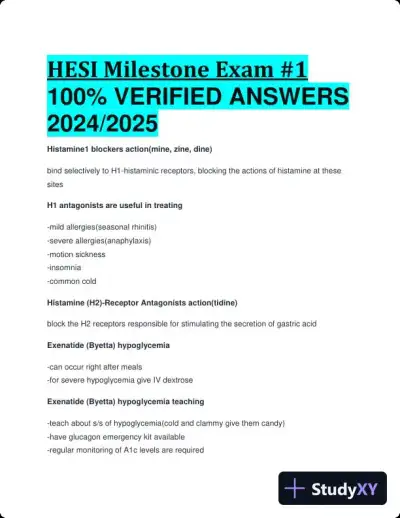 Past Exams
2024-2025 HESI Milestone Exam 1 with Answers (162 Solved Questions)
Health Education Systems, Inc.
26 pages119downloadsFeb 2025 Past Exams
2024-2025 HESI A2 Critical Thinking with Answers (124 Solved Questions)
Health Education Systems, Inc.
114 pages106downloadsFeb 2025 Past Exams
2024-2025 HESI RN Exit Exam with Answers (156 Solved Questions)
Health Education Systems, Inc.
44 pages92downloadsFeb 2025 Past Exams
HESI Leadership/Management Exit Exam with Answers (59 Solved Questions)
Health Education Systems, Inc.
4 pages54downloadsFeb 2025
Study this document with CramX
Once it is in your library, every tool can work from it.