

HESI Comprehensive A2 Entrance Exam With Answers (150 Solved Questions)
- Health Education Systems, Inc.
- 23 pages
- Shared May 2025
Study smarter with HESI Comprehensive A2 Entrance Exam With Answers, a collection of carefully selected past exams.
Preview 7 of 23 pages
See the first 7 pages exactly as they appear in the document.
Page 1 Read page 1 as text
1 / 11 HESI A2 Entrance Exam 1. Abstain: To voluntarily refrain from something. (The dental hygeienist instructed the patient to from smoking to improve his breath odor.) 2. Accountable: To be responsible. (Paramedics are for maintaining up - to - date knowledge of resuscitation techniques.) 3. Acute: Sudden, intense. (The nurse administered the prescribed pain medication to the patient who was experiencing pain after surgery.) 4. Adhere: To hold fast or stick together. (The tape must to the patient's skin to hold the bandage in place.)
Page 2 Page 3 Read page 3 as text
2 / 11 5. Adverse: Undesired, possibly harmful. (Vomiting is an effect of many medications.) 6. Aegis: Control, protection (Unit staffing decisions are under the of the nurse manag er) 7. Ambibalent: Uncertain, having contradictory feelings (After learning that she had breast cancer, the patient was about having a mastectomy.) 8. Apply: To place, put on, or spread something. (The nurse will a medication to the wound before covering the wound with a bandage.) 9. Assent: To give consent; to agree (The attention was asked to to the surgery by signing the informed consent document.)
Page 4 Read page 4 as text
3 / 11 10. Audible: Able to be heard (The respiratory therapist noted the patient's wheezing as a symptom of the patient's asthma.) 11. Bacteria: Single - called, microscopic organisms (The physician ordered a laboratory test to confirm that the patient's illness was caused by rather than a virus.) 12. Bilateral: Present on two sides. (The unlicensed assistive personnel reported to the nurse that the patient had weakness int he legs when walking.) 13. Cardiac: Of or relating to the heart (Smoking increases the risk of disease.)
Page 5 Read page 5 as text
4 / 11 14. Cavity: An opening or an empty area. (The nurse inspected the patient's oral for lesions.) 15. Cease: Come to an end or bring to an end (Because the patient's breathing had , the paramedic began resuscitation measures.) 16. Chronology: Order of events as they occurred; timeline. (The police interviewed witnesses and first responders to determine the of the accident.) 17. Compensatory: Offsetting or making up for something. (When the patient's blood pressure decreased, the paramedic noted that the heart rate increased, which the paramedic recognized as a action.) 18. Concave: Rounded inward (The dietician noticed that the patient was very thin and that the patient's abdomen appeared .) 19. Concise: Brief, to the point. (When teaching a patient, the nurse tried to be so that the instructions would be easy to remember.) 20. Consistency: Degree of viscosity; how thick or thin a fluid is in relation to how
Page 6 Read page 6 as text
5 / 11 it flows. (The respiratory therapist noticed that the mucus the patient was coughing was of a thin, watery .) 21. Constrict: To draw together or become smaller. (The nurse knows that the small blood vessels of the skin will when ice is applied to the skin.) 22. Contingent: Dependent (The hygienist told the patient that a healthy mouth is on careful daily brushing and flossing.) 23. Contraindication: A reason something is not advisable or should not be done. (The patient's excessive bleeding was a for discharge front eh hospital.) 24. Convulsive: Having or causing convulsions, i.e., violent shaking of the body. (Epilepsy is a disorder) 25. Cursory: Quick, perfunctory, not thorough. (During triage, the paramedic gave each accident victim a examination.)
Page 7 Read page 7 as text
6 / 11 26. Defecate: Expel feces. (The unlicensed assistive personnel helped the patient to the toilet when the patient needed to .) 27. Deficit: A deficiency or lack of something. (The therapist explained that the patient will experience a fluid if the patient continues to perspire heavily during exercise without drinking enough fluids.) 28. Depress: Press downward (The nurse will the patient's skin to see if any swelling is present.) 29. Depth: Downward measurement from a surface (The physician measures the of a wound by inserting a cotton swab into the wound.) 30. Deteriorating: Worsening (The dental hygienist explains that the condition of the patient's gums is deterio - rating and treatment by the dentist is needed right away.) 31. Device: Tool or piece of equipment (A thermometer is a used to measure the patient's body temperature) 32. Diagnosis: Identification of an injury or disease. (The patient received a of pancreatitis.)
16 more pages in the full document
Unlock it once and it stays in your library, ready to chat with or turn into flashcards.
Unlock the full documentMore Health Education Systems, Inc. study materials
See all Past Exams
2023-2024 RN HESI Exit Exam Version 3 with Answers (53 Solved Questions)
Health Education Systems, Inc.
13 pages163downloadsFeb 2025 Past Exams
2024-2025 HESI A2 Biology Entrance Exam with Answers (42 Solved Questions)
Health Education Systems, Inc.
13 pages154downloadsFeb 2025 Past Exams
2024-2025 HESI A2 Anatomy and Physiology V1/V2 Practice Exam with Answers (134 Solved Questions)
Health Education Systems, Inc.
15 pages134downloadsFeb 2025 Past Exams
2024-2025 HESI A2 Entrance Exam with Answers (232 Solved Questions)
Health Education Systems, Inc.
26 pages132downloadsFeb 2025 Past Exams
2024-2025 HESI Milestone Exam 1 with Answers (162 Solved Questions)
Health Education Systems, Inc.
26 pages119downloadsFeb 2025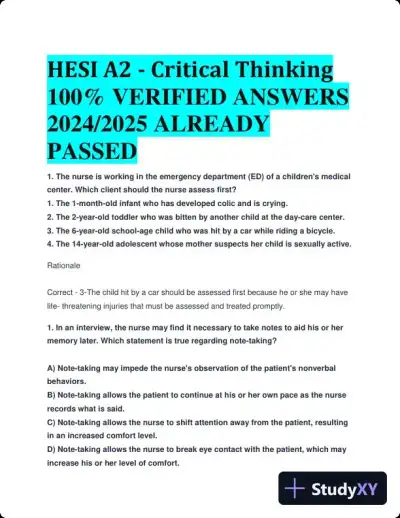 Past Exams
2024-2025 HESI A2 Critical Thinking with Answers (124 Solved Questions)
Health Education Systems, Inc.
114 pages106downloadsFeb 2025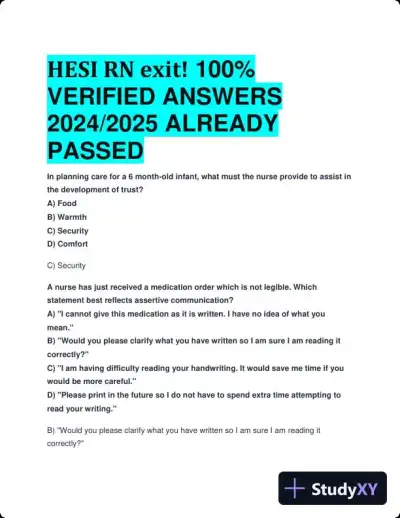 Past Exams
2024-2025 HESI RN Exit Exam with Answers (156 Solved Questions)
Health Education Systems, Inc.
44 pages92downloadsFeb 2025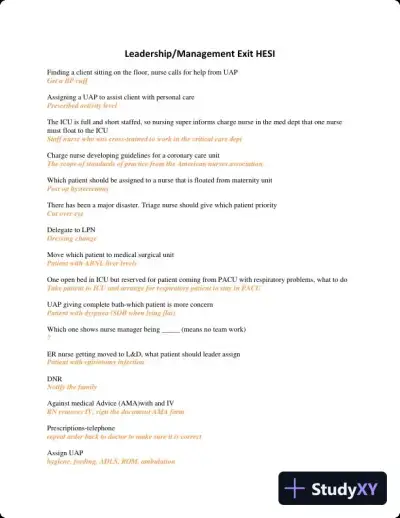 Past Exams
HESI Leadership/Management Exit Exam with Answers (59 Solved Questions)
Health Education Systems, Inc.
4 pages54downloadsFeb 2025
Study this document with CramX
Once it is in your library, every tool can work from it.