

HESI Comprehensive Entrance Exam With Answers (292 Solved Questions)
- Health Education Systems, Inc.
- 81 pages
- Shared May 2025
HESI Comprehensive Entrance Exam With Answers makes exam preparation easier by providing past exam insights.
Preview 16 of 81 pages
See the first 16 pages exactly as they appear in the document.
Page 1 Read page 1 as text
HESI A2 ENTRANCE EXAM: READING COMPREHENSION, CHEMISTRY, GRAMMAR, BIOLOGY, VOCABULARY & GENERAL KNOWLEDGE, CRITICAL THINKING, ANATOMY & PHYSIOLOGY AND MATH VERSION 2 ( With answers)
Page 2 Page 3 Read page 3 as text
Reading Comprehension Neurologists and biological psychologists have witnessed a sharp increase in the knowledge and understanding of particular structures of the brain over the past two decades. As technology becomes ever more advanced, scientists are able to isolate the functions of even small regions of the human brain. One noteworthy discovery is the role of the amygdala in human fear and aggression. The amygdala, a small, almond-shaped conglomerate, is just one part of the limbic system. Located at the very center of the brain, the limbic system is the core of our 'emotional brain;' each individual structure in the limbic system is somehow connected to an aspect of human emotion. Scientists have found that electrode stimulation of the amygdala can elicit extreme and aggressive acts. Patients or experimental subjects who experience this utter rage and fearlessness have no rational foundation for their reaction. In other words, this aggression is wholly attributable to electrode stimulation. On the other hand, patients with trauma or damage to this structure exhibit a complete absence of aggression. Researchers find that no amount of poking, prodding or harassment will evoke even remotely aggressive responses from these subjects. 1. The author suggests that persistent passivity and imperturbability may be a direct result of which of the following? A. Drug-induced stimulation of the amygdala. B. A stroke that resulted in severe tissue damage in the limbic system C. Encephalitis as a result of head trauma D. Activation of a strategically implanted electrode in a patient’s amygdala. 2. Which statement is not listed as a detail within the passage? A. Electrode stimulation of the amygdala can elicit extreme aggressive acts. B. Scientists are able to isolate the functions of even small regions of the human brain. C. Typically, temperamental rhesus monkeys with amygdala d amage are completely imperturbable. D. Subjects who experience this utter rage and fearlessness have no rational foundation for their reaction. 3. What is the main idea of the passage?
Page 4 Read page 4 as text
A. The human brain is as complex as it is mysterious. B. Patients with damaged amygdalas are less aggressive than individuals with healthy ones. C. Electrode stimulation is a valuable tool for researchers who study the human brain. D. Scientists have learned a lot about how the amygdala affects human emotion. The Bicycle V2 Today, bicycle s are so common that it’s hard to believe they haven’t always been around. But two hundred years ago, bicycles didn’t even exist, and the first bicycle, invented in Germany in 1818, was nothing like our bicycles today. It was made of wood and didn’t even h ave pedals. Since then, however, numerous innovations and improvements in design have made the bicycle one of the most popular means of recreation and transportation around the world. In 1839, Kirkpatrick Macmillan, a Scottish blacksmith, dramatically improved upon the original bicycle design. Macmillan’s machine had tires with iron rims to keep them from getting worn down. He also used foot – operated cranks like pedals, so his bicycle could be ridden at a quick pace. It didn’t look much like a modern bicy cle, though, because its back wheel was substantially larger than its front wheel. In 1861, the French Michaux brothers took 4. The main idea of this passage is best explained in which sentence? A. Sentence (1): Today, bicycles are so common that it’s hard to believe they haven’t always been around. B. Sentence (13): It wasn’t until 1874 that the first truly modern bicycle appeared on the scene. C. Sentence (4): Since then, however, numerous innovations and improvements in design have made the bicycle one of the most popular means of recreation and transportation around the world. D. Sentence (18): Today they are built, used, and enjoyed all over the world. 5. Which of the following would be the best title for this passage?
Page 5 Read page 5 as text
A. Bicycles are better B. A ride through the history of bicycles C. Cycle your way to fitness D. The popularity of bicycles 6. Sentence (8); It didn’t look much like a modern bicycle, through because its back wheel was substantially larger than its front wheel, “follows which pattern? A. Fact, fact B. Fact, opinion C. Opinion, fact D. Opinion, opinion 7. Macmillan added iron rims to the tires of his bicycle to…. o Add wight to the bicycle o Makes the tires last longer o Makes the ride less bumpy o Makes the ride less tiring Jazz Jazz has been called "the art of expression set to music", and "America's great contribution to music". It has functioned as popular art and enjoyed periods of widespread public response, in the "jazz age" of the 1920s, in the "swing era" of the late 1930s and in the peak popularity of modern jazz in the late 1950s. The standard legend about Jazz is that it originated around the end of the 19th century in New Orleans and moved up the Mississippi River to Memphis, St. Louis, and finally to Chicago. It welded together the elements of Ragtime, marching band music, and the Blues. However, the influences of what led to those early sounds goes back to tribal African drumbeats and European musical structures. Buddy Bolden, a New Orleans barber and cornet player, is generally considered to have been the first real Jazz musician, around 1891. What made Jazz significantly different from the other earlier forms of music was the use of improvisation. Jazz displayed a break from traditional music where a composer wrote an entire piece of music on paper, leaving the musicians to break
Page 6 Read page 6 as text
their backs playing exactly what was written on the score. In a Jazz piece, however, the song is simply a starting point, or sort of skeletal guide for the Jazz musicians to improvise around. Many of the early Jazz musicians were bad sight readers and some couldn't even read music at all. These early musicians couldn't make money very much and were stuck working menial jobs to make a living. The second wave of New Orleans Jazz musicians included such memorable players as Joe Oliver, Kid Ory, and Jelly Roll Morton. These men formed small bands and took the music of earlier musicians, improved its complexity, and gained greater success. This music is known as "hot Jazz" due to the enormously fast speeds and rhythmic drive. A young cornet player by the name of Louis Armstrong was discovered by Joe Oliver in New Orleans. He soon grew up to become one of the greatest and most successful musicians of all time, and later one of the biggest stars in the world. The impact of Armstrong and other talented early Jazz musicians changed the way we look at music. 8. Definition of confluence. a. Melding b. Influence c. Intersection d. Coming together 9. Where and when did jazz originate? Southern US. 20 th century 10. How does the author regard Jazz? a. A real aficionado b. Unable to determine c. Doesn’t like it much d. Enjoys it occasionally 11. Derivation of the word “Jazz” West coast slang
Page 7 Read page 7 as text
Electoral College The Electoral College has nothing to do with college and contains no students. The Electoral College consists of votes that each state acquires based on the number of representatives it has in Congress. Each state has two electoral votes because each state has two senators. The remaining electoral votes are determined by the number of Congressmen, the number of which is based on the population of the state established by the Census taken each decade. During the presidential election, most states cast all their electoral votes for the candidate who wins the popular vote in that state. It's all very confusing, but the founding fathers know what they were doing. By having and using the Electoral College candidates' campaign in every state, but just because they win the popular vote across the country doesn't mean they will always win the election. Case in point, in election 2000, Al Gore won the popular vote across the country, but George W. Bush won more electoral votes. Therefore, he became our 43rd president. 12. Which statement is a fact? Each state casts their electoral votes during the Presidential election. 13. What does cast mean? To give one’s vo te 14. The author intends the ready to ? Have an understanding of the Electoral College. The Golden Gate Bridge Passage The Golden Gate Bridge is one of the most famous straits on the west coast of America. The narrow passage crosses the Pacific Ocean. Before the bridge, people traveled by boat. The Golden Garden Bridge is a suspension strain with to great of a risk for some residents. Joseph Strauss, chief engineer, overcame many technical problems. Risks were taken to complete the bridge, but the best and brightest worked on the challenge to build a bridge which connects the Pacific Ocean to San Francisco Bay.
Page 8 Read page 8 as text
Strauss set a net installed beneath the gate that saved numerous lives because he was concerned for the safety of his workers. The workers started building at each end with big concrete blocks sunk deep into the ground which over 200 thick steel cables which the bridge would be suspended were to be anchored. The workers after completed the roadway which was the most dangerous task. Today, the famous west coast strait is a staple to San Francisco. Golden Gate Bridge Linking San Francisco to Marin County in California, the Golden Gate Bridge is one of the most famous bridges in the world. The bridge crosses over a narrow strait which connects the Pacific Ocean to San Francisco Bay. Prior to the bridge, people traveled by ferry boat across the strait. Although most people thought a bridge was necessary to expedite travel, some residents of the Bay area felt the risk of building the bridge was too great. Joseph Strauss believed that nothing was impossible, and dreams would never come to fruition if risks weren’t taken. So, he decided to gather the best and brightest builders, architects, and workers to embark on the challenge of building a bridge across the Golden Gate Strait. With safety nets in place, the construction began in 1937. Building the anchorages first, the builders then move on to the towers on each end, and then to the three-foot thick cables to support the suspension bridge. Lastly, workers labored to complete the roadway which become the most dangerous and treacherous part of the entire task. The builders had to keep the bridge balance, so it wouldn’t fall into the bay. Today, over sixty-five years later, the bridge remains a lifeline for the people of the San Francisco Bay Area. 15. The authors’ reason for writing this piece seems to be to Inform the reader 16. 1What body of water does The Golden Gate Bridge cross? Golden Gate Strait 17. Why was the roadway so dangerous to build? If the road wasn’t bala nced, it would collapse
Page 9 Read page 9 as text
18. In the passage the word embark means to Begin an undertaking, start 19. Which part of the bridge was built first? Anchorage 20. Where is The Golden Gate Bridge located specifically? A. West Coast B. San Francisco C. San Fernando D. America 21. Why did Strauss set a net? A. For suspension B. For balance C. For aesthetics D. For safety 22. Which part of the bridge was built first? A. Steel cables B. A net C. The roadway D. Concrete blocks 23. In passage the word strait means to A. A narrow passage B. Moving in one direction C. Move away aimlessly D. A roadway
Page 10 Read page 10 as text
A bit about bicycles Today, bicycles are so common that it's hard to believe they haven't always been around. But two hundred years ago, bicycles didn't even exist, and the first bicycle, invented in Germany in 1818, was nothing like our bicycles today. It was made of wood and didn't even have pedals. Since then, however, numerous innovations and improvements in design have made the bicycle one of the most popular means of recreation and transportation around the world. In 1839, Kirkpatrick Macmillan, a Scottish blacksmith, dramatically improved upon the original bicycle design. Macmillan's machine had tires with iron rims to keep them from getting worn down. He also used foot-operated cranks like pedals, so his bicycle could be ridden at a quick pace. It didn't look much like a modern bicycle, though, because its back wheel was substantially larger than its front wheel. In 1861, the French Michaux brothers took the evolution of the bicycle a step further by inventing an improved crank mechanism. Ten years later, James Starley, an English inventor, revolutionized bicycle design. He made the front wheel many times larger than the back wheel, put a gear on the pedals to make the bicycle more efficient, and lightened the wheels by using wire spokes. Although this bicycle was much lighter and less tiring to ride, it was still clumsy, extremely top heavy, and ridden mostly for entertainment. It wasn't until 1874 that the first truly modern bicycle appeared on the scene. (14) Invented by another Englishman, H.J. Lawson, the "safety bicycle" would look familiar to today's cyclists. This bicycle had equal-sized wheels, which made it less prone to toppling over. Lawson also attached a chain to the pedals to drive the rear wheel. With these improvements, the bicycle became extremely popular and useful for transportation. Today they are built, used, and enjoyed all over the world. 24. About how long did it take for bicycles to look and feel like they do today? 53 centuries or 5300 years. 25. The author intended the reader to what? Understand a bit about the history of bicycles 26. Taste means? a. Perceiving a sensation on the tongue b. A sensation in the
Page 11 Read page 11 as text
tongue c. A liking d. Ability to enjoy what is beautiful and harmonious 27. What has been added to the basic design of the bicycle? Gears and hand operated breaks 28. After reading this article the reader learned that ? Bicycling is gaining in popularity all over the world . The Moon The Moon has been worshipped by primitive peoples and has inspired humans to create everything from lunar calendars to love sonnets, but what do we really know about it? The most accepted theory about the origin of the Moon is that it was formed of the debris from a massive collision with the young Earth about 4.6 billion years ago. A huge body, perhaps the size of Mars, struck the Earth, throwing out an immense amount of debris that coalesced and cooled in orbit around the Earth. The development of Earth is inextricably linked to the moon; the Moon’s gravitational influence upon the Earth is the primary cause of ocean tides. In fact, the Moon has more than twice the effect upon the tides than does the Sun. The Moon makes one rotation and completes a revolution around the Earth every 27 days, 7 hours, and 43 minutes. This synchronous rotation is caused by an uneven distribution of mass in the Moon (essentially, it is heavier on one side than the other) and has allowed the Earth’s gravity to keep one side of the Moon permanently facing Earth. It is an average distance from Earth of 384,403 km. The Moon has no atmosphere; without an atmosphere, the Moon has nothing to protect it from meteorite impacts, and thus the surface of the Moon is covered with impact craters, both large and small. The Moon also has no active tectonic or volcanic activity, so the erosive effects of atmospheric weathering, tectonic shifts, and volcanic upheavals that tend to erase and reform the Earth’s surface features are not at work on the Moon. In fact, even tiny surface features such as the footprint left by an astronaut in the lunar soil are likely to last for millions of years, unless obliterated by a chance meteorite strike. The surface gravity of the Moon is about one-sixth that
Page 12 Read page 12 as text
of the Earth’s. Therefore, a man weighing 82 kilograms on Earth would only weigh 14 kilograms on the Moon. The geographical features of the Earth most like that of the Moon are, in fact, places such as the Hawaiian volcanic craters and the huge meteor crater in Arizona. The climate of the Moon is very unlike either Hawaii or Arizona, however; in fact the temperature on the Moon ranges between 123 degrees C. to – 233 degrees C. 29. What is the passage primarily about? A. What we know about the Moon and its differences to Earth B. A comparison of the Moon and the Earth C. The Moon’s effect upon the Earth D. The origin of the Moon 30. The word “massive” in line 4 is closest in meaning to A. Dense B. Impressive C. Huge D. Unavoidable 31. The word “debris” in line 5 is closest in meaning to A. Earth B. Rubbish C. Moons D. Satellites 32. According to the passage, the Moon is A. Older than the Earth B. Composed of a few active volcanoes C. The primary cause of Earth’s ocean tides D. Protected by a dense atmosphere
Page 13 Read page 13 as text
33. The word “uneven “in line 11 is closest in meaning to A. Heavier B. Not uniform C. Orderly D. Equally distributed 34. Why does the author mention “impact craters” in line 16? A. To explain the corrosive effects of atmospheric weathering B. To explain why the Moon has no plant life because of meteorites C. To show the result of the Moon not having an atmosphere D. To show the result of the Moon not having active tectonic or volcanic activity 35. Th e word “erase” in line 19 is closest in meaning to A. Impact B. Erupt C. Change D. Obliterate 36. A person on the Moon would weigh less than on the Earth because A. The surface gravity of the Moon is less B. The Moon has no active tectonic or volcanic activity C. Of the composition of lunar soil D. The Moon has no atmosphere 37. All of the following are true about the Moon EXCEPT A. It has less effect upon the tides than the Sun B. It has a wide range of temperatures C. It is unable to protect itself from meteorite attacks D. It is heavier on one side than the other
Page 14 Read page 14 as text
38. Which of the following can be inferred from the passage? A. The Moon is not able to support human life B. If the Moon had no gravitational influence, the Earth would not have tides C. People living in Hawaii and Arizona would feel at home on the Moon D. Mars could have been formed in a similar way to the Moon 39. Why did the author write the passage? A. To summarize the main features of immigration B. To explain and give examples of the concept of a ―melting pot‖ C. To outline the ways immigration has been restricted D. To emphasize the impact of migrants from Europe A nanometer is a billionth of a meter. A DNA molecule is 2 nanometers in diameter. Protein molecules are about 10 nanometers in diameter. A human hair is 100,000 nanometers in diameter. But what is a nanometer and how does it relate to technology? Nanotechnology is defined as the understanding and control of matter at dimensions of roughly 1 to 100 nanometers, a scale at which unique properties of materials emerge that can be used to develop novel technologies and products. At the nanoscale, the physical, chemical, and biological properties of materials differ from the properties of matter either at smaller scales, such as atoms, or at larger scales that we use in everyday life such as millimeters or inches. Nanotechnology involves imaging, measuring, modeling, and manipulating matter only a few nanometers in size. Gold nanoparticles are made of the same material as in jewelry. But when light interacts with particles of gold, different colors are reflected. The different colors can be used in simple medical tests to indicate infection or disease. Metals such as copper become extremely rigid at the nanoscale, rather than bendable as in copper wires seen in everyday use. 40. What is the major difference between matter at the nanoscale and matter at larger scales such as millimeters or inches? A. At the nanoscale, metals are bendable, and at larger scales they are rigid. B. Matter has different and special characteristics at the nanoscale. C. At the nanoscale, matter has the same properties as matter at the atomic level. D. There is no difference.
Page 15 Read page 15 as text
41. Which claim from the passage best describes the benefits of nanotechnology? A. Scientists can develop novel technologies and products . B. Nanotechnology is defined as the understanding and control of matter at dimensions of roughly 1 to 100 nanometers. C. The different colors can be used in simple medical tests to indicate infection or disease. D. Unique properties of materials emerge. 42. What is the author’s primary purpose in writing this ess ay? A. To explain how to utilize the nanoscale B. To review the conversion between the nanoscale and nanotechnology C. To advocate for the usage of more nanotechnology D. To describe nanotechnology and what it is Lightning Strike 43. The author seems to . Favor the use of lightning rods 44. The passage suggest lightning rods are used to what? Draw lightning away from buildings. 45. When taking cover from lightning, you should? Get into metal car, or lie flat 46. The reader can conclude that lightning? Consists of a main stroke a nd several smaller strokes. 47. The word penetrates means. To pierce
Page 16 Read page 16 as text
Critical Thinking Questions 1. The Patient: A 65-year- old male. The Situation: The family brings the patient to the emergency room because he just took an entire bottle of pills. The Question: What action should the nurse take first?
65 more pages in the full document
Unlock it once and it stays in your library, ready to chat with or turn into flashcards.
Unlock the full documentMore Health Education Systems, Inc. study materials
See all Past Exams
2023-2024 RN HESI Exit Exam Version 3 with Answers (53 Solved Questions)
Health Education Systems, Inc.
13 pages163downloadsFeb 2025 Past Exams
2024-2025 HESI A2 Biology Entrance Exam with Answers (42 Solved Questions)
Health Education Systems, Inc.
13 pages154downloadsFeb 2025 Past Exams
2024-2025 HESI A2 Anatomy and Physiology V1/V2 Practice Exam with Answers (134 Solved Questions)
Health Education Systems, Inc.
15 pages134downloadsFeb 2025 Past Exams
2024-2025 HESI A2 Entrance Exam with Answers (232 Solved Questions)
Health Education Systems, Inc.
26 pages132downloadsFeb 2025 Past Exams
2024-2025 HESI Milestone Exam 1 with Answers (162 Solved Questions)
Health Education Systems, Inc.
26 pages119downloadsFeb 2025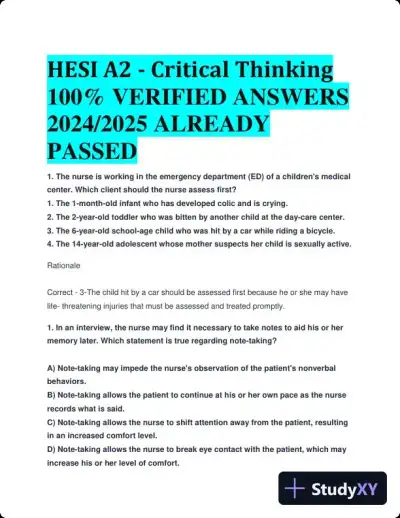 Past Exams
2024-2025 HESI A2 Critical Thinking with Answers (124 Solved Questions)
Health Education Systems, Inc.
114 pages106downloadsFeb 2025 Past Exams
2024-2025 HESI RN Exit Exam with Answers (156 Solved Questions)
Health Education Systems, Inc.
44 pages92downloadsFeb 2025 Past Exams
HESI Leadership/Management Exit Exam with Answers (59 Solved Questions)
Health Education Systems, Inc.
4 pages54downloadsFeb 2025
Study this document with CramX
Once it is in your library, every tool can work from it.