

HESI Health Assessment Practice Exam With Answers (50 Solved Questions)
- Health Education Systems, Inc.
- 19 pages
- Shared May 2025
Gain valuable test experience with HESI Health Assessment Practice Exam With Answers, an extensive past exam guide.
Preview 6 of 19 pages
See the first 6 pages exactly as they appear in the document.
Page 1 Read page 1 as text
1 / 19 Health Assessment HESI Exam 1. The registered nurse (RN) recognizes which client group is at the greatest risk for developing a urinary tract infection (UTI)? (Rank from highest risk to lowest risk.) - School - aged females - Older males - Older females - Adolescent males: 1. older females 2. school - aged females 3. older males 4. adolescent males 2. The registered nurse (RN) is interviewing a female client who states she has a persistent productive cough during the winter caused by bronchitis. Which additional finding should the RN assess for bronchitis? A.) Phlegm production & wheezing B.) Smoking history C.) Hemoptysis D.) Night sweats: A.) phlegm production & wheezing 3. The registered nurse (RN) is caring for a client with tuberculosis (TB) who is taking a combination drug regimen. The client complains about taking "so many pills." What information should the RN provide to the client about the prescribed treatement? A.) The d evelopment of resistant strains of TB are decreased with a combina - tion of drugs. B.) Compliance to the medication regimen is challenging but should be main - tained. C.) Side effects are minimized with the use of a single medication but is less effective. D.) The treat ment time is decreased from 6 months to 3 months with this standard regimen.: A.) The development of resistant strains of TB are decreased with a combination of drugs.
Page 2 Page 3 Read page 3 as text
2 / 19 4. A client with progressive hearing loss appears distressed when the registered nurse ( RN) asks open - ended questions about the client's health history. Which forms of communication should the RN use? (SATA) A.) Face the client so the client can see the RN's mouth. B.) Increase one's speech volume when interacting with the client. C.) Repeat information to the client if misunderstood. D.) Check if the client's hearing aides are working properly. E.) Reduce environmental noise surrounding the client.: A.) Face the client so the client can see the RN's mouth. D.) Check if the client's hearing aides are working properly . E.) Reduce environmental noise surrounding the client. Speaking clearly with enunciation and in a regular tone is easier for a client to understand than increasing the volume of speech. If a client shows signs of confusion, rephrasing the question, instead of repeating, should be done to decrease client anxiety and facilitate understanding. 5. The registered nurse (RN) is administering haloperidol 0.5 mg IM PRN to a client for the first time. What side effects should the RN assess the client for during the i nitial dose? A.) Bradykinesia. B.) Dystonia. C.) Somatization. D.) Akathisia.: B.) Dystonia 6. An older client is admitted to the hospital with severe diarrhea. The registered nurse (RN) is completing an assessment and notes the client has dry mucous membranes and poor sk in turgor. Which assessment data should the RN gather to determine if the client has a fluid volume deficit? A.) Lower extremity edema. B.) Orthostatic hypotension. C.) Elevated blood pressure. D.) Cheyne - Stokes respirations: B.) Orthostatic hypotension.
Page 4 Read page 4 as text
3 / 19 Orthostatic hypot ension can be a sign of fluid volume deficit in an older client who has experienced severe diarrhea. 7. The registered nurse (RN) notifies the spouse of a client who was admitted to hospice with shallow respirations, of a change in the client's condition. Over the past hour, the client's respiratory pattern has changed to a Cheyne Stokes pattern. After receiving this information, the client's spouse begins vacuuming around the bed. Which stage of grief is the spouse displaying during the visit? A.) Acceptance. B.) Denial. C.) Bargaining. D.) Depression.: B.) Denial. The spouse is exhibiting the first stage of denial of Kubler - Ross's grief model by ignoring that the client's death is imminent. 8. The registered nurse (RN) is teaching a client who is being discharged after treatment of tuberculosis (TB). Which cultural issues should the RN assess when preparing the client for discharge? (Select all that apply.) A.) Native language. B.) Education level. C.) Type of lifestyle. D.) Financial resources. E.) Previous medical history.: A.) Native lan guage. B.) Education level. C.) Type of lifestyle. D.) Financial resources. 9. The registered nurse (RN) is assisting the healthcare provider (HCP) with the removal of a chest tube. Which intervention has the highest priority and should be anticipated by the RN after the removal of the chest tube? A.) Prepare the client for chest x - ray at the bedside. B.) Review arterial blood gases after removal. C.) Elevate the head of bed to 45 degrees.
Page 5 Read page 5 as text
4 / 19 D.) Assist with disassembling the drainage system.: A.) Prepare the client for chest x - ray at th e bedside. A chest x - ray should be performed immediately after the removal of a chest tube to ensure lung expansion has been maintained after its removal. 10. The registered nurse (RN) is developing the plan of care for a client who is admitted for alcohol detoxification. Which goal should be most important for the RN to primarily focus the client's care? A.) The client maintains optimal nutritional status. B.) The client will remain alert and oriented. C.) The client will remain free from injury. D.) The client will remai n alcohol free during hospitalization.: C.) The client will remain free from injury. The client is at highest risk for injury due to altered cognitive and sensory disturbances as well as delirium tremors during withdrawal. Remaining free from injury is the most important goal for the acute phase of alcohol withdrawal. 11. The registered nurse (RN) assesses a client's results for arterial blood gases who has emphysema. Which finding is consistent with respiratory acidosis? A.) pH 7.32, pCO2 46 mmHg, HCO3 24 MEq/ L. B.) pH 7.45 , pCO2 37 mmHg, HCO3 24 mEq/L. C.) pH 7.34, pCO2 36 mmHg, HCO3 21 mEq/L. D.) pH 7.46, pCO2 35 mmHg, HCO3 28 mEq/L.: A.) pH 7.32, pCO2 46 mmHg, HCO3 24 MEq/L. Represents a client with respiratory acidosis which is characterized by: low pH, pCO2 higher th an normal, and HCO3 within normal limits. 12. The registered nurse (RN) is caring for a client with peptic ulcer disease (PUD). What assessment should the RN identify and document that is consistent with PUD? (Select all that apply). A.) Hematemesis.
Page 6 Read page 6 as text
5 / 19 B.) Gastric p ain on an empty stomachC.) Colic - like pain with fatty food ingestion. D.) Intolerance of spicy foods. E.) Diarrhea and stearrhea.: A.) Hematemesis. B.) Gastric pain on an empty stomach D.) Intolerance of spicy foods 13. A client with cirrhosis of the liver asks the registered nurse (RN) to explain how varicose veins can occur in the esophagus. Which statement should the RN provide to teach the client about the physiological etiology? A.) The enlarged liver presses on the lower half of the esophagus which weakens bloo d vessel walls. B.) Abnormal vessels form as a result of liver damage that causes chronic low serum protein levels. C.) Esophageal swelling and tissue damage causes blood to circulate blood back through the stomach. D.) Increased portal pressure causes blood flow thro ugh liver to be shunted to the esophageal vessels.: D.) Increased portal pressure causes blood flow through liver to be shunted to the esophageal vessels. Cirrhotic and fibrosed liver damage causes obstructed blood flow through portal vessels to the liver which increases the portal pressure causing the blood flow through the liver to be shunted to the esophageal vessels. The result of this shunting of blood causes the esophageal vessels (veins) to balloon out and weaken. As the portal hypertension increases , these esophageal varices can rupture and cause bleeding resulting in bloody emesis and black tarry stools. 14. A client is admitted for dehydration, weight loss, and a flat affect. After reviewing the client's history, the registered nurse (RN) discovers that the client's spouse died 2 weeks ago. Which nursing interventions should the RN implement to help the client begin the process of dealing with loss? A.) Establish trust by creating an safe atmosphere for sharing. B.) Share personal stories about how other cl ients dealt with grief. C.) Help the client identify ways to adapt lifestyle to accommodate loss. D.) Assure the client that their grief will last a short period of time.
13 more pages in the full document
Unlock it once and it stays in your library, ready to chat with or turn into flashcards.
Unlock the full documentMore Health Education Systems, Inc. study materials
See all Past Exams
2023-2024 RN HESI Exit Exam Version 3 with Answers (53 Solved Questions)
Health Education Systems, Inc.
13 pages163downloadsFeb 2025 Past Exams
2024-2025 HESI A2 Biology Entrance Exam with Answers (42 Solved Questions)
Health Education Systems, Inc.
13 pages154downloadsFeb 2025 Past Exams
2024-2025 HESI A2 Anatomy and Physiology V1/V2 Practice Exam with Answers (134 Solved Questions)
Health Education Systems, Inc.
15 pages134downloadsFeb 2025 Past Exams
2024-2025 HESI A2 Entrance Exam with Answers (232 Solved Questions)
Health Education Systems, Inc.
26 pages132downloadsFeb 2025 Past Exams
2024-2025 HESI Milestone Exam 1 with Answers (162 Solved Questions)
Health Education Systems, Inc.
26 pages119downloadsFeb 2025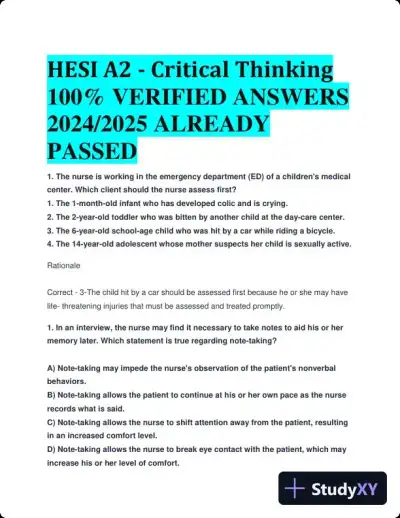 Past Exams
2024-2025 HESI A2 Critical Thinking with Answers (124 Solved Questions)
Health Education Systems, Inc.
114 pages106downloadsFeb 2025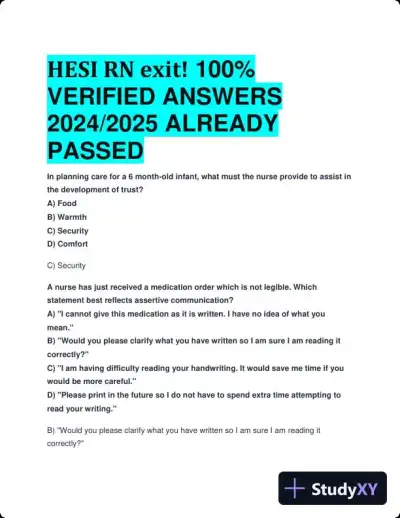 Past Exams
2024-2025 HESI RN Exit Exam with Answers (156 Solved Questions)
Health Education Systems, Inc.
44 pages92downloadsFeb 2025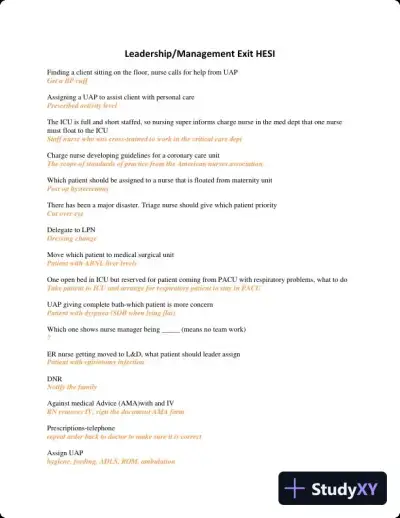 Past Exams
HESI Leadership/Management Exit Exam with Answers (59 Solved Questions)
Health Education Systems, Inc.
4 pages54downloadsFeb 2025
Study this document with CramX
Once it is in your library, every tool can work from it.