

HESI Medical Surgical Review Questions With Answers (244 Solved Questions)
- Health Education Systems, Inc.
- 58 pages
- Shared May 2025
Improve your problem-solving speed with HESI Medical Surgical Review Questions With Answers, a collection of past exams.
Preview 16 of 58 pages
See the first 16 pages exactly as they appear in the document.
Page 1 Read page 1 as text
A client who has undergone abdominal surgery calls the nurse and reports that she just felt “something give way” in the abdominal incision. The nurse checks the incision and notes the presence of wound dehiscence. The nurse immediately: Contacts the physician Documents the findings Places the client in a supine position with the legs flat Covers the abdominal wound with a sterile dressing moistened with sterile saline solution Rationale: Wound dehiscence is the disruption of a surgical incision or wound. When dehiscence occurs,the nurse immediately places the client in a low Fowler’s position or supine with the knees bent and instructs the client to lie quietly. These actions will minimize protrusion of the underlying tissues. The nurse then covers the wound with a sterile dressing moistened with sterile saline. The physician is notified, and the nurse documents the occurrence and the nursing actions that were implemented in response. Test-Taking Strategy: Use the process of elimination and note the strategic word “immediately.” Visualize this occurrence and recall that the primary concern when wound dehiscence occurs is the protrusion of underlying tissues. This will direct you to the correct option. Review the nursing actions to be taken immediately in the event of wound dehiscence if you had difficulty with this question. A client who just returned from the recovery room after a tonsillectomy and adenoidectomy is restless and her pulse rate is increased. As the nurse continues the assessment, the client begins to vomit a copious amount of bright-red blood. The immediate nursing action is to: Notify the surgeon Continue the assessment Check the client’s blood pressure Obtain a flashlight, gauze, and a curved hemostat Rationale: Hemorrhage is a potential complication after tonsillectomy and adenoidectomy. If the client vomits a large amount of bright-red blood or the pulse rate increases and the patient is restless, the nurse must notify the surgeon immediately. The nurse should obtain a light, mirror, gauze, curved hemostat, and waste basin to facilitate examination of the surgical site. The nurse should also gather additional assessment data, but the surgeon must be contacted immediately. Test-Taking Strategy: Focus on the data in the question. Noting the words “bright-red blood” will assist in directing you to the correct option. Remember that the presence of bright-red blood indicates active bleeding. Review the nursing actions to be taken immediately when bleeding occurs after a tonsillectomy and adenoidectomy if you had difficulty with this question.
Page 2 Page 3 Read page 3 as text
A client who has just undergone surgery suddenly experiences chest pain, dyspnea, and tachypnea. The nurse suspects that the client has a pulmonary embolism and immediately sets about: Preparing the client for a perfusion scan Attaching the client to a cardiac monitor Administering oxygen by way of nasal cannula Correct Ensuring that the intravenous (IV) line is patent Rationale: Pulmonary embolism is a life-threatening emergency. Oxygen is immediately administered nasally to relieve hypoxemia, respiratory distress, and central cyanosis, and the physician is notified. IV infusion lines are needed to administer medications or fluids. A perfusion scan, among other tests, may be performed. The electrocardiogram is monitored for the presence of dysrhythmias. Additionally, a urinary catheter may be inserted and blood for arterial blood gas determinations drawn. The immediate priority, however, is the administration of oxygen. Test-Taking Strategy: Focus on the client’s diagnosis and use the skills of prioritizing. Apply the ABCs (airway, breathing, and circulation) to find the correct option. Review the nursing actions to be taken immediately in the event of pulmonary embolism if you had difficulty with this question. A nurse is assessing a client who has a closed chest tube drainage system. The nurse notes constant bubbling in the water seal chamber. What actions should the nurse take? (Select all that apply). Clamping the chest tube Changing the drainage system Assessing the system for an external air leak Reducing the degree of suction being applied Documenting assessment findings, actions taken, and client response Rationale: Constant bubbling in the water seal chamber of a closed chest tube drainage system may indicate the presence of an air leak. The nurse would assess the chest tube system for the presence of an external air leak if constant bubbling were noted in this chamber. If an external air leak is not present and the air leak is a new occurrence, the physician is notified immediately, because an air leak may be present in the pleural space. Leakage and trapping of air in the pleural space can result in a tension pneumothorax. Clamping the chest tube is incorrect. Additionally, a chest tube is not clamped unless this has been specifically prescribed in the agency’s policies and procedures. Changing the drainage system will not alleviate the problem. Reducing the degree of suction being applied will not affect the bubbling in the water seal chamber and could be harmful. The nurse would document the assessment findings and interventions taken in the client’s medical record. Test-Taking Strategy: Use the process of elimination and your knowledge regarding the priority actions in the care of a closed chest tube drainage system. Focus on the data in the question,
Page 4 Read page 4 as text
noting that there is bubbling in the water seal chamber. Recalling that this may indicate an air leak will direct you to the correct options. Review the nursing actions to be taken immediately in the event that complications of a closed chest tube drainage system occur if you had difficulty with this question. A nurse is helping a client with a closed chest tube drainage system get out of bed and into a chair. During the transfer, the chest tube is caught on the leg of the chair and dislodged from the insertion site. The immediate priority on the part of the nurse is: Contacting the physician Reinserting the chest tube Transferring the client back to bed Covering the insertion site with a sterile occlusive dressing Rationale: If a chest tube is dislodged from the insertion site, the nurse immediately covers the site with sterile occlusive dressing. The nurse then performs a respiratory assessment, helps the client back into bed, and contacts the physician. The nurse does not reinsert the chest tube. The physician will reinsert the chest tube as necessary. Test-Taking Strategy: Use the process of elimination, noting the strategic word “immediate.” Eliminate the option that involves reinsertion of the chest tube first, because a nurse is not trained to insert a chest tube. To select from the remaining options, focus on the subject, dislodgment of a chest tube from its insertion site, and recall the complications associated with this occurrence; this will direct you to the correct option. Review the nursing actions to be taken immediately in the event of complications associated with a closed chest tube drainage system if you had difficulty with this question. A nurse performing nasopharyngeal suctioning and suddenly notes the presence of bloody secretions. The nurse would first: Continue suctioning to remove the blood Check the degree of suction being applied Encourage the client to cough out the bloody secretions Remove the suction catheter from the client’s nose and begin vigorous suctioning through the mouth Rationale: The return of bloody secretions is an unexpected outcome of suctioning. If it occurs, the nurse should first assess the client and then determine the degree of suction being applied. The degree of suction pressure may need to be decreased. The nurse must also remember to apply intermittent suction and perform catheter rotation during suctioning. Continuing the suctioning or performing vigorous suctioning through the mouth will result in increased trauma and therefore increased bleeding. Suctioning is normally performed on clients who are unable to expectorate secretions. It is therefore unlikely that the client will be able to cough out the bloody secretions.
Page 5 Read page 5 as text
Test-Taking Strategy: Use the process of elimination. Eliminate the options of continuing the suctioning to remove the blood and removing the suction catheter from the nose to begin vigorous suctioning through the mouth, because they are comparable or alike. Next eliminate the option that involves encouraging the client to cough out the bloody secretions, because it is unlikely that the client will be able to do so. Review the nursing actions to be taken immediately in the event of a complication during suctioning if you had difficulty with this question. A nurse is suctioning a client through a tracheostomy tube. During the procedure, the client begins to cough, and the nurse hears a wheeze. The nurse tries to remove the suction catheter from the client’s trachea but is unable to do so. The nurse would first: Call a code Contact the physician Administer a bronchodilator Disconnect the suction source from the catheter Rationale: Inability to remove a suction catheter is a critical situation. This finding, along with the client’s symptoms presented in the question, indicates the presence of bronchospasm and bronchoconstriction. The nurse immediately disconnects the suction source from the catheter but leave the catheter in the trachea. The nurse then connects the oxygen source to the catheter. The physician is notified and will most likely prescribe an inhaled bronchodilator. The nurse also prepares for emergency resuscitation if the bronchospasm is not relieved. Test-Taking Strategy: Use the process of elimination, noting the strategic word “first.” Eliminate the option of administering a bronchodilator, because this action requires a physician’s prescription. To select from the remaining options, visualize the situation presented in the question. Noting that the nurse is unable to remove the suction catheter from the client’s trachea will direct you to the correct option. Review the nursing actions to be taken immediately in the event of a complication during suctioning if you had difficulty with this question. A nurse assesses the closed chest tube drainage system of a client who underwent lobectomy 24 hours ago. The nurse notes that there has been no chest tube drainage for the past hour. The nurse first: Contacts the physician Checks for kinks in the drainage system Checks the client’s blood pressure and heart rate Connects a new drainage system to the client’s chest tube Rationale: If a chest tube is not draining, the nurse must first check for a kink or clot in the chest drainage system. The nurse also observes the client for signs of respiratory distress or mediastinal shift; and if such signs are noted, the physician is notified. Checking the heart rate and blood pressure is not directly related to the lack of chest tube drainage. Connecting a new drainage system to the client’s chest tube is done once the fluid drainage chamber is full. A specific procedure is followed when a new drainage system is connected to a client’s chest tube.
Page 6 Read page 6 as text
Test-Taking Strategy: Use the process of elimination, noting the strategic word “first.” Focusing on the subject, a lack of chest tube drainage, will direct you to the correct option. Review unexpected outcomes and related interventions in the care of a chest tube drainage system if you had difficulty with this question. A nurse is assessing a postoperative client on an hourly basis. The nurse notes that the client’s urine output for the past hour was 25 mL. On the basis of this finding, the nurse first: Calls the physician Increases the rate of the IV infusion Checks the client’s overall intake and output record Administers a 250-mL bolus of normal saline solution (0.9%) Rationale: Clients are at risk for becoming hypovolemic after surgery, and often the first sign of hypovolemia is decreasing urine output. However, the nurse needs additional data to make an accurate interpretation. Neither an increase in the rate of the IV infusion nor administration of a 250-mL bolus of normal saline (0.9%) would be implemented without a prescription from the physician. The physician is called once the nurse has gathered all necessary assessment data, including the overall fluid status and vital signs. Test-Taking Strategy: Note the strategic word “first.” Try to visualize the situation and use the steps of the nursing process to answer the question. The correct option addresses the process of assessment. Eliminate increasing the rate of the IV infusion and administering a 250-mL bolus of normal saline (0.9%), because each requires a physician’s prescription. In this situation, the nurse needs to gather additional information before contacting the physician. Review unexpected outcomes after surgery and priority nursing interventions in the event of such outcomes if you had difficulty with this question. A nurse is getting a client out of bed for the first time since surgery. The nurse raises the head of the bed, and the client complains of dizziness. Which of the following actions should the nurse take first? Checking the client’s blood pressure Checking the oxygen saturation level Having the client take some deep breaths Lowering the head of the bed slowly until the dizziness is relieved Rationale: Dizziness or a feeling of faintness is not uncommon when a client is positioned upright for the first time after surgery. If this occurs, the nurse lowers the head of the bed slowly until the dizziness is relieved. The nurse then checks the client’s pulse and blood pressure. Because the problem is circulatory, not respiratory, checking the oxygen saturation level and having the client take some deep breaths are not the first actions to be taken. Test-Taking Strategy: Use the process of elimination, noting the strategic word “first.” Note the relationship between the subject of the question (the client becomes dizzy) and the correct
Page 7 Read page 7 as text
answer. Review unexpected outcomes after surgery and the priority nursing interventions in the event of such outcomes if you had difficulty with this question. A nurse is preparing for intershift report when a nurse’s aide pulls an emergency call light in a client’s room. Upon answering the light, the nurse finds a client who returned from surgery earlier in the day experiencing tachycardia and tachypnea. The client’s blood pressure is 88/60 mm Hg. Which action should the nurse take first? Calling the physician Checking the hourly urine output Checking the IV site for infiltration Placing the client in a modified Trendelenburg position Rationale: The client is exhibiting signs of shock and requires emergency intervention. The first action is to place the client in a modified Trendelenburg position to increase blood return from the legs, which in turn increases venous return and subsequently the blood pressure. The nurse calls the physician, verifies the client’s blood volume status by assessing urine output, and ensures that the IV infusion is proceeding without complications. Test-Taking Strategy: Note the strategic word “first.” Use your knowledge of the ABCs (airway, breathing, circulation). The correct option addresses the client’s circulatory status. Review the nursing interventions to be taken immediately in the event of postoperative shock if you had difficulty with this question. A nurse is assessing the chest tube drainage system of a postoperative client who has undergone a right upper lobectomy. The closed drainage system contains 300 mL of bloody drainage, and the nurse notes intermittent bubbling in the water seal chamber. One hour after the initial assessment, the nurse notes that the bubbling in the water seal chamber is now constant, and the client appears dyspneic. On the basis of these findings, the nurse should first assess: The client’s vital signs The amount of drainage The client’s lung sounds The chest tube connections Rationale: The client’s dyspnea is most likely related to an air leak caused by a loose connection. Other causes might be a tear or incision in the pulmonary pleura, which requires physician intervention. Although the interventions identified in the other options should also be taken in this situation, they should be performed only after the nurse has tried to locate and correct the air leak. It only takes a moment to check the connections, and if a leak is found and corrected, the client’s symptoms should resolve. Test-Taking Strategy: Note the strategic word “first” and focus on the data in the question. Recalling that a constant bubbling in the water seal chamber could indicate a leak in the system
Page 8 Read page 8 as text
will direct you to the correct option. Review care of the client with a closed chest tube drainage system if you had difficulty with this question. A client recovering from surgery has a large abdominal wound. Which of the following foods, high in vitamin C, should the nurse encourage the client to eat as a means of promoting wound healing? Steak Veal Cheese Oranges Rationale: Citrus fruits and juices are especially high in vitamin C. Other sources are potatoes, tomatoes, and other fruits and vegetables. Meats and dairy products are not especially high in vitamin C. Meats are high in protein. Dairy products are high in calcium. Test-Taking Strategy: Note the strategic word "high" in the question. Eliminate steak and veal first because they are comparable or alike in that they are meats. To select from the remaining options, recall that cheese is high in calcium, not vitamin C; this will direct you to the correct option. If you are unfamiliar with foods high in vitamin C, review this content. A nurse is caring for a client who has just regained bowel sounds after undergoing surgery. The physician has prescribed a clear liquid diet for the client. Which of the following items does the nurse ensure is available in the client’s room before allowing the client to drink? Straw Napkin Suction equipment Oxygen saturation monitor Rationale: Aspiration is a concern when fluids are offered to a client who has just undergone surgery. It is possible that the swallow reflex is still impaired as an effect of anesthesia. The nurse checks the gag and swallow reflexes before offering fluids to the client, but suction equipment still must be available. An oxygen saturation monitor is unnecessary when fluids are being administered, nor is a napkin or straw necessary; in fact, the straw could contribute to the formation of flatus, resulting in gastrointestinal discomfort. Test-Taking Strategy: The subject of the question is protecting the client’s gag and swallow reflexes. Use your knowledge of the ABCs (airway, breathing, and circulation) to answer this question. The correct option helps maintain airway clearance. If you had difficulty with this question, review care of the client who has recently undergone surgery. A client in the postanesthesia care unit has an as-needed prescription for ondansetron (Zofran). Which of the following occurrences would prompt the nurse to administer this medication to the client? Paralytic ileus
Page 9 Read page 9 as text
Incisional pain Urine retention Nausea and vomiting Rationale: Ondansetron is an antiemetic that is used in the treatment of postoperative nausea and vomiting, as well as nausea and vomiting associated with chemotherapy. This medication is not used to treat any of the problems identified in the other options. Test-Taking Strategy: To answer this question accurately, it is necessary to know the classification of this medication. Focusing on the clinical setting identified in the question should narrow your choices to nausea and vomiting and incisional pain. To correctly select from these two options, it is necessary to know that ondansetron is an antiemetic. Review the action of this medication if you had difficulty with this question. A nurse administers scopolamine as prescribed to a client in preparation for surgery. For which side effect of this medication does the nurse monitor the client? Pupil constriction Increased urine output Complaints of dry mouth Complaints of feeling sweaty Rationale: Scopolamine, an anticholinergic medication, often causes the side effects of dry mouth, urine retention, decreased sweating, and pupil dilation. The other options are incorrect. Test-Taking Strategy: Note the words “in preparation for surgery” and use the process of elimination. Recalling that this medication dries body secretions will direct you to the correct option. Review the expected side effects of this medication if this question was difficult for you. A nurse is preparing a client for transfer to the operating room. Which of the following actions should the take in the care of this client at this time? Ensuring that the client has voided Administering all daily medications Practicing postoperative breathing exercises Verifying that the client has not eaten for the last 24 hours Rationale: The nurse should ensure that the client has voided if a Foley catheter is not in place. The nurse does not administer all daily medications just before sending a client to the operating room. Rather, the physician writes a specific prescription outlining which medications may be given with a sip of water. The client is usually prescribed to have nothing by mouth for 8 hours before surgery, not 24 hours. The time of transfer to the operating room is not the time to practice breathing exercises. This should have been done earlier. Test-Taking Strategy: Note the words “at this time.” Eliminate the option that involves administering all daily medications because of the close-ended word “all.” Eliminate the option that involves verifying that the client has not eaten for the last 24 hours because of the words
Page 10 Read page 10 as text
“last 24 hours.” To select from the remaining options, focus on the words “at this time”; this will direct you to the correct option. Remember that the client is likely to be anxious at this time, meaning that it would be inappropriate to practice breathing exercises. Review preoperative client care measures if you had difficulty with this question. A nurse receives a telephone call from a nurse on the post-anesthesia care unit, who reports that a client is being transferred to the surgical unit. What should the nurse plan to do first on arrival of the client? Assess the patency of the airway Check tubes and drains for patency Check the dressing for bleeding Assess the vital signs to compare them with preoperative measurements Rationale: The first action of the nurse is to assess the patency of the airway. The nurse then performs an assessment of cardiovascular function, the condition of the surgical site, the patency of tubes and drains for patency, and the function of the central nervous system. If the airway is not patent, immediate measures must be taken to help ensure the survival of the client. Test-Taking Strategy: Use your knowledge of the ABCs (airway, breathing, and circulation). Airway patency is the priority. The incorrect options are all nursing actions that should be performed after a patent airway has been established. Review priority nursing assessments in the client who has undergone surgery if you had difficulty with this question. A client without a history of respiratory disease has a pulse oximeter in place after surgery. The nurse monitors the pulse oximeter readings to ensure that oxygen saturation remains above: 85% 89% 95% 100% Rationale: Pulse oximetry is a noninvasive method of continuously monitoring the oxygen saturation of hemoglobin (SaO2). In the absence of underlying respiratory disease, the expected reading is at least 95%. Therefore the other options are incorrect. Readings of 85% and 89% are lower than what is desired in the postoperative period. A level of 100% is most desirable, but the level should remain at least 95% Test-Taking Strategy: Familiarity with the pulse oximeter and normal readings is needed to answer this question. Noting the strategic word “above” in the question will help you answer correctly. If you had difficulty with this question, review the purpose and expected results of pulse oximetry.
Page 11 Read page 11 as text
A client who underwent preadmission testing 1 week before surgery had blood drawn for several serum laboratory studies. Which abnormal laboratory results should the nurse report to the surgeon’s office? Select all that apply. Hematocrit 30% Sodium 141 mEq/L Hemoglobin 8.9 g/dL Platelets 210,000 cells/mm3 Serum creatinine 0.8 mg/dL Rationale: Routine screening tests include complete blood cell count, serum electrolyte analysis, coagulation studies, and serum creatinine tests. The complete blood cell count includes the hemoglobin and hematocrit analysis. All of these values are within their normal ranges except the hemoglobin and hematocrit. If a client has low hemoglobin and hematocrit levels, the surgery may be postponed by the surgeon. The normal hemoglobin level ranges from 12 to 16.5 g/dL, and the hematocrit ranges from 35% to 52%. Test-Taking Strategy: Note the strategic word “abnormal” in the question and focus on the subject, laboratory results that could necessitate the postponement of surgery. Recalling the normal values for the laboratory studies identified in the options will direct you to the correct ones. Review these normal laboratory values if you had difficulty answering this question. A client has been scheduled for magnetic resonance imaging (MRI). For which of the following conditions, a contraindication to MRI, does the nurse check the client’s medical history? Pancreatitis Pacemaker insertion Type 1 diabetes mellitus Chronic airway limitation Rationale: The candidate for MRI must be free of metal devices or implants. A careful history is conducted to determine whether any such metal objects, such as orthopedic hardware, pacemakers, artificial heart valves, aneurysm clips, and intrauterine devices, are inside the client. These may heat up in the magnetic field generated by the MRI device, become dislodged, or malfunction during the procedure. The other medical problems listed do not pose a risk or contraindication for this procedure. Test-Taking Strategy: Use the process of elimination. Note that each of the incorrect options is a medical disorder. The correct option is the name of a procedure in which a device is implanted into the client. Remember that it is crucial to ensure that there are no metal objects in the vicinity of the MRI machine. Review contraindications to MRI if you had difficulty with this question. A client has just undergone lumbar puncture. Into which position does the nurse assist the client after the procedure? Flat Semi-Fowler
Page 12 Read page 12 as text
Side-lying, with the head of the bed elevated Sitting up in a recliner with the feet elevated Rationale: After lumbar puncture, the client must remain flat for as long as 12 hours to help prevent post-procedure spinal headache and leakage of cerebrospinal fluid. Therefore the other options are incorrect. Test-Taking Strategy: Use the process of elimination. Note that the incorrect options are comparable or alike in that they all involve elevation of the client’s head. Review care of the client after lumbar puncture if you had difficulty with this question. A client has just returned to the nursing unit after computerized tomography (CT) with contrast medium. Which of the following actions should the nurse plan to take as part of routine after-care for this client? Administering a laxative Encouraging fluid intake Maintaining the client on strict bed rest Holding all medications for at least 2 hours Rationale: After CT scanning, the client may resume all usual activities. The client should be encouraged to consume extra fluids to replace those lost during diuresis of the contrast dye. Medications do not have to be withheld. There is no reason to administer a laxative; also, a physician’s prescription is needed for this intervention. Test-Taking Strategy: Use the process of elimination and note the strategic words “contrast medium” in the question. Recalling the importance of flushing the dye from the system after this procedure will direct you to the correct option. Review care after a CT scan if you had difficulty with this question. A client reports for a scheduled electroencephalogram (EEG). Which statement by the client indicates a need for additional preparation for the test? “I didn’t shampoo my hair.” “I ate breakfast this morning.” “I didn’t take my anticonvulsant today.” “It was hard not to drink coffee this morning, but I knew that I couldn’t, so I didn’t.” Rationale: Preprocedure care for EEG involves client teaching about the procedure, ensuring that the client’s hair has been freshly shampooed, and providing a light meal and fluids to prevent hypoglycemia, which could alter brain waves. Medications such as antidepressants, tranquilizers, and anticonvulsants are withheld for 24 to 48 hours before the procedure as prescribed. Stimulants such as coffee, tea, cola, alcohol, and cigarettes are also withheld. Test-Taking Strategy: Use your knowledge of the EEG procedure to answer the question and note the strategic words “needs additional preparation.” Recalling the purpose of an EEG and
Page 13 Read page 13 as text
the anatomical location of this test will direct you to the correct option. Review preparation for an EEG if you had difficulty with this question. Blood is drawn from a client with suspected uric acid calculi for a serum uric acid determination. Which value does the nurse recognize as a normal uric acid level? 1.7 mg/dL 5.8 mg/dL 8.9 mg/dL 12.8 mg/dL Rationale: The normal range for uric acid is 4.5 to 8 mg/dL for males and 2.5 to 6.2 mg/dL for females. Therefore the other options are incorrect. Test-Taking Strategy: To answer this question correctly, you must be familiar with the normal range of values for serum uric acid. Review this reference range if you had difficulty with this question. A nurse is providing post-procedure instructions to a client returning home after arthroscopy of the shoulder. The nurse should tell the client: To resume full activity the next day Not to eat or drink anything until the next morning To keep the shoulder completely immobilized for the rest of the day To report to the physician the development of fever or redness and heat at the site Rationale: After arthroscopy, signs and symptoms of infection such as fever or redness and heat at the site should be reported to the physician. The client may resume the usual diet immediately. The arm does not have to be completely immobilized once sensation has returned, but the client is usually encouraged to refrain from strenuous activity for at least a few days. Test-Taking Strategy: Use the process of elimination. Eliminate keeping the shoulder completely immobilized for the rest of the day and resuming full activity the next day, because they represent extremes of activity variations. To select from the remaining options, remember that the client is always taught to report signs and symptoms of infection to the physician. Review client instructions after arthroscopy if you had difficulty with this question. A client is tested for HIV with the use of an enzyme-linked immunosorbent assay (ELISA), and the test result is positive. The nurse should tell the client that: HIV infection has been confirmed The client probably has an opportunistic infection The test will need to be confirmed with the use of a Western blot A positive test is a normal result and does not mean that the client is infected with HIV Rationale: The normal value for an ELISA test is negative. A positive ELISA test must be confirmed with the use of the Western Blot. The other options are incorrect.
Page 14 Read page 14 as text
Test-Taking Strategy: Read each option carefully and note that the test result is positive. Recalling that an ELISA test is an HIV antibody-screening test and that a positive result must be confirmed with the use of the Western blot will direct you to the correct option. Review interpretations of the results of an ELISA test if you had difficulty with this question. A CD4+ lymphocyte count is performed on a client who is infected with HIV. The results of the test indicate a CD4+ count of 450 cells/L. The nurse interprets this test result as indicating: Improvement in the client The need for antiretroviral therapy The need to discontinue antiretroviral therapy An effective response to the treatment for HIV Rationale: The normal CD4+ count is between 500 and 1600 cells/mcL. Antiretroviral therapy is recommended when the CD4+ count is less than 500 cells/mcL or below 25%, or when the client shows symptoms of HIV. The other options are incorrect. Test-Taking Strategy: Use the process of elimination to answer the question. Eliminate the incorrect options because they are comparable or alike in that they indicate a positive response to treatment. If you had difficulty with this question, review the CD4+ count and the interpretation of its results. A client has just undergone a renal biopsy. Which intervention should the nurse include intervention in the post-procedure plan of care? Restricting fluid intake for the first 24 hours Periodically testing the urine for occult blood Avoiding the administration of opioid analgesics Having the client ambulate in the room and hall for short distances Rationale: After renal biopsy, bed rest is maintained and the client’s vital signs and puncture site are assessed frequently. Urine is tested periodically for occult blood to detect bleeding as a complication.Fluids are encouraged to reduce the risk of clot formation at the biopsy site. Opioid analgesics are often needed to manage the renal colic pain that some clients feel after this procedure. Test-Taking Strategy: Use the process of elimination. Recalling that pain and bleeding are potential concerns after this procedure will direct you to the correct option. Review care of the client after renal biopsy if you had difficulty with this question. A nurse has a prescription to collect a 24-hour urine specimen from a client. Which of the following measures should the nurse take during this procedure? Keeping the specimen at room temperature Saving the first urine specimen collected at the start time Discarding the last voided specimen at the end of the collection time Asking the client to void, discarding the specimen, and noting the start time
Page 15 Read page 15 as text
Rationale: Because the 24-hour urine collection is a timed quantitative determination, the test must be started with an empty bladder. Therefore the first urine is discarded. Fifteen minutes before the end of the collection time, the client should be asked to void, and this specimen is added to the collection. The collection should be refrigerated or placed on ice to help prevent changes in urine composition. Test-Taking Strategy: Use the process of elimination. Recalling that the 24-hour urine collection is a timed quantitative determination will assist you in identifying the correct option. Review the procedure for collecting a 24-hour urine specimen if you had difficulty with this question. A nurse is preparing a client for intravenous pyelography (IVP). Which action by the nurse is most important? Administering a sedative Encouraging fluid intake Administering an oral preparation of radiopaque dye Questioning the client about allergies to iodine or shellfish Rationale: Some IVP dyes are iodine based; if the dye to be used in this procedure is one of them and the client has an allergy to iodine or shellfish, he may experience an allergic reaction, manifested as itching, hives, rash, a tight feeling in the throat, shortness of breath, or bronchospasm. For this reason, assessing the client for allergies is the priority. The dye is injected intravenously. The client may or may not receive premedication. Nothing-by-mouth status is generally imposed after midnight on the day before the test. Test-Taking Strategy: Knowledge regarding preprocedure care for this diagnostic test is necessary to answer this question. Noting the word “intravenous” in the name of the test indicates that a dye will be injected. This will help direct you to the correct option. Review the priority assessments in preprocedure care for this diagnostic test if you had difficulty with this question. A client who has undergone renal biopsy complains of pain, radiating to the front of the abdomen, at the biopsy site. For which of the following findings should the nurse assess the client? Bleeding Renal colic Infection at the site Increased temperature Rationale: Bleeding should be suspected if pain originates at the biopsy site and begins to radiate to the flank area and around to the front of the abdomen. Hypotension, a decreasing hematocrit, and gross or microscopic hematuria are also indicators of bleeding. Signs of infection would not appear immediately after a biopsy. There is no information in the question to indicate the presence of renal colic.
Page 16 Read page 16 as text
Test-Taking Strategy: Use the process of elimination. Eliminate the options of increased temperature and infection at the site first because they are comparable or alike. To choose between the remaining options, recall that the information in the question is not indicative of renal colic. Review the complications associated with renal biopsy if you had difficulty with this question. A client has undergone renal angiography by way of the right femoral artery. The nurse determines that the client is experiencing a complication of the procedure on noting: Urine output of 40 mL/hr Blood pressure of 118/76 mm Hg Respiratory rate of 18 breaths/min Pallor and coolness of the right leg Rationale: Complications of renal angiography include allergic reaction to the dye, dye-induced renal damage, and a number of vascular complications, including hemorrhage, thrombosis, and embolism. The nurse detects these complications by monitoring the client for signs and symptoms of allergic reaction, decreased urine output, hematoma or hemorrhage at the insertion site, and signs of diminished circulation to the affected leg. The incorrect options are normal findings. Test-Taking Strategy: Use the process of elimination and note the words “a complication of the procedure,” which should tell you that the correct option is an abnormal assessment finding. Eliminate the incorrect options, because they are normal findings. Pallor and coolness indicate thrombosis or hematoma and should be further assessed and reported. Review the signs of complications after renal angiography if you had difficulty with this question. A nurse reviews a client’s urinalysis report. Which finding does the nurse recognize as abnormal? pH of 6.0 An absence of protein The presence of ketones Specific gravity of 1.018 Rationale: The normal pH range of urine is 4.5 to 7.8, and normal specific gravity ranges from 1.016 to 1.022. The urine is typically screened for protein, glucose, ketones, bilirubin, casts, crystals, red blood cells, and white blood cells, none of which should be present. Test-Taking Strategy: Use the process of elimination and note the strategic word “abnormal” in the query of the question. The words “the presence of” should direct you to the correct option. Review normal urinalysis findings if you had difficulty with this question. A nurse provides information to a client who is scheduled for cardiac catheterization to rule out coronary occlusion. The nurse should tell the client that: The procedure is performed in the operating room
42 more pages in the full document
Unlock it once and it stays in your library, ready to chat with or turn into flashcards.
Unlock the full documentMore Health Education Systems, Inc. study materials
See all Past Exams
2023-2024 RN HESI Exit Exam Version 3 with Answers (53 Solved Questions)
Health Education Systems, Inc.
13 pages163downloadsFeb 2025 Past Exams
2024-2025 HESI A2 Biology Entrance Exam with Answers (42 Solved Questions)
Health Education Systems, Inc.
13 pages154downloadsFeb 2025 Past Exams
2024-2025 HESI A2 Anatomy and Physiology V1/V2 Practice Exam with Answers (134 Solved Questions)
Health Education Systems, Inc.
15 pages134downloadsFeb 2025 Past Exams
2024-2025 HESI A2 Entrance Exam with Answers (232 Solved Questions)
Health Education Systems, Inc.
26 pages132downloadsFeb 2025 Past Exams
2024-2025 HESI Milestone Exam 1 with Answers (162 Solved Questions)
Health Education Systems, Inc.
26 pages119downloadsFeb 2025 Past Exams
2024-2025 HESI A2 Critical Thinking with Answers (124 Solved Questions)
Health Education Systems, Inc.
114 pages106downloadsFeb 2025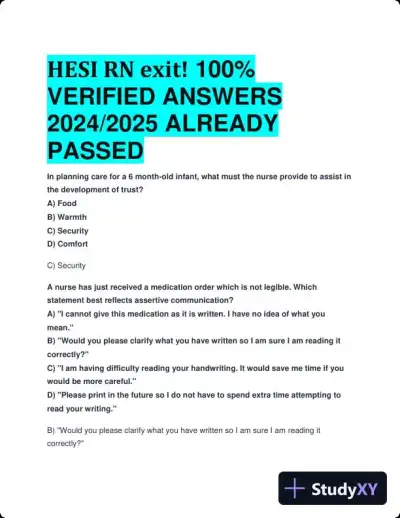 Past Exams
2024-2025 HESI RN Exit Exam with Answers (156 Solved Questions)
Health Education Systems, Inc.
44 pages92downloadsFeb 2025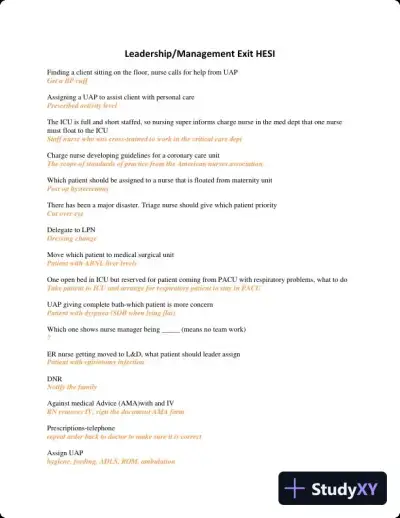 Past Exams
HESI Leadership/Management Exit Exam with Answers (59 Solved Questions)
Health Education Systems, Inc.
4 pages54downloadsFeb 2025
Study this document with CramX
Once it is in your library, every tool can work from it.