

HESI Medical Surgical Test Bank With Answers (239 Solved Questions)
- Health Education Systems, Inc.
- 83 pages
- Shared May 2025
HESI Medical Surgical Test Bank With Answers provides a comprehensive review of past exam formats.
Preview 16 of 83 pages
See the first 16 pages exactly as they appear in the document.
Page 1 Read page 1 as text
c. The PT will be 1.5 times the normal c. White blood cell (WBC) count MS4 HESI MED SURG EXAMS TEST BANK 1. Following long-term administration of warfarin sodium to a client with a medical diagnosis of deep vein thrombosis, the nurse should expect which treatment? a. The hemoglobin will be greater than 10 g/dl b. The hematocrit will be less than 35% d. The PTT will be 1.5 times the normal 2. A client who has been taking finasteride, an enzyme (5 alpha reductase) inhibitor used to shrink the prostate gland, is admitted because of continuing benign prostate prostatic hypertrophy (BPH) symptoms when planning care. Which nursing problem should the nurse address first? a. Chronic pain c. Risk for infection d. Disturbed sleep pattern 3. An older client has been diagnosed with chronic venous insufficiency. To prevent venous return, which action should the nurse encourage the client to a. Wear cotton socks and enclosed toe shoes whenever outside b. Drink 8 to 10 ounces of water a day c. Sit at the side of the bed for 15 minutes before standing d. Lie down in bed 2 times a day 4. When caring for a client with a full thickness burn covering 40% of the body, the nurse observes pertinent drainage at the wound. Before reporting this finding to the healthcare provider, the nurse should review which of the client’s laboratory values? a. Hematocrit b. Platelet count d. Blood pH level 5. An older client arrives at the outpatient eye surgery clinic for a right cataract extraction and implant. During the immediate postoperative period, which intervention should the nurse implement a. Provide an eye shield to be worn while sleeping b. Obtain vital signs every 2 hours during hospitalization b. Urinary retention
Page 2 Page 3 Read page 3 as text
c. Encourage deep breathing and coughing exercises d. Teach a family member to administer eye drops 6. After several days of coughing and taking acetaminophen to treat temperatures of 101 F (38. 3 C), a client with DI is admitted to the hospital with an upper respiratory infection. Several hours after admission, the client reports having a severe headache and freezing dizzy. Which intervention should the nurse implement first? a. Reassess vital signs b. Obtain sputum for culture c. Obtain a fingerstick glucose d. Administer an antipyretic 7.a client takes daily supplemental iron tablets for iron deficiency anemia reports feeling increasingly fatigued. Which laboratory values should the nurse review? a. Serum electrolytes b. Comp lete blo od count c. Liver enzymes d. Platelet count 8. The nurse is caring for a client post anesthesia care unit (PACU) who underwent a thoracotomy two hours ago. The nurse observes the following vital signs: heart rate 140 beats/minute, respirations 26 breaths/minute, and blood pressure 140/90 mmHg. Which intervention is most important for the nurse to implement? a. Administer IV fluid bolus as prescribed by the healthcare provider b. Medicate for pain and monitor vital signs according to protocol c. Encourage the client to splint the incision with a pillow to cough and deep breathe d. Apply oxygen at 10 L via non-rebreather mask and monitor pulse oximeter 9. A client who was involved in a motor vehicle collision is admitted with a fractured left femur which is immobilized using a fracture traction splint in preparation for an open reduction internal fraction (ORIF). The nurse determines that the client’s distal pulses are diminished in the left foot. Which interventions should the nurse implement? (SATA) a. Offer ice chips and oral clear liquids e. Administer oral antispasmodics and narcotics analgesics 10. A nurse is caring for a client with Diabetes Insipidus (DI). which data warrants the most immediate intervention by the nurse? b c d . Evaluate the application of the splint to the left leg . Monitor left leg for pain, pallor, paresthesia, paralysis, pressure . Verify pedal pulses using a doppler pulse device
Page 4 Read page 4 as text
c. d. b. Pain relief can be provided by shrinking tumors that press against spinal nerves d. Troponin I c. Provide a bedside commode for toileting a. Dry skin with inelastic turgor b. Apical rate of 110 beats per minute c. Polyuria and excessive thirst 11. The nurse assesses a client with petechiae and ecchymosis scattered across the arms and legs. Which laboratory result should the nurse review? t b. Red blood cell count c. Hemoglobin levels white blood cell count 12. A male client is admitted to the emergency department with vomiting of dark brown, foul- smelling emesis. He reports he had a surgical repair of a recurrent inguinal hernia one week ago and complains of intense abdominal pain. After assessing that his bowel sounds are hyperactive, which prescription should the nurse implement first 13. A client is admitted to the hospital for shortness of breath and chest pain after an episode of syncope. Which laboratory finding is most important for the nurse to report to the healthcare provider? a. Hematocrit b. Blood glucose c. Oxygen saturation 14. A client is hospitalized after experiencing a myocardial infarction (MI) to reduce cardiac workload, which intervention should the nurse include in the client’s plan of care? a. Teach to sleep in a side-lying position b. Encourage active range of motion exercises d. Assist with ambulation in the hallway 15. The healthcare provider prescribes radiation therapy (RT) for a client with terminal metastatic who is experiencing increased pain due to spinal compression. The client asks the nurse why radiation therapy is prescribed. Which mechanism supports the use of RT in the client’s metastatic cancer? a. Implementation of all possible treatments offers clients the best chance of survival Evidence indicates that RT can prolong life in clients with metastatic cancers RT is an alternative to surgery that affects tumor growth and eradicates cancer Insert a nasogastric tube (NGT) and attach to low intermittent suction a. Platelet coun d. Serum sodium of 185 mEq/L
Page 5 Read page 5 as text
b. d. Serum creatinine and blood urea nitrogen (BUN) c. Sensation in feet and legends Skin condition of lower extremities a. visual acuity c. Bilateral diffuse wheezing a. Increase the flow of the bladder irrigation c. The stoma mucosa is purple in color 16. The nurse is caring for a client diagnosed with psoriasis vulgaris who is receiving a PUVA treatment. Which assessment finding indicates that the client has been overexposed to the treatment? a. Brown, rough, greasy, wart-like papules on the face b. Thick skin plagues topped by silvery white scales c. Requires sunglasses because sunlight hurts eyes d. Tenderness upon palpation and generalized erythema 17. An older client with long-term type 2 diabetes mellitus (DM) is seen in the clinic for a routine health assessment. Which assessments would the nurse to determine if the patient with type 2 DM is experiencing long-term complications? (SATA) e. Signs of respiratory tract infection 18. A client with a history of chronic obstructive disease (COPD) is admitted with pneumonia. Vital signs include oxygen saturation 89% temperature 100.5 F ( C) heart rate 120 beats/minute, respirations 28 breaths/minute and blood pressure 170/90mmHg. Which finding warrants immediate intervention by the nurse? a. Shortness of breath on exertion b. Coarse breath sounds d. Yellow expectorated sputum 19. The nurse observes an increased number of blood clots in the drainage tubing of a client with continuous bladder irrigation following a transurethral resection of the prostate (TURP). What is the best initial nursing action? b. Measure the client’s intake and output c. Administer a PRN dose of an antispasmodic agent d. Provide additional oral fluid intake 20. The nurse assesses an adult client 24 hours after a bowel exploration and formation of a sigmoid colostomy. Which assessment finding should be reported to the surgeon? a. The fecal matter is brown and has a solid consistency b. There are no bowel sounds in the left lower quadrant d. The stoma has streaks of bright red blood
Page 6 Read page 6 as text
21. The nurse is caring for a client admitted to the hospital with a tentative diagnosis of bacterial meningitis. Which diagnostic procedure should the nurse prepare the client for the healthcare provider? a. Skull radiography b. Computerized tomography (CT) scan c. Magnetic resonance imaging (MRI) d. Lumbar puncture 22. A young adult male client has a leg cast following an open reduction for fractured tibia. He is in skeletal traction with 10 lbs of weight. Approximately two hours after returning to the unit, he reports severe pain in the affected extremity, and the nurse observes that the limb is blue and blunched. Which action should the nurse promote first? a. Release the traction and notify the healthcare provider b. Administer PRN pain medication routinely as prescribed d. Record the observations and check the imb every 15 minutes. 23. A client is receiving combination chemotherapy for treatment of metastatic carcinoma. When monitoring the client for systemic, side effects which assessment findings warrants intervention by the nurse? a. Polycythemia c. Ascites d. nystagmus 24. The nurse is planning care for an older adult male who experienced a cerebrovascular accident several weeks ago. Because of expressive aphasia, the client often becomes frustrated with the nursing staff. Which intervention should the nurse implement? a. Encourage client’s use of picture charts b. Ask the client simple questions c. Teach the client use of basic sign language d. Speak slowly to the client 25. The nurse has determined that a client with trigeminal neuralgia has the nursing problem, “imbalanced nutrition, less than body requirements”. Which cause contributing to the problem? a. Altered taste sensation b. Nausea c. Fatigue c. Notify the healthcare provider of the assessment findings b. Leukopenia
Page 7 Read page 7 as text
. Pain when eating a. Irregular apical pulse a. Take the clients temperature using another method d 26. A client with Cushing’s syndrome is recovering from an elective laparoscopic procedure. Which assessment finding warrants immediate intervention by the nurse? b. Purple marks on skin of the abdomen c. Pitting ankle edema d. Quarter size blood spot on dressing 27. The nurse is assessing a client who has herpes zoster. Which question will allow the nurse to gather further information about this condition? a. Has everyone at home already had varicella? b. Do you have any dry patches on your feet and hands? c. Do your family members share combs and brushes? d. Have the antifungal creams been effective? 28. The healthcare provider prescribed D5W 1800 mL IV to infuse in 24 hours. The IV administration set delivers 60 microdroplets. The nurs should program the 29. A client with COPD arrives at the emergency department reporting of shortness of breath upon exertion and weakness. The client the nurse of normally receiving dialysis three times a week but missed the last treatment. The client’s serum potassium is 4.8 mEq/L and creatinine os 1.4 , accompanied with a blood pressure of 200/120 mmHg. The client has salt crystals present on the skin. Which finding is most important for the nurse to bring to the attention of the healthcare provider? a. Potassium level b. Blood pressure c. Uremic frost d. Creatinine results 30. The nurse determines that an adult client who is admitted to the post anesthesia care unit (PACU) following abdominal surgery has a tympanic temperature of 94.6 F(34,8 *C), a pulse rate of 88 beats/minute, a respiratory rate of 14breaths/minute, and a blood pressure of 94.64mmHg. Which action should the nurse implement? b. Check the blood pressure every five minutes for one hour c. Ask the client to cough and deep breathe d. Raise the head of the bed to 60 to 90 degrees. 31. An adult client is diagnosed with restless leg syndrome and is referred to the sleep clinic. ANS 75
Page 8 Read page 8 as text
c. Serum iron and ferritin c. Perform chest physiotherapy c. Monitor urinary stream for decreased output The healthcare provider prescribes sulfate 300 mg PO daily. Which laboratory values should the nurse monitor? a. Serum electrolytes b. Platelet count and hematocrit d. Neutrophils and eosinophils 32. To reduce the risk for pulmonary complication for a client with Amyotrophic. Lateral Sclerosis (ALS), what interventions should the nurse implement? (SATA) b. Establish a regular bladder routine d. Initiate passive range of motion exercises 33. A client with ureterolithiasis is preparing for discharge after a ureteroscopy removal. Which instruction should the nurse include in this client’s postoperative discharge teaching? a. Use incentive spirometer b. Report when hematuria becomes pink triggered d. Restrict physical activities 34. After assessing in a left lateral thoracentesis for a client with pleural effusion, the nurse the pleural fluid samples and sends them to the lab procedure, which finding warrants immediate intervention by the nurse? a. Oxygen saturation 90% on 4 liters nasal cannula b. Left-sided pain on inhalation d. Decreased left lung breath sounds 35. During a preoperative assessment phone call, a client states taking several “pills” every day. Which response should the office nurse provide? a. “Obtain a copy of your medications records from your healthcare provider” b. “Bring all your pill containers to your preoperative appointment” c. “Discuss with your healthcare provider which medications to take before surgery” d. “Bring copies of all your prescriptions to your preoperative appointm ent” 36. Which food is most important for the nurse to encourage a client with osteomalacia to c. Subcutaneous emphysema around insertion site e. Teach the client breathing exercises a. Encourage use of incentive spirometer
Page 9 Read page 9 as text
c. Teach the client to elevate the head of the bed on blocks include in a daily diet? b. Citrus fruits and juices c. Red meats and eggs d. Green leafy vegetables 37. The healthcare provider prescribes metoclopramide 7.5 mg/mL IM every 3 hours PRN vomiting for a client who is receiving chemotherapy. The nurse prepares using a 2 mL prefilled syringe cartridge labeled, “metoclopramide 5 mg/mL” How many mL should the nurse administer? ANS: 3 38. The nurse is assessing a client’s arteriovenous (AV) fistula. Which finding provides evidence of its normal function? a. Ecchymotic area b. Enlarg ed vein c. Pulselessness d. redness 39. Which instruction should the nurse include in the discharge teaching for a client who has gastroesophageal reflux? a. Encourage the client to lie down and rest after meals b. Remind the client to avoid high-fiber foods d. Instruct the client to use antacids only as a last resort 40. The home health nurse is evaluating a male client who manages his asthma and measures his peak expiratory flow rate (PEFR). Today he is experiencing an acute exacerbation and tells the nurse his PERF is 60% of his personal-best reading. He is experiencing expiratory and inspiratory wheezes and has a RR of 24 breaths/minute, and oxygen saturation rate of 94% on room air. Which PRN medication should the nurse instruct the client to use? a. Albuterol 2.5 to 5 mg per nebulization b. Epinephrine auto-injector 0.15mg c. Salmeterol 2 puffs per measured- dose inhaled d. Oxygen at 6 liter.minute by nasal cannula 41.The nurse assesses a client who is newly diagnosed with hyperthyroidism and observes that the clients eyeballs are protuberant causign a wide eyed appearance and eye discomfort. 42. The nurse prepares a teaching plan for an adult client with metabolic syndrome. Which Obtain prescription for artificial tear drops a. Fortified milk and cereals
Page 10 Read page 10 as text
Complete the full course of antibiotics finding should the nurse address to help the client reduce the risk for diabetes mellitus and vascular disease? (Select all that apply) s 43. A client with gouty arthritis reports tenderness and swelling of the right ankle and great toe. The nurse observes the area of inflammation. The client receives prescriptions for colchicine and indomethacin, Which instruction should the nurse include in the discharge teaching? A. Limit use of mobility equipment to avoid muscle atrophy B. Massage joints to relax muscles and decrease pain C. Substitute natural fruit juices for carbonated drinks 44. After teaching a female client newly diagnosed with cholecystitis about recommended diet changes, the nurse evaluates the clients learning. Elimination of which food choices by the client indicates teaching is successful? 45. A client with chronic obstructive pulmonary disease (COPD) is admitted to a non-emergent cholecystectomy. The admission arterial blood gas ) ABG PCO2 48 mmHG 46. A client with pyelonephritis is receiving discharge instructions with the goal to prevent readmission.Which instruction is most important to include in the discharge teaching plan. 47. A client with heart failure is receiving intravenous fluids at 125 ml/hour. The nurse observes an increased jugular venous distention. Which assessment should the nurse make before reporting to the healthcare provider. b. Assess for inflammation of the calves 48.The nurse is caring for a client after a cerebrovascular accident (CVA) who is adapting to functional changes in mobility. The client continues to experience awareness of the urge to urinate and retains a large amount of residual urine after voiding. Which action should the nurse include? 49.Which dietary instruction is most important for the nurse to explain to a client who had a gastric bypass surgery? a. Sip fluids with each meal b. Eat small frequent meals c. Chew Slowly and thoroughly Remind the client to practice pelvic floor (Kegel) exercises regularly Whole milk and daily ice cream servings D. Return for periodic liver functions studies Blood pressure of 150/96 Abdominal obesity lcemia Hyper gy Increased triglyceride level Administer a PRN bronchodilator a. Observe for change in breathing pattern
Page 11 Read page 11 as text
D. avoid washing the skin inside the radiation portal site. . Initiate airborne particulate isolation precautions - Rythm of apical pulse - Re - orient the client to his present location and circumstances C. Gather additional assessment data about the pain and weakness d. Reduce intake of fatty foods 50.The nurse is providing teaching to a client with Type 2 diabetes mellitus and peripheral neuropathy. What information should the nurse provide? A. Heading pads are useful if on the lowest setting B. Shoes should be worn outside the house, but it is fine to be barefoot inside. C. Family members can help with regular foot exams D. Aching feet may be soaked in lukewarm water for one hour or more 51. A client with a history of heart failure reports increasing fatigue over the past week. On assessment the nurse obtains the following blood pressure 122/70 mmgHg, and respiratory rate 24 breaths/minute. While waiting for an electrocardiogram (ECG),, 52. The nurse assists a client with parkinson's disease to ambulate in the hallway.The client appears to “Freeze” and then tells the nurse of pretending to step over a crack on the floor. How should the nurse respond? 53. When completing a health assessnent for a client with migraine headachesm the nurse assesses bilateral weakness in the … trouble twisting a door knob due to weakness. What action should the nurse take in response to these findings? 54. A client is admitted with a deep and productive cough, hemophytisis, and a low grade fever. The client’s Mantoux skin test has 15mm induration. Which intervention should the nurse implement first? A. Provide a mask for the client to wear in public areas B C. Administer the initial dose of rifampin and isonaizaid D. Collect a sputum specimen for acid fast baccilus 55. The nurse is caring for a client who is receiving teletheraphy radiation for a maligant tumor. Which instructions regarding skin care of the
Page 12 Read page 12 as text
1. Following long-term administration of warfarin sodium to a client with a medical diagnosis of deep vein thrombosis, the nurse should expect which treatment? a. The hemoglobin will be greater than 10 g/dl b. The hematocrit will be less than 35% c. The PT will be 1.5 times the normal-good d. The PTT will be 1.5 times the normal- 2. A client who has been taking finasteride, an enzyme (5 alpha reductase) inhibitor used to shrink the prostate gland, is admitted because of continuing benign prostate prostatic hypertrophy (BPH) symptoms when planning care. Which nursing problem should the nurse address first? a. Chronic pain b. Urinary retention-good c. Risk for infection d. Disturbed sleep pattern 3. An older client has been diagnosed with chronic venous insufficiency. To prevent venous return, which action should the nurse encourage the client to a. Wear cotton socks and enclosed toe shoes whenever outside(-good b. Drink 8 to 10 ounces of water a day c. Sit at the side of the bed for 15 minutes before standing d. Lie down in bed 2 times a day 4. When caring for a client with a full thickness burn covering 40% of the body, the nurse observes pertinent drainage at the wound. Before reporting this finding to the healthcare provider, the nurse should review which of the client’s laboratory values? a. Hematocrit b Platelet count (other pick) b. White blood cell (WBC) count (on quizlet)-good c. Blood pH level 5. An older client arrives at the outpatient eye surgery clinic for a right cataract extraction and implant. During the immediate postoperative period, which intervention should the nurse implement a. Provide an eye shield to be worn while sleeping-good b. Obtain vital signs every 2 hours during hospitalization c. Encourage deep breathing and coughing exercises d. Teach a family member to administer eye drops 6. After several days of coughing and taking acetaminophen to treat temperatures of 101 F (38. 3 C), a client with DI is admitted to the hospital with an upper respiratory infection. Several hours after admission, the client reports having a severe headache and freling dizzy. Which intervention should the nurse implement first? a. Reassess vital signs b. Obtain sputum for culture c. Obtain a fingerstick glucose-good d. Administer an antipyretic 7.a client takes daily supplemental iron tablets for iron deficiency anemia reports feeling increasingly fatigued. Which laboratory values should the nurse review? a. Serum electrolytes b. Complete blood count-good c. Liver enzymes
Page 13 Read page 13 as text
d. Platelet count 8. The nurse is caring for a client post anesthesia care unit (PACU) who underwent a thoracotomy two hours ago. The nurse observes the following vital signs: heart rate 140 beats/ minute, respirations 26 breaths/minute, and blood pressure 140/90 mmHg. Which intervention is most important for the nurse to implement? a. Administer IV fluid bolus as prescribed by the healthcare provider b. Medicate for pain and monitor vital signs according to protocol-i put this c. Encourage the client to splint the incision with a pillow to cough and deep breathe d. Apply oxygen at 10 L via non-rebreather mask and monitor pulse oximeter 9. A client who was involved in a motor vehicle collision is admitted with a fractured left femur which is immobilized using a fracture traction splint in preparation for an open reduction internal fraction (ORIF). The nurse determines that the client’s dista l pulses are diminished in the left foot. Which interventions should the nurse implement? (SATA)-good a. Offer ice chips and oral clear liquids b. Verify pedal pulses using a doppler pulse device c. Monitor left leg for pain, pallor, paresthesia, paralysis, pressure d. Evaluate the application of the splint to the left leg e. Administer oral antispasmodics and narcotics analgesics 10. A nurse is caring for a client with Diabetes Insipidus (DI). which data warrants the most immediate intervention by the nurse?-g00d a. Dry skin with inelastic turgor b. Apical rate of 110 beats per minute c. Polyuria and excessive thirst d. Serum sodium of 185 mEq/L 11. The nurse assesses a client with petechiae and ecchymosis scattered across the arms and legs. Which laboratory result should the nurse review? a. Platelet count -good b. Red blood cell count c. Hemoglobin levels d. White blood cell count 12. A male client is admitted to the emergency department with vomiting of dark brown, foul- smelling emesis. He reports he had a surgical repair of a recurrent inguinal hernia one week ago and complains of intense abdominal pain. After assessing that his bowel sounds are hyperactive, which prescription should the nurse implement first ● Insert a nasogastric tube (NGT) and attach to low intermittent suction-good 13. A client is admitted to the hospital for shortness of breath and chest pain after an episode of syncope. Which laboratory finding is most important for the nurse to report to the healthcare provider? a. Hematocrit b. Blood glucose c. Oxygen saturation d. Troponin I-good 14. A client is hospitalized after experiencing a myocardial infarction (MI) to reduce cardiac workload, which intervention should the nurse include in the client’s plan of care? a. Teach to sleep in a side-lying position
Page 14 Read page 14 as text
b. Encourage active range of motion exercises c. Provide a bedside commode for toileting?-good d. Assist with ambulation in the hallway 15. The healthcare provider prescribes radiation therapy (RT) for a client with terminal metastatic who is experiencing increased pain due to spinal compression. The client asks the nurse why radiation therapy is prescribed. Which mechanism supports the use of RT in the client’s metastatic cancer? a. Implementation of all possible treatments offers clients the best chance of survival b. Pain relief can be provided by shrinking tumors that press against spinal nerves c. Evidence indicates that RT can prolong life in clients with metastatic cancers d. RT is an alternative to surgery that affects tumor growth and eradicates cancer-good 16. The nurse is caring for a client diagnosed with psoriasis vulgaris who is receiving a PUVA treatment. Which assessment finding indicates that the client has been overexposed to the treatment? a. Brown, rough, greasy, wart-like papules on the face b. Thick skin plagues topped by silvery white scales c. Requires sunglasses because sunlight hurts eyes d. Tenderness upon palpation and generalized erythema-good 17. An older client with long-term type 2 diabetes mellitus (DM) is seen in the clinic for a routine health assessment. Which assessments would the nurse to determine if the patient with type 2 DM is experiencing long-term complications? (SATA)-good a. visual acuity b. Skin condition of lower extremities c. Sensation in feet and legends d. Serum creatinine and blood urea nitrogen (BUN) e. Signs of respiratory tract infection 18. A client with a history of chronic obstructive disease (COPD) is admitted with pneumonia. Vital signs include oxygen saturation 89% temperature 100.5 F ( C) heart rate 120 beats/ minute, respirations 28 breaths/minute and blood pressure 170/90mmHg. Which finding warrants immediate intervention by the nurse?-good a. Shortness of breath on exertion b. Coarse breath sounds? c. Bilateral diffuse wheezing d. Yellow expectorated sputum 19. The nurse observes an increased number of blood clots in the drainage tubing of a client with continuous bladder irrigation following a transurethral resection of the prostate (TURP). What is the best initial nursing action?-good a. Increase the flow of the bladder irrigation b. Measure the client’s intake and output c. Administer a PRN dose of an antispasmodic agent d. Provide additional oral fluid intake 20. The nurse assesses an adult client 24 hours after a bowel exploration and formation of a sigmoid colostomy. Which assessment finding should be reported to the surgeon?-good a. The fecal matter is brown and has a solid consistency b. There are no bowel sounds in the left lower quadrant c. The stoma mucosa is purple in color d. The stoma has streaks of bright red blood
Page 15 Read page 15 as text
21. The nurse is caring for a client admitted to the hospital with a tentative diagnosis of bacterial meningitis. Which diagnostic procedure should the nurse prepare the client for the healthcare provider?-good a. Skull radiography b. Computerized tomography (CT) scan c. Magnetic resonance imaging (MRI) d. Lumbar puncture 22. A young adult male client has a leg cast following an open reduction for fractured tibia. He is in skeletal traction with 10 lbs of weight. Approximately two hours after returning to the unit, he reports severe pain in the affected extremity, and the nurse observes that the limb is blue and blunched. Which action should the nurse promote first? a. Release the traction and notify the healthcare provider b. Administer PRN pain medication routinely as prescribed c. Notify the healthcare provider of the assessment findings-g0od d. Record the observations and check the imb every 15 minutes. 23. A client is receiving combination chemotherapy for treatment of metastatic carcinoma. When monitoring the client for systemic, side effects which assessment findings warrants intervention by the nurse? a. Polycythemia b. Leukopenia-good c. Ascites d. nystagmus 24. The nurse is planning care for an older adult male who experienced a cerebrovascular accident several weeks ago. Because of expressive aphasia, the client often becomes frustrated with the nursing staff. Which intervention should the nurse implement? a. Encourage client’s use of picture charts -good b. Ask the client simple questions c. Teach the client use of basic sign language d. Speak slowly to the client 25. The nurse has determined that a client with trigeminal neuralgia has the nursing problem, “imbalanced nutrition, less than body requirements”. Which cause contributing to the problem? a. Altered taste sensation b. Nausea c. Fatigue d. Pain when eating-good 26. A client with Cushing’s syndrome is recovering from an elective laparoscopic procedure. Which assessment finding warrants immediate intervention by the nurse? a. Irregular apical pulse-good b. Purple marks on skin of the abdomen c. Pitting ankle edema d. Quarter size blood spot on dressing 27. The nurse is assessing a client who has herpes zoster. Which question will allow the nurse to gather further information about this condition? a. Has everyone at home already had varicella?-good
Page 16 Read page 16 as text
b. Do you have any dry patches on your feet and hands? c. Do your family members share combs and brushes? d. Have the antifungal creams been effective? 28. The healthcare provider prescribed D5W 1800 mL IV to infuse in 24 hours. The IV administration set delivers 60 microdroplets. The nurs should program the ● ANS 75 -good 29. A client with COPD arrives at the emergency department reporting of shortness of breath upon exertion and weakness. The client the nurse of normally receiving dialysis three times a w eek but missed the last treatment. The client’s serum potassium is 4.8 mEq/L and creatinine os 1.4 , accompanied with a blood pressure of 200/120 mmHg. The client has salt crystals present on the skin. Which finding is most important for the nurse to bring to the attention of the healthcare provider? a. Potassium level b. Blood pressure??-good c. Uremic frost d. Creatinine results 30. The nurse determines that an adult client who is admitted to the post anesthesia care unit (PACU) following abdominal surgery has a tympanic temperature of 94.6 F(34,8 *C), a pulse rate of 88 beats/minute, a respiratory rate of 14breaths/minute, and a blood pressure of 94.64mmHg. Which action should the nurse implement? a. Take the clients temperature using another method b. Check the blood pressure every five minutes for one hour c. Ask the client to cough and deep breathe d. Raise the head of the bed to 60 to 90 degrees.-good 31. An adult client is diagnosed with restless leg syndrome and is referred to the sleep clinic. The healthcare provider prescribes sulfate 300 mg PO daily. Which laboratory values should the nurse monitor? a. Serum electrolytes b. Platelet count and hematocrit c. Serum iron and ferritin-good d. Neutrophils and eosinophils 32. To reduce the risk for pulmonary complication for a client with Amyotrophic. Lateral Sclerosis (ALS), what interventions should the nurse implement? (SATA)good a. Encourage use of incentive spirometer b. Establish a regular bladder routine c. Perform chest physiotherapy d. Initiate passive range of motion exercises e. Teach the client breathing exercises 33. A client with ureterolithiasis is preparing for discharge after a ureteroscopy removal. Which instruction should the nurse include in this client’s postoperative discharge teaching? a. Use incentive spirometer b. Report when hematuria becomes pink triggered c. Monitor urinary stream for decreased output-good d. Restrict physical activities
67 more pages in the full document
Unlock it once and it stays in your library, ready to chat with or turn into flashcards.
Unlock the full documentMore Health Education Systems, Inc. study materials
See all Past Exams
2023-2024 RN HESI Exit Exam Version 3 with Answers (53 Solved Questions)
Health Education Systems, Inc.
13 pages163downloadsFeb 2025 Past Exams
2024-2025 HESI A2 Biology Entrance Exam with Answers (42 Solved Questions)
Health Education Systems, Inc.
13 pages154downloadsFeb 2025 Past Exams
2024-2025 HESI A2 Anatomy and Physiology V1/V2 Practice Exam with Answers (134 Solved Questions)
Health Education Systems, Inc.
15 pages134downloadsFeb 2025 Past Exams
2024-2025 HESI A2 Entrance Exam with Answers (232 Solved Questions)
Health Education Systems, Inc.
26 pages132downloadsFeb 2025 Past Exams
2024-2025 HESI Milestone Exam 1 with Answers (162 Solved Questions)
Health Education Systems, Inc.
26 pages119downloadsFeb 2025 Past Exams
2024-2025 HESI A2 Critical Thinking with Answers (124 Solved Questions)
Health Education Systems, Inc.
114 pages106downloadsFeb 2025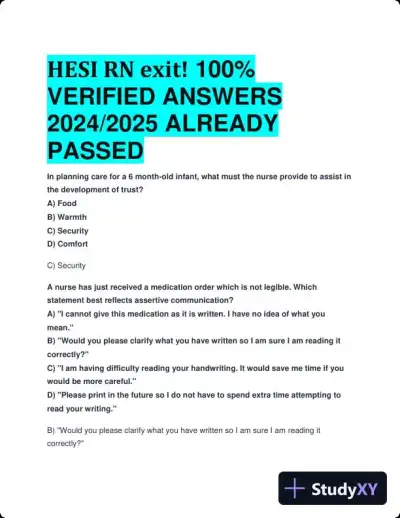 Past Exams
2024-2025 HESI RN Exit Exam with Answers (156 Solved Questions)
Health Education Systems, Inc.
44 pages92downloadsFeb 2025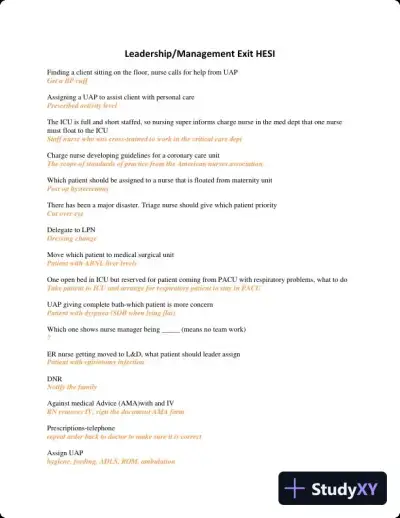 Past Exams
HESI Leadership/Management Exit Exam with Answers (59 Solved Questions)
Health Education Systems, Inc.
4 pages54downloadsFeb 2025
Study this document with CramX
Once it is in your library, every tool can work from it.