

HESI Mental Health Practice Exam With Answers (229 Solved Questions)
- Health Education Systems, Inc.
- 93 pages
- Shared May 2025
Learn exam shortcuts and strategies with HESI Mental Health Practice Exam With Answers, featuring past test questions.
Preview 16 of 93 pages
See the first 16 pages exactly as they appear in the document.
Page 1 Read page 1 as text
Mental Health HESI 1. Which characteristic is commonly associated with adolescent depression? (Select all that apply.) A. Exercising daily B. Having suicidal ideation C. Exhibiting tearfulness D. Having poor muscle tone E. Avoiding previously enjoyed activities and relation- ships B. Having suicidal ideation C. Exhibiting tear- fulness E. Avoiding previ- ously enjoyed ac- tivities and rela- tionships 2. Which characteristic of adolescence is exempli- fied by risk-taking behavior without fear of conse- quences? A. Animism B. Personal fable C. Imaginery audience D. Sense of invulnerability D. Sense of invul- nerability 3. A client does not take their medication regularly and is depressed. Which inference can the nurse make about the client's motivational level? A. Not motivated B. Intrinsically motivated C. Extrinsically motivated with self-determination D. Extrinsically motivated without self-determination A. Not motivated 4. Which action would the nurse take for a withdrawn client who suddenly screams, bursts into tears, and runs from the room to the far end of the hallway? A. Walk to the end of the hallway where the client is standing B. Accept the action as the impulsive behavior of a sick person C. Ask another client in the dayroom why the client acted in this way D. Document objectively the incident in the client's record immediately A. Walk to the end of the hallway where the client is standing This lets the client know that the nurse is available. It also demon- strates an accep- tance of the client. 5. Which consistent approach would the nurse use for a client diagnosed with an antisocial personality dis- 1 / 93
Page 2 Page 3 Read page 3 as text
order? A. Warm and firm without being punitive B. Indifferent and detached but nonjudgemental C. Confidentiality acquiescent to client demands D. Clearly communicative of personal disapproval A. Warm and firm without being punitive 6. Which technique would be appropriate for clients who exhibit mild neurocognitive impairment? A. Reality orientation B. Behavioral confrontation C. Reflective communication D. Reminiscence group therapy A. Reality orienta- tion 7. Which characteristic is most essential for the nurse to have in caring for clients with mental health disor- ders? A. Empathy B. Sympathy C. Organization D. Authoritarianism A. Empathy Empathy - under- standing and, to some extent, shar- ing the emotions of another- en- courages the ex- pression of feel- ings. Sympathy, or feeling sorry for someone, may further decrease the client's feel- ings of self-worth. 8. Which stage is a terminally ill client displaying by gradually moving towards resolution of feelings about impending death according to Kubler-Ross' theory of death and dying? A. Anger stage B. Denial stage C. Bargaining stage D. Acceptance stage D. Acceptance stage When acceptance is reached. the in- dividual is begin- ning to withdraw from life; commu- nication is simple, concise, and most 2 / 93
Page 4 Read page 4 as text
often nonverbal. Kubler-Ross' re- search has shown that at this stage, verbal communi- cation is typical- ly less impor- tant, and touch and presence are most important. The client has moved past the anger, denial, and bargaining stages. 9. Which action would the nurse take for a client with an obsessive-compulsive disorder who continually walks up and down the hall, touching every other and becomes upset if interrupted? A. Distract the client, which will help the client forget about touching the chairs. B. Encourage the client to continue touching the chairs as long as the client wants until fatigue sets in C. Remove chairs from the hall, thereby relieving the client of the necessity of touching every other one D. Allow the behavior to continue for a specified time, letting the client help set the time limits to be imposed D. Allow the be- havior to contin- ue for a speci- fied time, letting the client help set the time limits to be imposed 10. Place the five stages of grievingidentified and de- scribed by Elisabeth Kubler-Ross in order of progres- sion from first to last. 1. Anger 2. Denial 3. Depression 4. Acceptance 5. Bargaining 2. Denial 1. Anger 5. Bargaining 3. Depression 4. Acceptance 11. 3 / 93
Page 5 Read page 5 as text
Which assessment finding would the nurse observe in a client with bipolar disorder, manic phase? A. Constant singing B. Ritualistic behavior C. Flat affect D. Apathetic demeanor A. Constant singing 12. Which reason would be likely for a client's anger and acting out when the nurse interrupts the hand-wash- ing ritual of a client with obsessive-compulsive dis- order? A. Has overwhelming feelings of anxiety B. Resents the nurse's authoritarian manner C. Is clashing with the nurse's personality D. Reflects and aggressive characteristic A. Has over- whelming feelings of anxiety 13. Which response would the nurse make to a client who says, 'I feel so guilty. None of this makes any sense. Everyone must really think I'm crazy,' after performing a complex ritual? A. 'Your behavior is bizarre, but it serves a useful purpose.' B. 'You're concerned about what other people are thinking about you.' C. 'I am sure people understand that you can't help this behavior right now.' D. 'Guilt serves no useful purpose. It just helps you stay stuck where you are.' B. 'You're con- cerned about what other people are thinking about you.' 14. Which characteristic of clients with antisocial person- ality disorder would the nurse consider when plan- ning care? A. Engages in many rituals B. Is a perfectionist C. Exhibits lack of empathy for others D. Possesses limited communication skills C. Exhibits lack of empathy for others 15. At which stage of Kohlberg's theory does an individ- ual want to fulfill the expectations of one's immediate group? A. Good boy-nice orientation 4 / 93
Page 6 Read page 6 as text
A. Good boy-nice orientation B. Society-maintaining orientation C. Instrumental relativist orientation D. Universal ethical principle orientation The good boy-good girl ori- entation stage in- volves an individ- ual who wants to win the approval and maintain the expectations of one's immedi- ate group. During the society-main- taining orientation stage, an individ- ual expands fo- cus from a rela- tionship with oth- ers to societal con- cerns. The instru- mental relativist orientation stage involves a child who wants to fol- low parental rules. the universal eth- ical principle ori- entation stage de- fines "right" by the decision of con- science according to self-chosen eth- ical principles. 16. Which side effect would the nurse monitor for in a severely depressed client who received electrocon- vulsive therapy (ECT)? A. Loss of appetite B. Postural hypotension C. Total memory loss D. Confusion immediately after the treatment D. Confusion im- mediately after the treatment 5 / 93
Page 7 Read page 7 as text
17. A client is diagnosed with Alzheimer disease and is exhibiting hyperorality. Which parameter would the nurse closely monitor to keep this client safe? A. For choking at meal times B. For the presence of mouth ulcers C. For injuries from touching hot foods D. For attempts at eating inedible objects D. For attempts at eating inedible ob- jects 18. Which period of Piaget's theory covers the preva- lence of egocentrism in adolescents? A. Sensorimotor B. Preoperational C. Formal operations D. Concrete operations C. Formal opera- tions 19. Which explanation, when providing a change-of-shift report, would the nurse use to describe a client di- agnosed with schizophrenia who is experiencing op- posing emotions simultaneously? A. Double bind B. Ambivalence C. Loose association D. Inappropriate affect B. Ambivalence 20. Which response would the nurse use when a client di- agnosed with acquired immunodeficiency syndrome (AIDS) states, "I'm not worried because they have a cure for AIDS"? A. "Repeated phlebotomies may be able to rid you of the virus." B. "You may be cured for AIDS after prolonged phar- macological therapy." C. "Perhaps you should have worn condoms to pre- vent contracting the virus." D. "There is no cure for AIDS, but there are medica- tions that can slow down the virus." D. "There is no cure for AIDS, but there are medica- tions that can slow down the virus." 21. Which type of group is Alcoholics Anonymous (AA)? A. Social group B. Self-help group 6 / 93
Page 8 Read page 8 as text
B. Self-help group C. Resocialization group D. Psychotherapeutic group 22. Which type of delusion would the nurse chart about a client who says, 'I've figured out how foreign agents have infiltrated the news media. Now they want to shut me up'? A. Nihilistic B. Persecution C. Control D. Grandeur B. Persecution 23. When planning for a client's care during the detoxifi- cation phase of early alcohol withdrawal, which ac- tion would the nurse take? A. Check on the client frequently. B. Keep the client's room lights dim C. Address the client in a loud, clear voice D. Restrain the client during periods of agitation A. Check on the client frequently. 24. Which rationale explains why the client who is dis- playing hyperactive and manic behaviors with flights of ideas is not eating? A. Feels undeserving of the food B. Is too busy to take time to eat C. Wishes to avoid others in the dining area D. Believes that the food is poisoned B. Is too busy to take time to eat 25. The parent of a child with a terminal illness ap- pears overwhelmed and anxious. Which is the best response by the nurse? A. Explaining the diagnosis in a variety of ways B. Encouraging the parent to express their feelings C. Recommending that the parent talk with other par- ents D. Offering assurance that surgery will probably cor- rect the problem B. Encouraging the parent to ex- press their feel- ings 26. 7 / 93
Page 9 Read page 9 as text
Which is the nurse's most therapeutic response for the child who is about to have an intravenous (IV) line inserted and cries out that he is afraid of IVs? A. 'Tell me what frightens you.' B. 'It's just a little prick in the arm.' C. 'You're a big boy; this will hardly hurt.' D. 'Come on-there's no reason to be afraid.' A. 'Tell me what frightens you.' 27. An 8-year-old child has experienced the death of a sister. The child begins to ask many questions about what happens to the body after death. The parent wonders if this is abnormal behavior picked up from playing video games. Which is the best response by the nurse? A. "Playing video games can cause morbid behav- iors." B. "Children handle the event of death more realisti- cally than adults do." C. "School-aged children are inquisitive and ask a lot of questions about death." D. "Giggling, attracting attention, and playing are the usual ways of dealing with death." C. "School-aged children are in- quisitive and ask a lot of questions about death." 28. A child has a fractured arm and multiple old injuries. Child maltreatment is suspected. Which parental characteristic supports this suspicion? A. Inquiring about the time of discharge B. Displaying signs of guilt about the injuries C. Expressing concern about the child's health D. Offering inconsistent stories about the injuries D. Offering in- consistent stories about the injuries 29. Which type of crisis has occurred when a sudden terrorist act causes the deaths of thousands of adults and children and negatively affects their families, friends, communities, and the nation? A. Situation-maturational B. Situational C. Maturational D. Adventitious D. Adventitious An adventitious crisis is a cri- sis or disaster that is unplanned and accidental; its subcategories 8 / 93
Page 10 Read page 10 as text
inc. natural dis- asters, nation- al disasters, and crimes of violence. A situational-mat- urational crisis is not a typical cate- gory in crisis theo- ry. If 2 events oc- curred around the same time-for ex- ample, retirement (maturational cri- sis) and the un- expected death of a spouse (stu- ational crisis)-the client would have to deal with both issues. A situa- tional crisis results from an external source and the loss is often unex- pected. A matura- tional crisis occurs as an individual moves into a new stage of devel- opment and prior coping styles are no longer effec- tive; maturational crises are usually predictable. 30. Which characteristic of a therapeutic milieu would the nurse consider important for a confused older adult with socially aggressive behavior? A. Sets limits The therapeutic 9 / 93
Page 11 Read page 11 as text
A. Sets limits B. Has variety C. Is group oriented D. Allows freedom of expression milieu characteris- tic would be to set limits. Because clients with social- ly aggressive be- havior have poor control, these in- dividuals require a therapeutic envi- ronment in which appropriate lim- its for behav- ior are set for them. Variety will increase anxiety. The daily routine should be struc- tured and repeti- tive. A group-ori- ented environ- ment is too stim- ulating for a per- son with socially aggressive behav- ior. Freedom of ex- pression may re- sult in injury to the client or oth- ers, becuase the client may be un- able to control im- pulses. 31. Which activity would the nurse ask an older adult to do when testing short-term memory? A. Substract serial sevens from 100 B. Copy one simple geometric figure C. State three random words mentioned earlier in the examination C. State three ran- dom words men- tioned earlier in the examination 10 / 93
Page 12 Read page 12 as text
D. Name two common objects when the nurse points to them 32. Which action would the nurse take for an older adult with Alzheimer disease who has laid out several out- fits on the bed to wear to a recreational session but is still wearing nightclothes? A. Assist the client to dress and explain when resi- dents are expected at the activity. B. Prompt the client to dress more quickly to avoid delaying the other residents C. Help the client select appropriate attire and offer to help the client get dressed D. Allow the client time to dress but explain that the client has missed the opportunity to attend the activ- ity C. Help the client select appropriate attire and offer to help the client get dressed 33. Which characteristic would a nurse expect to be ex- hibited by an adolescent? (Select all that apply) A. A belief in their own invulnerability B. Personal fable C. Temper tantrums D. Attempts to control situations E. Eagerness for formal education A. A belief in their own invulnerability B. Personal fable They show per- sonal fable be- cause they think their thoughts and feelings are unique. Toddlers get to know their abilities to con- trol situations and seem pleased with it. Preschoolers refine the mastery of their bodies and eagerly await the beginning of for- mal education. 34. 11 / 93
Page 13 Read page 13 as text
How do adolescents establish group identity during psychosocial development? A. By evaluating their own health with a feeling of well-being B. By fostering their independence with balanced family structure C. By achieving marked physical changes with mas- culine and feminine behaviors D. By building close peer relationships to achieve acceptance in the society D. By build- ing close peer relationships to achieve accep- tance in the soci- ety 35. In which period will the adolescent have a prevalence of egocentric thoughts according to Piaget's theory? A. Sensorimotor C. Preoperational C. Formal operations D. Concrete operations C. Formal opera- tions During the period of formal opera- tions, there is a prevalence of ego- centric thought in adolescents. Dur- ing the sensorimo- tor period, infants develop a schema or action pattern for dealing with the environment. Dur- ing the preoper- ational period, a toddler has ego- centric thoughts. During the con- crete operations period, the child thinks about an action before it is performed physi- cally. 36. 12 / 93
Page 14 Read page 14 as text
Which characteristic is found in an adolescent ac- cording to Erikson's theory of psychosocial develop- ment (Select all that apply) A. The adolescent develops a conscience B. The adolescent concentrates on work and play C. The adolescent develops autonomy by making choices D. The adolescent is concerned about his or her ap- pearance and body image E. The adolescent acquires a sense of identity by participating in decision-making D. The adoles- cent is concerned about his or her appearance and body image E. The adolescent acquires a sense of identity by par- ticipating in deci- sion-making 37. Which statement describes adolescent according to Lawrence Kohlberg's theory of moral development? (Select all that apply.) A. "An individual recognizes that there is more than one correct view." B. "An individual's thoughts are influenced by moral decisions and behaviors." C. "An individual expands his or her focus from a relationship with others to societal concerns." D. "An individual wants to win the approval of and maintain the expectations of one's immediate group." E. "An individual's response to a moral dilemma is in terms of absolute obedience to authority and rules." B. "An individual's thoughts are in- fluenced by moral decisions and be- haviors." C. "An individual expands his or her focus from a rela- tionship with oth- ers to societal con- cerns." 38. Which period of Piaget's theory marks the end of cognitive development? A. Sensorimotor B. Preoperational C. Formal operations D. Concrete operations C. Formal opera- tions 39. Which response would the nurse give to the common statement "But you don't understand" when caring for an adolescent? A. "I don't understand what you mean." B. "I do understand; I was a teenager once too." C. "It would be helpful to under- stand; let's talk." 13 / 93
Page 15 Read page 15 as text
C. "It would be helpful to understand; let's talk." D. "It's you who should try to understand others." 40. At which stage does an adolescent develop abstract thinking? A. Genital stage B. Conventional reasoning C. Formal operations period D. Identity vs. role confusion C. Formal opera- tions period According to Pi- aget's moral de- velopment theo- ry, an adolescent develops abstract thinking during the formal operations period. According to Freud's geni- tal stage, sexu- al urges reawak- en and are direct- ed to an individual outside the family circle. During the conventional rea- soning stage, a person establish- es his or her morals based on his or her person- al internalization of societal expec- tations. According to the identity ver- sus role confu- sion stage, there is a marked pre- occupation with appearance and body image. 41. 14 / 93
Page 16 Read page 16 as text
Which behavior would an adolescent exhibit? A. Temper tantrums B. Attempting to control situations C. Synchronization of moral skills D. Eagerness for formal education C. Synchroniza- tion of moral skills Adolescents re- fine and synchro- nize physical, psy- chosocial, cogni- tive, and moral skills to be- come an accepted member of soci- ety. Toddlers tend to have temper tantrums. Toddlers also learn about how to control situ- ations. Preschool- ers refine the mas- tery of their bodies and eagerly await the beginning of formal education. 42. Which aspect of psychosocial development is com- monly observed in adolescents? (Select all that ap- ply.) A. A search for personal identity B. Development of an ethical system C. A sense of invincibility D. Belief that their parents are materialistic E. Emotional dependence on parents A. A search for personal identity B. Development of an ethical system An adolescent tends to search for his or her personal identity and develop his or her own ethi- cal system during psychosocial de- velopment. During the cognitive de- velopment, ado- 15 / 93
77 more pages in the full document
Unlock it once and it stays in your library, ready to chat with or turn into flashcards.
Unlock the full documentMore Health Education Systems, Inc. study materials
See all Past Exams
2023-2024 RN HESI Exit Exam Version 3 with Answers (53 Solved Questions)
Health Education Systems, Inc.
13 pages163downloadsFeb 2025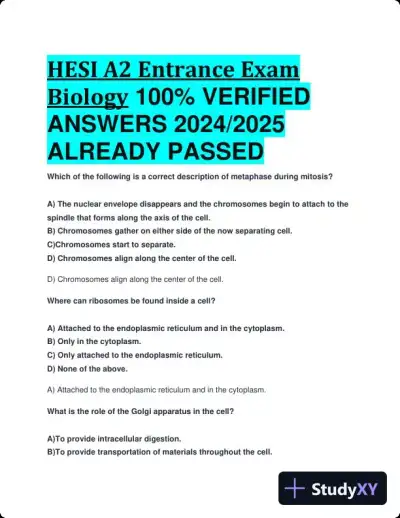 Past Exams
2024-2025 HESI A2 Biology Entrance Exam with Answers (42 Solved Questions)
Health Education Systems, Inc.
13 pages154downloadsFeb 2025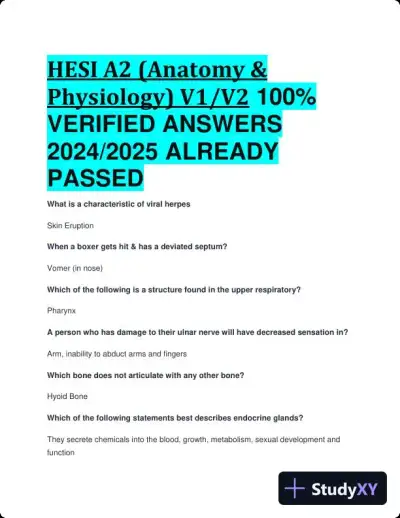 Past Exams
2024-2025 HESI A2 Anatomy and Physiology V1/V2 Practice Exam with Answers (134 Solved Questions)
Health Education Systems, Inc.
15 pages134downloadsFeb 2025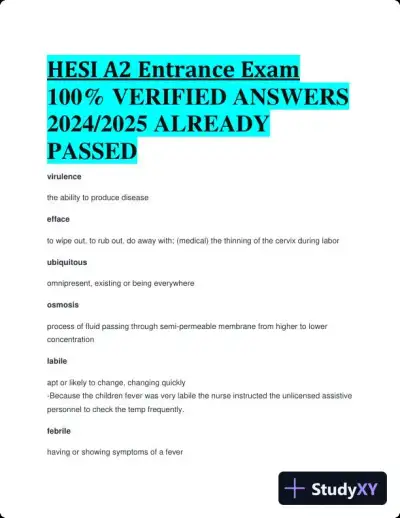 Past Exams
2024-2025 HESI A2 Entrance Exam with Answers (232 Solved Questions)
Health Education Systems, Inc.
26 pages132downloadsFeb 2025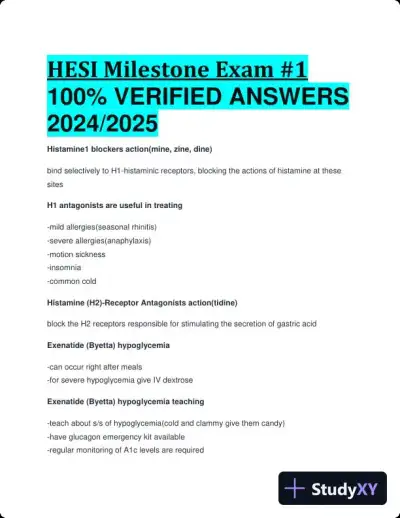 Past Exams
2024-2025 HESI Milestone Exam 1 with Answers (162 Solved Questions)
Health Education Systems, Inc.
26 pages119downloadsFeb 2025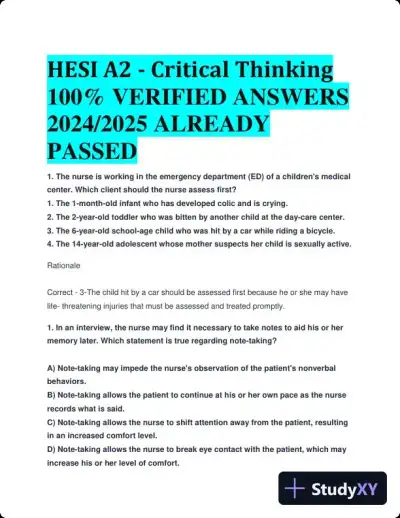 Past Exams
2024-2025 HESI A2 Critical Thinking with Answers (124 Solved Questions)
Health Education Systems, Inc.
114 pages106downloadsFeb 2025 Past Exams
2024-2025 HESI RN Exit Exam with Answers (156 Solved Questions)
Health Education Systems, Inc.
44 pages92downloadsFeb 2025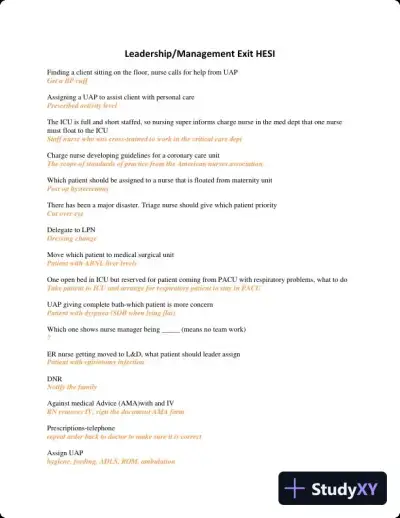 Past Exams
HESI Leadership/Management Exit Exam with Answers (59 Solved Questions)
Health Education Systems, Inc.
4 pages54downloadsFeb 2025
Study this document with CramX
Once it is in your library, every tool can work from it.