

HESI Others Exit Exam With Answers (656 Solved Questions)
- Health Education Systems, Inc.
- 204 pages
- Shared May 2025
HESI Others Exit Exam With Answers makes studying more efficient with real past exam practice.
Preview 16 of 204 pages
See the first 16 pages exactly as they appear in the document.
Page 1 Read page 1 as text
799 RN Exit Exam Terms in this set (798) Following discharge teaching, a male client with duodenal ulcer tells the nurse the he will drink plenty of dairy products, such as milk, to help coat and protect his ulcer. What is the best follow-up action by the nurse? a. Remind the client that it is also important to switch to decaffeinated coffee and tea. b. Suggest that the client also plan to eat frequent small meals to reduce discomfort c. Review with the client the need to avoid foods that are rich in milk and cream. d. Reinforce this teaching by asking the client to list a dairy food that he might select. Review with the client the need to avoid foods that are rich in milk and cream Rationale: Diets rich in milk and cream stimulate gastric acid secretion and should be avoided. A male client with hypertension, who received new antihypertensive prescriptions at his last visit returns to the clinic two weeks later to evaluate his blood pressure (BP). His BP is 158/106 and he admits that he has not been taking the prescribed medication because the drugs make him "feel bad". In explaining the need for hypertension control, the nurse should stress that an elevated BP places the client at risk for which pathophysiological condition? a. Blindness secondary to cataracts b. Acute kidney injury due to glomerular damage c. Stroke secondary to hemorrhage d. Heart block due to myocardial damage Stroke secondary to hemorrhage Rationale: Stroke related to cerebral hemorrhage is major risk for uncontrolled hypertension. The nurse observes an unlicensed assistive personnel (UAP) positioning a newly admitted client who has a seizure disorder. The client is supine and the UAP is placing soft pillows along the side rails. What action should the nurse implement? a. Ensure that the UAP has placed the pillows effectively to protect the client. b. Instruct the UAP to obtain soft blankets to secure to the side rails instead of pillows. c. Assume responsibility for placing the pillows while the UAP completes another task. d. Ask the UAP to use some of the pillows to prop the client in a side lying position. lOMoARcPSD|12029159
Page 2 Page 3 Read page 3 as text
Instruct the UAP to obtain soft blankets to secure to the side rails instead of pillows Rationale: The nurse should instruct the UAP to pad the side rails with soft blankest because the use of pillows could result in suffocation and would need to be removed at the onset of the seizure. The nurse can delegate paddling the side rails to the UAP An adolescent with major depressive disorder has been taking duloxetine (Cymbalta) for the past 12 days. Which assessment finding requires immediate follow-up a. Describes life without purpose b. Complains of nausea and loss of appetite c. States is often fatigued and drowsy d. Exhibits an increase in sweating. Describes life without purpose Rationale: Cymbalta is a selective serotonin and norepinephrine reuptake inhibitor that is known to increase the risk of suicidal thinking in adolescents and young adults with major depressive disorder. B, C and D are side effects A 60-year-old female client with a positive family history of ovarian cancer has developed an abdominal mass and is being evaluated for possible ovarian cancer. Her Papanicolau (Pap) smear results are negative. What information should the nurse include in the client's teaching plan a. Further evaluation involving surgery may be needed b. A pelvic exam is also needed before cancer is ruled out c. Pap smear evaluation should be continued every six month d. One additional negative pap smear in six months is needed. Further evaluation involving surgery may be needed Rationale: An abdominal mass in a client with a family history for ovarian cancer should be evaluated carefully A client who recently underwent a tracheostomy is being prepared for discharge to home. Which instructions is most important for the nurse to include in the discharge plan? a. Explain how to use communication tools. b. Teach tracheal suctioning techniques c. Encourage self-care and independence. d. Demonstrate how to clean tracheostomy site. Teach tracheal suctioning techniques Rationale: Suctioning helps to clear secretions and maintain an open airway, which is critical. In assessing an adult client with a partial rebreather mask, the nurse notes that the oxygen reservoir bag does not deflate completely during inspiration and the client's respiratory rate is 14 breaths / minute. What action should the nurse implement lOMoARcPSD|12029159
Page 4 Read page 4 as text
a. Encourage the client to take deep breaths b. Remove the mask to deflate the bag c. Increase the liter flow of oxygen d. Document the assessment data Document the assessment data Rational: reservoir bag should not deflate completely during inspiration and the client's respiratory rate is within normal limits. During shift report, the central electrocardiogram (EKG) monitoring system alarms. Which client alarm should the nurse investigate first? a. Respiratory apnea of 30 seconds b. Oxygen saturation rate of 88% c. Eight premature ventricular beats every minute d. Disconnected monitor signal for the last 6 minutes. Respiratory apnea of 30 seconds Rationale: The priority is the client whose alarm indicating respiratory apnea that should be assessed first. During a home visit, the nurse observed an elderly client with diabetes slip and fall. What action should the nurse take first? a. Give the client 4 ounces of orange juice b. Call 911 to summon emergency assistance c. Check the client for lacerations or fractures d. Asses clients blood sugar level Check the client for lacerations or fractures Rationale: After the client falls, the nurse should immediately assess for the possibility of injuries and provide first aid as needed At 0600 while admitting a woman for a schedule repeat cesarean section (C-Section), the client tells the nurse that she drank a cup a coffee at 0400 because she wanted to avoid getting a headache. Which action should the nurse take first? a. Ensure preoperative lab results are available b. Start prescribed IV with lactated Ringer's c. Inform the anesthesia care provider d. Contact the client's obstetrician. Inform the anesthesia care provider Rationale: Surgical preoperative instruction includes NPO after midnight the day of surgery to decrease the risk of aspiration should vomiting occur during anesthesia. While it is possible the C-section will be done on schedule or rescheduled for later in the day, the anesthesia provider should be notified first. After placing a stethoscope as seen in the picture, the nurse auscultates S1 and S2 heart sounds. To determine if an S3 heart sound is present, what action should the lOMoARcPSD|12029159
Page 5 Read page 5 as text
nurse take first a. Side the stethoscope across the sternum. b. Move the stethoscope to the mitral site c. Listen with the bell at the same location d. Observe the cardiac telemetry monitor Listen with the bell at the same location Rationale: The nurse uses the bell of the stethoscope to hear low-pitched sounds such as S3 and S4. The nurse listens at the same site using the diaphragm the diaphragm and bell before moving systematically to the next sites. A 66-year-old woman is retiring and will no longer have a health insurance through her place of employment. Which agency should the client be referred to by the employee health nurse for health insurance needs? a. Woman, Infant, and Children program b. Medicaid c. Medicare d. Consolidated Omnibus Budget Reconciliation Act provision. Medicare Rationale: Title XVII of the social security Act of 1965 created Medicare Program to provide medical insurance for person more than 65 years or older, disable or with permeant kidney failure, WIC provides supplemental nutrition to meet the needs of pregnant of breastfeeding woman, infants and children up to age of 6. Medicaid provides financial assistance to pay for medical services for poor older adults, blind, disable and families with dependent children. COBRA(D) health benefit provisions is a limited insurance plan for those who has been laid off or become unemployed. Upgrade to remove ads Only $35.99/year A client who is taking an oral dose of a tetracycline complains of gastrointestinal upset. What snack should the nurse instruct the client to take with the tetracycline? a. Fruit-flavored yogurt. b. Cheese and crackers. c. Cold cereal with skim milk. d. Toasted wheat bread and jelly Toasted wheat bread and jelly Rationale: Dairy products decrease the effect of tetracycline, so the nurse instructs the client to eat a snack such as toast, which contains no dairy products and may decrease GI symptoms. Following a lumbar puncture, a client voices several complaints. What complaint indicated to the nurse that the client is experiencing a complication? a. "I am having pain in my lower back when I move my legs" lOMoARcPSD|12029159
Page 6 Read page 6 as text
b. "My throat hurts when I swallow" c. "I feel sick to my stomach and am going to throw up" d. I have a headache that gets worse when I sit up" "I have a headache that gets worse when I sit up" Rationale: A post-lumbar puncture headache, ranging from mild to severe, may occur as a result of leakage of cerebrospinal fluid at the puncture site. This complication is usually managed by bedrest, analgesic, and hydration. An elderly client seems confused and reports the onset of nausea, dysuria, and urgency with incontinence. Which action should the nurse implement a. Auscultate for renal bruits b. Obtain a clean catch mid-stream specimen c. Use a dipstick to measure for urinary ketone d. Begin to strain the client's urine. Obtain a clean catch mid-stream specimen Rationale: This elderly is experiencing symptoms of urinary tract infection. The nurse should obtain a clean catch mid-stream specimen to determine the causative agent so an anti-infective agent can be prescribed. The nurse is assisting the mother of a child with phenylketonuria (PKU) to select foods that are in keeping with the child's dietary restrictions. Which foods are contraindicated for this child? a. Wheat products b. Foods sweetened with aspartame. c. High fat foods d. High calories foods. Foods sweetened with aspartame Rationale: Aspartame should not be consumed by a child with PKU because ut is converted to phenylalanine in the body. Additionally, milk and milk products are contraindicated for children with PKU. Before preparing a client for the first surgical case of the day, a part-time scrub nurse asks the circulating nurse if a 3 minute surgical hand scrub is adequate preparation for this client. Which response should the circulating nurse provide? a. Ask a more experience nurse to perform that scrub since it is the first time of the day b. Validate the nurse is implementing the OR policy for surgical hand scrub c. Inform the nurse that hand scrubs should be 3 minutes between cases. d. Direct the nurse to continue the surgical hand scrub for a 5-minute duration. Direct the nurse to continue the surgical hand scrub for a 5 minute duration Rationale: The surgical hand scrub should last for 5 to 10 mints, so the nurse should be directed to continue the vigorous scrub using a reliable agent for the total duration of 5 mints. It is not necessary to reassign staff (A). The length of the hand scrub and lOMoARcPSD|12029159
Page 7 Read page 7 as text
subsequent scrubs during the day require the same process for the same amount of time, (B and C) Which breakfast selection indicates that the client understands the nurse's instructions about the dietary management of osteoporosis? a. Egg whites, toast and coffee. b. Bran muffin, mixed fruits, and orange juice. c. Granola and grapefruit juice d. Bagel with jelly and skim milk. Bagel with jelly and skim milk Rationale: D includes dairy products which contain calcium and does not include any foods that inhibit calcium absorption. The primary dietary implication of osteoporosis is the need for increased calcium and reduction in foods that decrease calcium absorption, such as caffeine and excessive fiber. The charge nurse of critical care unit informed at beginning of shift that less than optimal number registered nurses be working that shift. In planning assignments, which client should receive most care hours by a registered nurse a. A 34 yo admitted today after emergency appendendectomy who has peripheral intravenous catheter, Foley catheter. b. A 48 yo marathon runner w/a central venous catheter experiencing nausea, vomiting due to electrolyte disturbance following a race. c. A 63 yo chain smoker w/ chronic bronchitis receiving O2 nasal cannula and a saline- locked peripheral intravenous catheter. d. An 82 yo client with Alzheimer's disease newly-fractures femur w/Foley catheter and soft wrist restrains applied An 82-year-old client with Alzheimer's disease newly-fractures femur who has a Foley catheter and soft wrist restrains applied Rationale: (D) describe the client at the most risk for injury and complications because of the factor listed. (A) has complete the recovery period form anesthesia but requires critical care because of the invasive lines and new abdominal incision. (B) is likely to be in excellent physical condition and has one invasive line needed for rehydration. (C) is essentially stable, despite having a chronic condition. A mother brings her 6-year-old child, who has just stepped on a rusty nail, to the pediatrician's office. Upon inspection, the nurse notes that the nail went through the shoe and pierced the bottom of the child's foot. Which action should the nurse implement first? a. Cleanse the foot with soap and water and apply an antibiotic ointment b. Provide teaching about the need for a tetanus booster within the next 72 hours. c. have the mother check the child's temperature q4h for the next 24 hours d. transfer the child to the emergency department to receive a gamma globulin injection lOMoARcPSD|12029159
Page 8 Read page 8 as text
Cleanse the foot with soap and water and apply an antibiotic ointment Rationale: The nurse should cleanse the wound first and implement B next. The mother of an adolescent tells the clinic nurse, "My son has athlete's foot, I have been applying triple antibiotic ointment for two days, but there has been no improvement." What instruction should the nurse provide? a. Antibiotics take two weeks to become effective against infections such as athlete's foot. b. Continue using the ointment for a full week, even after the symptoms disappear. c. Applying too much ointment can deter its effectiveness. Apply a thin layer to prevent maceration. d. Stop using the ointment and encourage complete drying of the feet and wearing clean socks. Stop using the ointment and encourage complete drying of the feet and wearing clean socks. Rationale: Athlete's foot (tinea pedi) is a fungal infection that afflicts the feet and causes scaliness and cracking of the skin between the toes and on the soles of the feet. The feet should be ventilated, dried well after bathing, and clean socks should be placed on the feet after bathing. Antifungal ointments may be prescribed, but antibiotic ointments are not useful. A 26-year-old female client is admitted to the hospital for treatment of a simple goiter, and levothyroxine sodium (Synthroid) is prescribed. Which symptoms indicate to the nurse that the prescribed dosage is too high for this client? The client experiences a. Palpitations and shortness of breath b. Bradycardia and constipation c. Lethargy and lack of appetite d. Muscle cramping and dry, flushed skin Palpitations and shortness of breath Rationale: An overdose of thyroid preparation generally manifests symptoms of an agitated state such as tremors, palpitations, shortness of breath, tachycardia, increased appetite, agitation, sweating and diarrhea. A client with a history of heart failure presents to the clinic with a nausea, vomiting, yellow vision and palpitations. Which finding is most important for the nurse to assess to the client? a. Determine the client's level of orientation and cognition b. Assess distal pulses and signs of peripheral edema c. Obtain a list of medications taken for cardiac history. d. Ask the client about exposure to environmental heat. Obtain a list of medications taken for cardiac history lOMoARcPSD|12029159
Page 9 Read page 9 as text
Rationale: The client is presenting with signs of digitalis toxicity. A list of medication, which is likely to include digoxin (Lanoxin) for heart failure, can direct further assessment in validating digitalis toxicity with serum labels greater than 2 mg/ml that is contributing to client's presenting clinical picture. The healthcare provider prescribes an IV solution of isoproterenol (Isuprel) 1 mg in 250 ml of D5W at 300 mcg/hour. The nurse should program the infusion pump to deliver how many ml/hour? (Enter numeric value only.) 75 75 Rationale: Convert mg to mcg and use the formula D/H x Q. 300 mcg/hour / 1,000 mcg x 250 ml = 3/1 x 25 = 75 ml/hour The pathophysiological mechanism are responsible for ascites related to liver failure? (Select all that apply) a. Bleeding that results from a decreased production of the body's clotting factors b. Fluid shifts from intravascular to interstitial area due to decreased serum protein c. Increased hydrostatic pressure in portal circulation increases fluid shifts into abdomen d. Increased circulating aldosterone levels that increase sodium and water retention e. Decreased absorption of fatty acids in the duodenum leading to abdominal distention. b. Fluid shifts from intravascular to interstitial area due to decreased serum protein c. Increased hydrostatic pressure in portal circulation increases fluid shifts into abdomen d. Increased circulating aldosterone levels that increase sodium and water retention Rationale: When liver fail production of albumin is reduced. Since albumin is the primary serum protein creating intravascular osmotic pressure, decreased serum protein allows a fluids shift into the interstitial space. Pressure increases in the portal circulation © when venous return from the upper GI tract cannot flow freely into sclerosed liver, which cause a pressure gradient to further Increase fluid shifts into the abdomen. A failing liver ineffectively inactivates steroidal hormones, such as aldosterone resulting in sodium and water retention. The nurse is auscultating a client's heart sounds. Which description should the nurse use to document this sound? (Please listen to the audio first to select the option that applies) a. S1 S2 b. S1 S2 S3 c. Murmur d. Pericardial friction rub. Murmur Rationale: A murmur is auscultated as a swishing sound that is associated with the blood turbulence created by the heart or valvular defect. B is associate with Heart Failure. lOMoARcPSD|12029159
Page 10 Read page 10 as text
The healthcare provider prescribes celtazidime (Fortax) 35 mg every 8 hours IM for an infant. The 500 mg vial is labeled with the instruction to add 5.3 ml diluent to provide a concentration of 100 mg/ml. How many ml should the nurse administered for each dose? (Enter numeric value only. If rounding is required, round to the nearest tenth. 0.4 0.4 rationale: 35mg/100mg x 1 = 0.35 = 0.4 ml The nurse notes that a client has been receiving hydromorphone (Dilaudid) every six hours for four days. What assessment is most important for the nurse to complete? a. Auscultate the client's bowel sounds b. Observe for edema around the ankles c. Measure the client's capillary glucose level d. Count the apical and radial pulses simultaneously Auscultate the client's bowel sounds Rationale: hydromorphone is a potent opioid analgesic that slows peristalsis and frequently causes constipation, so it is most important to Auscultate the client's bowel sounds A female client is admitted with end stage pulmonary disease is alert, oriented, and complaining of shortness of breath. The client tells the nurse that she wants "no heroic measures" taken if she stops breathing, and she asks the nurse to document this in her medical record. What action should the nurse implement? Ask the client to discuss "do not resuscitate" with her healthcare provider A client is receiving a full strength continuous enteral tube feeding at 50 ml/hour and has developed diarrhea. The client has a new prescription to change the feeding to half strength. What intervention should the nurse implement? a. Add equal amounts of water and feeding to a feeding bag and infuse at 50ml/hour b. Continue the full strength feeding after decreasing the rate of infusion to 25 ml/hr. c. Maintain the present feeding until diarrhea subsides and the begin the next new prescription. d. Withhold any further feeding until clarifying the prescription with healthcare provides. Add equal amounts of water and feeding to a feeding bag and infuse at 50ml/hour Rationale: Diluting the formula can help alleviate the diarrhea. Diarrhea can occur as a complication of enteral tube feeding and can be due to a variety of causes including hyperosmolar formula. A female client reports that her hair is becoming coarse and breaking off, that the outer part of her eyebrows have disappeared, and that her eyes are all puffy. Which follow-up question is best for the nurse to ask? a. "Is there a history of female baldness in your family?" lOMoARcPSD|12029159
Page 11 Read page 11 as text
b. "Are you under any unusual stress at home or work?" c. "Do you work with hazardous chemicals?" d. "Have you noticed any changes in your fingernails?" Have you noticed any changes in your fingernails? Rationale: The pattern of reported manifestations is suggestive of hypothyroidism After a third hospitalization 6 months ago, a client is admitted to the hospital with ascites and malnutrition. The client is drowsy but responding to verbal stimuli and reports recently spitting up blood. What assessment finding warrants immediate intervention by the nurse? a. Bruises on arms and legs b. Round and tight abdomen c. Pitting edema in lower legs d. Capillary refill of 8 seconds Capillary refill of 8 seconds Rationale: The client is bleeding and hypovolemia is likely. Capillary refill is greater than 3 to 5 seconds indicates poor perfusion and requires immediate attention Upgrade to remove ads Only $35.99/year After the nurse witnesses a preoperative client sign the surgical consent form, the nurse signs the form as a witness. What are the legal implications of the nurse's signature on the client's surgical consent form? (Select all that apply) a. The client voluntarily grants permission for the procedure to be done b. The surgeon has explained to the client why the surgery is necessary. c. The client is competent to sign the consent without impairment of judgment d. The client understands the risks and benefits associated with the procedure e. After considering alternatives to surgery, the client elects to have the procedure. a. The client voluntarily grants permission for the procedure to be done c. The client is competent to sign the consent without impairment of judgment d. The client understands the risks and benefits associated with the procedure Rationale: Inform consent is required for any invasive procedure. The nurse's signature as a witness to the client's signature on surgical consent indicates that the client voluntary gives consent for the scheduled procedure. C is competent to give consent, and D and understand the risk and benefits of the procedure. Following surgery, a male client with antisocial personality disorder frequently requests that a specific nurse be assigned to his care and is belligerent when another nurse is assigned. What action should the charge nurse implement? a. Ask the client to explain why he constantly request the nurse lOMoARcPSD|12029159
Page 12 Read page 12 as text
b. Encourage the client to verbalize his feelings about the nurse c. Reassure the client that his request will be met whenever possible. d. Advise the client that assignments are not based on client requests Advise the client that assignments are not based on clients requests Rationale: Those with antisocial personality disorders are manipulative in order to meet their own needs. The charge nurse must set limits on this behavior. The client's superficial charm and emotional maturity prevent effective therapeutic communication and (A and B) will be used to the client's advantage. C encourage further manipulative behavior. A client with cervical cancer is hospitalized for insertion of a sealed internal cervical radiation implant. While providing care, the nurse finds the radiation implant in the bed. What action should the nurse take? a. Call the radiology department b. Reinsert the implant into the vagina c. Apply double gloves to retrieve the implant for disposal. d. Place the implant in a lead container using long-handled forceps Place the implant in a lead container using long-handled forceps Rationale: Solid or sealed radiation sources, such as Cesium which is removed after treatment, are inserted into an applicator or cervical implant to emit continuous, low energy radiation for adjacent tumor tissues. If the radiation source or the applicator become dislodged long-handled forceps should be used to retrieve the radiation implant to prevent injury due to direct handling. The applicator is then placed in the lead container. The client with which type of wound is most likely to need immediate intervention by the nurse? a. Laceration b. Abrasion c. Contusion d. Ulceration Laceration Rationale: A laceration is a wound that is produced by the tearing of soft body tissue. This type of wound is often irregular and jagged. A laceration wound is often contaminated with bacteria and debris from whatever object caused the cut The nurse is planning care for a client admitted with a diagnosis of pheochromocytoma. Which intervention has the highest priority for inclusion in this client's plan of care? a. Record urine output every hour b. Monitor blood pressure frequently c. Evaluate neurological status d. Maintain seizure precautions lOMoARcPSD|12029159
Page 13 Read page 13 as text
Monitor blood pressure frequently Rationale: A pheochromocytoma is a rare, catecholamine-secreting tumor that may precipitate life-threatening hypertension When caring for a client who has acute respiratory distress syndrome (ARDS), the nurse elevates the head of the bed 30 degrees. What is the reason for this intervention? a. To reduce abdominal pressure on the diaphragm b. to promote retraction of the intercostal accessory muscle of respiration c. to promote bronchodilation and effective airway clearance d. to decrease pressure on the medullary center which stimulates breathing To reduce abdominal pressure on the diaphragm Rationale: a semi-sitting position is the best position for matching ventilation and perfusion and for decreasing abdominal pressure on the diaphragm, so that the client can maximize breathing When assessing a mildly obese 35-year-old female client, the nurse is unable to locate the gallbladder when palpating below the liver margin at the lateral border of the rectus abdominal muscle. What is the most likely explanation for failure to locate the gallbladder by palpation? a. The client is too obese b. Palpating in the wrong abdominal quadrant c. The gallbladder is normal d. Deeper palpation technique is needed The gallbladder is normal Rationale: a normal healthy gallbladder is not palpable A woman with an anxiety disorder calls her obstetrician's office and tells the nurse of increased anxiety since the normal vaginal delivery of her son three weeks ago. Since she is breastfeeding, she stopped taking her antianxiety medications, but thinks she may need to start taking them again because of her increased anxiety. What response is best for the nurse to provide this woman? a. Describe the transmission of drugs to the infant through breast milk b. Encourage her to use stress relieving alternatives, such as deep breathing exercises c. Inform her that some antianxiety medications are safe to take while breastfeeding d. Explain that anxiety is a normal response for the mother of a 3-week-old. Inform her that some antianxiety medications are safe to take while breastfeeding Rationale: There are several antianxiety medications that are not contraindicated for breastfeeding mothers. The woman is apparently aware that drugs can be transmitted through breast milk, so A is not helpful. C might be helpful, but the client's history suggest that nonpharmacological methods of anxiety management do not produce the best outcome. (D) the mother's history places her at risk for severe anxiety. lOMoARcPSD|12029159
Page 14 Read page 14 as text
An older male client with a history of type 1 diabetes has not felt well the past few days and arrives at the clinic with abdominal cramping and vomiting. He is lethargic, moderately, confused, and cannot remember when he took his last dose of insulin or ate last. What action should the nurse implement first? a. obtain a serum potassium level b. administer the client's usual dose of insulin c. assess pupillary response to light d. Start an intravenous (IV) infusion of normal saline Start an intravenous (IV) infusion of normal saline Rationale: the nurse should first start an intravenous infusion of normal saline to replace the fluids and electrolytes because the client has been vomiting, and it is unclear when he last ate or took insulin. The symptoms of confusion, lethargy, vomiting, and abdominal cramping are all suggestive of hyperglycemia, which also contributes to diuresis and fluid electrolyte imbalance. A client who received multiple antihypertensive medications experiences syncope due to a drop in blood pressure to 70/40. What is the rationale for the nurse's decision to hold the client's scheduled antihypertensive medication? a. Increased urinary clearance of the multiple medications has produced diuresis and lowered the blood pressure b. The antagonistic interaction among the various blood pressure medications has reduced their effectiveness c. The additive effect of multiple medications has caused the blood pressure to drop too low. d. The synergistic effect of the multiple medications has resulted in drug toxicity and resulting hypotension. The additive effect of multiple medications has caused the blood pressure to drop too low Rationale: When medication with a similar action are administered, an additive effect occurs that is the sum of the effects of each of the medication. In this case, several medications that all lower the blood pressure, when administer together, resulted in hypotension. Which client is at the greatest risk for developing delirium? a. An adult client who cannot sleep due to constant pain. b. an older client who attempted 1 month ago c. a young adult who takes antipsychotic medications twice a day d. a middle-aged woman who uses a tank for supplemental oxygen An adult client who cannot sleep due to constant pain. Rationale: Client who are in constant pain ad have difficulty sleeping or resting are at lOMoARcPSD|12029159
Page 15 Read page 15 as text
high risk for delirium. Supplemental oxygen may cause confusion. B is taking medication so is not at high risk of delirium. Which intervention should the nurse include in a long-term plan of care for a client with Chronic Obstructive Pulmonary Disease (COPD)? a. Reduce risks factors for infection b. Administer high flow oxygen during sleep c. Limit fluid intake to reduce secretions d. Use diaphragmatic breathing to achieve better exhalation Reduce risks factors for infection Rationale: Interventions aimed at reducing the risk factors of infections should be included in the plan of care COPD client are at particular risk for respiratory infection. Prevention and early detection of infections are necessary. Which location should the nurse choose as the best for beginning a screening program for hypothyroidism? a. A business and professional women's group. b. An African-American senior citizens center c. A daycare center in a Hispanic neighborhood d. An after-school center for Native-American teens A business and professional women's group Rationale: The population at highest risk is A so this is the group that would benefit the most for a screening program of hypothyroidism and occurs between 35 and 60 years of age and is most common in females. A female client has been taking a high dose of prednisone, a corticosteroid, for several months. After stopping the medication abruptly, the client reports feeling "very tired". Which nursing intervention is most important for the nurse to implement? a. Measure vital signs b. Auscultate breath sounds c. Palpate the abdomen d. Observe the skin for bruising Measure vital signs Rationale: Abrupt withdrawal of an exogenous corticosteroids can precipitate adrenal insufficiency and hypoglycemia, hypokalemia, and circulatory collapse can occur. Is most important for the nurse to assess vital sign to impending shock. A male client reports the onset of numbness and tingling in his fingers and around his mouth. Which lab is important for the nurse to review before contacting the health care provider? a. capillary glucose b. urine specific gravity lOMoARcPSD|12029159
Page 16 Read page 16 as text
c. Serum calcium d. white blood cell count Serum calcium Rationale: Numbness and tingling of the fingers and around the mouth, along with muscle cramps are signs of hypocalcemia What explanation is best for the nurse to provide a client who asks the purpose of using the log-rolling technique for turning? a. working together can decrease the risk for back injury b. The technique is intended to maintain straight spinal alignment. c. Using two or three people increases client safety. d. turning instead of pulling reduces the likelihood of skin damage The technique is intended to maintain straight spinal alignment. Rationale: The main rationale for use of the long-rolling technique is to maintain the client's spine straight alignment. A client receiving chemotherapy has severe neutropenia. Which snack is best for the nurse to recommend to the client? a. Plain yogurt with sweetened with raw honey b. Peanuts in the shell, roasted or un-roasted. c. Aged farmer's cheese with celery sticks d. Baked apples topped with dried raisins Baked apples topped with dried raisins Rationale: A patient with chemotherapy-induced severe neutropenia is at high risk for infection. A low bacteria diet is required D is a healthy snack for a client receiving chemotherapy. A, B and C have a high bacterial count and should be avoided. Which action should the school nurse take first when conducting a screening for scoliosis? a. Compare dorsal measurement of trunk b. Extend arms over head for visualization c. Inspect for symmetrical shoulder height. d. Observe weight-bearing on each leg. Inspect for symmetrical shoulder height. Rationale: Children between 9 and 15 years old should be screening for scoliosis, which is exhibited.... Vertebral column. Screening for scoliosis should begin with inspection of shoulder height An Unlicensed assistive personnel (UAP) assigned to obtain client vital signs reports to the charge nurse that a client has a weak pulse with a rate of 44 beat/ minutes. What action should the charge nurse implement? lOMoARcPSD|12029159
188 more pages in the full document
Unlock it once and it stays in your library, ready to chat with or turn into flashcards.
Unlock the full documentMore Health Education Systems, Inc. study materials
See all Past Exams
2023-2024 RN HESI Exit Exam Version 3 with Answers (53 Solved Questions)
Health Education Systems, Inc.
13 pages163downloadsFeb 2025 Past Exams
2024-2025 HESI A2 Biology Entrance Exam with Answers (42 Solved Questions)
Health Education Systems, Inc.
13 pages154downloadsFeb 2025 Past Exams
2024-2025 HESI A2 Anatomy and Physiology V1/V2 Practice Exam with Answers (134 Solved Questions)
Health Education Systems, Inc.
15 pages134downloadsFeb 2025 Past Exams
2024-2025 HESI A2 Entrance Exam with Answers (232 Solved Questions)
Health Education Systems, Inc.
26 pages132downloadsFeb 2025 Past Exams
2024-2025 HESI Milestone Exam 1 with Answers (162 Solved Questions)
Health Education Systems, Inc.
26 pages119downloadsFeb 2025 Past Exams
2024-2025 HESI A2 Critical Thinking with Answers (124 Solved Questions)
Health Education Systems, Inc.
114 pages106downloadsFeb 2025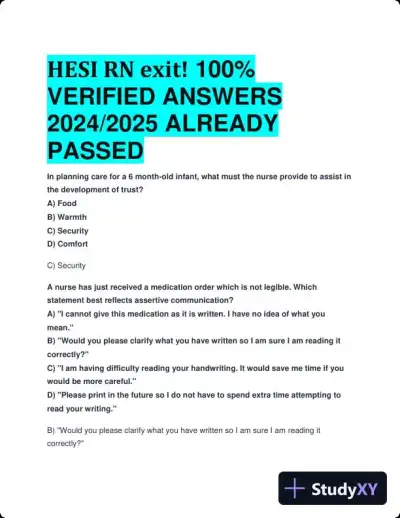 Past Exams
2024-2025 HESI RN Exit Exam with Answers (156 Solved Questions)
Health Education Systems, Inc.
44 pages92downloadsFeb 2025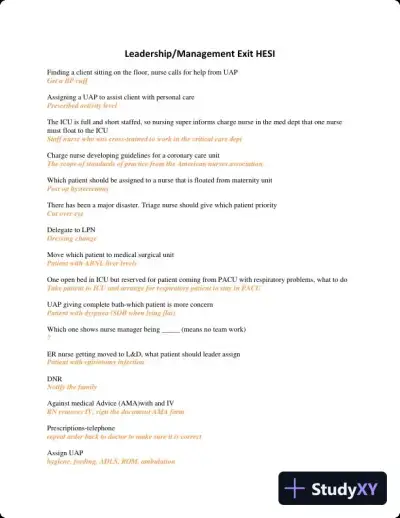 Past Exams
HESI Leadership/Management Exit Exam with Answers (59 Solved Questions)
Health Education Systems, Inc.
4 pages54downloadsFeb 2025
Study this document with CramX
Once it is in your library, every tool can work from it.