
HESI Pharmacology Practice Exam With Answers (354 Solved Questions)

HESI Pharmacology Practice Exam With Answers helps you ace your test by providing past exam exposure.

Victoria Lee
Contributor
4.7
52
10 months ago
Preview (16 of 457 Pages)
100%
Log in to unlock

Page 1

HESI Pharmacology Practice Exam With Answers (354 Solved Questions) - Page 1 preview image

Loading page ...

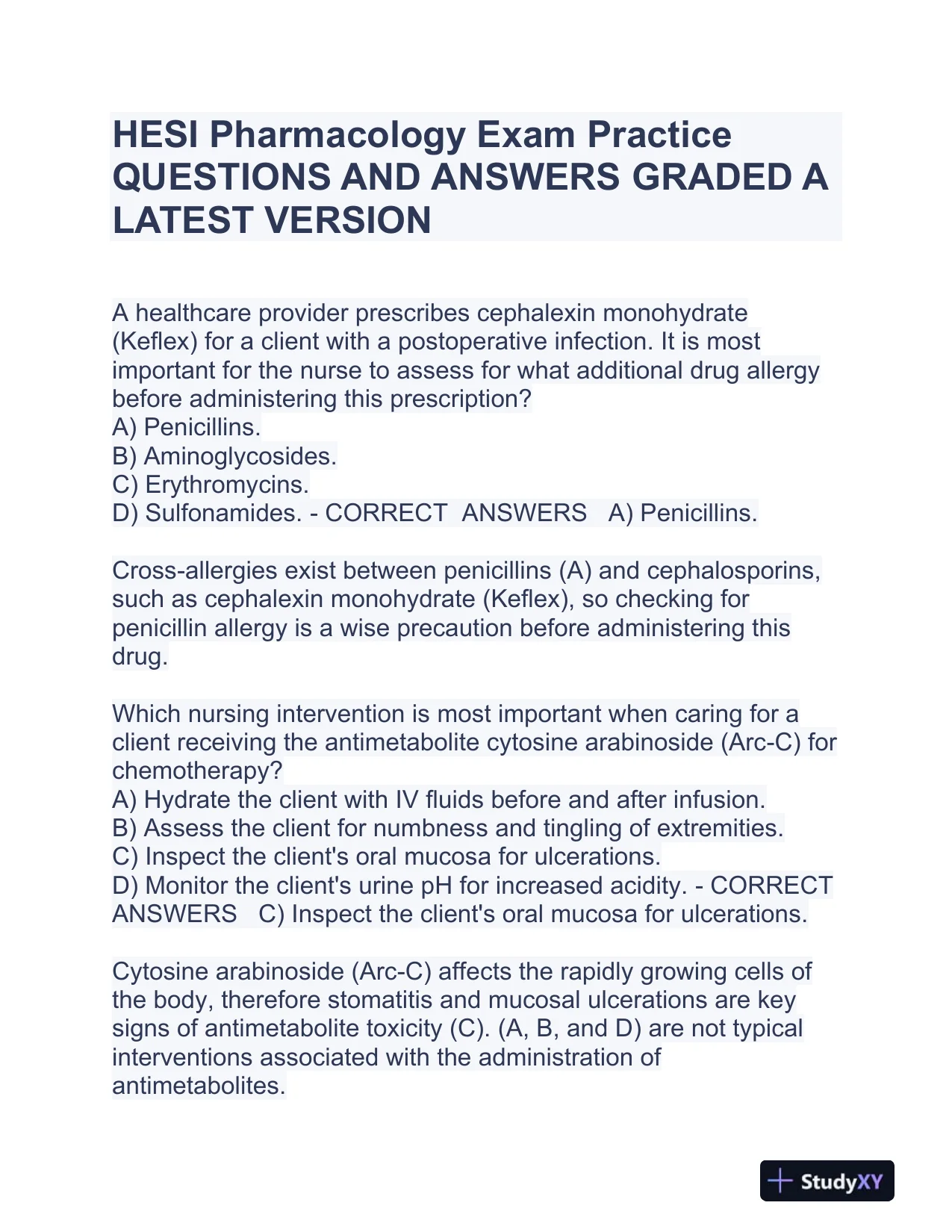
HESI Pharmacology Exam PracticeQUESTIONS AND ANSWERS GRADED ALATEST VERSIONA healthcare provider prescribes cephalexin monohydrate(Keflex) for a client with a postoperative infection. It is mostimportant for the nurse to assess for what additional drug allergybefore administering this prescription?A) Penicillins.B) Aminoglycosides.C) Erythromycins.D) Sulfonamides.-CORRECT ANSWERSA) Penicillins.Cross-allergies exist between penicillins (A) and cephalosporins,such as cephalexin monohydrate (Keflex), so checking forpenicillin allergy is a wise precaution before administering thisdrug.Which nursing intervention ismost important when caring for aclient receiving the antimetabolite cytosine arabinoside (Arc-C) forchemotherapy?A) Hydrate the client with IV fluids before and after infusion.B) Assess the client for numbness and tingling of extremities.C) Inspect the client's oral mucosa for ulcerations.D) Monitor the client's urine pH for increased acidity.-CORRECTANSWERSC) Inspect the client's oral mucosa for ulcerations.Cytosine arabinoside (Arc-C) affects the rapidly growing cells ofthebody, therefore stomatitis and mucosal ulcerations are keysigns of antimetabolite toxicity (C). (A, B, and D) are not typicalinterventions associated with the administration ofantimetabolites.

Page 2

HESI Pharmacology Practice Exam With Answers (354 Solved Questions) - Page 2 preview image

Loading page ...

Page 3

HESI Pharmacology Practice Exam With Answers (354 Solved Questions) - Page 3 preview image

Loading page ...

When assessing an adolescent who recently overdosed onacetaminophen (Tylenol), it is most important for the nurse toassess for pain in which area of the body?A) Flank.B) Abdomen.C) Chest.D) Head.-CORRECT ANSWERSB) Abdomen.Acetaminophen toxicity can result in liver damage; therefore, it isespecially important for the nurse to assess for pain in the rightupper quadrant of the abdomen (B), which might indicate liverdamage. (A, C, and D) are not areas where pain would beanticipated.An adult client is given a prescription for a scopolamine patch(Transderm Scop) to prevent motion sickness while on a cruise.Which information should the nurse provide to the client?A) Apply the patch at least 4 hours prior to departure.B) Change the patch every other day while on the cruise.C) Place the patch on a hairless area at the base of the skull.D) Drink no more than 2 alcoholic drinks during the cruise.-CORRECT ANSWERSA) Apply the patch at least 4 hours priorto departure.Scopolamine, an anticholinergic agent, is used to prevent motionsickness and has a peak onset in 6 hours, so the client should beinstructed to apply the patch at least 4 hours before departure (A)on the cruise ship. The duration of the transdermal patch is 72hours, so (B) is not needed. Scolopamine blocks muscarinicreceptors in the inner ear and to the vomiting center, so the bestapplication site of the patch is behind the ear, not at the base ofthe skull (C). Anticholinergic medications are CNS depressants,so the client should be instructed to avoid alcohol (D) while usingthe patch.

Page 4

HESI Pharmacology Practice Exam With Answers (354 Solved Questions) - Page 4 preview image

Loading page ...

The nurse is reviewing the use of the patient-controlled analgesia(PCA) pump with a client in the immediate postoperative period.The client will receive morphine 1 mg IV per hour basal rate with 1mg IV every 15 minutes per PCA to total5 mg IV maximally perhour. What assessment has the highest priority before initiatingthe PCA pump?A) The expiration date on the morphine syringe in the pump.B) The rate and depth of the client's respirations.C) The type of anesthesia used during thesurgical procedure.D) The client's subjective and objective signs of pain.-CORRECT ANSWERSB) The rate and depth of the client'srespirations.A life-threatening side effect of intravenous administration ofmorphine sulfate, an opiate narcotic, is respiratory depression (B).The PCA pump should be stopped and the healthcare providernotified if the client's respiratory rate falls below 12 breaths perminute, and the nurse should anticipate adjustments in the client'sdosage before the PCA pump isrestarted. (A, C, and D) providehelpful information, but are not as high a priority as theassessment described in (B).A medication that is classified as a beta-1 agonist is mostcommonly prescribed for a client with which condition?A) Glaucoma.B) Hypertension.C) Heart failure.D) Asthma.-CORRECT ANSWERSC) Heart failure.Beta-1 agonists improve cardiac outputby increasing the heartrate and blood pressure and are indicated in heart failure (C),shock, atrioventricular block dysrhythmias, and cardiac arrest.Glaucoma (A) is managed using adrenergic agents and beta-adrenergic blocking agents. Beta-1 blocking agents are used in

Page 5

HESI Pharmacology Practice Exam With Answers (354 Solved Questions) - Page 5 preview image

Loading page ...

the management of hypertension (B). Medications that stimulatebeta-2 receptors in the bronchi are effective forbronchoconstriction in respiratory disorders, such as asthma (D).A female client with rheumatoid arthritis take ibuprofen (Motrin)600 mg PO 4 times a day. To prevent gastrointestinal bleeding,misoprostol (Cytotec) 100 mcg PO is prescribed. Whichinformation is most important for the nurse to include in clientteaching?A) Use contraception during intercourse.B) Ensure the Cytotec is taken on an empty stomach.C) Encourage oral fluid intake to prevent constipation.D) Take Cytotec 30 minutes prior to Motrin.-CORRECTANSWERSA) Use contraception during intercourse.Cytotec, a synthetic form of a prostaglandin, is classified aspregnancy Category X and can act as an abortifacient, so theclient should be instructed to use contraception during intercourse(A) to prevent loss of an early pregnancy. (B) is not necessary. Acommon side effect of Cytotec is diarrhea, so constipationprevention strategies are usually not needed (C). Cytotec andMotrin should be taken together (D) to provide protectiveproperties against gastrointestinal bleeding.A client with heart failure is prescribed spironolactone(Aldactone). Which information is most important for the nurse toprovide to the client about diet modifications?A) Do not add salt to foods during preparation.B) Refrain for eating foods high in potassium.C) Restrict fluid intake to 1000 ml per day.D) Increase intake ofmilk and milk products.-CORRECTANSWERSB) Refrain for eating foods high in potassium.Spironolactone (Aldactone), an aldosterone antagonist, is apotassium-sparing diuretic, so a diet high in potassium should be

Page 6

HESI Pharmacology Practice Exam With Answers (354 Solved Questions) - Page 6 preview image

Loading page ...

avoided (B), including potassium salt substitutes, which can leadto hyperkalemia. Although (A) is a common diet modification inheart failure, the risk of hyperkalemia is more important withAldactone. Restriction of fluids (C) or increasing milk and milkproducts (D) are not indicated withthis prescription.In evaluating the effects of lactulose (Cephulac), which outcomeshould indicate that the drug is performing as intended?A) An increase in urine output.B) Two or three soft stools per day.C) Watery, diarrhea stools.D) Increasedserum bilirubin.-CORRECT ANSWERSB) Twoor three soft stools per day.Lactulose is administered to reduce blood ammonia by excretionof ammonia through the stool. Two to three stools a day indicatethat lactulose is performing as intended (B). (A) would beexpected if the patient received a diuretic. (C) would indicate anoverdose of lactulose and is not expected. Lactulose does notaffect (D).The healthcare provider prescribes naproxen (Naproxen) twicedaily for a client with osteoarthritis of the hands. The client tellsthe nurse that the drug does not seem to be effective after threeweeks. Which is the best response for the nurse to provide?A) The frequency of the dosing is necessary to increase theeffectiveness.B) Therapeutic blood levels of this drug are reached in 4 to 6weeks.C) Another type of nonsteroidal antiinflammatory drug may beindicated.D) Systemic corticosteroids are the next drugs of choice for painrelief.-CORRECT ANSWERSC) Another type of nonsteroidalantiinflammatory drug may be indicated.

Page 7

HESI Pharmacology Practice Exam With Answers (354 Solved Questions) - Page 7 preview image

Loading page ...

Individual responses to nonsteroidal antiinflammatory drugs arevariable, so (C) is the best response. Naproxen is usuallyprescribed every 8 hours, so (A) is not indicated. The peak fornaproxen is one to two hours, not (B). Corticosteroids are notindicated for osteoarthritis (D).Which instruction(s)should the nurse give to a female client whojust received a prescription for oral metronidazole (Flagyl) fortreatment of trichomonas vaginalis? (Select all that apply.)A) Increase fluid intake, especially cranberry juice.B) Do not abruptly discontinue the medication; taper use.C) Check blood pressure daily to detect hypertension.D) Avoid drinking alcohol while taking this medication.E) Use condoms until treatment is completed.F) Ensure that all sexual partners are treated at the same time.-CORRECT ANSWERSA) Increase fluid intake, especiallycranberry juice.D) Avoid drinking alcohol while taking this medication.E) Use condoms until treatment is completed.F) Ensure that all sexual partners are treated at the same time.Correct selections are (A, D, E, and F). Increased fluid intake andcranberry juice (A) are recommended for prevention andtreatment of urinary tract infections, which frequently accompanyvaginal infections. It is not necessary to taper use of this drug (B)or to checkthe blood pressure daily (C), as this condition is notrelated to hypertension. Flagyl can cause a disulfiram-likereaction if taken in conjunction with ingestion of alcohol, so theclient should be instructed to avoid alcohol (D). All sexual partnersshould be treated at the same time (E) and condoms should beused until after treatment is completed to avoid reinfection (F).A client receiving albuterol (Proventil) tablets complains of nauseaevery evening with her 9 p.m. dose. What action should the nursetake to alleviate this side effect?

Page 8

HESI Pharmacology Practice Exam With Answers (354 Solved Questions) - Page 8 preview image

Loading page ...

A) Change the time of the dose.B) Hold the 9 p.m. dose.C) Administer the dose with a snack.D) Administer an antiemetic with the dose.-CORRECTANSWERSC) Administer the dose with a snack.Administering oral doses with food (C) helps minimize GIdiscomfort. (A) would be appropriate only if changing the time ofthe dose corresponds to meal times while at the same timemaintaining an appropriate time interval between doses. (B)would disrupt the dosing schedule, and could result in anontherapeutic serum level of the medication. (D) should not beattempted before other interventions, such as (C), have beenproven ineffective in relieving the nausea.A client receiving Doxorubicin (Adriamycin)intravenously (IV)complains of pain at the insertion site, and the nurse notes edemaat the site. Which intervention is most important for the nurse toimplement?A) Assess for erythema.B) Administer the antidote.C) Apply warm compresses.D) Discontinue the IV fluids.-CORRECT ANSWERSD)Discontinue the IV fluids.Doxorubicin is an antineoplastic agent that causes inflammation,blistering, and necrosis of tissue upon extravasation. First, all IVfluids should be discontinued at the site (D) to prevent furthertissue damage by the vesicant. Erythema is one sign of infiltrationand should be noted, but edema and pain at the infusion siterequire stopping the IV fluids (A). Although an antidote may beavailable (B), additional fluids contribute to the trauma of thesubcutaneous tissues. Depending on the type of vesicant, warmor cold compresses (C) may be prescribed after the infusion isdiscontinued.

Page 9

HESI Pharmacology Practice Exam With Answers (354 Solved Questions) - Page 9 preview image

Loading page ...

A client with congestive heart failure (CHF) is being dischargedwith a new prescription for the angiotensin-converting enzyme(ACE) inhibitor captopril (Capoten). The nurse's dischargeinstruction should include reporting which problem to thehealthcare provider?A) Weight loss.B) Dizziness.C) Muscle cramps.D) Dry mucous membranes.-CORRECT ANSWERSB)Dizziness.Angiotensin-converting enzyme (ACE) inhibitors are used in CHFto reduce afterload by reversing vasoconstriction common in heartfailure. This vasodilation can cause hypotension and resultantdizziness (B). (A) is desired if fluid overload is present, and mayoccur as the result of effective combination drug therapy such asdiuretics with ACE inhibitors. (C) often indicates hypokalemia inthe client receiving diuretics. Excessive diuretic administrationmay result in fluid volume deficit, manifested by symptoms suchas (D).The nurse is preparing the 0900 dose of losartan (Cozaar), anangiotensin II receptor blocker (ARB), for a client withhypertension and heart failure. The nurse reviews the client'slaboratory results and notes thatthe client's serum potassiumlevel is 5.9 mEq/L. What action should the nurse take first?A) Withhold the scheduled dose.B) Check the client's apical pulse.C) Notify the healthcare provider.D) Repeat the serum potassium level.-CORRECT ANSWERSA) Withhold the scheduled dose.The nurse should first withhold the scheduled dose of Cozaar (A)because the client is hyperkalemic (normal range 3.5 to 5 mEq/L).

Page 10

HESI Pharmacology Practice Exam With Answers (354 Solved Questions) - Page 10 preview image

Loading page ...

Although hypokalemia is usually associated with diuretic therapyin heart failure, hyperkalemia is associated with several heartfailure medications, including ARBs. Because hyperkalemia maylead to cardiac dysrhythmias, the nurse should check the apicalpulse for rate and rhythm (B), and the blood pressure. Beforerepeating the serum study (D),the nurse should notify thehealthcare provider (C) of the findings.The nurse is assessing the effectiveness of high dose aspirintherapy for an 88-year-old client with arthritis. The client reportsthat she can't hear the nurse's questions because her ears areringing. What action should the nurse implement?A) Refer the client to an audiologist for evaluation of her hearing.B) Advise the client that this is a common side effect of aspirintherapy.C) Notify the healthcare provider of this finding immediately.D) Ask the client to turn off her hearing aid during the exam.-CORRECT ANSWERSC) Notify the healthcare provider of thisfinding immediately.Tinnitus is an early sign of salicylate toxicity. The healthcareprovider should be notified immediately (C), and the medicationdiscontinued. (A and D) are not needed, and (B) is inaccurate.The healthcare provider prescribes digitalis (Digoxin) for a clientdiagnosed with congestive heart failure. Which interventionshould the nurse implement prior to administering the digoxin?A) Observe respiratory rate and depth.B) Assess the serum potassium level.C) Obtain the client's blood pressure.D) Monitor the serum glucose level.-CORRECT ANSWERSB)Assess the serum potassium level.Hypokalemia (decreased serum potassium) will precipitatedigitalis toxicity in persons receiving digoxin (B). (A and C) will not

Page 11

HESI Pharmacology Practice Exam With Answers (354 Solved Questions) - Page 11 preview image

Loading page ...

affect the administration of digoxin. (D) should be monitored ifhe/she is a diabetic and is perhaps receiving insulin.A client who has been taking levodopa PO TID to control thesymptoms of Parkinson's disease has a new prescription forsustained release levodopa/carbidopa (Sinemet 25/100) PO BID.The client took his levodopa at 0800. Which instruction should thenurse include in the teaching plan for this client?A) Take the first dose of Sinemet today, as soon as yourprescription is filled.B) Since you already took your levodopa, wait until tomorrow totake the Sinemet.C) Take both drugs for the first week, then switch to taking onlythe Sinemet.D) You can begin taking the Sinemet this evening, but do not takeany more levodopa.-CORRECT ANSWERSD) You can begintaking the Sinemet this evening, but do not take any morelevodopa.Carbidopa significantly reduces the need for levodopa in clientswith Parkinson's disease, so the new prescription should not bestarted until eight hours after the previous dose of levodopa (D),but can be started the same day (B). (A and C) may result intoxicity.A client with a dysrhythmia is to receive procainamide (Pronestyl)in 4 divided doses over the next 24 hours. What dosing scheduleis best for the nurse to implement?A) q6h.B) QID.C) AC and bedtime.D) PC and bedtime.-CORRECT ANSWERSA) q6h.Pronestyl is a class 1A antidysrhythmic. It should be takenaround-the-clock (A) so that a stable blood level of the drug can

Page 12

HESI Pharmacology Practice Exam With Answers (354 Solved Questions) - Page 12 preview image

Loading page ...

be maintained, thereby decreasing thepossibility of hypotension(an adverse effect) occurring because of too much of the drugcirculating systemically at any particular time of day. (B, C, and D)do not provide an around-the-clock dosing schedule. Pronestylmay be given with food if GI distress is a problem, but an around-the-clock schedule should still be maintained.A client is receiving ampicillin sodium (Omnipen) for a sinusinfection. The nurse should instruct the client to notify thehealthcare provider immediately if which symptom occurs?A) Rash.B) Nausea.C) Headache.D) Dizziness.-CORRECT ANSWERSA) Rash.Rash (A) is the most common adverse effect of all penicillins,indicating an allergy to the medication which could result inanaphylactic shock, a medical emergency. (B, C, and D) arecommon side effects of penicillins that should subside after thebody adjusts to the medication. These would not requireimmediate medical care unless the symptoms persist beyond thefirst few days or become extremely severe.A client is being treated for hyperthyroidism with propylthiouracil(PTU). The nurse knows that the action of this drug is toA) decrease the amount of thyroid-stimulating hormone circulatingin the blood.B) increase the amount of thyroid-stimulating hormone circulatingin the blood.C) increase the amount of T4 and decrease the amount of T3produced by the thyroid.D) inhibit synthesis of T3 and T4 by the thyroid gland.-CORRECT ANSWERSD) inhibit synthesis of T3 and T4 by thethyroid gland.

Page 13

HESI Pharmacology Practice Exam With Answers (354 Solved Questions) - Page 13 preview image

Loading page ...

PTU is an adjunct therapy used to control hyperthyroidism byinhibiting production of thyroid hormones (D). It is often prescribedin preparation for thyroidectomy or radioactive iodine therapy.Thyroid-stimulating hormone (TSH) is produced by the pituitarygland, and PTU does not affect the pituitary (A and B). PTUinhibits the synthesis of all thyroid hormones--both T3 and T4(C).A client has myxedema, which results from a deficiency of thyroidhormone synthesis in adults. The nurse knows that whichmedication should be contraindicated for this client?A) Liothyronine (Cytomel) to replace iodine.B)Furosemide (Lasix) for relief of fluid retention.C) Pentobarbital sodium (Nembutal Sodium) for sleep.D) Nitroglycerin (Nitrostat) for angina pain.-CORRECTANSWERSC) Pentobarbital sodium (Nembutal Sodium) forsleep.Persons with myxedema are dangerously hypersensitive tonarcotics, barbiturates (C), and anesthetics. They do tolerateliothyronine (Cytomel) (A) and usually receive iodine replacementtherapy. These clients are also susceptible to heart problemssuch as angina for which nitroglycerin (Nitrostat) (D) would beindicated, and congestive heart failure for which furosemide(Lasix) (B) would be indicated.Which change in data indicates to the nurse that the desiredeffect of the angiotensin II receptor antagonist valsartan (Diovan)has been achieved?A) Dependent edema reduced from +3 to +1.B) Serum HDL increased from 35 to 55 mg/dl.C) Pulse rate reduced from 150 to 90 beats/minute.D) Blood pressure reduced from 160/90 to 130/80.-CORRECTANSWERSD) Blood pressure reduced from 160/90 to 130/80.

Page 14

HESI Pharmacology Practice Exam With Answers (354 Solved Questions) - Page 14 preview image

Loading page ...

Diovan is an angiotensin receptor blocker, prescribed for thetreatment of hypertension. The desired effect is a decrease inblood pressure (D). (A, B, and C) do not describe effects ofDiovan.A client is receiving digoxin for the onset of supraventriculartachycardia (SVT). Which laboratory findings should the nurseidentify that places this client at risk?A) Hypokalemia.B) Hyponatremia.C) Hypercalcemia.D) Low uric acid levels.-CORRECT ANSWERSA)Hypokalemia.Hypokalemia affects myocardial contractility, so (A) places thisclient at greatest risk for dysrhythmias that may be unresponsiveto drug therapy. Although an imbalance of serum electrolytes, (Band C), can effect cardiac rhythm, the greatest risk for the clientreceiving digoxin is (A). (D) does not cause any interactionsrelated to digoxin therapy for supraventricular tachycardia (SVT).Which dosing schedule shouldthe nurse teach the client toobserve for a controlled-release oxycodone prescription?A) As needed.B) Every 12 hours.C) Every 24 hours.D) Every 4 to 6 hours.-CORRECT ANSWERSB) Every 12hours.A controlled-release oxycodone provides long-acting analgesia torelieve moderate to severe pain, so a dosing schedule of every 12hours (B) provides the best around-the-clock pain management.Controlled-release oxycodone is not prescribed for breakthroughpain on a PRN or as needed schedule (A). (C) isinadequate for

Page 15

HESI Pharmacology Practice Exam With Answers (354 Solved Questions) - Page 15 preview image

Loading page ...

continuous pain management. Using a schedule of every 4 to 6hours (D) may jeopardize patient safety due to cumulative effects.A postoperative client has been receiving a continuous IV infusionof meperidine (Demerol) 35 mg/hr for four days. The client has aPRN prescription for Demerol 100 mg PO q3h. The nurse notesthat the client has become increasingly restless, irritable andconfused, stating that there are bugs all over the walls. Whataction should the nurse take first?A) Administera PRN dose of the PO meperidine (Demerol).B) Administer naloxone (Narcan) IV per PRN protocol.C) Decrease the IV infusion rate of the meperidine (Demerol) perprotocol.D) Notify the healthcare provider of the client's confusion andhallucinations.-CORRECT ANSWERSC) Decrease the IVinfusion rate of the meperidine (Demerol) per protocol.The client is exhibiting symptoms of Demerol toxicity, which isconsistent with the large dose of Demerol received over fourdays. (C) is the most effective action to immediately decrease theamount of serum Demerol. (A) will increase the toxic level ofmedication in the bloodstream. Naloxone (B) is an opioidantagonist that is used during an opioid overdose, but it is notbeneficial during Demerol toxicity andcan precipitate seizures.The healthcare provider should be notified (D), but that is not theinitial action the nurse should take; first the amount of druginfusing should be decreased.A client is being treated for osteoporosis with alendronate(Fosamax), and the nurse has completed discharge teachingregarding medication administration. Which morning schedulewould indicate to the nurse that the client teaching has beeneffective?A) Take medication, go for a 30 minute morning walk, then eatbreakfast.

Page 16

HESI Pharmacology Practice Exam With Answers (354 Solved Questions) - Page 16 preview image

Loading page ...

B) Take medication, rest in bed for 30 minutes, eat breakfast, gofor morning walk.C) Take medication with breakfast, then take a 30 minute morningwalk.D) Go for a 30 minute morning walk, eat breakfast, then takemedication.-CORRECT ANSWERSA) Take medication, go fora 30 minute morning walk, then eat breakfast.Alendronate (Fosamax) is best absorbed when taken thirtyminutes before eating in the morning. The client shouldalso beadvised to remain in an upright position for at least thirty minutesafter taking the medication to reduce the risk of esophageal refluxand irritation. (A) is the best schedule to meet these needs. (B, C,and D) do not meet these criteria.In teaching a client who had a liver transplant about cyclosporine(Sandimmune), the nurse should encourage the client to reportwhich adverse response to the healthcare provider?A) Changes in urine color.B) Presence of hand tremors.C) Increasing body hirsutism.D) Nausea and vomiting.-CORRECT ANSWERSB) Presenceof hand tremors.Neurological complications, such as hand tremors (B), occur inabout 50% of clients taking cyclosporine and should be reported.Although this drug can be nephrotoxic, (A) typically does notoccur. (C and D) are common side effects, but are not usuallysevere.While taking a nursing history, the client states, "I am allergic topenicillin." What related allergy to another type of antiinfectiveagent should the nurse ask theclient about when taking thenursing history?A) Aminoglycosides.
Preview Mode

This document has 457 pages. Sign in to access the full document!