

HESI Radiography Practice Exam With Answers (500 Solved Questions)
- Health Education Systems, Inc.
- 140 pages
- Shared May 2025
HESI Radiography Practice Exam With Answers makes mastering exams easier with authentic past test questions.
Preview 16 of 140 pages
See the first 16 pages exactly as they appear in the document.
Page 1 Read page 1 as text
HESI RADIOGRAPHY PRACTICE TEST 1 & 2 With Rationale Which digital communication network is used to store patient billing information? a. RIS. b. HR. c. PACS. d. HIS. - d. HIS. The HIS, which stands for health information system, is used to store all patient data that is relative to billing and demographic information. The RIS is the radiology information system and includes information about the patient's radiology exams and data relevant to them. PACS, which stands for picture archival and communication system, is used to store images. HR stands for human resources and is a department located in the hospital that handles all employee information. Which grid ratio results in the lowest dose to a patient, because less milliampere- seconds (mAs) is required? a. 12:1. b. 16:1. c. 8:1.
Page 2 Page 3 Read page 3 as text
d. 5:1 - d. 5:1 A 5:1 grid ratio provides less exposure to the patient than higher grid ratios due to higher lead content. Grid selection always involves a trade-off between obtaining an optimal image and exposure to the patient. Higher ratio grids improve image contrast at the expense of increased patient dose. What does "ventricular fibrillation" mean? a. Erratically quivering ventricles. b. Slow heart rate. c. Rapid heart rate. d. Premature ventricular contractions. - a. Erratically quivering ventricles. Ventricular fibrillation means that the ventricles are quivering which results in the heart's inability to pump blood. If the heart is beating too slowly, the patient is suffering from bradycardia. On the other hand, if the heart is beating too quickly, the patient has tachycardia. Premature ventricular contractions (PVCs) are extra beats that do not contribute to the blood flow, but this is not generally a life- threatening rhythm. How should the radiographer position the patient to best demonstrate a left axillary 6th rib fracture? a. Supine and 45 degree left posterior oblique (LPO). b. Upright posteroanterior (PA).
Page 4 Read page 4 as text
c. Upright and 45 degree left posterior oblique (LPO). d. Prone. - c. Upright and 45 degree left posterior oblique (LPO). To best visualize a left axillary 6th rib fracture, the radiographer should place the patient in an upright and 45 degree LPO position. Prone or Supine and 45 degree LPO would be used to visualize ribs below the diaphragm (generally the 9th-12th ribs). An upright PA is used to visualize the anterior upper ribs. What is the term for a reduction in x-ray photon intensity as it passes through the patient? a. Absorption. b. Divergence. c. Scattering. d. Attenuation - d. Attenuation The reduction in intensity of the xray beam as it passes through matter is attenuation. Absorption occurs when the photon interacts with matter and disappears. Scattering is when there is a partial transfer of energy to matter. Divergence refers to the x-ray beam spreading out as it travels away from the x- ray tube. A posteroanterior (PA) chest radiograph demonstrates the left clavicle closer to the center of the spine than the right clavicle. Which action should the radiographer take?
Page 5 Read page 5 as text
a. Turn left side closer to image receptor (IR). b. Accept the image. c. Roll shoulders forward. d. Turn right side closer to image receptor (IR). - d. Turn right side closer to image receptor (IR). The patient is in a slight left anterior oblique (LAO) position, so the right side should be rotated closer to the IR. This image should not be accepted, because rotation is present. Rolling the shoulders forward will move the scapulae out of the lung field, but will not change rotation. Turning the left side closer to the IR will increase the patient's obliquity. What is the angle formed by the intervertebral foramina and the midsagittal plane in the thoracic spine? a.70 degrees. b. 15 degrees. c. 90 degrees. d. 45 degree - c. 90 degrees. The intervertebral foramina of the thoracic spine form a 90 degree angle with the midsagittal plane, thus much larger than 15 degrees. The intervertebral foramina
Page 6 Read page 6 as text
of the cervical spine form a 45 degree angle with the midsagittal plane. The thoracic zygapophyseal joints form a 70 degree angle with the midsagittal plane. The radiographer is using automatic brightness control during fluoroscopy. What change in patient exposure should the radiographer expect as the patient size increases? a. Reduction in exposure. b. No change in exposure. c. Indeterminant change in exposure. d. Increase in exposure - d. Increase in exposure Automatic brightness control (ABC) increases patient exposure as patient size increases, compensating for additional attenuation of a thicker body to maintain image brightness. ABC does not reduce patient exposure under these conditions. Since the ABC does change patient exposure, it fails to maintain patient exposure at the same level. The patient exposure change is definite--an increase--not indeterminate. Which nonverbal cue best demonstrates attentiveness and concern for a patient who is giving a medical history? a. A pleasant smile. b. Turning the head to the side to place one ear closer. c. Consistent eye contact.
Page 7 Read page 7 as text
d. Taking notes - c. Consistent eye contact. Maintaining eye contact is an effective way to show the patient attentiveness and concern. A pleasant smile communicates warmth, but may not be appropriate while listening to a medical history. Taking notes requires listening, but appropriate eye contact conveys understanding. Turning the head to the side to place one ear closer might imply that it is difficult to hear the patient. How is signal maximized to a digital image receptor? a. Lower milliamperage (mA) setting. b. Shorter exposure time. c. Higher source to image receptor distance (SID) value. d. Longer exposure time. - d. Longer exposure time. The greatest signal strength is obtained with longer exposure time. The other responses reduce signal at the digital image receptor. Which is the best approach for speaking to a patient with a hearing impairment? a. Ask patient to adjust hearing aid volume. b. Speak in a low register. c. Talk very slowly.
Page 8 Read page 8 as text
d. Do not make eye contact. - b. Speak in a low register. Patients with hearing loss most often have difficulty hearing voices in a high register, so speaking in a low register is recommended. Speaking at a moderate pace is preferable, rather than very slowly. It is best to face the patient with hearing loss, so good eye contact is appropriate. Patients should not be advised to adjust their hearing aids in order to facilitate communication. Which protective feature is designed to reduce exposure to the patient during fluoroscopic procedures? a. Bucky slot cover. b. Magnification mode. c. Protective curtain. d. Foot switch. - d. Foot switch. Radiologists are trained to repeatedly depress and release the fluoroscopic foot switch in order to reduce beam-on time and patient exposure. The bucky slot cover and protective curtain are designed to reduce exposure to personnel, rather than to the patient. While the magnification mode is helpful in certain situations, it does increase exposure to the patient. How can digital radiography contribute to patient dose reduction today, in spite of generally being slower in system speed than 400 speed film screen systems? a. Lower kilovolts peak (kVp) should be used with digital.
Page 9 Read page 9 as text
b. Lower milliampere-seconds (mAs) should be used with digital. c. Higher milliampere-seconds (mAs) should be used with digital. d. Higher kilovolts peak (kVp) should be used with digital - d. Higher kilovolts peak (kVp) should be used with digital Higher kVp should be used with digital radiography, because lost contrast can be replaced during image processing. The net effect is a patient dose reduction compared to film-screen systems for the same body part. Lower kVp should not be used. Lower mAs cannot be assured due to the speed of the imaging system, but it may result from the choice of higher kVp. Higher mAs may be required due to the speed of the imaging system, but it certainly does not contribute to patient dose reduction. Which position should a patient be placed in immediately following a seizure? a. Dorsal recumbent. b. Sitting. c. Lateral recumbent. d. Ventral recumbent. - c. Lateral recumbent. Lateral recumbent is the preferred position for patients to be placed after having a seizure to avoid aspiration of secretions. Dorsal recumbent inhibits breathing
Page 10 Read page 10 as text
and does not prevent aspiration. Ventral recumbent hides the patient's face from being observed for further complications. Sitting is contraindicated due to the patient weakness following the seizure. Who judges radiographic images for quality? (Select the four that apply.) a. Ordering physicians. b. Lawyers. c. Radiologists. d. Radiographers. e. Quality control technologists - a. Ordering physicians. c. Radiologists. d. Radiographers. e. Quality control technologists Radiographs are judged for quality by essentially all quality control technologists, ordering physicians, radiographers, and radiologists who see them. Lawyers depend upon hired expert radiologists to judge radiographs for them. How does the Density log Exposure (D log E) curve appear for a digital imaging receptor (IR)? a. A straight line at a 45 degree angle. b. An S curve.
Page 11 Read page 11 as text
c. A shallow slope. d. A steep slope. - a. A straight line at a 45 degree angle. D log E curves for digital imaging demonstrate the wide dynamic range of the image receptor as a straight line at a 45 degree angle. As an image is windowed, the data is moved up and down the 45 degree line. D log E curves are bell curves with the left half of the bell demonstrated. A steep slope and shallow slope pertain to film/screen imaging. Following administration of contrast media, the radiologist asks the radiographer to obtain a conus projection. Which patient position and centering point should be used for the image? a. Lateral centered to L3-L4. b. Anteroposterior (AP) centered to L3-L-4. c. Lateral centered to T12-L-1. d. Anteroposterior (AP) centered to T-12-L - d. Anteroposterior (AP) centered to T- 12-L The conus projection is used to image the conus medullaris or terminal end of the spinal cord. It terminates at L1-L2. An AP position centered to T12-L1 is obtained to best image this structure. An AP centered to L3-L4 is below the conus medullaris. A lateral position centered to T12-L1 does not demonstrate the conus medullaris as well as in the AP position. Using a lateral centered to L3-L4 is below the level of the conus medullaris.
Page 12 Read page 12 as text
Which term describes stray radiation that is emitted through the x-ray tube housing? a. Exit . b. Off-focus. c. Scatter. d. Leakage. - d. Leakage. Leakage radiation is radiation emitted through the housing of the x-ray tube that results in additional exposure to the patient and radiographer. Exit radiation is the portion of the primary beam that passes through the patient to form the image on the image receptor. Scatter is a change in direction of x-rays as the beam passes through an object in its path. Off-focus radiation describes x-rays produced within the tube, but outside of the focal spot. What is the longest field size dimension allowable for 10 inches by 12 inches collimation at a 40 inch source to image distance (SID)? a. 12.8 inches. b. 13.2 inches. c. 10.6 inches. d. 11.4 inches. - a. 12.8 inches.
Page 13 Read page 13 as text
Field size may be off +/- 2% of the SID, which in this case is 0.8 inches. 12.8 inches is in the acceptable range. 10.6 inches and 11.4 inches have collimation-field size discrepancies that are within the acceptable range. 13.2 inches exceeds the acceptable range. A radiographer prepares to transfer a patient from a wheelchair to the x-ray table. The patient recently suffered a stroke, exhibits left-sided weakness, and is able to bear some weight. How should the radiographer move the patient to the table? a. Position the left side of the wheelchair next to the table. b. Have one radiographer lift the torso while another lifts the feet. c. Use a hydraulic lift. d. Position the right side of the wheelchair next to the table - d. Position the right side of the wheelchair next to the table Because the patient's strongest side is the right side, the radiographer should position the right side of the wheelchair next to the table. Hydraulic lifts are used for patients who cannot bear weight and are too heavy to lift. Positioning the left side of the wheelchair to the table places the patient's strong side away from the table. Two radiographers to move the patient is called a two-person lift and is used when the patient cannot bear weight but can be lifted manually. How does the central ray (CR) for an anteroposterior (AP) scapula differ from an AP shoulder x-ray? a. CR is the same.
Page 14 Read page 14 as text
b. One inch lower. c. One inch higher. d. Same level, medial. - b. One inch lower. The CR for an AP scapula is one inch lower than the CR for an AP shoulder, or two inches inferior to the coracoid process. The CR is not the same for these two projections. One inch higher is at the level of the coracoid process, too high. At the same level, but medial, will be one inch too high. Where is the central ray (CR) directed for an anteroposterior (AP) projection of the lower leg? a. At the level of the medial malleolus. b. Two inches distal to the medial condyle of the tibia. c. Mid-lower leg. d. 0.5 inch inferior to patellar apex. - c. Mid-lower leg. An AP projection of the lower leg requires the CR to enter mid-lower leg. Half an inch inferior to the patellar apex, the level of the medial malleolus, and two inches distal to the medial condyle of the tibia are all either too high or too low. What should the radiographer do if a radiologist's instructions are unclear? a. Question the lead technologist.
Page 15 Read page 15 as text
b. Perform the exam in the usual way. c. Read the protocol book. d. Ask for clarification - d. Ask for clarification The radiographer should ask for clarification. This will allow for any miscommunication to be corrected and improve the patient outcome. The other options are incorrect. c. The radiographer. A metallic artifact from an object that can be clearly seen as the patient is positioned is clearly the responsibility of the radiographer. For those who would argue that the radiographer is not responsible for caps on teeth, notice that the head is tipped too far forward. The occipital bone is not even visualized on this image. This cap need not have obscured the tip of the odontoid process. No one else is responsible in this case. - Who is responsible for the metallic artifact seen in the open mouth odontoid image? a. The ordering physician. b. The receptionist. c. The radiographer. d. The patient Which step will reduce digital image noise, assuming no other changes? a. Longer exposure time.
Page 16 Read page 16 as text
b. Image magnification. c. Decreased kilovolts peak (kVp). d. Small pixel size. - a. Longer exposure time. A longer exposure time results in a greater amount of photons reaching the image receptor, which reduces image noise. Decreased kVp reduces the quantity of x- rays that reach the image receptor, which increases image noise. A matrix with a large number of small pixels results in greater image noise due to the availability of fewer photons per pixel. Magnification of the digital image does not affect image noise, but it may make what noise is there more visible. Which system can store images? a. Picture archival and communication system (PACS). b. Hospital information system (HIS). c. Digital imaging and communication in medicine (DICOM). d. Radiology information system (RIS). - a. Picture archival and communication system (PACS). The PACS can store images. The HIS contains much information, including billing information and patient treatment plans, but does not contain images. Likewise, the RIS does not contain images, though it has radiology-specific information, such as a radiology schedule history. The DICOM standard allows images to be exchanged between different devices.
124 more pages in the full document
Unlock it once and it stays in your library, ready to chat with or turn into flashcards.
Unlock the full documentMore Health Education Systems, Inc. study materials
See all Past Exams
2023-2024 RN HESI Exit Exam Version 3 with Answers (53 Solved Questions)
Health Education Systems, Inc.
13 pages163downloadsFeb 2025 Past Exams
2024-2025 HESI A2 Biology Entrance Exam with Answers (42 Solved Questions)
Health Education Systems, Inc.
13 pages154downloadsFeb 2025 Past Exams
2024-2025 HESI A2 Anatomy and Physiology V1/V2 Practice Exam with Answers (134 Solved Questions)
Health Education Systems, Inc.
15 pages134downloadsFeb 2025 Past Exams
2024-2025 HESI A2 Entrance Exam with Answers (232 Solved Questions)
Health Education Systems, Inc.
26 pages132downloadsFeb 2025 Past Exams
2024-2025 HESI Milestone Exam 1 with Answers (162 Solved Questions)
Health Education Systems, Inc.
26 pages119downloadsFeb 2025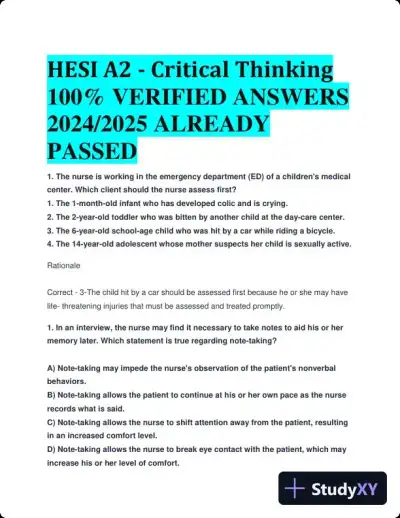 Past Exams
2024-2025 HESI A2 Critical Thinking with Answers (124 Solved Questions)
Health Education Systems, Inc.
114 pages106downloadsFeb 2025 Past Exams
2024-2025 HESI RN Exit Exam with Answers (156 Solved Questions)
Health Education Systems, Inc.
44 pages92downloadsFeb 2025 Past Exams
HESI Leadership/Management Exit Exam with Answers (59 Solved Questions)
Health Education Systems, Inc.
4 pages54downloadsFeb 2025
Study this document with CramX
Once it is in your library, every tool can work from it.