

HESI Science A2 Exam Testbank With Answers (50 Solved Questions)
- Health Education Systems, Inc.
- 16 pages
- Shared May 2025
Practice effectively with HESI Science A2 Exam Testbank With Answers, covering past test scenarios.
Preview 5 of 16 pages
See the first 5 pages exactly as they appear in the document.
Page 1 Read page 1 as text
Section III – Science 1. Electricity is a general term encompassing a variety of phenomena resulting from the presence and flow of electric charge. Which of the following statements about electricity is/are true? a. Electrically charged matter is influenced by, and produces, electromagnetic fields. b. Electric current is a movement or flow of electrically charged particles. c. Electric potential is a fundamental interaction between the magnetic field and the presence and motion of an electric charge. d. An influence produced by an electric charge on other charges in its vicinity is an electric field. 2. Which of the following is/are not included in Ohm’s Law? a. Ohm’s Law defines the relationships between (P) power, (E) voltage, (I) current, and (R) resistance. b. One ohm is the resistance value through which one volt will maintain a current of one ampere. c. Using Ohm’s Law, voltage is determined using V = IR, with I equaling current and R equaling resistance.
Page 2 Page 3 Read page 3 as text
d. An ohm (Ω) is a unit of electrical voltage. 3. The property of a conductor that restricts its internal flow of electrons is: a. Friction b. Power c. Current d. Resistance 4. In physics, ____________ is the force that opposes the relative motion of two bodies in contact. a. Resistance b. Abrasiveness c. Friction d. Antagonism 5. What is the difference, of any, between kinetic energy and potential energy? a. Kinetic energy is the energy of a body that results from heat while potential energy is the energy possessed by an object that is chilled b. Kinetic energy is the energy of a body that results from motion while potential energy is the energy possessed by an object by virtue of its position or state, e.g., as in a compressed spring. c. There is no difference between kinetic and potential energy; all energy is the same. d. Potential energy is the energy of a body that results from motion while kinetic energy is the energy possessed by an object by virtue of its position or state, e.g., as in a compressed spring. 6. What are considered the four fundamental forces of nature? a. Gravity, electromagnetic force, weak nuclear force, and strong nuclear force b. Gravity, electromagnetic force, negative nuclear force, and positive nuclear force c. Polarity, electromagnetic force, weak nuclear force, and strong nuclear force d. Gravity, chemical magnetic force, weak nuclear force, and strong nuclear force 7. Starting with the weakest, arrange the fundamental forces of nature in order of strength. a. Gravity, Weak Nuclear Force, Electromagnetic Force, Strong Nuclear Force b. Weak Nuclear Force, Gravity, Electromagnetic Force, Strong Nuclear Force c. Strong Nuclear Force, Weak Nuclear Force, Electromagnetic Force, Gravity d. Gravity, Strong Nuclear Force, Weak Nuclear Force, Electromagnetic Force 8. What is the difference between Strong Nuclear Force and Weak Nuclear Force? a. The Strong Nuclear Force is an attractive force that binds protons and neutrons and maintains the structure of the nucleus, and the Weak Nuclear Force is responsible for the
Page 4 Read page 4 as text
radioactive beta decay and other subatomic reactions. b. The Strong Nuclear Force is responsible for the radioactive beta decay and other subatomic reactions, and the Weak Nuclear Force is an attractive force that binds protons and neutrons and maintains the structure of the nucleus. c. The Weak Nuclear Force is feeble and the Strong Nuclear Force is robust. d. The Strong Nuclear Force is a negative force that releases protons and neutrons and threatens the structure of the nucleus, and the Weak Nuclear Force is an attractive force that binds protons and neutrons and maintains the structure of the nucleus. 9. The Law of Conservation of Mass states that: a. No detectable gain but, depending on the substances used, some loss can occur in chemical reactions. b. No detectable gain or loss occurs in chemical reactions. c. No detectable loss but some gain occurs in chemical reactions. d. Depending on the substances used, substantial gain or loss can occur in chemical reactions. 10. What is the difference, if any, between convection and heat radiation? a. Thermal radiation is the transfer of heat from one place to another by the movement of fluids; convection is electromagnetic radiation emitted from all matter due to its possessing thermal energy. b. Convection is the transfer of heat from one place to another by the movement of fluids; thermal radiation is nuclear energy emitted from all matter due to its possessing thermal energy. c. Convection is the transfer of heat from one place to another by the movement of fluids; thermal radiation is electromagnetic radiation emitted from all matter due to its possessing thermal energy. d. Convection is the transfer of heat from one place to another by the movement of fluids; thermal radiation is the barely detectable light emitted from all matter due to its possessing thermal energy. 11. In ________ cells, the cell cycle is the cycle of events involving cell division, including ______, ________, and _________. a. Prokaryotic, meiosis, cytokinesis, and interphase b. Eukaryotic, meiosis, cytokinesis, and interphase c. Eukaryotic, mitosis, kinematisis, and interphase d. Eukaryotic, mitosis, cytokinesis, and interphase 12. Which, if any, of the following statements about prokaryotic cells is false? a. Prokaryotic cells include such organisms as E. coli and Streptococcus. b. Prokaryotic cells lack internal membranes and organelles. c. Prokaryotic cells break down food using cellular respiration and fermentation. d. All of these statements are true.
Page 5 Read page 5 as text
13. __________ is a nucleic acid that carries the genetic information in the cell and is capable of self-replication. a. RNA b. Triglyceride c. DNA d. DAR 14. The complementary bases found in DNA are ______ and _______ or _______ and ________. a. Adenine and thymine or cytosine and guanine b. Cytosine and thymine or adenine and guanine c. Adenine and cytosine or thymine and guanine d. None of the above 15. A/an ________ is the basic structural unit of nucleic acids (DNA or RNA); their sequence determines individual hereditary characteristics. a. Gene b. Nucleotide c. Phosphate d. Nitrogen base 16. _________________ is a ______________ that plays an important role in the creation of new _________. a. Deoxyribonucleic acid (DNA) is a chain of nucleotides that plays an important role in the creation of new proteins. b. Ribonucleic acid (RNA) is a chain of nucleotides that plays an important role in the creation of new proteins. c. Ribonucleic acid (RNA) is a cluster of enzymes that plays an important role in the creation of new proteins. d. Ribonucleic acid (RNA) is a chain of nucleotides that plays an important role in the creation of new genes. 17. Which, if any, of the following statements are false? a. A mutation is a permanent change in the DNA sequence of a gene. b. Mutations in a gene’s DNA sequence can alter the amino acid sequence of the protein encoded by the gene. c. Mutations in DNA sequences usually occur spontaneously. d. Mutations in DNA sequences are caused by exposure to environmental agents such as sunshine. 18. _______ reactions occur in every cell and use _______ to convert glucose to energy; _______organisms such as many bacteria can release energy without the use of ________.
11 more pages in the full document
Unlock it once and it stays in your library, ready to chat with or turn into flashcards.
Unlock the full documentMore Health Education Systems, Inc. study materials
See all Past Exams
2023-2024 RN HESI Exit Exam Version 3 with Answers (53 Solved Questions)
Health Education Systems, Inc.
13 pages163downloadsFeb 2025 Past Exams
2024-2025 HESI A2 Biology Entrance Exam with Answers (42 Solved Questions)
Health Education Systems, Inc.
13 pages154downloadsFeb 2025 Past Exams
2024-2025 HESI A2 Anatomy and Physiology V1/V2 Practice Exam with Answers (134 Solved Questions)
Health Education Systems, Inc.
15 pages134downloadsFeb 2025 Past Exams
2024-2025 HESI A2 Entrance Exam with Answers (232 Solved Questions)
Health Education Systems, Inc.
26 pages132downloadsFeb 2025 Past Exams
2024-2025 HESI Milestone Exam 1 with Answers (162 Solved Questions)
Health Education Systems, Inc.
26 pages119downloadsFeb 2025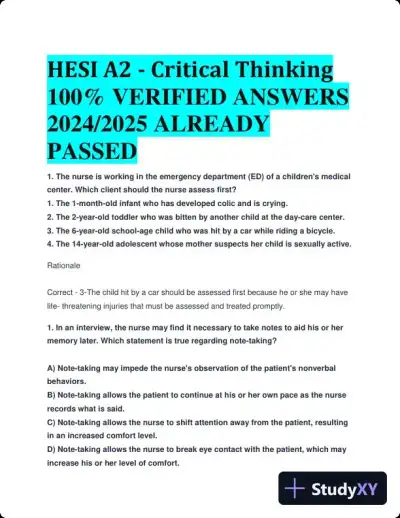 Past Exams
2024-2025 HESI A2 Critical Thinking with Answers (124 Solved Questions)
Health Education Systems, Inc.
114 pages106downloadsFeb 2025 Past Exams
2024-2025 HESI RN Exit Exam with Answers (156 Solved Questions)
Health Education Systems, Inc.
44 pages92downloadsFeb 2025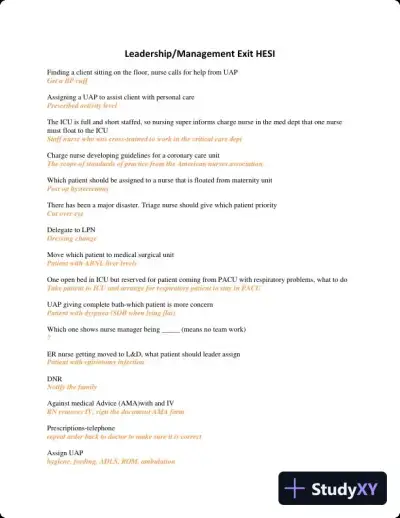 Past Exams
HESI Leadership/Management Exit Exam with Answers (59 Solved Questions)
Health Education Systems, Inc.
4 pages54downloadsFeb 2025
Study this document with CramX
Once it is in your library, every tool can work from it.