

HCA375� Continuous Quality Monitoring and Accreditation
- Healthcare
- Ashford University
- 11 pages
- Shared May 2025
Healthcare quality management systems and accreditation processes
Preview 4 of 11 pages
See the first 4 pages exactly as they appear in the document.
Page 1 Read page 1 as text
Running Head: REPORTING 1 Adverse Event Reporting HCA375 – Continuous Quality Monitoring and Accreditation Adverse Event Reporting Read Chapters 5, 6, and 7 in our textbook. After reviewing this week’s required reading, consider the following scenario: You are the lead of the risk management team that has been assigned to evaluate an incident that has occurred. You will be preparing a report for the CEO of the hospital that includes all system failures that contributed to the adverse event as well as utilizing a CQI tool. You will be using the Adverse Event template to complete the three parts to the assignment. Note: If you have responded substantively to each of the content items within the three parts of the assignment, the paper should be between six and seven pages. Part One: Description of Adverse Event (Complete Part One of the Adverse Event template ) Choose an adverse event from the following list: o Medication error o Patient falls o Post - operative hemorrhage Data - Patient Safety Event For XYZ Hospital for 20XX through 20YY # of Discharges # of Surgical Cases # of Medication Errors 20XX 20YY 20XX 20YY 20XX 20YY Jan 1200 1400 200 240 300 350 Feb 1278 1450 213 250 289 370 Mar 1389 1540 250 300 300 385 Apr 1199 1800 200 245 289 412 May 900 1768 159 289 215 404 Jun 1000 1690 173 285 215 398 Jul 1200 1100 215 200 278 246 Aug 1239 978 240 158 301 241 Sep 1000 1089 198 200 275 215 Oct 789 978 150 248 241 251 Nov 980 1000 175 209 230 231 Dec 700 980 145 215 200 235 Note: The number of beds and operating rooms increased effective 1/1/20YY. Describe the adverse event, including who was involved in the event.
Page 2 Page 3 Read page 3 as text
REPORTING 2 For your selected adverse event, graph the data for the two years. Analyze the data by determining if the frequency is increasing or decreasing. What factors could be attributed to the change? Discuss the communication techniques/methods utilized to inform the staff of the adverse event. Describe at least two operational or safety processes that might not have been followed that contributed or caused this event to take place. For instance, describe any regulations or procedures that the professional organization and/or accrediting agency measures compliance with the standard. Graph two years of data for your selected adverse event and analyze the data by determining if the frequency is increasing or decreasing. What factors could attribute to the change in data over two years? Summarize the historical and contemporary issues and legal implications related to patient safety in your chosen adverse event. Describe how processes of continuous quality monitoring could impact the adverse event you chose. Part Two: CQI Tool (Complete Part Two of the Adverse Event template ) Choose a CQI Tool that best suits your chosen Adverse Event from the following list: Flowchart Fishbone Diagram (Cause & Effect) Pareto Use the CQI Tool to illustrate the use of the tool with your chosen adverse event. You will be responsible for creating the CQI Tool, completing the tool, taking a screenshot, and copying/pasting the screenshot under the instructions in Part Two CQI Tool in the Adverse Event template . Part Three: Future Prevention (Complete Part Three of the Adverse Event template ) After describing the event in Part One and using a CQI tool in Part Two, apply the PDCA model to summarize the process and steps that your team would recommend to the CEO to prevent this adverse event from reoccurring. Make sure to include who (health care personnel) would be accountable at each step of the process. Complete the Explanation column in Part 3 of the Adverse Event template. It is important to keep in mind that some processes require a checks and balance system. You will need to determine if one of the steps you are recommending would require a checks and balance step and why it is necessary.
Page 4 Read page 4 as text
REPORTING 3 HCA375 - WEEK 4 ASSIGNMENT PART 1 – DESCRIPTION OF ADVERSE EVENT CONTENT DESCRIPTION ADVERSE EVENT CHOSEN The adverse event chose n for this assignment is medication error. “ Medication errors happen all the time, an estimated one million each year, contributing to 7,000 deaths. On average there is one medication erro r every day for every inpatient (Binder, 2013, p. 1).” This issue is a large contributing factor to low patient satisfaction as well as low - grade quality of care. If there is one area that there is absolutely zero room for mistake s , it would be in the medication management position of the hospital . I t is impossible to prevent medication errors from ever occurring, however, actions can be taken to see that the frequency remains low. Proper communication, use of updated technological systems, a nd staff coordination as well as up - to - date training are all tools that can be used in order to prevent medication errors from occurring within the facility. DESCRIBE THE EVENT With great regret, on the 25 th day of December 2014, a medication error was made by a nurse in the pediatric section of our intensive care unit resulting in the death of a 3 month old patient. The patient presented in our ICU wing for services related to what should have been a routine surgical procedure. The patient was given 60 times the normal dose of sodium through IV . This medication error was discovered after a great length of time and also was no t addressed in a timely fashion; resulting in the death of our patient brought on thr ough cardiac arrest. The patient suffered an overdose of sodium and due to the error in labeling of the medication as well as the poor monitoring of our floor nurses, the preventable death of this patient occurred.
7 more pages in the full document
Unlock it once and it stays in your library, ready to chat with or turn into flashcards.
Unlock the full documentMore Healthcare study materials
See all Solved Assignments
HCA 375 Satisfaction and Quality Care
Healthcare
6 pagesMay 2025 Solved Assignments
Program Design Plan: Enhancing Microsoft Word Skills for Legal Administrative Assistants
Healthcare
4 pagesMay 2025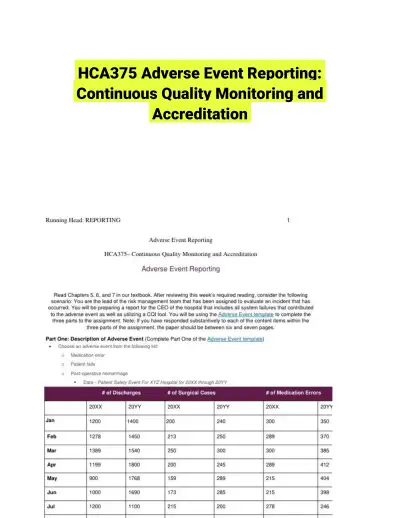 Solved Assignments
HCA375 Adverse Event Reporting: Continuous Quality Monitoring and Accreditation
Healthcare
11 pagesMay 2025 Exam Guides
Test Bank for Access To Health, 15th Edition
Healthcare
594 pages146downloadsFeb 2025 Exam Guides
Health Promotion Throughout the Life Span 9th Edition Test Bank
Healthcare
184 pages142downloadsFeb 2025 Exam Guides
Test Bank for Principles and Foundations of Health Promotion and Education, 7th Edition
Healthcare
107 pages135downloadsFeb 2025 Class Notes
Class Notes for Introduction to Hospitality, 7th Edition
Healthcare
243 pages120downloadsFeb 2025 Class Notes
Technology Strategies for the Hospitality Industry, 3rd Edition Class Notes
Healthcare
75 pages86downloadsFeb 2025
Study this document with CramX
Once it is in your library, every tool can work from it.