

Management of Occupational Health and Safety 7th Edition Test Bank
- Healthcare
- 133 pages
- Shared May 2025
Management of Occupational Health and Safety 7th Edition Test Bank covers everything from fundamental concepts to advanced problem-solving strategies to help you excel in your exam.
Preview 16 of 133 pages
See the first 16 pages exactly as they appear in the document.
Page 1 Read page 1 as text
Indicate whether the statement is true or false. 1. The internal responsibility system states that when a worker accepts employment, he or she also accepts all the normal risks associated with that occupation. a. True b. False 2. “Emphasis” is one of the three Es of the traditional views of safety. a. True b. False 3. Unions are important stakeholders in OH&S. a. True b. False 4. Occupational injury is any abnormal condition or disorder caused by exposure to environmental factors associated with employment. a. True b. False 5. In today’s health and safety climate, workplace safety inspectors routinely attribute workplace safety incidents to the accident proneness of the employees involved. a. True b. False 6. A lost - time injury is a workplace injury that results in an employee missing time from work. a. True b. False 7. Due diligence ensures that organizations can avoid all foreseeable accidents. a. True b. False 8. As an emergency room nurse, Ellie is often exposed to biological hazards such as blood, bacteria, and viruses. a. True b. False 9. Full - and part - time employees of an organization are required by law to report defective equipment and other workplace hazards. a. True b. False 10. Under OH&S laws, employers are responsible for conducting research on occupational health and safety. a. True b. False Indicate the answer choice that best completes the statement or answers the question.
Page 2 Page 3 Read page 3 as text
11. According to the text, what was the primary reason why supervisors on construction sites underestimated health and safety risks? a. They could not recognize unsafe conditions. b. They believed that risks were unavoidable. c. They had not experienced any recent incidents. d. They were obsessed with meeting deadlines. 12. Which of the following is a workplace injury that results in an employee missing time from work? a. occupational injury b. occupational illness c. a lost - time injury d. a covered workers’ compensation injury 13. According to the World Health Organization, which of the following describes a healthy workplace? a. work environment, employer, employee, workload b. health and safety, psychosocial environment, personal human resources, enterprise community involvement c. psychosocial environment, physical environment, psychological health, community d. occupational health and safety, physical environment, psychosocial environment, enterprise community involvement 14. Duane works for a heavy equipment operator. Recently, the brakes failed on an excavator Duane was assigned to operate. Duane and a construction worker were injured when the excavator drove into a building on the site. This incident was heavily covered in the news and the company now faces fines and a downturn in business due to the smear on its reputation. These expenses are best described as examples of which of the following? a. direct costs b. indirect costs c. insurable expenses d. economic imperative for safety 15. During the summer, Noriko works at a theme park. What is the main reason why seasonal workers like her are exposed to a higher risk of injury by the employer than full - time workers? a. They are less aware of job hazards. b. They have a more casual attitude toward safety. c. They receive less safety training. d. They are afraid to speak up. 16. Which of the following is an economic benefit of effective OH&S programs? a. a reduction in lost - time costs b. greater due diligence by employers c. workers looking out for the safety of their coworkers d. improved health and safety provisions during collective bargaining 17. Media stories about unsafe working conditions at overseas suppliers, such as the 2013 garment factory disaster in Bangladesh, lead to what indirect cost for Canadian companies? a. fines and penalties b. increased strikes c. negative publicity d. increased unionization
Page 4 Read page 4 as text
18. Which of the following is a primary barrier to OH&S programming in workplaces? a. people do not support the concept of safe working conditions b. not everyone is committed to implementing OH&S programs c. there are not enough safety inspectors d. some hazards are impossible to change 19. Which mechanism has been found to be the most influential in terms of health and safety in the workplace? a. inspection by the Ministry of Labour b. the internal responsibility system c. fines and penalties d. industry self - regulation 20. Which of the following is an example of an employer’s responsibility under OH&S legislation? a. providing financial support for injured workers b. cleaning up the workplace before an inspection c. conducting research on health and safety issues d. preparing a written occupational health and safety policy 21. Enrique is an OH&S professional at a large manufacturing company. The safety programs he implements always emphasize that the managers and workers share responsibility for healthy and safety at work. Which of the following can be said of Enrique’s programs? a. they use the internal responsibility system b. they meet the federal OH&S laws c. they help the organization demonstrate due diligence d. they reduce workplace illnesses 22. Jean owns a company that cleans up houses after fires and floods. The Ministry of Health is investigating a complaint from one of her employees who claims he has developed a chronic respiratory condition from his work. Jean has obtained a lawyer. Her lawyer reviewed Jean’s policies and practices to help demonstrate that Jean took every reasonable precaution to protect the health and safety of her workers. What is the lawyer most likely trying to demonstrate? a. that the employee knew the assumption of risk b. Jean’s moral consideration for health and safety c. Jean’s due diligence d. Jean’s compliance with Canadian standards 23. What is the main reason why the costs of workplace injuries may be higher than $12 billion per year? a. deaths may have been attributed to other causes b. injured workers buy some of their own medical supplies c. a large number of injuries go unreported d. rehabilitation takes a long time 24. According to the textbook, approximately how many workers in Canada die each day as a result of a workplace incident? a. 5 people per day b. 3 people per day c. 10 people per day d. 13 people per day
Page 5 Read page 5 as text
25. Diego is interested in a career in OH&S. His interests are focused on helping organizations develop motivational health and safety programs. Which of the following careers would be the best fit for him? a. registered occupational hygienist b. occupational health nurse c. registered occupational hygienist technologist d. a Canadian Registered Safety Professional designation following training in psychology 26. Which of the following is NOT considered one of the principal rights of workers outlined by the Royal Commission on the Health and Safety of Workers in Mines? a. right to know b. right to participate c. right to refuse d. right to advocate 27. What other group of workers might be as susceptible to “brown lung” as textile workers? a. carpenters/cabinet makers b. farmers c. hairdressers d. police officers 28. Which of the following does NOT explain why young workers are at particular risk for injury in the workplace? a. young workers may not be aware of their workplace rights b. young workers have less experience in recognizing hazards c. young workers are more accident prone d. young workers may not be given as much safety training as other workers 29. Raina is a retail manager. She sprained her wrist when she slipped off a stepladder when moving stock from a high shelf. Which of the following has Raina experienced? a. a lost - time injury b. a workplace hazard c. a safety violation d. an occupational injury 30. Priya is a high school geography teacher. This year there is a new geography curriculum and increased student feedback requirement for teachers. Priya is putting in very long hours to revise her teaching materials and complete report cards for her students. How is this heavy workload best described? a. an unhealthy workplace b. a psychological hazard c. an employee responsibility d. a physical hazard 31. Lars is a volunteer firefighter and has just watched the safety training video about the new respirators. He finds that the one he has been given by his supervisor does not fit properly over his orthodontic braces. What should Lars do? a. try to modify the new respirator to fit better b. report the problem to his supervisor c. swap equipment with another firefighter to get a better fit d. continue to wear the old equipment
Page 6 Read page 6 as text
32. Being an active member of a Joint Health and Safety Committee at work allows workers to satisfy which one of the principal OH&S employee rights? a. the right to refuse dangerous work without penalty b. the right to participate in identifying and correcting health and safety problems c. the right to know about hazards in the workplace d. the right to refuse wearing safety equipment that is uncomfortable 33. A delivery van driver for Chung’s courier company had a collision while on delivery. There was $6500 of damage to the van and a substitute driver needed to be paid while the regular driver was recovering from his injuries. These expenses are best described as examples of which of the following? a. direct costs b. indirect costs c. insurable expenses d. economic imperative for safety 34. Which of the following was articulated by the 1974 Royal Commission on the Health and Safety of Workers in Mines? a. requirement for mandatory inspections b. standards for ventilation c. system of compensation for injured workers d. rights of workers 35. In OH&S terminology, post - traumatic stress disorder (PTSD) experienced by members of Canada’s military as a result of events during their tour of duty would be classified as which of the following? a. a hazard b. an injury c. an agent d. an illness 36. You are the new safety director for a large supermarket chain that has hot food in the deli, in - house bakeries, and in - house meat cutting to give customers exactly what they want. The previous safety director emphasized the three Es of safety. Prepare a presentation for supermarket managers (new and experienced) to explain to them what the three Es are, how they can help to promote safety in workplaces, but importantly why they do not provide a total solution to workplace safety and why you, as the new safety director, are working closely with Human Resources in your new safety programming. 37. Three principal rights provide the basis for much of the health and safety legislature in Canada. Name each and describe a situation in which a worker might exercise this specific right. 38. What is a workplace hazard? Please define the term and give an example of a hazard that would be common in each of the following jobs: hairdresser, office worker, retail cashier. 39. Differentiate between direct and indirect costs of worker injuries and explain how indirect costs can affect the organization’s profitability. Give an example to support your answer. 40. Differentiate between the legal and the moral obligation of employers when it comes to health and safety. 41. Research has found that there is a negative relationship between job insecurity and safety, and between performance - based pay and safety. Explain why job insecurity and performance - based pay programs can override safety training.
Page 7 Read page 7 as text
42. List four major stakeholders in OH&S. Describe two different health and safety partnership initiatives that involve pairs or groups of stakeholders.
Page 8 Read page 8 as text
Answer Key 1. False 2. False 3. True 4. False 5. False 6. True 7. False 8. True 9. True 10. False 11. a 12. c 13. b 14. b 15. c 16. a 17. c 18. b 19. b 20. d 21. a 22. c 23. c 24. b 25. d 26. d 27. a
Page 9 Read page 9 as text
28. c 29. d 30. b 31. b 32. b 33. a 34. d 35. d 36. The three Es are: Engineering solutions — safer work environments, safer equipment, and personal protective equipment Education — of supervisors and employees Enforcement of regulations and practices — through supervision and consequences Focusing on the people side is necessary because effective safety programs depend on individual skills, abilities, and motivation to work safely — which are not adequately covered by the three Es. Enforcement only creates compliance — not a willingness to be proactive in creating a safe workplace. Variables such as safety leadership and safety climate are predictors of safety outcomes (e.g., incidents, accidents, and injuries). Other important people influences are: job design, high performance work systems, job insecurity, work scheduling, work overload, lean manufacturing, and pay for performance systems. Any of these can support safety or work against it. Human resources skills are important in safety promotion for several reasons. Safety is integrated with other HR functions, such as training and worker orientation. Safety compliance is related to legislative compliance, an area of strength of HR departments. Safety programs also decrease costs in areas such as sick time and workers’ compensation, again areas of knowledge for HR practitioners. 37. a) The right to refuse dangerous work without penalty. b) The right to participate in identifying and correcting health and safety problems. c) The right to know about hazards in the workplace. Right to refuse — situations could include being asked to climb on unsafe ladders/scaffolding, use unsafe equipment/vehicles, work where protective equipment has not been provided, or where chemical/biological agents are not properly stored. Right to participate — situations could include serving on a Joint Health and Safety Committee, participating in the investigation of a workplace incident, or participating in job analysis. Right to know — situations could include orientation and training, WHMIS training. 38. A hazard is any source of potential adverse health effect, damage, or harm to something or someone under certain conditions at work. Examples of hazards (not an inclusive list) Hairdresser: Repetitive hand and arm motion, chemicals in hair products Office worker: Repetitive motion (e.g., keyboarding), glare from computer screen, poor work station design, possible heavy workload Retail cashier: germs on money, cards, etc., possible exposure to biological hazards in handling meat products, repetitive motion, chemicals (BPA) in some cash register receipts.
Page 10 Read page 10 as text
39. Direct costs • Worker’s lost time • Investigation time • Finding/training replacement worker • Increased WCB premiums Indirect costs • Potential increase in WCB assessment • Potential fines and legal costs • Family impact/stress • Pain and suffering for long - term effects of injury • Work stoppages/strikes/employee stress • Negative publicity 40. Employers are obligated to follow existing legislation, but are not required to go beyond it. In contrast, employers have a moral obligation to employees, their families, and the community to provide a safe work environment, which may mean going past the legislation in order to maintain the health and safety of the worker and the financial and psychological well - being of his/her family. 41. Job insecurity means fear of losing one’s job (e.g., layoffs, downsizing) — commitment to safety may decrease because workers believe the organization no longer cares about them, or because they are just focused on getting their work done in order to improve their chances of keeping their job. Performance - based pay means reaching targets/goals to get rewards — such programs can switch the focus away from safety — workers will do whatever it takes to earn the reward. 42. • Health and safety professionals • Professional associations • Educators • Community associations • Organized labour • Employers • Employees • Government Examples of partnerships : not an exclusive list ∙ Health and safety professionals can help managers and HR staff to develop, manage, and evaluate their OH&S program. ∙ Government can be responsive to community associations and professional associations when developing legislation around OH&S. ∙ Government agencies can fund research by professionals and professional associations about OH&S. ∙ Organized labour and employers work together to ensure workplaces have appropriate health and safety management. ∙ Employees can work with their unions to communicate health and safety concerns to management. ∙ Professional associations (e.g., Industrial Accident Prevention Association) and educators can work together to develop safety programs for teenage workers (e.g., Young Worker Awareness Program). ∙ Employers and organized labour can work together to analyze incidents and reduce injuries and illnesses.
Page 11 Read page 11 as text
Indicate whether the statement is true or false. 1. Charges of criminal negligence can be laid under the federal OH&S Act in Canada. a. True b. False 2. Complying with standards, such as CSA Z1000 - 14, may help organizations demonstrate due diligence. a. True b. False 3. Veronica is a fire fighter. Under OH&S Acts across Canada she can never refuse unsafe work due to the nature of her job. a. True b. False 4. Standards and codes provide practical guidance on the implementation of occupational health and safety practices. a. True b. False 5. The Joint Health and Safety Committee helps to enact the internal responsibility system. a. True b. False 6. The Ministry of Labour and the Ministry of the Environment may be called in to investigate the same incident involving release of a controlled substance. a. True b. False 7. Government jurisdictions within Canada are expected to update regulations and acts to comply with WHMIS 2015 up until 2018. a. True b. False 8. The majority of Canadian workers are regulated by the federal Occupational Health and Safety Act. a. True b. False 9. In some Canadian jurisdictions a certified worker member of the JHSC can stop work under the OH&S Act. a. True b. False 10. Regulations are more specific than guidelines when describing rules. a. True b. False Indicate the answer choice that best completes the statement or answers the question.
Page 12 Read page 12 as text
11. Edwin is the owner of a chain of autobody shops in New Brunswick. He has been charged with criminal negligence causing death following a fatal incident at one of his shops. These charges have been laid under which of the following pieces of legislation? a. the Criminal Code of Canada b. the federal OH&S Act c. the New Brunswick OH&S Act d. the New Brunswick Crimes Act 12. Tim works at a machine shop. He notices that one of the guards on a grinder is very loose and not working properly. What duty does he have under OH&S legislation? a. tell his supervisor about the defective equipment b. start a stop work order c. fix the guard himself d. none, unless there is an incident 13. Which of the following is a duty described under OH&S legislation to be undertaken because of a health and safety regulation? a. mandated duty b. general duty c. prescribed duty d. safety duty 14. Ella and Anwar are certified members of the JHSC at an Ontario - based cleaning products manufacturer. Ella represents the management side and Anwar the employee side. When they noticed that there was a problem with the ventilation at their main plant they agreed to halt operations. Which of the following have Ella and Anwar enacted? a. a bilateral work stoppage b. a unilateral work stoppage c. the right to refuse unsafe work d. a safety inspection 15. D’Mari is a construction site supervisor on major commercial buildings. Part of his job is to follow provincial fire safety regulations. This is best described as which type of duty? a. mandated b. general c. safety d. prescribed 16. Which of the following is NOT an employer general duty? a. appoint a competent supervisor b. prepare policies regarding workplace violence and workplace harassment c. appoint a Board of Directors d. inform supervisors and workers of possible hazards 17. What is the PRIMARY function of the joint health and safety committee? a. to communicate with the Ministry of Labour b. to provide a nonadversarial opportunity for labour and management to work together to create a safer workplace c. to conduct OH&S meetings d. to ensure that safety messages are communicated
Page 13 Read page 13 as text
18. In OH&S terminology, which of the following is a person or company that oversees the construction of a project and is ultimately responsible for the health and safety of all workers? a. foreman b. constructor c. inspector d. supervisor 19. All Canadian OH&S legislation includes which of the following elements? a. Act, powers of enforcement, right to refuse, protection from reprisals, duties/responsibilities b. Act, regulations, guidelines, standards/codes c. Act, stakeholder enforcement, duties/responsibilities d. Act, right for referral, protection from reprisals, standards/codes 20. What is the most commonly found provincial requirement regarding which workplaces require a Joint Health and Safety Committee? a. workplaces with 10 or more employees b. workplaces with 15 or more employees c. workplaces with 20 or more employees d. workplaces with 25 or more employees 21. In R. v. Midland Transport Ltd . (1991), the New Brunswick Provincial Court held that the Transportation of Dangerous Goods Act is primarily for the protection of whom? a. workers b. shippers c. the general public d. carriers 22. What is the term for the specific rules that are not legally enforceable unless referred to in a regulation or an act? a. codes b. standards c. enforcements d. guidelines and policies 23. In which circumstances does a ministry inspector/officer get involved in a work refusal situation? a. when a worker identifies an unsafe work situation b. when a worker refuses to return to work after a full internal investigation has deemed there is no danger c. when a worker is told by the certified worker that he or she is endangered d. when a number of workers refuse to work 24. Which of the following is a primary duty that is directly articulated in an OH&S Act? a. mandated duty b. general duty c. prescribed duty d. safety duty
Page 14 Read page 14 as text
25. Lenny has just been promoted into a supervisory role at his work. Which of the following will be a new OH&S responsibility for him? a. advising workers about safety hazards b. proper use of safety equipment c. cooperating with health and safety policy d. taking all reasonable precautions to ensure his own safety and the safety of those affected by his work activities 26. Sharon Nelson is the bakery manager and is a certified member of the JHSC at the grocery store where she works. According to legislation, which of the following employees must also be certified as a member of the JHSC? a. Phillipe Gagnon, the store manager b. Michelle Strickland, a full - time cashier c. Asmin Zahid, the accounting manager d. Brock Sutherland, the produce manager 27. A cleaning firm worker carelessly mixes bleach and a cleaning product while cleaning office tower washrooms. The mix results in toxic fumes that cause throat irritation to other cleaners. Which authority has jurisdiction over this incident? a. Workplace Safety Board b. Ministry of Environment c. Ministry of Labour d. Workers’ Compensation Board 28. An employee expressed her concerns to her supervisor that the scaffolding she was working on for a painting job had several loose bolts. She was concerned for her safety and requested the supervisor’s permission to stop working immediately. However, the supervisor insisted that she continue working. What employee right did the supervisor’s behaviour violate? a. the employee’s right to refuse unsafe work b. the employee’s right to report unsafe conditions c. the employee’s right to participate in health and safety programs d. the employee’s right to a safe workplace 29. Which of the following provides guidelines for the presentation of information on chemical hazards in the workplace? a. the Chemical Recognition and Information System b. the Workplace Hazardous Materials Information System c. the Workers’ Compensation Act d. the Dangerous Goods Act 30. What workers’ rights are included in federal and provincial legislation? a. the right to know, the right to rehabilitation, and the right to refuse unsafe work b. the right to participate, the right to rehabilitation, and the right to refuse unsafe work c. the right to know, the right to participate, and the right to refuse unsafe work d. the right to know, the right to be compensated for injury, and the right to refuse unsafe work 31. Which of the following systems for the classification and labelling of chemicals is being adopted by countries around the world? a. OHSA b. ISO c. CSA d. GHS
Page 15 Read page 15 as text
32. What are the two essential limitations on the right to refuse unsafe work outlined in OH&S Acts across Canada? a. There are no limits on the right to refuse unsafe work in Canadian jurisdictions. b. The worker has previously performed the task, or the refusal would place another person’s safety in jeopardy. c. The employee works in a declared profession such as policing, or the refusal would place another person’s safety in jeopardy. d. The task in question is a normal condition of employment, or the refusal would place another person’s safety in jeopardy. 33. The passing of Bill C - 45 (Westray) legislation brought about changes to the Criminal Code introduced the notion of which of the following for the first time? a. corporate negligence b. corporate homicide c. corporate incompetence d. corporate manslaughter 34. Which of the following is a criticism that has been directed toward the Bill C - 45 (Westray) legislation regarding corporate liability of OH&S? a. its use is highly varied across the country b. it is being used in place of OH&S legislation c. the law lacks “teeth” in practice d. there are too many charges being laid under the legislation 35. WHMIS legislation applies to which type of workplace hazards? a. biological hazards b. chemical hazards c. psychological hazards d. physical hazards 36. Explain how HR professionals working in the organization’s human resources department can assist their employer and the organization’s supervisors and employees in complying with legislation dealing with controlled substances and the transportation of dangerous goods. 37. Describe CSA standard Z1000 - 14, then explain how it differs from a regulation and what is unique about it compared to other CSA standards. 38. Compare and contrast the duties of employers/contractors with the duties of supervisors when it comes to occupational health and safety in their workplace. 39. What is an OH&S Act? How does an Act differ from a) OH&S regulations and b) OH&S guidelines/policies? 40. In Canada, there are some limitations on the right to refuse unsafe work. What are the two essential limiting conditions on the right to refuse? Provide an example of each.
Page 16 Read page 16 as text
41. MERS - coV is a new coronavirus that emerged in late 2012/early 2013; it has severe respiratory symptoms and can cause death in humans, similar to but not the same as the SARS virus. The virus seems to be concentrated in the Middle East, hence the acronym. You are the HR Director of a large international airline with flights to many destinations. A few of your flight attendants have refused to work on flights involving Middle East destinations, citing unsafe work conditions due to the closed circulatory air system of an airplane, which they believe increases the chance of getting the virus and becoming ill. They have asked to be given alternate assignments. What would you do?
117 more pages in the full document
Unlock it once and it stays in your library, ready to chat with or turn into flashcards.
Unlock the full documentMore Healthcare study materials
See all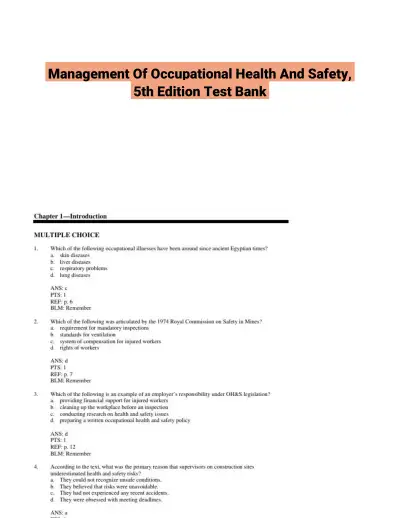 Exam Guides
Management Of Occupational Health And Safety, 5th Edition Test Bank
Healthcare
158 pagesMay 2025 Exam Guides
Test Bank for Access To Health, 15th Edition
Healthcare
594 pages146downloadsFeb 2025 Exam Guides
Health Promotion Throughout the Life Span 9th Edition Test Bank
Healthcare
184 pages142downloadsFeb 2025 Exam Guides
Test Bank for Principles and Foundations of Health Promotion and Education, 7th Edition
Healthcare
107 pages135downloadsFeb 2025 Class Notes
Class Notes for Introduction to Hospitality, 7th Edition
Healthcare
243 pages120downloadsFeb 2025 Class Notes
Technology Strategies for the Hospitality Industry, 3rd Edition Class Notes
Healthcare
75 pages86downloadsFeb 2025 Textbook Guides
Professional Server, The: A Training Manual, 3rd Edition Solution Manual
Healthcare
113 pages70downloadsFeb 2025 Past Exams
William Fredericks Health Assessment Practice Exam (1 Solved Case)
Healthcare
21 pages68downloadsFeb 2025
Study this document with CramX
Once it is in your library, every tool can work from it.