

Planning, Implementing, and Evaluating Health Promotion Programs: A Primer 7th Edition Test Bank
- Healthcare
- 69 pages
- Shared May 2025
Planning, Implementing, and Evaluating Health Promotion Programs: A Primer 7th Edition Test Bank helps you understand exam patterns, improve retention, and develop problem-solving skills.
Preview 16 of 69 pages
See the first 16 pages exactly as they appear in the document.
Page 1 Read page 1 as text
Planning, Implementing, & Evaluating Health Promotion Programs , 7e (McKenzie) Chapter 1 Health Education, Health Promotion, Health Education Specialists, and Program Planning 1) Health promotion was recognized for its potential to help control injury and disease and to promote health during the A) first quarter of the 20 th century. B) last quarter of the 20 th century. C) early 1800s. D) beginning of the 21 st century. Answer: B 2) The publication considered to have been the document that gave great momentum to the health promotion and disease prevention movement in America was called A) Healthy People 2000. B) Healthy People 2010. C) Healthy People: The Surgeon General's Report on Health Promotion and Disease Prevention (Healthy People, 1979). D) Healthy Nation 1970. Answer: C 3) Which major area is NOT one of the responsibilities outlined in the Hierarchical Model of Responsibilities and Competencies for Health Education Specialist? A) Assess Needs, Assets and Capability for Health Education B) Plan Health Education C) Conduct Evaluation and Research Related to Health Education D) Promote Healthy Behaviors Through Lifestyle Changes Answer: D 4) Those health education specialists who had an active CHES certification since 2005 and showed that they were practicing health education at an advanced level were granted the Master Certified Health Education Specialist (MCHES), this process was known as A) the Grandfather Law. B) testing out. C) the Experience Documentation Opportunity. D) the only way one can get the Master Certified Health Education Specialist Exam. Answer: C 5) Both the CHES and MCHES examinations are given twice a year and consist of A) 150 scored questions and 15 pilot questions on a weighted amount of the seven responsibilities. B) 100 scored questions on a randomly selected responsibility. C) 100 essay questions on the seven responsibilities. D) 150 scored questions and 50 pilot questions on a randomly selected responsibility. Answer: A
Page 2 Page 3 Read page 3 as text
6) Which modifiable risk factor is the leading cause of death in 2000? A) Lack of physical activity B) Poor nutrition C) Tobacco use D) Alcohol consumption Answer: C 7) Which is the most recent version of the Competency Based Framework for Health Education Specialists? A) National Health Educator Job Analysis (HEJA - 2010) B) National Health Educator Joint Association C) Health Education Specialist Practice Analysis (HESPA - 2015) D) National Council for the Accreditation of Teacher Education (NCATE) Answer: C 8) Self - breast examinations would be considered which level of prevention? A) Primary B) Secondary C) Tertiary D) Treatment Answer: B 9) Chemotherapy for cancer treatment is considered which level of prevention? A) Primary B) Secondary C) Tertiary D) Priority Answer: C 10) When a person is healthy, without signs and symptoms of disease, illness, or injury, the level of prevention most appropriate would be A) primary prevention. B) secondary prevention. C) tertiary prevention. D) low - priority prevention. Answer: A 11) The three main uses of the Framework includes all of the following EXCEPT A) provides a guide for colleges and universities to use when designing and revising their curricula. B) to provide a unified health education program for all health settings. C) to develop the core criteria for certifying individuals as health education specialists national certification exams. D) used by program accrediting and approval bodies to review college and university academic programs. Answer: B 12) Pre - planning is intended to answer questions related to all of the following EXCEPT A) the purpose of the program.
Page 4 Read page 4 as text
B) identifying and engaging partners. C) the success rate of the evaluation methods. D) the leadership structure. Answer: C 13) Assumptions of health promotion include all of the following EXCEPT A) appropriate prevention strategies can be developed to deal with the identified health problems. B) behavior can be changed and those changes can influence health. C) initiating and maintaining a behavior change is difficult. D) individual responsibility can best be viewed through victim blaming. Answer: D 14) What are the sequential steps in the Generalized Model of program planning? A) Assess, Goal Setting, Develop Intervention, Implementation, Evaluation B) Goal Setting, Assess, Develop Intervention, Implementation, Evaluation C) Evaluation, Assess, Goal Setting, Develop Intervention, Implementation D) Develop Intervention, Goal Setting, Assess, Implementation, Evaluation Answer: A 15) According to your text, many health education specialists' responsibilities are involved in some way with A) program planning, implementation, and evaluation. B) program evaluation to create new models. C) program measurement. D) program failure rates. Answer: A 16) It has been recommended that the profession de - emphasize the term health educator and use the term health education specialist in its place. Answer: TRUE 17) In its simplest terms, health promotion is the process of educating people about health. Answer: FALSE 18) In order to qualify for the Advanced Level of Practice 2, a Health Education Specialist must have a doctorate and at least 10 years of experience. Answer: FALSE 19) Decision makers are those who have the authority to approve a plan such as a governing board. Answer: TRUE 20) Stakeholders are those individuals who have a monetary interest in the program only. Answer: FALSE 21) The priority population refers to those whom the program is intended to serve. Answer: TRUE
Page 5 Read page 5 as text
22) One of the basic assumptions of health promotion is that health status can be changed. Answer: TRUE 23) Properly trained health education specialists are aware of the limitations of the discipline and understand the assumptions on which health promotion is based. Answer: TRUE 24) Cardiac rehabilitation is an example of secondary prevention. Answer: FALSE 25) The results of the National Health Educator Competencies Update Project (CUP) in 1998 found that the seven areas of responsibility for health education specialists were no longer valid. Answer: FALSE 26) List the seven Areas of Responsibility identified through the Role Delineation Project. Answer: I. Assess Needs, Assets and Capability for Health Education; II. Plan Health Education; III. Implement Health Education; IV. Conduct Evaluation and Research Related to Health Education; V. Administer and Manage Health Education; VI. Serve as a Health Education Resource Person; and VII. Communicate and Advocate for Health and Health Education. 27) Describe how the new CUP model structure differs from the previous model for Areas of Responsibility, Competencies, and Sub - competencies for Health Educators. Answer: The original model had an entry level, followed by three additional areas of responsibility for advanced levels. The new model is hierarchical, incorporating all competencies and sub - competencies within the same seven areas of responsibility. The new model also has three levels: Entry, Advanced I, and Advanced II, distinguished by degree and years of service. 28) List five of the nine health assumptions that must be in place before the health promotion process begins. Answer: (any five of the following): • Health status can be changed. • Health and disease are determined by dynamic interactions among biological, psychological, behavioral, and social factors. • Disease occurrence theories and principles can be understood. • Appropriate prevention strategies can be developed to deal with the identified health problems. • Behavior can be changed, and those changes can influence health. • Individual behavior, family interactions, community and workplace relationships and resources, and public policy all contribute to health and influence behavior change. • Initiating and maintaining a behavior change is difficult. • Individual responsibility should not be viewed as victim blaming, yet the importance of health behavior to health status must be understood. • For healthy behavior change to be permanent, an individual must be motivated and ready to change. 29) List out the steps in Generalized Model of program planning. Answer: Assess, Goal Setting, Develop Intervention, Implementation, Evaluation 30) List four of the six areas of concern for preplanning and what questions need to be answered with each.
Page 6 Read page 6 as text
Answer: Purpose of program • How is the community defined? • What are the desired health outcomes? • Does the community have the capacity and infrastructure to address with the problem? • Is a policy change needed? Scope of the planning process • Is it intra or inter - organizational? • What is the time frame for completing the project? Planning process outcomes (deliverables) • Written plan? • Program proposal? • Program documentation or justification? Leadership and structure • What authority, if any, will the planners have? • How will the planners be organized? • What is expected of those who participate in the planning process? Identifying and engaging partners • How will the partners be selected? • Will the planning process use a top - down or bottom - up approach? Identifying and securing resources • How will the budget be determined? • Will a written agreement (i.e., MOA — memorandum of agreement) outlining responsibilities be needed? • If MOA is needed, what will it include? • Will external funding (i.e., grants or contracts) be needed? • Are there community resources (e.g., volunteers, space, donations) to support the planned program? • How will the resources be obtained? 31) List four work settings where you would likely find health education specialists. Answer: Hospitals, government, schools, work sites, voluntary agencies
Page 7 Read page 7 as text
Planning, Implementing, & Evaluating Health Promotion Programs , 7e (McKenzie) Chapter 2 Starting the Planning Process 1) Which of the following is NOT considered to be an appropriate source for building a rationale? A) Needs assessment data B) Epidemiological data about a specific health problem C) Cost - effectiveness data of health promotion programs D) Wikipedia and similar websites Answer: D 2) When gaining support from decision makers, the term "resources" often refers to A) monies that could be used for staff, facilities, material supplies. B) congruent organizational policies. C) program and concept visibility. D) a place at the organizational power. Answer: A 3) The instrument to assess leadership support for health promotion programs in work settings is A) Health Promotion Inventory (HPI). B) Health Programs Inventory (HPI). C) Leading by Example (LBE). D) Leaders Assessment Tool (LAT). Answer: C 4) Data that describe the status of a health problem within a population based on distribution and determinants of health are referred to as A) social data. B) political data. C) epidemiological data. D) statistical data. Answer: C 5) In order for resources and support to flow into health promotion programming A) decision makers need to see values from the program. B) taxes must be raised to offset costs. C) planners must commit to fund raising efforts. D) materials must be available from previous, similar programming. Answer: A 6) The first step planners should take to gain the support of decision makers is to A) form a focus group. B) write a plan. C) develop a rationale. D) conduct a needs assessment. Answer: C 7) People willing to do the actual work needed to plan and implement a program are referred to as
Page 8 Read page 8 as text
A) managers. B) stakeholders. C) doers. D) interventionists. Answer: C 8) Health education specialists can access and understand background information to develop a rationale by A) conducting a literature review. B) conducting a longitudinal study. C) selecting a planning model. D) writing a grant proposal. Answer: A 9) A program rationale A) should be no more than two pages long. B) is the step that outlines each component of the program in detail. C) can be focused on funding issues. D) allows planners to sell the program to decision makers. Answer: D 10) Which of the following is a benefit statement for INDIVIDUALS of a health promotion program? A) Controls burden on taxpayers B) Lowers out - of - pocket costs for health care C) Improved price competitiveness D) Reduced pain and suffering Answer: B 11) Which of the following is a benefit for the COMMUNITY with health promotion programming? A) Increased worker morale B) Retention and recruitment tools C) Improved price competitiveness D) Improved quality of life of citizens Answer: D 12) Which of the following is a benefit for the EMPLOYER with health promotion programming? A) Enhanced worker performance/productivity B) Reduced pain and suffering from illness and accidents C) Provides model for other communities D) Improves the quality of life of citizens Answer: A 13) When starting the planning process, health educators A) use skills found in all Areas of Responsibility for Health Educators. B) are most apt to concentrate on Area of Responsibility IV. C) cannot use any of the Areas of Responsibility.
Page 9 Read page 9 as text
D) draw from several of the Areas of Responsibility. Answer: D 14) Often, the idea or big push for a health promotional program comes from top level people and not the community. Answer: FALSE 15) Evidence - based practice is more likely to produce quality programs than other approaches. Answer: TRUE 16) The most important initial step in the planning process is gaining the support of management. Answer: TRUE 17) References do not need to be included at the rationale preparation stage. Answer: FALSE 18) When ROI is less than 0, then the program is producing savings that exceed the cost of the program. Answer: FALSE 19) Social math refers to inflating national statistic to make the health problem appear more serious to decision makers. Answer: FALSE 20) Influencers are always much more important than doers in the planning process. Answer: FALSE 21) Keeping the same planning committee members throughout the life of a program ensures success. Answer: FALSE 22) Institutionalization refers to a program becoming imbedded within an organization. Answer: TRUE 23) A rationale can be viewed as a 4x4 matrix, with each square of each level representing the next step. Answer: FALSE 24) A planning committee is a group of individuals who are willing to serve in an advisory role and assist in program planning. Answer: TRUE
Page 10 Read page 10 as text
25) Two terms synonymous with planning committee are steering committee and advisory committee. Answer: TRUE 26) The guidelines for how a planning committee operates are referred to as parameters. Answer: TRUE 27) The most efficient and effective way to select planning committee members is to have them assigned by their employers for the task. Answer: FALSE 28) Name at least three types of individuals who would be important to include on a planning committee. Answer: (any three of the following) Representatives of all segments of the target population, Doers, Influencers, Representatives of the sponsoring agency, and Other stakeholders 29) List four methods for determining the values and benefits to be emphasized in a rationale. Answer: • Examine recent or past meeting minutes, decisions, or comments that are relevant to the value placed on health and prevention. • Find out from the individuals in a position to know why past decisions related to budget or employee benefits were made by the managers involved. • Review past formal reports or evaluations of health program and benefits that have been commissioned or carried out on behalf of the decision makers. • Conduct a formal survey of all or a portion of the key decision makers involved to determine what is the most important to them. 30) List, in order, the steps to include in a rationale. Answer: Title, Identify the problem globally, Narrow the problem, State a proposed solution, State what can be gained from the program, State why the program will be successful, Provide references. 31) List and explain three sources that can be used to build a rationale for a program. Answer: • Literature in the field — previous research and observations • Needs assessment data — show need for intervention by showing needs of target population • Epidemiological data — support your claim of need with statistics about the target population's health and the health status of similar populations • Values and benefits for decision makers — relates the benefits of the program to the values and benefits of the decision makers
Page 11 Read page 11 as text
32) List two questions that planners should consider when looking for partners. Answer: (any two of the following) • Who is also interested in meeting the needs of the priority population? • Who also sees the unmet need of a priority population as a problem? • Who has unused resources that could help solve a problem? • Who would benefit from being your partner?
Page 12 Read page 12 as text
Planning, Implementing, & Evaluating Health Promotion Programs , 7e (McKenzie) Chapter 3 Program Planning Models in Health Promotion 1) Which of the following options describes the Setting Goals and Objectives step in the Generalized Model of Program Planning? A) Process of collecting and analyzing data to determine the health needs of the population B) Identifies what will be accomplished through the intervention or program C) Putting intervention into action D) Improving the quality and effectiveness of the program Answer: B 2) Which of the following options describes the Evaluation step in the Generalized Model of Program Planning? A) Process of collecting and analyzing data to determine the health needs of the population B) Identifies what will be accomplished through the intervention or program C) Putting intervention into action D) Improving the quality and effectiveness of the program Answer: D 3) Which of the following options describes the Developing Interventions step in the Generalized Model of Program Planning? A) Process of collecting and analyzing data to determine the health needs of the population B) Identifies what will be accomplished through the intervention or program C) How the goals and objectives will be achieved D) Improving the quality and effectiveness of the program Answer: C 4) All of the following program models focus on linking the communities, local health departments, and the state level health department, EXCEPT A) PATCH. B) MAPP. C) PRECEED - PROCEDE. D) APEX - PH. Answer: C 5) Which of the following program plans was created to help guide public health and health education specialists' efforts to reach Healthy People 2020 ? A) MAP - IT B) PATCH C) MAPP D) MATCH Answer: A
Page 13 Read page 13 as text
6) The Educational and Ecological Assessment Phase of PRECEDE - PROCEED includes determining A) predisposing, reinforcing, and enabling factors. B) educational strategies. C) genetic and environmental factors. D) health and policy strategies. Answer: A 7) The benefits of the General Model of program planning include all of the following EXCEPT A) it streamlines the planning process with a common framework. B) the principles are the building blocks for all other models. C) it is linear and steps only flow in one direction in practice. D) it aligns with grant writing process. Answer: C 8) Which of the following would NOT be a factor for choosing a health planning model? A) Preference of the health education specialist B) Time and funding restrictions C) Degree in which client/population are involved D) Resources for data collection Answer: A 9) When steps in the program planning process are sequential or build on one another, they have A) fluidity. B) functionality. C) flexibility. D) formality. Answer: A 10) When steps in the program planning process are adapted to the needs of stakeholders, they have A) fluidity. B) functionality. C) flexibility. D) formality. Answer: C 11) In PRECEDE - PROCEED, Phase ________, which seeks to subjectively define the quality of life of those in the priority population, is called ________. A) II, Epidemiological Assessment B) III, Behavioral and Environmental Assessment C) IV, Administrative and Policy Assessment D) I, Social Assessment Answer: D
Page 14 Read page 14 as text
12) Predisposing factors A) almost always involve punishment. B) include knowledge and affective traits. C) are nearly impossible to change. D) are the same thing as reinforcing factors. Answer: B 13) Refusing to wear a seatbelt because friends will tease you is an example of A) a reinforcing factor. B) an enabling factor. C) a predisposing factor. D) a strategic factor. Answer: A 14) Matching appropriate strategies and interventions with projected changes and outcomes occurs during which phase of PRECEDE - PROCEED? A) II, Epidemiological Assessment B) IV, Administrative & Policy Assessment C) V, Implementation D) VIII, Outcome Evaluation Answer: D 15) According to PRECEDE - PROCEED, which of the following is NOT considered Impact Evaluation? A) Quitting smoking B) Weight loss C) Increased exercise D) Reduced incidence of heart attack Answer: D 16) Which of the following models was designed to fill a gap in health promotion practice by translating data collected in the PRECEDE phases of PRECEDE - PROCEED into appropriate interventions? A) Generalized Model B) Health Plan It C) SWOT D) Intervention Mapping Answer: D 17) Which of the following models had the goal to be the planning guide or model used to assist communities in adapting Healthy People 2020 at the state or local level? A) PRECEED PROCEDE B) SMART C) MAP - IT D) Health Communication Answer: C 18) The central focus of the SMART model is A) planners.
Page 15 Read page 15 as text
B) stakeholders. C) constituents. D) consumers. Answer: D 19) Which of the following is NOT one of the five CHANGE sectors? A) School sector B) Financial sector C) Community at large sector D) Worksite sector Answer: B 20) Which of the following was designed by the Healthy Communities Program to provide opportunities to create policy, systems, and environmental change? A) SMART model B) PRECEDE - PROCEED model C) Generalized model D) CHANGE tool Answer: D 21) Good health programs are created by chance. Answer: FALSE 22) Planners must also understand the interaction between a priority population and the communities in which they live. Answer: TRUE 23) It is critical for health education specialists to select one program planning model per program, and to use all of its components. Answer: FALSE 24) The best way to obtain epidemiological data is for health education specialist to do their own survey research among priority populations. Answer: FALSE 25) Most health program models have uniquely different phases. Answer: FALSE 26) The MAPP planning model represents a planning approach common to businesses and schools. Answer: FALSE 27) Community ownership and diverse partnership are both characteristics of the Healthy Communities Framework. Answer: TRUE 28) Intervention Mapping was designed to use the first three phases of the SMART model to fast track planning. Answer: FALSE
Page 16 Read page 16 as text
29) SWOT Analyses are particularly useful for program planners who have ample time to do in - depth planning. Answer: FALSE 30) The final phase of the CHANGE tool is to evaluate program effectiveness. Answer: FALSE 31) Most program planning models share some common steps. Name the model that represents these commonalities and list its steps. Answer: Model: Generalized Model for Program Planning Steps: Assessing needs, Setting goals and objectives, Developing an intervention, Implementing the intervention, Evaluating the results 32) Responsibility II for the Health Education Specialist has four competencies. Name these competencies. Answer: Competency 2.1: Involve priority populations and other stakeholders in the planning process Competency 2.2: Develop goals and objectives Competency 2.3: Select or design strategies and interventions Competency 2.4: Develop a scope and sequence for the delivery of health education 33) Describe and provide one example of each of the following components of the PRECEDE - PROCEED model: Predisposing factors, reinforcing factors, enabling factors. Answer: Predisposing factors: knowledge and attitudes — a belief that having sexual activity with multiple partners is ok. Reinforcing factors: feedback and rewards from self or others, positive or negative — breathing more easily after quitting smoking. Enabling factors: barriers or vehicles created by social systems — a mother can't get her children immunized because she has no transportation to get them to a clinic. 34) List the six phases of the MAPP framework. Answer: Organizing for Success & Partnership Development; Visioning; Four MAPP Assessments; Identify Strategic Issues; Formulate Goals & Strategies; The Action Cycle 35) Name the seven phases of the SMART Model. Answer: Preliminary planning; Consumer analysis; Market analysis; Channel analysis; Develop interventions, materials, and pretest; Implementation; Evaluation
53 more pages in the full document
Unlock it once and it stays in your library, ready to chat with or turn into flashcards.
Unlock the full documentMore Healthcare study materials
See all Exam Guides
Test Bank for Access To Health, 15th Edition
Healthcare
594 pages146downloadsFeb 2025 Exam Guides
Health Promotion Throughout the Life Span 9th Edition Test Bank
Healthcare
184 pages142downloadsFeb 2025 Exam Guides
Test Bank for Principles and Foundations of Health Promotion and Education, 7th Edition
Healthcare
107 pages135downloadsFeb 2025 Class Notes
Class Notes for Introduction to Hospitality, 7th Edition
Healthcare
243 pages120downloadsFeb 2025 Class Notes
Technology Strategies for the Hospitality Industry, 3rd Edition Class Notes
Healthcare
75 pages86downloadsFeb 2025 Textbook Guides
Professional Server, The: A Training Manual, 3rd Edition Solution Manual
Healthcare
113 pages70downloadsFeb 2025 Past Exams
William Fredericks Health Assessment Practice Exam (1 Solved Case)
Healthcare
21 pages68downloadsFeb 2025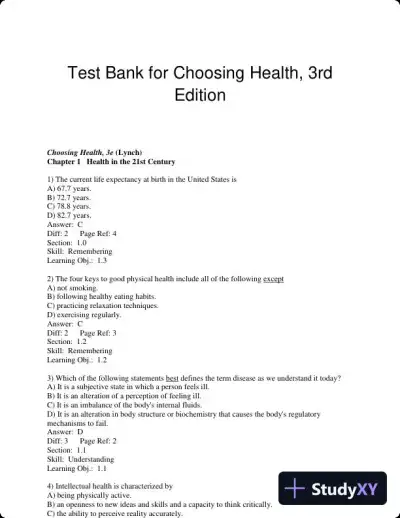 Exam Guides
Test Bank for Choosing Health, 3rd Edition
Healthcare
396 pages68downloadsFeb 2025
Study this document with CramX
Once it is in your library, every tool can work from it.