

Solution Manual for Occupational Safety and Health for Technologists, Engineers, and Managers, 9th Edition
- Healthcare
- 118 pages
- Shared February 2025
- 47 downloads
Solution Manual for Occupational Safety and Health for Technologists, Engineers, and Managers, 9th Edition is the ultimate guide for understanding and solving textbook problems.
Preview 31 of 118 pages
See the first 31 pages exactly as they appear in the document.
Page 1 Read page 1 as text
Online Instructor’s Manual with Testbank for Occupational Safety and Health For Technologists, Engineers, and Managers Ninth Edition David L. Goetsch
Page 2 Page 3 Read page 3 as text
TABLE OF CONTENTS Part Two: Answers to Review Questions 67 Chapter One 67 Chapter Two 69 Chapter Three 71 Chapter Four 74 Chapter Five 78 Chapter Six 80 Chapter Seven 86 Chapter Eight 89 Chapter Nine 91 Chapter Ten 95 Chapter Eleven 99 Chapter Twelve 102 Chapter Thirteen 106 Chapter Fourteen 108 Chapter Fifteen 111 Chapter Sixteen 116 Chapter Seventeen 120 Chapter Eighteen 122 Chapter Nineteen 126 Chapter Twenty 130 Chapter Twenty - One 137 Chapter Twenty - Two 139 Chapter Twenty - Three 142 Chapter Twenty - Four. 147 Chapter Twenty - Five 150 Chapter Twenty - Six 154 Chapter Twenty - Seven 156 Chapter Twenty - Eight 158 Chapter Twenty - Nine 160 Chapter Thirty 165 Chapter Thirty - One 167 Part Three: Transparency Masters 169 Chapter One Chapter Two Chapter Three Chapter Four Chapter Five Chapter Six Chapter Seven Chapter Eight Chapter Nine
Page 4 Read page 4 as text
Chapter Ten Chapter Eleven Chapter Twelve Chapter Thirteen Chapter Fourteen Chapter Fifteen Chapter Sixteen Chapter Seventeen Chapter Eighteen Chapter Nineteen Chapter Twenty Chapter Twenty - One Chapter Twenty - Two Chapter Twenty - Three Chapter Twenty - Four Chapter Twenty - Five Chapter Twenty - Six Chapter Twenty - Seven Chapter Twenty - Eight Chapter Twenty - Nine Chapter Thirty Chapter Thirty - One
Page 5 Read page 5 as text
1 P ART T WO A NSWERS TO R EVIEW Q UESTIONS Chapter One – Safety and Health Movement, Then and Now 1 . To what cause(s) can the improvements in workplace safety made to date be attributed? Improvements in safety up to now have been the result of pressure for legislation to promote safety and health, the steadily increasing costs associated with accidents and injuries, and the professionalization of safety as an occupation. 2 . Explain the significance of the Code of Hammurabi in terms of the safety movement. What is significant about the code from the perspective of safety and health is that it contained clauses dealing with injuries, allowable fees for physicians, and monetary damages assessed against those who injured others. 3 . Describe the circumstances that led to the development of the first organized safety program. In 1892 in a Joliet, Illinois, steel plant the first recorded safety program was established in response to a scare caused when a flywheel exploded . Following the explosion a committee of managers was formed to investigate and make recommendations. 4 . What is Frederick Taylor’s connection to the safety movement? Although safety was not a major focus of his work, Taylor did draw a connection between lost personnel ti me and management policies and procedures . This connection between safety and management represented a major step toward broad - based safety consciousness. 5 . Explain the development of the National Safety Council. The Association of Iron and Steel Electrical Engineers (AISEE), formed in the early 1900s, pressed for a national conference on safety . As a result of the AlSEE’s efforts, the first meeting of t he Cooperative Safety Congress took place in Milwaukee in 1912 . A year af ter the initial meeting of the Cooperative Safety Congress, the Nationa l Council of Industrial Safety was established in Chicago, Illinois . In 1915, this organization changed its name to the National Safety Council. 6 . What impact did labor shortages in World War II have on the safety movement? The loss of a skilled worker due to an injury or for any other reason created an excessive hardship.
Page 6 Read page 6 as text
2 7 . Explain how workplace tragedies have affected the safety movement . Give examples. Safety and health tragedies in the workplace have greatly accelerated the pace of the safety movement . Three of the most significant events in the history of the safety and health movement were the Hawk’s Nest, asbestos menace, and Bhopal tragedies. 8 . Explain the primary reasons behind the passage of OSHA. Generally, the state legislated safety requirements only in specific industries, had inadequate safety and health standards, and had inadequate budgets for enforcement . Th e injury and death toll due to industrial mishaps was still too high . In th e late 1960s, more than 14,000 employees were killed annually in connection with their jobs . Work injury rates were taking an upward swing. 9 . Summarize briefly the role organized labor has played in the advancement of the safety movement. Organized labor has fought for safer working conditions and appropriate compensation for workers injured on the job. 10 . Define the following terms: fellow servant rule; contributory negligence; assumption of risk. The most important contributions of organized labor to the safety movement was their work to overturn anti - labor laws relating to safety in the workplace . The fellow servant rule held that employees were not liable for workplace injuries that resulted from the negligence of other employees . If the actions of employees contributed to their own injuries, the employer was absolved of any liability . This was the doctrine of contributory negligence . Assumption of risk was based on the theory that people who accept a job assume the risks that go with it. 11 . Explain the Three E’s of Safety. Three E’s of Safety: Engineering – involves making design improvements to both product and process; Education – ensures that employees know how to work safely; and Enforcement – involves making sure that employees abide by safety policies, rules, regulations, practices, and procedures. 12 . Explain the term integration as it relates to modern safety and health. By working together and drawing on their own respective areas of expertise, safety and health professional s are better able to identify, predict, control, and correct safety and health problems.
Page 7 Read page 7 as text
3 Chapter Two – Accidents and Their Effects 1 . What are the leading causes of death in the United States? Accidents are the fourth leading cause of death in this country behind heart disease, cancer, and strokes. 2 . When the overall cost of an accident is calculated, what elements make up the cost? These costs include such factors as lost wages, medical expenses, insurance administration, fire - related losses, motor vehicle property damage, and indirect costs. 3 . What are the five leading causes of accidental deaths in the United States? Motor vehicle, poison (solid, liquid), drowning, falls, and fire - related 4 . What are the leading causes of death in the United States of people between the ages of 25 and 44? Accidents, motor vehicle, poison (solid, liquid), drowning, falls, fire - related, cancer, and heart disease 5 . Explain how todays’s rate of accidental work deaths now compares with the rate of the early 1900s. Between 1912 and 1989, accidental work deaths per 100,000 population were reduced 81 percent, from 21 to 4. 6 . What are the five leading causes of work deaths? Motor vehicle related, falls, electric current, drowning, and fire - related 7 . What are the five leading causes of work injuries by type of accident? Overexertion, impact accidents, falls, bodily reaction, and compression. 8 . When death rates are classified by industry type, what are the three leading industry types? Mining/quarrying, agriculture, construction 9 . Rank the following body parts according to frequency of injury from highest to lowest: neck, fingers, trunk, back, and eyes. Back, fingers, trunk, eyes, and neck 10 . Explain the reasons for high accident rates in developing countries. Rapid development and the pressure of global competition Missing safety and health infrastructure
Page 8 Read page 8 as text
4 Chapter Three – Theories of Accident Causation 1 . Explain the domino theory of accident causation, including its origin and its impact on more modern theories. There are five factors in the sequence of events leading up to an accident: 1) ancestry and social environment, 2) fault of person, 3) unsafe actimechanical or physical hazard, 4) accident, and 5) injury. 2 . What were the findings of Herbert W . Heinrich’s 1920s study of the causes of industrial accidents? 88 percent of industrial accidents are caused by unsafe acts committed by fellow workers . 10 percent of industrial accidents are caused by unsafe conditions . 2 percent of industrial accidents are unavoidable. 3 . List five of Heinrich’s Axioms of Industrial Safety. Accidents result from a completed series o f factors, one of which is the accident itself. An accident can occur only as the result of an unsafe act by a person and/or a physical or mechanical hazard. Most accidents are the result of unsafe behavior by peo ple. An unsafe act by a person or an unsafe condition does not always immediately result in an accident/injury. The reasons why people commit unsafe acts can serve as helpful guides in selecting corrective actions. The severity of an accident is largely fortuitous and the accident that caused it is largely preventable. The best accident prevention techniques are analogous with the best quality and productivity techniques. Management should assume responsibility for safety since it is in the best position to get results. The supervisor is the key person in the prevention of industrial accidents. In addition to the direct costs of an accident (i.e., compensation, liability claims, medical costs, and hospital expenses) there are also hidden or indirect costs. 4 . Explain the following concepts in the domino theory: preceding factor; central factor. Heinrich’s theory has two central points: 1) injuries are caused by the action of preceding factors; and 2) removal of the central factor (unsafe act/hazardous condition) negates the action of the preceding factor and, in so doing, prevents accidents and injuries. 5 . What are the three broad factors that lead to human error in the human factor theory? Briefly explain each. Overload – Overload amounts to an imbalance between a person’s capacity at any given time and the load that person is carrying in a given state.
Page 9 Read page 9 as text
5 Inappropriate Response/Incompatibility – How a person responds in a given situation can cause or prevent an accident . If a person detects a hazardous condition but does nothin g to correct it, he or she has responded inappropriately. Inappropriate Activities – Human error can be the result of inappropriate activities . An example of an inappropriate activity would be a person undertaking a task he or she doesn’t know how to do. 6 . Explain the systems failure component of the accident/incident theory. First, it shows the potential for a causal relationship between management decisions/management behavior and safety . Second, it establishes management’s role in accident prevention a s well as the broader concepts of safety and health in the workplace. 7 . What are the key components of the epidemiological theory and how does their interaction affect accident causation? The key components are predisposition characteristics and situational characteristics . These characteristics, taken together, can either result in or prevent conditions that might result in an accident. 8 . Explain the systems theory of accident causation. This theory views a situation in which an accident might occur as a system comprised of the following components: pe rson (host), machine (agency), and environment . The likelihood of an accident occurring is determined by how these components interact . Changes in the patterns of interaction can increase or reduce the probability of an accident occurring. 9 . What impact do stressors have in the systems theory? When stressors are introduced between points 1 and 2 the likelihood of an accident increases. 10 . List five factors to consider before making workplace decisions that involve risk. 1) Job requirements, 2) the worker’s abilities and limitations, 3) what is gained if the task is successfully accomplished, 4) what is lost if the task is attempted but fails, and 5) what is lost if the task is not attempted. 11 . Explain the principles of behavior - based safety. There are seven basic principles of BBS: Intervention that is focused on employee behavior Identification of external factors that will help understand and improve employee behavior Direct behavior with activators or events antecedent to the desired behavior, and motivation of the employee to behave as desired with incentives and rewards that will follow the desired behavior Focus on the positive consequences that will result from the desired behavior as a way to motivate employees Application of the scientific method to improve attempts at behavioral interventions Use of theory to integrate information rather than to limit possibilities
Page 10 Read page 10 as text
6 Planned interventions with the feelings and attitudes of the individual employee in mind 12 . What is the role of the safety and health professional with regard to handling employees who might be drug or alcohol abusers? Safety and health professionals should be aware of the workplace problems that can be caused by alcohol and drug abuse . Should also be a member of the cross - functional team of representatives who develop a drug - free workplace program. 13 . List the warning signs of clinical depression. Persistent dreary moods Signs of too little sleep Sleeping on the job or persistent drowsiness Sudden weight loss or gain General loss of interest, especially in areas of previous interest Restlessness, inability to concentrate, or irritability Chronic physical problems Forgetfulness or an inability to make simple decisions Persistent feeling of guilt Feeling of low self - worth Focus on death or talk of suicide 14 . What must management do if it is serous about providing a safe and healthy work environment for employees? Management must establish expectations, provide training, evaluate employee performance with safety in mind, and reinforce safe and healthy behavior. 15 . Explain the connections between obesity and injuries. The most common causes of injuries to obese people were the result of overexertion and falls . Efforts to promote optimal body weight may reduce not only the risk of chronic diseases, but also the risk of unintentional injuries. 16 . Explain the Swiss Cheese Model from the perspective of accident prevention. The Swiss Cheese Model bases accident prevention on providing multiple defensive layers between hazards and the harm they might cause.
Page 11 Read page 11 as text
7 Chapter Four – Roles and Professional Certifications for Safety and Health Professionals 1 . What types of positions might be included in a modern safety and health team? Engineers, physicists, industrial hygienists, occupational physicians, and occupational health nurses. 2 . Briefly explain the impact such issues as workers’ compensation and the environment have had on the commitment of corporate management to safety and health . OSHA Standards, on - site inspections, and penalties have encouraged a greater commitment to safety and health than was evident in the pa st as has the growing awareness that providing a safe and healthy workplace is the fight thing to do from both an ethical and a business perspective. 3 . What is the difference between a staff and a line position? Line authority means the safety and heal th manager has authority over and supervises certain employees . Staff authority means the safety and health manager is the staff person responsib le for a certain function, but he or she has no line authority over others involved with that function. 4 . Explain the types of problems modern safety and health managers can expect to confront in attempting to implement their programs. Lack of commitment Top management may go along with having a company - wide safety and health program because they see it as a necessary evil . Production versus Safety Industrial firms are in business to make a profit .Anything that interferes with production or proces sing is likely to be looked on unfavorably. 5 . Briefly explain what a company must do in order to succeed in today’s competitive global marketplace. The most productive company is the one that generates the most output with the least input. 6 . How can safety and health managers use the competitiveness issue to gain a commitment to their programs? Resources invested in safety and health can actually improve a company’s competitiveness . Productivity, quality, cost, image, and response time can go a long way in helping to gain management commitment to safety and health. 7 . List five different college majors that can lead to a career as a safety and health manager. Industrial safety, occupational safety, environmental technolo gy, safety and health management, and industrial hygiene. 8 . Explain the importance of ongoing in - service training for modern safety and health managers and how to get it.
Page 12 Read page 12 as text
8 In - service training, ongoing interaction with professional colleagues, and continued reading of professional literature are effective ways to stay current . This means joining the appropriate professional organizations, becoming familiar with related government agencies, and establishing links with relevant standards organizations. 9 . How can safety and health managers become certified in their profession? In order to qualify to sit for a certification examination, safety and health managers must have the required education and experience and submit letters of recommendation as specified by the certification board. 10 . Name three professional societies a safety and health manager may join. American Academy of Industrial Hygiene American Industrial Hygiene Association American Occupational Medical Association American Society of Safety Engineers National Safety Council Society of Toxicology 11 . What is meant by the statement “If a physician makes an error he might harm one person, but an engineer who errs might harm one hundred”? Engineers can make a significant contribution to safety . Correspondingly, they can cause, inadvertently or through incompetence, accidents that result in serious injury and property damage. 12 . Explain how the design process can affect safety. With a poorly designed seat belt installed in 10,000 automobiles, the engineer has inadvertently endangered the lives of as many as 40,000 people (estimating a maximum of four passengers per car). 13 . What typed of engineers are most likely to work as design engineers? Those that are most likely to be designers are aerospace, electrical, mechanical, and nuclear engineers. 14 . Why is the title safety engineer sometimes a misnomer? It implies that the person filling the position is a degreed engineer with formal education and/or special training in workplace safety . Typically, the title is given to the person who has overall responsibility for the company’s safety program or to a member of the company’s safety team who is responsible for the traditional aspects of the safety program. 15 . What specific strengths might industrial engineers bring to bear as safety engineers? Their knowledge of industrial systems, both manual and automated, can make them valuable members of a design team, particularly one that designs industrial systems and technologies. 16 . What specific strengths might chemical engineers bring to the safety and health team?
Page 13 Read page 13 as text
9 The coursework they take is particularly relevant since all of it relates either directly or indirectly to health. 17 . What specific strengths might chemical engineers bring to the safety and health team? A broad background has made the chemical engineer extremely versatile and capable of working in a wide variety of industries: chemical, petroleum, aerospace, nuclear, materials, microelectronics, sanitation, food processing, and computer technology. 18 . Describe the job of the industrial hygienist. To recognize environmental factors and to understand their effect on humans and their well - being. To evaluate on the basis of experience and with the aid of quantitative measurement techniques, the magnitude of these stresses in terms of ability to impair human health and well - being, and To prescribe methods to eliminate control, or reduce such stresses when necessary to alleviate their effects. 19 . What is a health physicist? Health physicists are concerned primarily with radiation in the workplace . Their duties include monitoring radiation inside and outside the facility, measuring the radioactivity levels of biological samples, developing the radiation components of the company’s emergency action plan, and supervising the decontamination of workers and the workplace when necessary. 20 . Describe the job of the occupational physician. Appraisal, maintenance, restoration, and improvement of the workers’ health through application of the principles of preventive medicine, emergency medical care, rehabilitation, and environmental medicine. Promotion of a productive and fulfilling interaction of the worker and the job, via application of principles of human behavior. Active appreciation of the social, econ omic, and administrative needs and sibilities of both the worker and work community. Team approach to safety and health, involving cooperation of the physician with occupational or industrial hygienists, occupational health nurses, safety personnel, and other specialists. 21 . Describe the job of the occupational health nurse. To adopt the nursing program to meet the specific needs of the individual company. To give competent nursing care for all employees. To ensure that adequate resources are available to support the nursing program. To seek out competent medical direction i f it is not available on - site. To establish and maintain an adequate system of records - relating to workplace health care.
Page 14 Read page 14 as text
10 To plan, prepare, promote, present, and broker educational activities for employees. To establish and maintain positive working relationships with all departments within the company. To maintain positive working relationships with all components of the local health care community. To monitor and evaluate the nursing program on a continual basis and adjust accordingly. 22 . Explain the concept of risk management. Risk management consists of the various activities and strategies in an organization to protect itself from situations, circumstances, or events that might undermine its security. 23 . Explain the role of the ergonomist. CPE must meet the following requirements: Must have a master’s degree in one of the correlative fields of ergonomics, such as biomechanics, human factor/ergonomics, industrial engineering, industrial hygiene, kinesiology, psychology, or systems engineering. Appropriateness of work experience and evidence of participation in projects requiring ergonomic expertise. A work sample that demonstrate a breadth of ergonomic knowledge and the ability to use ergonomic methods successfully. 24 . Explain the responsibilities of employees in safety and health. Employees are responsible for complying with all safety rules and regulations, safely and properly using tools and equipment, safely and properly following all procedures and processes, properly wearing appropriate PPE, refusing to take shortcuts, reporting unsafe conditions, encouraging fellow employees to work safely, and participating in safety training. 25 . Explain how to achieve each of the following certifications: Certified Safety Professional, Certified Industrial Hygienist, and Certified Professional Ergonomist. Certified Safety Professional o Apply to the Board of Certified Safety Professionals o Meet an academic requirement o Meet a professional safety experience requirement o Pass the Safety Fundamentals Examination o Pass the Comprehensive Practice Examination o Certified Industrial Hygienist o Technical Knowledge – Review c ourses; Professional reference questionnaire o Pass Review and Exam g iven by the American Board of Industrial Hygiene o Certification Maintenance o Certified Professional Ergonomist o Meet Academic Requirements o Meet Work Experience o Work Product
Page 15 Read page 15 as text
11 26 . Explain how to achieve the following certification: Certified Occupational Health Nurse - Safety Manager. Pass COHN - SM certification Exam Meet Academic Requirements Meet Work Experience Pass Additional Subspecialty Testing
Page 16 Read page 16 as text
12 Chapter Five – Safety, Health, and Competition in the Global Marketplace 1 . Explain why and how global competition can have a negative impact on safety and health in the workplace. It is not uncommon for this pressure to create a harried atmosphere that can increase the likelihood of accidents . It can also lead to shortcuts that increase the potential for health hazards. 2 . Define the term competitiveness . The Institute of Corporate Competitiven ess defines competitiveness as “the ability to consistently succeed and prosper in the marketplace whether it is local, regional, national, or global.” 3 . What are the common characteristics of the most competitive companies? Those who consistently outperform their competitors in the key areas of quality, productivity, response time, service, cost, and corporate image. Those who continually improve in all of these areas. 4 . Explain the importance of continual improvement as it relates to global competitiveness. The productivity record of today will be broken tomorrow . What is considered world - class quality today will be considered mediocre tomorrow . What is excellent service today will be unsatisfactory service tomorrow . The acceptable costs of today will be considered too high tomorrow . Record response time today will be too slow tomorrow . Finally, an excellent corporate image today can fade quickly and be gone tomorrow. 5 . Define the terms productivity and value added . Explain their relationship. Output / Input = Productivity Value added is the difference between what it costs to produce a product and what it costs to purchase it . This difference represents the value that has been added to the product by the production process . Value added is increased when productivity is increased. 6 . State two rules of thumb that explain how to recognize declining productivity. Productivity is declining when 1) output declines and input is constant; or 2) output is constant, but input increases. 7 . State two rules of thumb that explain how to recognize improving productivity. Productivity is improving when 1) output is constant, but input decreases; or 2) output increases and input is constant. 8 . Explain the relationship between productivity and quality as it relates to competitiveness. Quality goes hand - in - hand with productivity in the competitiveness equation . Today’s industrial company must have both . Quality without productivity results
Page 17 Read page 17 as text
13 in costs that are too high to be competitive . Productivity without quality results in a shabby product that quickly tarnishes the corporate image. 9 . Define the term quality . Quality is a measure of the extent to which a product or service meets or exceeds customer expectations. 10 . Write a brief rebuttal to the following statement: “A safety and health program is just a bunch of bureaucratic regulations that get in the way of profits.” Instructor/student opinion. Chapter Six – The OSH Act, Standards, and Liability 1 . Briefly explain the rationale for the OSH Act. To assure so far as possible every working man and woman in the nation safe and healthful working conditions and to preserve our human resources. 2 . What is OSHA’s mission or purpose? Encourage employers and employees to reduce workplace hazards Implement new safety and health programs Improve existing safety and health programs Encourage research that will lead to innovative ways of dealing with workplace safety and health problems Establish the rights of employers regarding the improvement of workplace safety and health Monitor job - related illnesses and injuries through a system of reporting and record - keeping Establish training programs to increase the number of safety and health professionals and to continually improve their competence Establish mandatory workplace safety and health standards and enforce those standards Provide for the development and approval of state - level workplace safety and health programs Monitor, analyze, and evaluate state - level safety and health programs 3 . List those who are exempted from coverage by OSHA. Persons who are self employed Family farms that employ only immediate members of the family Federal agencies covered by other federal statutes (in cases where these other federal statutes do not cover working conditions in a specific area or areas, OSHA standards apply) State and local governments (except that in order to gain OSHA’s approval of a state - level safety and health plan, states must provide a program for state and local government and employees that is at least equal to its private sector plan) 4 . Explain the difference between an OSHA standard and an OSHA regulation.
Page 18 Read page 18 as text
14 OSHA standards address specific hazards such as working in confined spaces, handling hazardous waste, or working with dangerous chemicals . Regulations do not apply to specific hazards . Regulations do not require the rigorous review process that standards go through. 5 . Explain how the following processes relating to OSHA standards are accomplished; passage of a new standard; request for a temporary variance; appealing a standard. Passage of a New Standard – OSHA must publish its intentions in the Federal Register in either a notice of proposed rule making or an advance notice of proposed rule making . After publishing notice, they must conduct a public hearing if one is requested . After the close of the comment period and public hearing, if one is held, OSHA must publish in the Federal register the full, final text of any stand ard amended or adopted and the date it becomes effective, along with an e xplanation of the standard and the reasons for implementing it. Request for a Temporary Variance – Employers must demonstrate that they are making a concerted effort to comply and taking the steps necessary to protect employees while working toward compliance . The requirements are as follows: 1) identificatio n of the parts of the standard that cannot be complied with; 2) explanation of the reasons why compliance is not possible; 3) detailed expl anation of the steps that have been taken so far to comply with the stand ard; and 4) explanation of the steps that will be taken to fully comply. Appealing a Standard – An appeal must be filed with the U.S . Court of Appeals serving the geographic region in which the complainant lives or does business . Appeal paperwork must be initiated within 60 days of a standard’s approval. 6 . Briefly describe OSHA’s record - keeping requirements. Employers are required to keep injury and illness records for each location where they do business . Records must be maintained on an annual basis using special forms prescribed by OSHA . Records are not sent to OSHA . Rather, they must be maintained locally for a minimum of five years . However , they must be available for inspection for OSHA at any time. 7 . What are OSHA’s reporting requirements? All occupational illnesses must be reported, regardless of the severity . Work - related injuries must be reported if they result in one or more of the following: Death of one or more workers One or most lost workdays Restricted motion or restrictions to the work an employee can do Loss of consciousness of one or more workers Transfer of an employee to another job Medical treatment beyond in - house first aid 8 . Explain what employers are required to do in order to keep employees informed. Employers are required to keep employees informed about safety and health issues that concern them . They are required to post the following material at
Page 19 Read page 19 as text
15 locations where employee informa tion is normally displayed: a) OSHA poster 2203; b) summaries of varia nce requests; c) copies of all OSHA citations received for failure to meet standards; and d) the summary page of OSHA form 200. 9 . Explain the various components of OSHA’s enhanced enforcement policy. Components of the enhanced enforcement policy include: Follow - up inspections – OSHA’s area directors are empowered to conduct follow - up inspections to verify compliance. Programmed inspections – OSHA’s site specific targeting process uses objective selection c riteria to schedule programmed inspections. Public awareness – when an organization receives a high gravity violation, OSHA makes the pub lic aware of the fact and all applicable enforcement actions by issuing press releases through local and national media. Settlements – provisions for hig h gravity violation settlement agreements require the organization to hire consultants to develop a feasible process for changing the sa fety and health culture in the facility. Section 11(b) summar y enforcement orders – once an order has been entered, organizati ons that fail to comply may be held in contempt of court — an action OSHA pursues. 10 . Describe how a hypothetical OSHA workplace inspection would proceed from the first step to the last. The OSHA compliance office presents his or her credentials to a company official. The compliance officer conducts an opening conference with pertinent company officials and employee representatives. The compliance officer makes the inspection tour. The compliance officer holds a closing conference, which involves open discussion between the officer and company/employee representatives. OSHA personnel advise company representatives of problems noted, actions planned as a result, and assistance available from OSHA. 11 . List and explain three different types of OSHA citations and the typical penalties that accompany them . Who gets the money from OSHA fines? Other than Serious Violation – A violation that has a direct relationship to job safety and health, but probably would not cause death or serious physical harm . A proposed penalty of up to $7,000 for each violation is discretionary. Willful Violation – A violation that the employer intentionally and knowingly commits. Repeat Violation – A violation of any standard, regulation, rule, or order where, upon re - inspection, a substantially similar violation is found. Failure to Correct Prior Violation – Failure to correct a prior violation may bring a civil penalty of up to $7,000 for each day the violation continues beyond the prescribed abatement date. OSHA fines go to the general fund of the U.S . Treasury 12 . Describe the process for appealing an OSHA citation.
Page 20 Read page 20 as text
16 The first step is to notify OSHA’s area director in writing . This is known as filing a notice of contest . It must be done within fifteen working days of receipt of a citation or penalty notice . The notice of contest must clearly describe the basis for the employee’s challenge and contain all of the i nformation about what is being challenged . Once OSHA receives a notice of contest, the area director forwards it and all pertinent materials to the Occupational Safety and Health Review Commission (OSHRC). 13 . List and briefly explain OSHA’s voluntary protection programs. Star Program – The Star Program recognizes companies that have incorporated safety and health into their regular management system so successfully that their injury rates are below the national average for their industry. Merit Program – The Merit Program is less strenuous than the Star Program . It is seen as a stepping - stone to recognize companies that have made a good start toward Star Program recognition. Demonstration Program – The Department of Labor describes the Demonstration Program as follows: “for companies that provide Star - quality worker protection in industries where certain Star requirements can be changed to include these companies as Star participants.” 14 . List five employer responsibilities. Meet the general duty responsibility to provide a workplace free from hazards that are causing or are likely to cause death or serious physical harm to employees, and comply with standards, rules, and regulations issued under the OSH Act. Be knowledgeable of mandatory standards and make copies available to employees for review upon request. Keep employees informed about OSHA. Continually examine workplace conditions to ensure they conform to standards. Minimize or reduce hazards. Make sure employees have and use safe tools and equipment (including appropriate personal protective equipment) that is properly maintained. Use color codes, posters, labels, or signs as appropriate to warn employees of potential hazards. Establish or update operating proc edures and communicate them so that employees follow safety and health requirements. Provide medical examinations when required by OSHA standards. Provide the training required by OSHA standards. Report to the nearest OSHA office within forty - eight hours of any fatal accident or one that results in the h ospitalization of five or more employees. Keep OSHA - required records of injuries and illnesses, and post a copy of the totals from the last page of OSHA No . 200 during the entire month of February each year . (This applies to employers with eleven or more employees.)
Page 21 Read page 21 as text
17 At a prominent location within the workplace, post OSHA poster 2203 informing employees of their rights and responsibilities. Provide employees, former employees, and their representative access to the Log and Summary of Occupational Injuries and Illnesses (OSHA No . 200) at a reasonable time and in a reasonable manner. Give employees access to medical and exposure records. Give the OSHA compliance officer names of authorized employee representatives who may be asked to accompany the compliance officer during an inspection. Do not discriminate against employees who properly exercise their rights under the act. Post OSHA citations at or near the work site involved . Each citation or copy must remain posted until the violation has been abated, or for three working days, whichever is longer. Abate cited violations within the prescribed period. 15 . List five employee rights. Complain to an employer, union, OSHA, or any other governmental agency about job safety and health hazards. File safety or health grievances. Participate in a workplace safety and health committee or in union activities concerning job safety and health. Participate in OSHA inspections, conferences, hearings, or other OSHA related activities. Expect employers to make review copies available of OSHA standards and requirements. Ask employers for information on emergency procedures. Receive safety and health training. Be kept informed about safety and health issues. Anonymously ask OSHA to conduct an investigation of hazardous conditions at the work site. Be informed of actions taken by OSHA as a result of a complaint. Observe during an OSHA inspection and respond to the questions asked by a compliance officer. See records of hazardous materials in the workplace. See their own medical record. Review the annual Log and Summary of Occupational Injuries (OSHA No . 200). Have an exit briefing with the OSHA compliance officer following an OSHA inspection. Anonymously ask NIOSH to provide information about toxicity levels of substances used in the workplace. Challenge the abatement period given employers to correct hazards discovered in an OSHA inspection.
Page 22 Read page 22 as text
18 Participate in hearings conducted by the Occupational Safety and Health Review Commission. Be advised when an employer requests a variance to a citation or any OSHA standard. Testify at variance hearings. Appeal decisions handed down at OSHA variance hearings. Give OSHA input concerning the development, implementation, modification, and/or revocation of standards. 16 . Describe the purpose and organization of NIOSH. The National Institute for Occupational Safety and Health (NIOSH) is part of the Department of Health and Human Services (HHS) . NIOSH has two broad functions: research and education . The main focus of the agency’s research is on toxicity levels and human tolerance levels of hazardous substances . Each year NIOSH publishes updated lists of toxic materials and recommended tolerance levels. 17 . Define the following legal terms as they relate to workplace safety: negligence; liability; ability to pay; and tort . Negligence – Negligence means failure to take reasonable care or failure to perform duties in ways that prevent harm to humans or damage to property. Liability – Liability is a duty to compensate as a result of being held responsible for an act or omission. Ability to Pay – The concept of ability to pay applies when there are a number of defendants in a case, but not all have the ability to pay financial damages . It allows the court to assess all damage against the defendant or defendants who have the ability to pay. Tort – A tort is an action involving a failure to exercise reasonable care that may, as a result, lead to civil litigation. 18 . Explain OSHA’s stand on safety incentives. OSHA is not o pposed to safety incentives per se . However, OSHA does recommend caution in using them to ensure that the desire to earn incentives does not lead to under - reporting of accidents, injuries, and near misses . Organizations that use safety incentives should have a plans for preventing under - reporting and be prepared to defend that plan .
Page 23 Read page 23 as text
19 Chapter Seven – Workers’ Compensation 1 . Explain the underlying rationale of workers’ compensation as a concept. The underlying rationale for workers’ compensation had two aspects: 1) fairness to injured employees, especially those without the resources to undertake legal actions that are often drawn out and expensive; and 2) reduction of costs to employers associated with workplace injuries (i.e., legal, image, and morale costs). 2 . List four objectives of workers’ compensation. Replacement of income Rehabilitation of the injured employee Prevention of accidents Cost allocation 3 . List five types of employees who may not be covered by workers’ compensation. Agricultural employees Domestic employees Casual employees Hazardous work employees Charitable or religious employees Employees of small organizations Railroad and maritime employees Contractors and subcontractors Minors Extraterritoriality employees 4 . What is meant by the term contributory negligence? Contributory negligence means that the injured worker’s own negligence contributed to the accident. 5 . What is meant by the term assumption of risk? If an employee knew that the job involved risk, he or she could not expect to be compensated when the risks resulted in accidents and injuries. 6 . Explain the reasons for the unprecedented increases in medical costs in the United States. The unprecedented increases can be attributed to two factors: 1) technological developments that have resulted in extraordinary but costly advances in medical care; and 2) a proliferation of litigation that has driven the cost of malpractice insurance steadily up. 7 . What are the three types of workers’ compensation insurance? State funds, private insurance, and self - insurance. 8 . Insurance companies use one of six methods for determining the premium rates of employers . Select three and explain them.
Page 24 Read page 24 as text
20 Schedule Rating – Insurance companies establish baseline safety conditions and evaluate the employer’s conditions against the baselines . Credits are awarded for conditions that are better than the baseline and debits are assessed for conditions that are worse . Insurance rates are adjusted accordingly. Manual Rating – A manual of rates is developed that establishes rates for various occupations . Each occupation may have a different rate based on its perceived level of hazard . The overall rate for the employer is a pro - rata combination of all the individual rates. Experience Rating – Employers are classified by type . Premium rates are assigned based on predictions of average losses for a given type of employer . Rates are then adjusted either up or down on the employer’s actual experience over the past three years. Retrospective Rating – Employees pay an established rate for a set period . At the end of the period the actual experience is assessed and an appropriate monetary adjustment is made. Premium Discounting – Large employers receive large discounts on their premiums based on their size. Combination Method – The insurer combines two or more of the other methods to arrive at premium rate. 9 . How can one determine if an injury should be considered serious? Student/instructor opinion. 10 . Explain the concepts of AOE and COE. When employees are injured when undertaking work prescribed in their job description, work assigned by a supervisor, or work normally expected of employees, they fall into the AOE category . Benefits are owed only when an injury occurs in the course of employment (COE). 11 . Distinguish between an employee and an independent contractor. A person who is on the company’s payroll, receives benefits, and has a supervisor is clearly an employee . However, a person who accepts a service contract to perform a specific task or set of tasks and is not directly supervised by the company is not considered an employee. 12 . Define the following terms: temporary disability, permanent disability . Temporary Disability – Temporary disability is the state that exists when it is probable that an injured worker who is currently unable to work will be able to resume gainful employment with no or only partial disability . Temporary disability assumes there will be substantial improvement. Permanent Disability – Permanent partial disability is the condition that exists when an injured employee is not expected to recover fully . In such cases the employee will be able to work again but not at full capacity . Often employees who are partially disabled must be retrained for another occupation. 13 . Explain the following theories of handling permanent partial disability cases: whole - person, wage - loss, loss of wage - earning capacity . Whole Person Theory – Once it has been determined that an injured worker’s capabilities have been permanently impaired to some extent, the theory is applied
Page 25 Read page 25 as text
21 like a subtraction problem . What the worker can do after recuperation from the injury is determined and subtracted from what he or she could do before the accident . Facto rs such as age, education, and occupation are not considered. Wage - Loss Theory – The wage - loss theory requires a determination of how much the employee could have earned had the injury not occurred. Loss of Wage - Earning Capacity – The loss of wage - earning capacity theory, is based not just on what the employee earned at the time of the accident, but also on what he or she might have earned in the future. 14 . Distinguish between medical vocational rehabilitation. Medical rehabilitation consists of providing whatever treatment is required to restore to the extent possible any lost ability to function normally . Vocational rehabilitation involves providing the education and training needed to prepare the worker for a new occupation. 15 . What are the three approaches for settling workers’ compensation claims? Direct settlement, agreement settlement, and public hearing. 16 . Explain the concept of medical management of workplace injuries. Out - of - control workers’ compensation cases in the ’90s led to the concept of medical management of workplace injuries . Through better management of workers’ compensation claims, more than 30 states have merged the concepts of workers’ compensation and managed care . The goals are to speed up the processing of workers’ compensation claims; reduce costs; reduce fraud and abuse; and improve medical management of workplace injuries. 17 . Explain the theory of cost allocation. Cost allocation is the process of spreading the cost of workers’ compensation across an industry so that no individual company is overly burdened . The cost of workers’ compensation includes the costs of premiums, benefits, and administration. 18 . Summarize briefly the problems most widely associated with workers’ compensation. The most fundamental problem with workers’ compensation is that it is not fulfilling its objectives . Lost income is not being adequately replaced, the number of accidents has not decreased, and the effectiveness of cost allocation is questionable. 19 . What types of actions are workers’ compensation reform movements likely to recommend in the future? Stabilizing workers’ compensation costs over the long term. Streamlining administration of the system. Reducing the costs associated with the resolution of medical issues. Limiting stress - related claims. Limiting vocational rehabilitation benefits. Increasing benefits paid for temporary and permanent disabilities. Reducing the amount insurers may charge for overhead. Providing more public input into the settling of rates.
Page 26 Read page 26 as text
22 20 . Explain the most common workers’ compensation cost reduction strategies. Stay in touch with the injured employee. Have a return - to - work program and use it. Determine the cause of the accident.
Page 27 Read page 27 as text
23 Chapter Eight – Accident Investigation and Reporting 1 . Explain the rationale for investigating accidents. The primary reason for investigating an accident is not to identify a scapegoat, but to determine the cause of the accident. 2 . When should an investigation be reported? Why? An investigation should be conducted immediately . First, immediate investigations are more likely to produce accurate information . Second, it is important to collect information before the accident scene is changed and before witnesses begin comparing notes . Finally, an immediate investigation is evidence of managem ent’s commitment to preventing future accidents. 3 . Explain the difference between an accident report and an accident - analysis report. An accident report is completed when the accident in question represents only a minor accident . It answers the questions who, what, when, and where . An accident - analysis report is completed when the accident in question is serious . It answers the questions who, what, when, where, and why. 4 . List the categories of the most common causes of accidents. Personal beliefs and feelings Mismatch or overload Systems failure Traps Unsafe conditions Unsafe acts 5 . What are the terms that should guide the conduct of an accident investigation? The investigation should be guided by the following words: who, what, when, where, why , and how. 6 . What role should the safety and health professional play in the conduct of an accident investigation? The safety and health profession should play a leadership role in collecting and analyzing the facts and developing recommendations. 7 . List and explain the steps for conducting an accident investigation. Isolate the Accident Scene – The entire area surrounding such a scene is blocked off by barriers or heavy yellow tape. Record All Evidence – It is important to make a permanent record of all pertinent evidence as quickly as possible. Photograph and/or Videotape the Scene – Modern photographic and videotaping technology has simplified the task of observing and recording evidence.
Page 28 Read page 28 as text
24 Identify Witnesses – In identifying witnesses it is important to compile a witness list . Names should be recorded in three categories: a) primary witnesses, b) secondary witnesses, and c) tertiary witnesses. 8 . Why is it important to record all pertinent evidence relating to an accident immediately after an accident has occurred? Certain types of evidence may be perishable. The longer an accident scene must be isolated, the more likely it is that evidence will be disturbed, knowingly, or unknowingly. If the isolated scene contains a critical piece of equipment or a critical component in a larger process, pressure will quickly mount to get it back into operation. 9 . What can you do when taking close - up photographs to put them in proper perspective? When photographing objects involved in the accident, be sure to identify and measure them to show the proper perspective . Place a ruler or coin next to the object when making a close - up photograph . This technique will help to demonstrate the object’s size or perspective. 10 . List and differentiate among the three categories of witnesses to an accident. Primary witnesses are eyewitnesses to the accident. Secondary witnesses are witnesses who did not actually see the accident happen, but were in the vicinity and arrived on the scene immediately or very shortly after the accident. Tertiary witnesses are witnesses who were not present at the time of the accident or afterward but may still have relevant evidence to present (i.e., an employee who had complained earlier about a problem with the machine involved in the accident). 11 . Briefly explain the when and where of interviewing witnesses. When to Interview – Interviews should begin as soon as the witness list has been compiled and once begun, they should proceed expeditiously. Where to Interview – The best place to interview is at the accident site . If this is not possible, interviews should take place in a private setting elsewhere . It is important to ensure that all distractions are removed, interruptions are guarded against, and the witness is not accompanied by other witnesses. 12 . Briefly explain the how of interviewing witnesses. The key to getting at the facts is to put the witness at ease and to listen . Listen to what is said, how it is said, and what isn’t said . Ask questions that will get at the information listed earlier in this chapter, but phrase them in an open - ended format . Don’t lead witnesses with your questions or influence them with gestures, facial expressions, tone of voice, or any other form of nonverbal communication . Interrupt only if absolutely necessary to seek clarification on a critical point . Remain nonjudgmental and objective. 13 . What is the purpose of an accident report?
Page 29 Read page 29 as text
25 The purpose of the report is to record the findings of the accident investigation, the cause or causes of the accident, and recommendations for corrective action. 14 . Who is responsible for filing accident reports with OSHA? All employers are required to report work - related deaths . All employers are required to report any worker amputation, eye loss, or in - patient hospitalization . All employers are required to report fatal heart attacks that occur at work and motor vehicle deaths that occur in a construction zone . Employers with 10 or more employees that are not classified as partially exempt must record serious work - related injuries and illnesses using the appropriate OSHA forms (i.e . 300, 300A, and 301).
Page 30 Read page 30 as text
26 Chapter Nine – Product Safety and Liability 1 . Explain the best way for a manufacturer to limit its exposure to product liability lawsuits. The best way the manufacturer can prevent or defend such claims is by manufacturing a reasonably safe and reliable product, and, where necessary, by providing instructions for its proper use . The key to achieving a reasonably safe and reliable product and, at the same time, reducing the product liability exposure is to build in product safety. 2 . What are the steps to follow in filing a product liability lawsuit? An injured party decides to seek redress against the manufacturer of a product and engages an attorney. The attorney files a complaint in state or federal court. The discovery period is undertaken during which evidence is collected, depositions are taken, and the product is examined. A trial date is set. The trial takes place or a settlement is reached out of court. 3 . What is the discovery period in a product liability lawsuit? The collection of evidence can involve taking depositions from expert witnesses and examining the product in question . Product examination might involve running a variety of tests and observing simulations. 4 . Briefly explain the concept of strict liability in tort. A . One who sells any product in a defective condition unreasonably dangerous to the user or consumer or to his property is subject to liability for physical harm thereby caused to the ultimate consumer or user, or to his property if: 1) The seller is engaged in the business of selling such a product 2) It is expected to and does reach the user or consumer without substantial change in the condition in which it is sold. B . The rule stated in Subsection (1) applies although: 1) The seller has exercised all possible care in preparation and sale of his product, and; 2) The user or consumer has not bought the product from or entered into any contractual relation with the seller. 5 . List the three criteria governing a company’s duty to warn. The potential for an accident when the product is used without a warning, provided the use to which it is put is reasonably predictable. Probable seriousness of injuries if an accident does occur. Potential positive effectiveness and feasibility of a warning. 6 . What are two purposes of the Consumer Product Safety Act? To protect the public from the risk of injuries incurred while using consumer products. To help consumers make objective evaluations of the risks associated with using consumer products.
Page 31 Read page 31 as text
27 To encourage uniformity in standards and regulations and to minimize conflicts among regulations at the various levels of government. To encourage research into the causes of product - related injuries, health problems, and deaths and how these things can be prevented. 7 . Define the following concepts associated with product liability law: patent defect, latent defect, prudent man concept . Patent Defect – A patent defect is one that occurs in all items in a manufactured batch. Latent Defect – A latent defect occurs in only one or a limited number of copies in a batch. Prudent Man Concept – In determining whether a risk is reasonable or unreasonable, the prudent man concept is applied . A reasonable risk exists when consumers a) understand the risk; b) evaluate the level of risk; c) know how to deal with the risk; and d) accept the risk based on reasonable risk/benefit considerations . In other words, they behave prudently. 8 . Explain the reporting requirements component of the Community Right - to - Know Act. Companies are required to maintain accurate, up - to - date information on chemicals they produce, store, use, transport, and so on . They are required to provide material safety data sheets (MSDSs) or other communication devices that contain at least the following information: name, formula, and other technical information about the chemical; potential safety and health hazards; handling precautions; and emergency procedures . Companies are required to give LEPCs and SERCs information about how much of a given chemical is typically present on their site or sites and where it is stored. 9 . List and briefly explain the three components of a comprehensive product safety program. Product Safety Coordinator – A successful product safety program must involve all departments within the company . It is important to have one person responsible for coordinating and facilitating this involvement . This person is the product safety Coordinator. Product Safety Committee – A product safety committee with a representative from all major departments is formed because effective product safety is the responsibility of all departments. Product Safety Auditor – The product safety auditor is responsible for evaluating the overall organization and individual departments within it. 10 . How may assigning product safety coordination duties to an executive of the company affect the success of the program? Giving coordination responsibility to a person who lacks executive level access and decision - making powers can contribute to the failure of a product safety program. 11 . What role do you think safety and health professionals should play in a product safety program?
87 more pages in the full document
Unlock it once and it stays in your library, ready to chat with or turn into flashcards.
Unlock the full documentMore Healthcare study materials
See all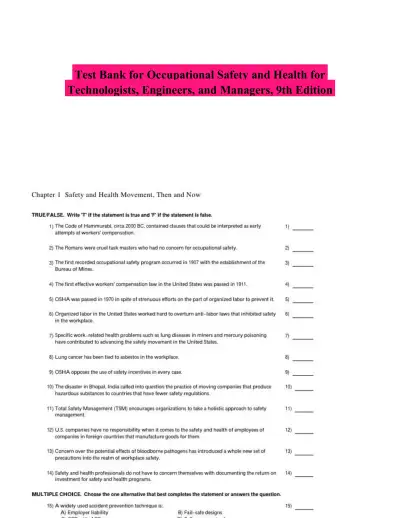 Exam Guides
Test Bank for Occupational Safety and Health for Technologists, Engineers, and Managers, 9th Edition
Healthcare
93 pagesMay 2025 Exam Guides
Test Bank for Access To Health, 15th Edition
Healthcare
594 pages146downloadsFeb 2025 Exam Guides
Health Promotion Throughout the Life Span 9th Edition Test Bank
Healthcare
184 pages142downloadsFeb 2025 Exam Guides
Test Bank for Principles and Foundations of Health Promotion and Education, 7th Edition
Healthcare
107 pages135downloadsFeb 2025 Class Notes
Class Notes for Introduction to Hospitality, 7th Edition
Healthcare
243 pages120downloadsFeb 2025 Class Notes
Technology Strategies for the Hospitality Industry, 3rd Edition Class Notes
Healthcare
75 pages86downloadsFeb 2025 Textbook Guides
Professional Server, The: A Training Manual, 3rd Edition Solution Manual
Healthcare
113 pages70downloadsFeb 2025 Past Exams
William Fredericks Health Assessment Practice Exam (1 Solved Case)
Healthcare
21 pages68downloadsFeb 2025
Study this document with CramX
Once it is in your library, every tool can work from it.