

Test Bank for Introduction to Hospitality , 8th Edition
- Healthcare
- 109 pages
- Shared May 2025
Strengthen your exam preparation with Test Bank for Introduction to Hospitality, 8th Edition, offering a diverse set of questions and answers.
Preview 16 of 109 pages
See the first 16 pages exactly as they appear in the document.
Page 1 Read page 1 as text
1 Introduction to Hospitality, 8e (Walker) Chapter 1 Introducing Hospitality 1) The word hospitality comes from A) hospital B) inns and taverns C) hospice D) All of the above Answer: C 2) Since its introduction, the pineapple has been internationally recognized as A) non - nutritional B) a widely used vegetable in the southwest C) a symbol of hospitality D) a symbol of danger Answer: C 3) Key to being successful in the hospitality industry is A) being service oriented B) waiting tables C) knowi ng how to cook D) bartending skills Answer: A 4) Intangible means A) something the guest uses but does not possess B) assets of the business C) a souvenir purchased as a gift D) physical property Answer: A 5) In the hospitality industry, the con cept of perisha bility means A) spoiled food that must be discarded B) an unsold airline seat, hotel room or empty restaurant table C) it cannot be measured D) it is intangible Answer: B 6) Inseparability refers to A) the fact that production and co nsumption occur independently B) hospitality products being inherently heterogeneous C) the fact that production and consumption occur simultaneously D) hospitality products are tangible Answer: C
Page 2 Page 3 Read page 3 as text
2 7) Each of the following is a characteristic of the Hospitality Industry EXCEPT: A) characterized by shift work B) the service product and the guest are separate C) no such thing as business hours D) product is intangible and perishable Answer: B 8) Mention of hospitality is found in writing dating b ack to A) Medieval times B) The Sumerians C) Ancient Greece and Rome D) The Silk Road Answer: B 9) Anyone who receives or benefits from the output of someone's work is A) an internal guest B) an em ployee C) a vendor D) a guest Answer: A 10) Int ernal customers are A) the employees B) restaurant dining room customers C) loyal customers who return often D) hotel guests Answer: A 11) Quality guest service requires that we A) increase service advertising B) prioritize our profit motive C) f ocus on food quality D) understand our guests' needs Answer: D 12) Associate empowerment leads to A) increased guest satisfaction B) incre ased productivity C) the Ritz Carlton associates spending up to $2,000 to make a guest completely happy D) all of the above Answer: D
Page 4 Read page 4 as text
3 13) Empowerment is A) delegated to management only B) a process that eliminates the need for management C) allowing all employees to make any decision they want D) a feeling of partnership in which employees feel responsible for their jobs and have a stake in the organization's success Answer: D 14) The central focus in hospitality is A) guest service B) attitude C) communication D) provide a big profit Answer: A 15) Corporate philosophy A) embraces the values of the o rganization B) embraces the values of guests including ethics and equality C) em braces the values of the associates including ethics, morals, fairness, and equality D) A and C Answer: A 16) Recruiters are looking for A) creativity B) well - rounded candi dates C) honesty D) service - oriented people Answer: D 17) The concept of pr otecting the natural resources of the planet while achieving corporate profitability is known as A) perishability B) operational values C) sustainability D) productivity Ans wer: C 18) In the United States, which tavern was the Revolutionary Headquarte rs of General George Washington? A) Coles Ordinary B) Fraunces C) Krieger's D) A and C Answer: B
Page 5 Read page 5 as text
4 19) Who is regarded as the father of the modern restaurant? A) Pot au Feu B) Thomas Jefferson C) August Escoffier D) M. Boulanger Answer: D 20) In the hospitality industry, the reason we are in business is A) to make a return on investment B) for society C) for non - consumers D) A and C Answer: A 21) What is the reason for succ ess in the hospitality industry? A) Handling guest complaints B) B eing of assistance to all guests C) Service, service, service D) A and C Answer: C 22) Pineapples are A) displayed on bedroom doors B) an exotic fruit reserved for hospitality students C) a symbol of hospitality D) A and C Answer: D 23) The heart of the house is A) the front desk B) the concierge C) the doorman D) behind the scenes Answer: D 24) In the hospitality industry, our services are mostly A) intangible B) tangible C) inseparabl e D) A and C Answer: A
Page 6 Read page 6 as text
5 25) Another unique dim ension of our industry is A) sold seats go unused B) empty cabins are paid for C) sustainability D) perishability Answer: D 26) Using the four facets of the hospitality industry (travel, lodging, foodservic e, and recreation), differentiate between the me thods of service offered to customers. Use specific examples. Answer: Student answers will vary according to specific type of service they choose from each facet. 27) Compare and contrast your ideal weekly work schedule with that of a typical manager in the hospitality field. Where are the main differences and how does the hospitality industry justify the differences. Answer: Most students will note their perfect schedule as Monday - Friday 9 AM - 5 PM with w eekends and holidays off. The reality of a 60 - t o 70 - hour workweek and holidays being the busiest days is not the most appealing schedule for young people. The rationale has been that the service the hospitality industry offers best is convenience, yet con venience to the guest does not always mean conve nience to the provider. 28) You are a service leader for a national airline preparing to leave on a transcontinental flight from Atlanta to Los Angeles. List the "moments of truth" your customer will encount er from the time they arrive at the terminal to the time they land in LA. Answer: The list will vary from student to student, depending on their perspective. Some lists will be all inclusive and some will be more limited to the moments that they are more passionate about. Stress the importance of every nuance of the service experience. 29) Using the concept of "sustainability," describe at least three goals your hotel may targe t that will help to ensure a healthy and protected local environment and also achieve economic prosperity. Answer: The student should focus their answer on water conservation, solid waste management, alternative power, and reduction of energy. They shoul d discuss the effectiveness of a cost effective program versus a sustained pro fitability. Students should also include a discussion about how the program may enable guest loyalty. 30) You are the owner of a new hotel chain. Outline the corporate culture y ou hope to create for your employees. Give examples. Answer: Students should outline how they want their employees to view them as a manager, how they intend to treat their employees, and the importance of the customer in the day - to - day implementation of a cultural philosophy.
Page 7 Read page 7 as text
6 31) Discuss the pros and cons of an internship progr am, a job - shadowing program, and a mentoring program. Which do you think is most effective and why? Answer: Students will look at each program with a variety of pros and cons. I nternships are often viewed as an opportunity for "real world" experience, bu t if they are not managed properly, students often fall into the "gopher " role. Shadowing is effective for a short - term glimpse into the industry, but the experience is exactly t hat: short term. Mentoring is usually most effective as part of the new emplo yee orientation process. 32) You are being interviewed for an entry - level management position with a cruise line. Generate a list of five questions that you think would best allo w you to portray yourself as the perfect candidate for the job. Answer: The common answers here will center around the proverbial "What are your strengths and weaknesses?" and "What makes you the best candidate for the job?" Encourage students to ask mor e open - ended questions that allow them the flexibility to showcase those stre ngths and mi n imize the weaknesses.
Page 8 Read page 8 as text
1 Introduction to Hospitality, 8e (Walker) Chapter 2 The Hotel Business 1) Purchasing the right to use a company's trademark to expand more rapidly and use copyrighted materials is known as A) leasing B) syndication C) franchising D) a partnership An swer: C 2) Hotel companies are increasingly opting for ________ because co nsiderably less capital is tied up in managing as compared to ownership. A) real estate investment trusts B) management companies C) referral companies D) franchising Answer: B 3) In franchising, the franchisee is granted rights to A) use trademark s, operating procedures and other business procedures B) full ownership of the land C) change the name of the business D) full ownership of the building Answer: A 4) The prim ary growth and development strategy of hotels during the 1960s was A) refer ral associations B) real estate investment trusts C) management contracts D) franchising Answer: D 5) Franchasie Central reservations generally produce A) between 17 and 26 p ercent of reservations B) between 8 and 18 percent of reservations C) between 12 and 22 percent of reservations D) between 14 and 28 percent of reservations Answer: A 6) The lack of operational power, high fees, and low percentage of reservations from th e central reservation syst em are all ________ of franchising. A) bonuses B) benefits C) trends D) drawbacks Answer: D
Page 9 Read page 9 as text
2 7) The benefits of franchising include all of the following EXCEPT: A) set of plans and specifications for building B) participati ng in the volume purchasi ng discounts C) high fee percentages charged by credit card companies D) national advertising Answer: C 8) Hotels and motels that are part of a ________ share a centralized reservation system and a common image, logo or advert ising slogan. A) franchi se B) referral association C) REIT D) proprietorship Answer: B 9) In this type of "ownership," investors do not pay corporate income tax; however, they distribute the majority of net income to shareholders and are publicly tr aded. A) Partnerships B) Franchises C) Independent ownership D) Real estate investment trusts Answer: D 10) Marriott builds a hotel for $34 million and sells it to a banking firm for $52 million. Marriott charges the banking firm 2 - 4 % of gross reve nues to operate the hotel. This business transaction is known as A) REIT B) management contract C) franchising D) investment partnership Answer: B 11) Corporations that operate a hotel without capital outlay in exchange for a percentage of gross sal es are known as A) vacation brokers B) franchisees C) management companies D) leasing compani es Answer: C 12) An organization that rates and classifies hotels and awards them Diamonds is the A) American Hotel & Motel Association B) United States A utomobile Club C) American Automobile Association D) Exxon Excellence Association Answer: C
Page 10 Read page 10 as text
3 13) Hotels may be classified by A) size B) location, price and service C) country D) type of recreational facilities Answer: B 14) Examples of hotel loc ation include A) spa, convention, casino, bed and breakfast B) luxury, all suites, economy, bud get C) full service, mid - scale, extended stay, limited service D) city, resort, airport, freeway Answer: D 15) Examples of hotel price classification incl ude A) full service, mid - scale, extended stay, limited service B) city, resort, airport, freewa y C) spa, convention, casino, bed and breakfast D) luxury, all suites, economy, budget Answer: D 16) Examples of hotel level of service classification inc lude A) full service, mid - scale, extended stay, limited service B) city, resort, airport, freew ay C) luxury, all suites, economy, budget D) spa, convention, casino, bed and breakfast Answer: A 17) In order to determine if a hotel development project would likely succeed, we would perform a(n) A) operating assessment B) trust initiative C) feasibility study D) property appraisal Answer: C 18) Airport hotels A) are often smaller, budget hotels B) are generally not full service C) range from 20 0 - 600 rooms with full service D) face less competition than other types of hotels Answer: C
Page 11 Read page 11 as text
4 19) Casino hotels A) are marketing themselves as business hotels B) are becoming more family friendly C) are focusing more on the budget traveler D) make m ore money from gaming than from rooms Answer: A 20) The following are c haracteristics of airport hotels EXCEPT: A) budget focused B) 200 - 600 rooms C) full service D) airport shuttle service Answer: A 21) Hotels that are a cross between a chain an d a marketing group for independent hotels are classified as A) corporate hotels B) independent hotels C) chain hotels D) quasi - chain Answer: D 22) City center, resort, airport and freeway are all examples of hotels being classified by A) price B) location C) service D) amenities Answer: B 23) Hotels that are typically furnished, have a well - stocked kitchen, and cater to guests staying for longer periods of time are A) boutique hotels B) convention hotels C) full service hotels D) extended - stay hotels Answer: D 24) Mixed use hotel develop ment indicates that a hotel A) may also have residences B) is near transportation C) can be used for meetings and lodging D) serves food Answer: A
Page 12 Read page 12 as text
5 25) As the hotel industry matures, corporations are either acquiring or merging with each other. This is A) consolidation B) diversification C) safety and security D) capacity control Answer: A 26) List five factors involved in the growth of franchising. Answer: Fresh look — curb appeal Location — nea r highways, airports, and suburbs Expansion in smaller cities throughout the United States New markets — located in proximity to golf courses and other attractions Foreign expansion — increasing brand awareness 27) List three popular forms of ownership use d i n the lodging industry that allow for rapid expansion. Answer: Franchising, management contracts, and REITs 28) Compare and contrast the following concepts: franchise, partnership, leasing and syndication. Answer: Students should cover the positiv e a spects of each (liability issues, initial investment, and freedom to manage). The negatives will mirror the positives (liability, overinvestment, and limited freedom to manage). 29) Of the ten hotel classifications, select five and give a general descr ipt ion of the types of hotels in each segment. Be sure to include price, location, and degree of service and target market. Answer: The text lists the classifications of hotels. Students should select five of those classifications on the list and give an ou tline of the segment. Answers will vary depending on which five they select. 30) List the six main types of hotels by price segment and give two examples of each. Outline a general profile of the typical customer for each segment. Answer: In this que sti on, the student needs to look at the needs and wants of the customer in each price range. The primary focus is the hotel meeting the customer's expectations. For example, a person looking for a budget hotel is most like price sensitive, needing a room f or one night, and is in transit from one destination to another. 31) Discuss marketability of the sustainable hotel industry. Discuss costs versus a standard hotel, guest demographic, and the positive or negative impact in the local community. Answer: T he student may discuss the cost of building a sustainable building versus the cost saving in energy: gas, electric, air conditioning, water conservation, and waste disposal. Marketing the hotel as a LEED certified structure to conservation - minded, conscien tio us guests may find a new guest base. Using local materials and leaving a small "footprint" in the environment can foster partnerships with the local community and result in positive public relations which translates to low cost marketing opportunities.
Page 13 Read page 13 as text
6 32 ) You own a three star hotel in an upscale area of town and find it necessary to upgrade to four - star to be competitive in your market. List and describe how you intend to accomplish the upgrade. Answer: Student answers should reflect the various rati ng systems, the rating system requirements, and the projected impact on occupancy. Discussions will hover around hotel infrastructure upgrades, training of staff, technology, décor, menu selection, etc. In general, the type of clientele will change and the ho tel must upgrade all services to accommodate the new guest. The discussion may also involve which of the several rating agencies to focus efforts on. AAA, Forbes, and Smith Travel each have their economic - minded fol l owers.
Page 14 Read page 14 as text
1 Introduction to Hospitality, 8e (Walker) Chapter 3 Rooms Division 1) The executive committee of a hotel is A) made up of key executives who head major departments B) the top three executives in the hotel C) the general manager and executive housekeep er D) the general manager and director of sales Answer: A 2) The ultimate responsibility and authority of running a hotel rests with A) the front office manager B) the executive committee C) the general man ager D) the regional vice president Answe r: C 3) Which of the following would NOT be considered a hotel department? A) Food and beverage B) Front office C) Property management system D) Housekeeping Answer: C 4) The front office, housekeeping, s ecurity and communications all fall under w hat department? A) Night auditor B) Comptroller division C) Concierge D) Rooms division Answer: D 5) The area of a hotel most often described as the nerve center or hub of a hotel is A) the front office B) banquets C) the night auditor D) housek eeping Answer: A 6) The basic functions of the front office include all of the following EXCEPT: A) revi ewing the previous night's ADR and occupancy B) maintaining sales and catering records C) reviewing arrivals and departures D) staffing and sched uling Answer: B
Page 15 Read page 15 as text
2 7) When selling rooms, a front desk associate might try to "upsell." This means A) selli ng the room at the rack rate B) honoring a guests discount coupon C) suggestively selling the features of a larger room, a higher floor or perhap s a better view D) providing a discount rate Answer: C 8) The more common name for a guest's account is A) a file B) open ledger C) folio D) rewards account Answer: C 9) Guest folios are typically managed by A) the general manager B) concierge C) sales department D) hotel property management system Answer: D 10) Special hotel accounts for a company that has established credit with a hotel are called A) city ledger B) city rates C) block rates D) city folios Answer: A 11) The individ ual responsible for the task of balancing the guests accounts receivables is the A) front office manager B) guest services agent C) night auditor D) front desk manager Answer: C 12) The Hotel California has 642 rooms and 413 are occupied. The occupa ncy percentage is A) 64% B) 60% C) 73% D) 32% Answer: A
Page 16 Read page 16 as text
3 13) The Hotel California has 642 rooms with 413 occupied and the room revenue is $84,593. The REV PAR is A) $131.76 B) $130.94 C) $83.91 D) $215.45 Answer: A 14) The daily report perfor med by the night auditor contains key operating ratios used by manag ement including A) previous evening's banquets B) total number of rooms in the hotel C) room occupancy percentage D) front office schedule Answer: C 15) Allocating the right type of room to the right guest at the right price is the job of A) the co ncierge B) the revenue management system C) the sales department D) the point of sale system Answer: B 16) Room occupancy percentage, or ROP, is A) room cost divided by room sales B) total rooms occupied divided by total available rooms C) room re venue divided by number of rooms sold D) total rooms available divided by number of rooms sold Answer: B 17) Average daily room rate is A) total rooms occupied divided by total availa ble rooms B) total rooms available divided by number of rooms sold C) room cost divided by room sales D) room revenue divided by number of rooms sold Answer: D 18) Hotels can avoid overselling (overbooking) rooms by too large a margin by using a(n) A ) point of sal e system B) call accounting system C) central reservation system D) energy management system Answer: C
93 more pages in the full document
Unlock it once and it stays in your library, ready to chat with or turn into flashcards.
Unlock the full documentMore Healthcare study materials
See all Class Notes
Class Notes for Introduction to Hospitality, 7th Edition
Healthcare
243 pages120downloadsFeb 2025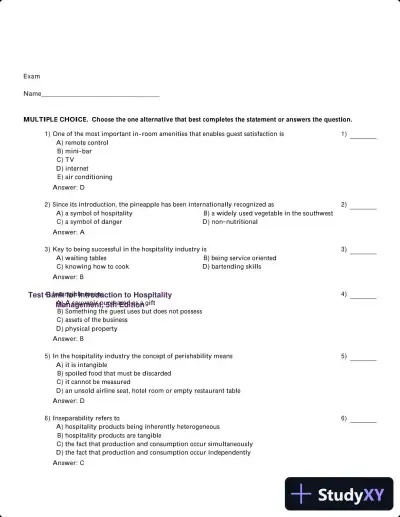 Exam Guides
Test Bank for Introduction to Hospitality Management, 5th Edition
Healthcare
97 pages52downloadsFeb 2025 Textbook Guides
Solution Manual for Introduction to Hospitality, 7th Edition
Healthcare
243 pagesMay 2025 Exam Guides
Test Bank for Access To Health, 15th Edition
Healthcare
594 pages146downloadsFeb 2025 Exam Guides
Health Promotion Throughout the Life Span 9th Edition Test Bank
Healthcare
184 pages142downloadsFeb 2025 Exam Guides
Test Bank for Principles and Foundations of Health Promotion and Education, 7th Edition
Healthcare
107 pages135downloadsFeb 2025 Class Notes
Technology Strategies for the Hospitality Industry, 3rd Edition Class Notes
Healthcare
75 pages86downloadsFeb 2025 Textbook Guides
Professional Server, The: A Training Manual, 3rd Edition Solution Manual
Healthcare
113 pages70downloadsFeb 2025
Study this document with CramX
Once it is in your library, every tool can work from it.