

Solution Manual for Automation, Production Systems, and Computer-Integrated Manufacturing, 4th Edition
- Information Technology
- 266 pages
- Shared May 2025
Need help with textbook problems? Solution Manual for Automation, Production Systems, and Computer-Integrated Manufacturing, 4th Edition is the perfect solution, providing comprehensive answers to every question.
Preview 16 of 266 pages
See the first 16 pages exactly as they appear in the document.
Page 1 Read page 1 as text
Solutions Manual for Automation, Production Systems, and Computer Integrated Manufacturing Fourth Edition Mikell P. Groover Professor of Industrial and Systems Engineering Lehigh University 200 West Packer Avenue Bethlehem, Pennsylvania 18015
Page 2 Page 3 Read page 3 as text
Ch01 Introduction - 4 e - A& S 09 - 10 , 09 - 20 - 2013 1-1 Chapter 1 INTRODUCTION REVIEW QUESTIONS 1.1 What is a production system? Answer : As defined in the text, a production system is a collection of people, equipment, and procedures organized to perform the manufacturing operations of a company. 1.2 Production system s consist of two major components . Name and briefly define the m . Answer : The two major components given in the text are (1) facilities, which consist of the factory, the equipment in the factory, and the way the equipment is organized; and (2) m anufacturin g support systems, which are the procedures used by the company to manage production and to solve the technical and logistics problems encountered in ordering materials, moving the work through the factory, and ensuring that products meet quality standards . Product design and certain business functions are included among the manufacturing support systems. 1.3 What are manufacturing systems, and how are they distinguished from production systems? Answer : A manufacturing system is a logical grouping of equipment in the factory and the worker(s) who operate(s) it. Examples include worker - machine systems, production lines, and machine cells. A production system is a larger system that includes a collection of manufacturing systems and the support systems used to man age them. A manufacturing system is a subset of the production system. 1.4 Manufacturing systems are divided into three categories, according to worker participation. Name the three categories. Answer : The three categories are (1) manual work systems, (2) wor ker - machine systems, and (3) automated systems. 1.5 What are the four functions included within the scope of manufacturing support systems? Answer : As identified in the text, the four functions are (1) business functions, (2) product design, (3) manufacturing planning, and (4) manufacturing control. 1.6 Three basic types of automation are defined in the text. What is fixed automation and what are some of its features? Answer : Fixed automation is a system in which the sequence of processing (or assembly) operations is fixed by the equipment configuration. Each operation in the sequence is usually simple, but the integration and coordination of many such operations in one piece of equipment makes the system complex. Typical features of fixed automation are (1) high in itial investment for custom - engineered equipment, (2) high production rates, and (3) relatively inflexible in accommodating product variety. 1.7 What is programmable automation and what are some of its features? Answer : In programmable automation , the producti on equipment is designed with the capability to change the sequence of operations to accommodate different part or product configurations. The operation sequence is controlled by a program , which is a set of instructions coded so that they can be read and interpreted by the system. Some of the features of programmable automation are (1) high investment in general purpose
Page 4 Read page 4 as text
Ch01 Introduction - 4 e - A& S 09 - 10 , 09 - 20 - 2013 1-2 equipment, (2) lost production time due to changeovers of physical setup and reprogramming, (3) lower production rates than fixed automati on, (4) flexibility to deal with variations and changes in product configuration, and (5) most suitable for batch production. 1.8 What is flexible automation and what are some of its features? Answer : Flexible automation is an extension of programmable automat ion. A flexible automated system is capable of producing a variety of parts (or products) with virtually no time lost for changeovers from one part style to the next. There is no lost production time while reprogramming the system and altering the physical setup. Accordingly, the system can produce various mixes and schedules of parts or products instead of requiring that they be made in batches. F eatures of flexible automation are (1) high investment for a custom - engineered system, (2) continuous productio n of variable mixtures of products, (3) medium production rates, and (4) flexibility to deal with product design variations 1.9 What is computer - int egrated manufacturing? Answer : As defined in the text, computer - integrated manufacturing (CIM) denotes the perva sive use of computer systems to design the products, plan the production, control the operations, and perform the various information - processing functions needed in a manufacturing firm. True CIM involves integrating all of these functions in one system th at operates throughout the enterprise. 1.10 What are some of the reasons why companies automate their operations? Answer : The reasons give in the text are (1) increase labor productivity, (2) reduce labor cost, (3) mitigate the effects of labor shortages, (4) reduce or eliminate routine manual and clerical tasks, (5) improve worker safety, (6) improve product quality, (7) reduce manufacturing lead time, (8) accomplish processes that cannot be done manually, and (9) avoid the high cost of not automating. 1.11 Identi fy three situations in which manual labor is preferred over automation. Answer : The five situations listed in the text are the following: (1) The task is technologically too difficult to automate. (2) Short product life cycle. (3) Customized product. (4) T o cope with ups and downs in demand. (5) To reduce risk of product failure. 1.12 Human workers will be needed in factory operations, even in the most highly automated operations. The text identifies at least four types of work for which humans will be needed. Name them . Answer : The four types of work identified in the text are (1) equipment maintenance, (2) programming and computer operations, (3) engineering project work, and (4) plant management. 1.13 What is the USA Principle? What does each of the letters stand for? Answer : The USA Principle is a common sense approach to automation and process improvement projects. U means “understand the existing process,” S stands for “simplify the process,” and A stands for “automate the process.” 1.14 The text lists ten strategie s for automation and process improvement. Identify five of these strategies. Answer : The ten strategies listed in the text are (1) specialization of operations, (2)
Page 5 Read page 5 as text
Ch01 Introduction - 4 e - A& S 09 - 10 , 09 - 20 - 2013 1-3 combined operations, (3) simultaneous operations, (4) integration of operations, (5) increa sed flexibility, (6) improved material handling and storage, (7) o n - line inspection, (8) process control and optimization, (9) plant operations control, and (10) computer - integrated manufacturing (CIM). 1.15 What is an automation migration strategy? Answer : As defined in the text, an automation migration strategy is a formalized plan for evolving the manufacturing systems used to produce new products as demand grows. 1.16 What are the three phases of a typical automation migration strategy? Answer : As defined in th e text, the three typical phases are the following: Phase 1: Manual production using single - station manned cells operating independently. Phase 2: Automated production using single - station automated cells operating independently. Phase 3: Automated integra ted production using a multi - station automated system with serial operations and automated transfer of work units between stations.
Page 6 Read page 6 as text
M fg Ops - 4 e - A& S 10 - 17 , 10 - 19 - 2012 2 - 1 Chapter 2 MANUFACTURING OPERATIONS REVIEW QUESTIONS 2.1 What is manufacturing? Answer : Two definitions are given in the text. The technological definition is the following: Manufacturing is the application of physical and chemical processes to alter the geomet ry, properties, and/or appearance of a given starting material to make parts or products . M anufacturing also includes the joining of multiple parts to make assembled products. The economic definition is the following: Manufacturing is the transformation of materials into items of greater value by means of one or more processing and/or assembly operations. 2.2 What are the three basic industry categories? Answer : The three basic industry categories are (1) p rimary industries, which are those that cultivate and e xploit natural resources, such as agriculture and mining; (2) secondary industries, which convert the outputs of the primary industries into products; they include manufacturing, construction, and power generation; and (3) t ertiary industries, which consti tute the service sector of the economy ; examples include banking, retail, transportation, education, g overnment . 2.3 What is the difference between consumer goods and capital goods? Answer : Consumer goods are products that are purchased directly by consumers, such as cars, personal computers, TVs, tires, toys, and tennis rackets. Capital goods are products purchased by other companies to produce goods and supply services. Examples include commercial aircraft, mainframe computers, machine tools, railroad equipme nt, and construction machinery. 2.4 What is the difference between a processing operation and an assembly operation? Answer : A processing operation transforms a work material from one state of completion to a more advanced state that is closer to the final des ired part or product. It adds value by changing the geometry, properties, or appearance of the starting material. An assembly operation joins two or more components to create a new entity, called an assembly, subassembly, or some other term that refers to the joining process. 2.5 Name the four categories of part - shaping operations, based on the state of the starting work material. Answer : The four categories are (1) solidification processes, (2) particulate processing, (3) deformation processes, and (4) materi al removal processes. 2.6 Assembly operations can be classified as permanent joining methods and mechanical assembly. What are the four types of permanent joining methods? Answer : The joining processes are (1) welding, (2) brazing, (3) soldering, and (4) adhes ive bonding. 2.7 What is the difference between hard product variety and soft product variety? Answer : Hard product variety is when the products differ substantially. In an assembled product, hard variety is characterized by a low proportion of common parts am ong
Page 7 Read page 7 as text
M fg Ops - 4 e - A& S 10 - 17 , 10 - 19 - 2012 2 - 2 products; in many cases, there are no common parts. Soft product variety is when there are only small differences between products. There is a high proportion of common parts among assembled products whose variety is soft. 2.8 What type of production d oes a job shop perform? Answer : Low production of specialized and customized products. The products are typically complex, such as experimental aircraft and special machinery. 2.9 Flow line production is associated with which one of the following layout types: (a) cellular layout, (b) fixed - position layout, (c) process layout, or (d) product layout? Answer : (d) Product layout. 2.10 What is the difference between a single - model production line and a mixed - model production line? Answer : A single - model production line makes products that are all identical. A mixed - model production line makes products that have model variations characterized as soft product variety. 2.11 What is meant by the term technological processing capability ? Answer : Technological processing capability of a plant (or company) is its available set of manufacturing processes. It includes not only the physical processes, but also the expertise possessed by plant personnel in these processing technologies. PROBLEMS Answers to problems labeled (A) are listed in the Appendix at the back of the book. 2.1 (A) A manufacturing plant produces three product lines in one of its plants : A, B, and C. Each product line has multiple models : 3 models within product line A, 5 models within B, and 7 within C. Average annual pro duction quantities of model A is 4 00 units, 8 00 units for model B , and 5 00 units for model C. Determine the number of (a) different product models and (b) total quantity of products produced annually in this plant. Solution : (a) The total number of differe nt product models produced is P = 3 + 5 + 7 = 1 5 different models (b) T he total production quantity of all products made in the factory is Q f = 3 ( 4 00) + 5 ( 8 00) + 7 ( 5 00) = 12 00 + 40 00 + 35 00 = 87 00 units annually 2.2 Consider product line A in p receding Probl em 2.1. Its three models have an average of 46 components each, and the average number of operations needed to produce each component is 3.5. All components are made in the same plant. Determine the total number of (a) components produced and (b) operation s performed in the plant annually. Solution : (a) The total number of components produced is given by Eq. (2.7) . n pf = PQn p = 3(400)(46) = 55,200 components (b) The total number of operations performed annually in the plant is given by Eq. (2.9). n of = PQn p n o = 3(400)(46)(3.5) = 193,200 operations 2.3 A company produces two products in one of its plants: A and B. Annual production of Product A is 3600 units and of Product B is 2500 units. Product A has 47 components and Product B has 52 components. For Product A, 40% of the components are made in the plant, while 60% are purchased parts. For Product B, 3 0% of the components are made in the plant,
Page 8 Read page 8 as text
M fg Ops - 4 e - A& S 10 - 17 , 10 - 19 - 2012 2 - 3 while 7 0% are purchased. For these two products taken together, what is the total number of (a) components made in t he plant and (b) components purchased? Solution : (a) The total number of components produced in the plant can be determined using Eq. (2.3) , adjusting it for the proportions of each part made in the factory : n pf = 3600(47)(0.40) + 2500(52)(0.30) = 67,680 + 39,000 = 106,680 parts made in plant (b) Let n pp = the total number of parts purchased: n pp = 3600(47)(0.60) + 2500(52)(0.70) = 101,520 + 91,000 = 192,520 purchased parts 2.4 (A) A product line has two models: X and Y. Model X consists of 4 components : a, b, c, and d. The number of processing operations required to produce these four components are 2, 3, 4, and 5 , respectively . Model Y consists of 3 components: e, f, and g. The number of processing operations required to produce these three components are, 6, 7, and 8 respectively . The annual quantity of Model X is 1000 units and of Model Y is 1500 units. Determine the total number of (a) components and (b) processing operations associated with these two models. Solution : (a) The total number of components can be determined using Eq. (2.3) : n pf = 1000(4) + 1500(3) = 4000 + 4500 = 8500 components Alternatively, Eq. (2.7) can be used, first computing the average values for Q and n p using Eqs. (2.6) and (2.8). Q = (1000 + 1500)/2 = 1250 units n p = (1000(4) + 1500( 3))/(2 × 1250) = 3.4 components per unit product n pf = 2(1250)(3.4) = 8500 components (b) The total number of processing operations can be determined using Eq. (2.4) : n of = 1000(2 + 3 + 4 + 5) + 1500(6 + 7 + 8) = 1000(14) + 1500( 21) = 45,500 operations Alt ernatively, Eq. (2.9) can be used, first computing the average values for n p and n o using Eqs. (2.8) and (2.10). The value of n p was calculated above: n p = 3.4 components per unit product n o = (1000(2 + 3 + 4 + 5) + 1500(6 + 7 + 8))/3.4 = 5.353 operations per component n of = 2(1250)(3.4)(5.353) = 45,500 operations 2.5 The ABC Company is planning a new product line and a new plant to produce the parts for the line. The product line will include 8 different models. Annual production of each model is expected to be 9 00 units. Each product will be assembled of 180 components. All processing of parts will be accomplished in the new plant . On average , 6 processing operations are required to produce each component, and each operation takes an average of 1.0 min (inclu d ing an allowance for setup time and part handling). All processing operations are performed at workstations, each of which includes a production machine and a human worker. The plant operates one shift. D etermine the number of (a) components, (b) processi ng operations , and (c) workers that will be needed to accomplish the processing operations if each worker works 2000 hr/yr . Solution : (a) N umber of components produced in the plant: n pf = PQn p = 8(900)(180) = 1,296,000 components (b) Number of operations performed in the plant: n of = PQn p n o = 8 ( 9 00)( 180 )(6) = 7 , 776 ,000 operations in the plant per year (c) Total operation time TT = n of T p , where T p = time for one processing operation. TT = 7,776,000(1.0) = 7,776,000 min = 129,600 hr of processing time
Page 9 Read page 9 as text
M fg Ops - 4 e - A& S 10 - 17 , 10 - 19 - 2012 2 - 4 At 2 000 hours/yr per worker, number of workers w = 129,600/2000 = 64.8 workers This sh ould be rounded up to 65 workers . 2.6 The XYZ Company is planning a new product line and a new factory to produce the parts and assembly the final products. The product line will include 10 different models. Annual production of each model is expected to be 1000 units. Each product will be assembled of 3 00 components , but 65% of these will be purchased parts (not made in the new factory) . There are an average of 8 processing opera tions required to produce each component, and each processing step takes 30 sec (includ ing an allowance for setup time and part handling). Each final unit of product takes 4 8 min to assemble. All processing operations are performed at work cells that inclu de a production machine and a human worker. Products are assembled at single workstations consisting of one worker e ach plus assembly fixtures and tooling . E ach work cell and each workstation require 2 5 m 2 of floor space and an additional allowance of 4 5% must be added to the total production area for aisles, work - in - process storage, shipping and receiving, rest rooms, and other utility space. T he factory will operate one shift ( the day shift, 2000 hr/yr) . D etermine (a) how many processing and assembly oper ations, (b) how many workers (direct labor only) , and (c) how much total floor space will be required in the plant. Solution : (a) The number of products is Q f = PQ = 10(1000) = 10,000 products/yr Therefore, the n umber of final assembly operations = 10,000 asby ops/yr Total number of parts n pf = 10(1000)(300) = 3,000,000 components, but 65% of these are purchased, so the number made in the plant will be 0.35(3,000,000) = 1,050,000 Number of processing operations n of = 1,050,000 (8) = 8 , 4 00,000 proc ops/yr ( b ) Total processing time TT p = n of T p , where T p = time for one processing operation. TT p = 8,400,000(0.50) = 4,200,000 min = 70,000 hr/yr Total assembly time TT a = QT a , where T a = assembly time for each product. TT a = 10,000(4 8 ) = 4 8 0,000 min/yr = 80 00 hr/y r Number of workers w = (70,000 + 80 00)/2000 = 39 workers ( c ) With 1 worker per workstation for processing operations and 1 worker per assembly workstation , n = w = 39 workstations. Total floor space T A = nA w (1 + AL ), where A w = area of each work cell or w orkstation, and AL = allowance for aisles, storage, etc. TA = 39(25)(1 + 0.45) = 1413 . 75 m 2 (~15,217 ft 2 ) 2.7 Suppose the company in Problem 2. 6 were to operate two shifts ( a day shift and an evening shift, a total of 4 000 hr/yr) instead of one shift to accomp lish the processing operations. The assembly of the product would still be accomplished on the day shift. D etermine (a) how many processing and assembly operations, (b) how many workers on each shift (direct labor only) , and (c) how much total floor space will be required in the plant. Solution : (a) Number of final assembly operations PQ = 10(1000) = 10,000 asby ops/yr Total number of parts n pf = 10(1000)(300) = 3,000,000 components, but 65% of these are purchased, so the number made in the plant will be 0 .35(3,000,000) = 1,050,000 Number of processing operations n of = 1,050,000 (8) = 8 , 4 00,000 proc ops/yr ( b ) Total processing time TT p = n of T p , where T p = time for one processing operation. TT p = 8,400,000(0.50 min) = 4,200,000 min = 70,000 hr/yr total for t wo shifts TT p = 70,000/2 = 35,000 hr/yr total for each shift Number of processing operation workers per shift w p = 35,000/2000 = 17.5 rounded up to 18 parts production workers per shift
Page 10 Read page 10 as text
M fg Ops - 4 e - A& S 10 - 17 , 10 - 19 - 2012 2 - 5 Total assembly time TT a = QT a , where T a = assembly time for each produ ct. TT a = 10,000(48) = 480,000 min/yr = 8000 hr/yr Number of assembly workers w a = 8000/2000 = 4 assembly workers Number of workers on day shift w = 18 + 4 = 22 workers Number of workers on evening shift w = 18 workers (c) The floor space must be based on the number of day shift operations, which includes processing and assembly operations. Total floor space TA = nA w (1 + AL ), where A w = area of each work cell or workstation, and AL = allowance for aisles, etc. TA = 22(25)(1 + 0.45) = 797.5 m 2 (~8584 ft 2 ) C omment : This is a savings in floor space of ~44% compared to the one - shift operation in the previous problem.
Page 11 Read page 11 as text
Ch03 Mfg Eco - 4 e - S 10 - 29 , 11 - 26 - 2012 3 - 1 Chapter 3 MANUFACTURING METRICS REVIEW QUESTIONS 3.1 What is the cycle time in a manufacturing operation? Answer : As defined in the text, the cycle time T c is the time that one work unit spends being processed or assembled. It is the time between when one wor k unit begins processing (or assembly) and when the next unit begins. 3.2 What is a bottleneck station? Answer : The bottleneck station is the slowest workstation in a production line, and therefore it limits the pace of the entire line. 3.3 What is production cap acity? Answer : P roduction capacity is the maximum rate of output that a production facility (or production line, work center, or group of work centers) is able to produce under a given set of assumed operating conditions. 3.4 How can plant capacity be increas ed or decreased in the short term? Answer : As listed in the text, the two ways that plant capacity can be increased or decreased in the short term are (1) add workers, (2) change the number of work shifts per week S w , and ( 3 ) change the number of hours wor ked per shift H sh . 3.5 How can plant capacity be increased or decreased in the intermediate or long term? Answer : As listed in the text, the two ways that plant capacity can be increased or decreased in the intermediate or long term are (1) increase or decrea se the number of work centers in the plant or (2) increase the production rate of the work centers by making methods improvements or using more productive processing technologies. 3.6 What is utilization in a manufacturing plant? Provide a definition. Answer : Utilization is the proportion of time that a productive resource (e.g., a work center) is used relative to the time available under the definition of capacity. Expressing this as an equation, i ij j U f = ∑ where U i = utilization of machine i , and f ij = the fraction of time during the available hours that machine i is processing part style j . An overall utilization for the plant is determined by averaging the U i values over the number of work centers: 1 n ij i i j j f U U n n = = = ∑∑ ∑ 3.7 What is availability and how is it defined?
Page 12 Read page 12 as text
Ch03 Mfg Eco - 4 e - S 10 - 29 , 11 - 26 - 2012 3 - 2 Answer : Availability is a reliability metric that indicates the proportion of time that a piece of equipment is up and working properly. It is defined as follows: A = ( MTBF – MTTR )/ MTBF where A = availability, MTBF = mean time between failures, and MTTR = mean time to repair. 3.8 What is manufacturing lead time? Answer : M anufacturing lead time is the total time required to process a given part or product through the plant, including any lost time due to delays, time spen t in storage, reliability problems, and so on. 3.9 What is work - in - process? Answer : W ork - in - process (WIP) is the quantity of parts or products currently located in the factory that are either being processed or are between processing operations. WIP is invent ory that is in the state of being transformed from raw material to finished product. 3.10 How are fixed costs distinguished from variable costs in manufacturing? Answer : F ixed costs remain constant for any level of production output. Examples include the cost o f the factory building and production equipment, insurance, and property taxes. Variable costs vary in proportion to the level of production output. As output increases, variable costs increase. Examples include direct labor, raw materials, and electric po wer to operate the production equipment. 3.11 Name five typical factory overhead expenses? Answer : Table 3. 2 in the text lists the following examples of factory overhead expenses: plant supervision, applicable taxes, factory depreciation, line foremen, insuran ce, equipment depreciation, maintenance, heat and air conditioning, fringe benefits, custodial services, light, material handling, security personnel, power for machinery, shipping and receiving, tool crib attendant, payroll services, and clerical support. 3.12 Name five typical corporate overhead expenses? Answer : Table 3. 3 in the text lists the following examples of corporate overhead expenses: corporate executives, engineering, applicable taxes, sales and marketing, research and development, cost of office s pace, accounting department, support personnel, security personnel, finance department, insurance, heat and air conditioning, legal counsel, fringe benefits, and lighting. 3.13 Why should factory overhead expenses be separated from corporate overhead expenses ? Answer : A manufacturing company may operate more than one factory, and each factory has its own overhead expenses that are different from the expenses at other factories. On the other hand corporate overhead exp e nses are applied to all factories operated by the company. Also, in matters of analyzing costs, corporate overhead would simply inflate the operating costs so they should not be included in the cost analyses, but at least some of the factory overhead costs should be included. In pricing decisions, both factory and corporate expenses must be included . 3.14 What is the capital recovery factor in cost analysis ?
Page 13 Read page 13 as text
Ch03 Mfg Eco - 4 e - S 10 - 29 , 11 - 26 - 2012 3 - 3 Answer : The capital recovery factor ( A / P , i , N ) converts an initial cost of an investment at year 0 into a series of equivalent uniform annual year - end values, where i = annual interest rate and N = number of years in the service life of the equipment. PROBLEMS Answers to problems labeled (A) are listed in the App endix at the back of the book. Cycle Time and Production Rate 3.1 (A) A batch of parts is produced on a semi - automated production machine. Batch size is 200 units. S etup requires 55 min. A worker loads and unloads the machine each cycle, which takes 0.44 min. Machine processing time is 2.86 min/cycle , and tool handling time is negligible. One part is produced each cycle. Determine (a) average cycle time, (b) time to complete the batch, and (c) average production rate. Solution : (a) T h = 0.44 min, T o = 2.86 min, and T t = 0 Cycle time T c = 0. 44 + 2.86 = 3 . 30 min (b) Batch time T b = 55 + 200(3.30) = 715 min = 11.92 hr (c) Average production time T p = 715/200 = 3.575 min/pc Production rate R p = 60/3.575 = 16 .78 pc/hr 3.2 In a batch machining operation, setup time is 1.5 hours and batch size is 80 units. The cycle time consists of part handling time of 30 sec and processing time of 1.37 min. One part is produced each cycle. Tool changes must be performed every 10 parts and this takes 2.0 min. Determine (a) average cycle t ime, (b) time to complete the batch, and (c) average production rate. Solution : (a) T h = 0.50 min, T o = 1.37 min, and T t = 2.0/10 = 0.20 min Cycle time T c = 0.50 + 1.37 + 0.20 = 2.07 min (b) Batch time T b = 1.5(60) + 80(2.07) = 255.6 min = 4.26 hr (c) Aver age production time T p = 255.6/80 = 3.195 min/pc Production rate R p = 60/3.195 = 18.78 pc/hr 3.3 A batch production operation has a machine setup time of 3.0 hours and a processing time of 1.60 min per cycle. Two parts are produced each cycle. No tool handling time is included in the cycle . P art handling time each cycle is 4 5 sec. It consists of the worker obtaining two starting work units from a parts tray, loading them into the machine, and then after processing, unloading the completed units and placing the m into the same tray. Each tray holds 24 work units. When all of the starting work units have been replaced with completed units, the tray of completed parts is moved aside and a new tray of starting parts is moved into position at the machine. This irregul ar work element takes 3.0 min. Batch quantity is 2400 units. Determine (a) average cycle time, (b) time to complete the batch, and (c) average production rate. Solution : (a) T h = 0. 75 min /cycle , T o = 1. 60 min, and T t = 0 . The irregular work element is an a dditional component of work handling time: T h 2 = 3.0/(24/2) = 0.25 min Cycle time T c = 0. 75 + 1. 60 + 0.2 5 = 2. 60 min (b) Batch time T b = 3.0(60) + (2400/2)(2.60) = 180 + 3120 = 3300 min = 55 hr (c) Average production time T p = 3300/1200 = 2.75 min/cycle = 1.375 min/pc
Page 14 Read page 14 as text
Ch03 Mfg Eco - 4 e - S 10 - 29 , 11 - 26 - 2012 3 - 4 Production rate R p = 60/1.375 = 43 . 64 pc/hr 3.4 A flow line mass production operation consists of eight manual workstations. Work units are moved synchronously and automatically between stations, with a transfer time of 15 sec. The manual processi ng operations performed at the eight stations take 40 sec, 52 sec, 43 sec, 48 sec, 30 sec, 57 sec, 53 sec, and 49 sec, respectively. Determine (a) cycle time for the line, (b) time to process one work unit through the eight workstations , (c) average produc tion rate, and (d) time to produce 10,000 units. Solution : (a) The longest processing operation time, Max T o = 57 sec at station 6. It sets the pace for the rest of the line. T c = 15 + 57 = 72 sec = 1.2 min (b) T ime to process one work unit through the eig ht workstations = 8(1.2) = 9.6 min (c) Production rate R p = 60/1.2 = 50 pc/hr (d) Time to produce 10,000 units = 10,000/50 = 200 hr 3.5 A verage setup time on a certain production machine is 4 .0 hours. Average batch size is 48 parts, and average operation cycle time is 4.2 min. The reliability of this machine is characterized by mean time between failures of 37 hours and a mean time to repair of 5 5 min. (a) If availability is ignored, what is the average hourly production rate of the machine. (b) Taking into acc ount the availability of the machine, determine its average hourly production rate. (c) Suppose that availability only applied during the actual run time of the machine and not the setup time. Determine the average hourly production rate of the machine und er this scenario. Solution : (a) Batch time T b = 4(60) + 48(4.2) = 240 + 201.6 = 441.6 min T p = 441.6/48 = 9.2 min and p roduction rate R p = 60/9.2 = 6.52 pc/hr (b) Availability A = (37 – 55/60)/37 = 0.975 = 97.5% Production rate including effect of availabi lity = AR p = 0.975(6.52) = 6.36 pc/hr (c) If availability only applies during run time, then T b = 4(60) + 48 (4.2/0.975) = 240 + 206.77 = 446.77 min T p = 446.77/48 = 9.31 min and production rate R p = 6.45 pc/hr Plant Capacity and Utilization 3.6 (A) A mass - pro duction plant has six machines and currently operates one 8 - hour shift per day, 5 days per week , 50 weeks per year . The six machines produc e the same part each at a rate of 12 parts per hour . (a) Determine the annual production capacity of this plant. (b) If the plant were to operate three 8 - hour shifts per day, 7 days per week , 52 weeks per year , determine the annual percentage increase in plant capacity? Solution : (a) From Table 3.1, H pc = 2000 hr Annual plant capacity using 50 weeks/yr PC y = 2000(6) ( 12 ) = 1 44 , 0 00 pc/ yr (b) Working three 8 - hr shifts/day, 7 days/wk, H pc = 8736 hr. Annual plant capacity PC y = 8736(6)(12) = 628 , 992 pc/wk This is an increase of 628,992 / 144 ,000 – 1 = 3.368 = 336.8% Comment: This problem illustrates the significant effect that h ours of operation can have on plant capacity .
Page 15 Read page 15 as text
Ch03 Mfg Eco - 4 e - S 10 - 29 , 11 - 26 - 2012 3 - 5 3.7 One million units of a certain product are to be manufactured annually on dedicated production machines that run 16 hours per day, five days per week, 50 weeks per year. (a) If the cycle time of a machine to pr oduce one part is 1. 2 minute, how many of the dedicated machines will be required to keep up with demand? Assume that availability and utilization are 100%, and that setup time can be neglected . (b) Solve part (a) except that availability = 90 % . Solution : (a) Total workload WL = 1,000,000(1 .2 min/60) = 20,000 hr/yr From Table 3.1, h ours available/machine = 4 000 hr Number of machines n = (20,000 hr)/(4000 hr/machine) = 5 machines (b) At A = 90%, n = (20,000 hr)/(4000 × 0.90) = 5.55 rounded up to 6 machines 3.8 A job shop has four machines and operates 40 hours per week . During the most recent week, machine 1 processed part A for 25 hours at a production rate of 10 parts per hour , and part B for 1 2 hours at a rate of 7 parts per hour . Machine 2 processed part C for 37 hours at a rate of 14 parts per hour , and was idle 3 hours . Machine 3 processed part D for 15 hours at a rate of 2 0 parts per hour , and part E for 25 hours at a rate of 15 parts per hour . Machine 4 processed part F for 13 hours at a rate of 9 parts per hour , part G for 12 hours at a rate of 18 parts per hour , and was idle the rest of the week. Determine (a) weekly production output of the shop and (b) average utilization of equipment . Solution : (a) For machine 1, f 1 A = 25/40 = 0. 625 and f 1 B = 12/40 = 0. 30 . For machine 2, f 2 C = 37/40 = 0.9 25 . For machine 3, f 3 D = 15/40 = 0.3 7 5 and f 3E = 25/40 = 0.62 5. For machine 4, f 4 F = 13/40 = 0.325 and f 4 G = 12/40 = 0.30. A verage weekly production rate is R ph = 0.625(10) + 0.3(7) + 0.925(14) + 0.375(20) + 0.625(15) + 0.325(9) + 0.3(18) R ph = 46.5 pc/hr Weekly production rate R pw = 40( 46 . 5 ) = 1860 pc/wk (b) 0.625 0.30 0.925 0.375 0.625 0.325 0.30 4 U + + + + + + = = 0.869 = 86.9% 3.9 A batch production plant works 40 hours per week and has three machines. In a typical week, five batches of parts are pro cessed through the se machines. Production rates, batch times, and operation sequences for the parts are given in the table below for one week . (a) Determine the weekly production rate for the shop. (b) Is this weekly production rate equal to the plant capa city? If not, determine what the output would be if all three machine s could be operated up to 40 hours per week , given the constraint that no reductions in weekly production rates are allowed for any part. Use of a spreadsheet calculator is recommended fo r this problem. Machine 1 Machine 2 Machine 3 Part R p 1 (pc/hr) T b 1 (hr) R p 2 (pc/hr) T b 2 (hr) R p 3 (pc/hr) T b 3 (hr) A 10 15 15 10 18.75 8 B 15 14 10 21 C 8 21 D 20 5 25 4 E 16 5 10 8 Solution : (a) Current weekly output can be determi ned by multiplying the R p values by the T b values in each cell of the table. This is done in the following spreadsheet.
Page 16 Read page 16 as text
Ch03 Mfg Eco - 4 e - S 10 - 29 , 11 - 26 - 2012 3 - 6 Part R p 1 T b 1 R p 2 T b 2 R p 3 T b 3 Batch size A 150 150 150 150 B 210 210 210 C 168 168 D 100 100 100 E 80 80 80 Total 708 Total w eekly output of the three machines is 708 pc/wk Alternative solution : Use Equation (3.1 3 ) to find the time fractions out of 40 hr for each part and machine combination. This is done in the following spreadsheet, which also calculates the f ij R pij / n oj terms in Equation (3.1 3 ). Part f 1 j f 2 j f 3 j R p 1 j R p 2 j R p 3 j n oj f 1 j R p 1 j / n oj f 2j R p 2 j / n oj f 3 j R p 3 j / n oj A 0.375 0.25 0.2 10 15 18.75 3 1.25 1.25 1.25 B 0.35 0.525 15 10 2 2.625 2.625 C 0.525 8 1 4.20 D 0.125 0.1 20 25 2 1.25 1.25 E 0.125 0.2 16 10 2 1.00 1.00 Total 0.85 1.0 0.925 5.125 7.70 4.875 W eekly production rate is R p p w = (40)(5.125 + 7.7 + 4.875) = 40(17.7) = 708 pc/wk (b) Machine 2 is already operating 40 hr/wk, so no increases can be made in its weekly production output. It produces parts A, C, D, and E, so the weekly quantities of these parts remain unchanged. The only part whose output can be increased is therefore part B, produced on machines 1 and 3. Machine 1 operates 34 hr/wk (85% utilization), so the hours devoted to the produ ction of part B could be increased from 14 to 20 hr/wk. At a production rate of 15 pc/hr, the quantity produced by Machine 1 could be increased from 210 to 300. Machine 3 operates 37 hr/wk (92.5% utilization), so the hours devoted to the production of par t B could be increased from 21 to 24 hr/wk. At a production rate of 10 pc/hr, the quantity produced by Machine 3 could be increased from 210 to 240. Machine 3 turns out to be the bottleneck in the operation sequence for Part B , so that means that Machine 1 cannot be used the full 40 hr/wk . A ny output beyond 24 0 pc/wk could not be processed by Machine 3 within the 40 - hour week. Thus, 16 hours of time on Machine 1 will be devoted to Part B, thus increasing the hours of operation for Machine 1 from 34 to 36 (9 0% utilization) . That still leaves 4 hours of unutilized time per week on Machine 1. Perhaps those 4 hours could be used to produce a sixth part (Part F). Plant capacity has been increased by 30 parts per week (output of Part B increases from 210 pc/wk to 240 pc/wk). Thus, PC w = 150 + 240 + 168 + 100 + 80 = 738 pc/wk 3.10 There are ten machines in the automatic lathe section of a certain machine shop. The setup time on an automatic lathe averages 5 hours. A verage batch size for parts processed through the sectio n is 10 0. A verage operation time = 9 .0 minutes. Under shop rules, an operator can be assigned to run one or two machines. Accordingly, there are five operators in the section for the ten lathes. In addition to the lathe operators, there are two setup worke rs who perform only machine setups. These setup workers are busy the full shift. The section runs one 8 - hour shift per day, 5 days per week. Scrap losses are negligible and availability = 100% . The production control manager claims that the capacity of the section should be 2000 parts per
250 more pages in the full document
Unlock it once and it stays in your library, ready to chat with or turn into flashcards.
Unlock the full documentMore Information Technology study materials
See all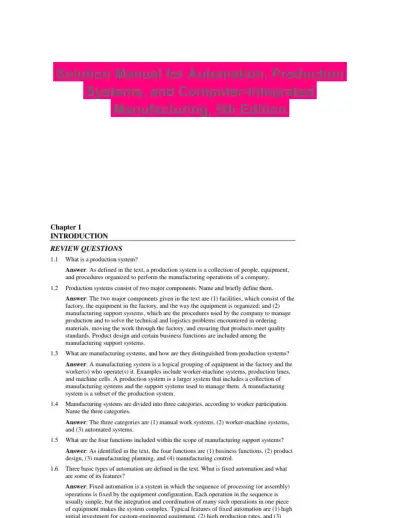 Textbook Guides
Solution Manual for Automation, Production Systems, and Computer-Integrated Manufacturing, 5th Edition
Information Technology
261 pagesMay 2025 Exam Guides
Test Bank for Managing and Using Information Systems: A Strategic Approach, 7th Edition (Chapters 1-13)
Information Technology
452 pages149downloadsFeb 2025 Exam Guides
Test Bank for Essentials of MIS, 12th Edition
Information Technology
342 pages146downloadsFeb 2025 Exam Guides
A+ Guide to Hardware, 9th Edition Test Bank
Information Technology
116 pages142downloadsFeb 2025 Textbook Guides
Solution Manual for Essentials of System Analysis and Design, 4th Edition
Information Technology
282 pages140downloadsFeb 2025 Textbook Guides
Guide To Networking Essentials, 7th Edition Solution Manual
Information Technology
48 pages139downloadsFeb 2025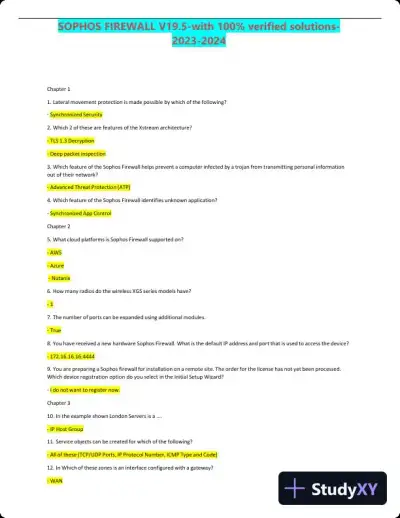 Past Exams
2023-2024 SOPHOS FIREWALL V19.5 Practice Exam with Answers (75 Solved Questions)
Information Technology
7 pages134downloadsFeb 2025 Class Notes
Lecture Notes for CCNP Enterprise: Core Networking (ENCOR) v8 Lab Manual, 2nd Edition
Information Technology
1089 pages123downloadsFeb 2025
Study this document with CramX
Once it is in your library, every tool can work from it.