

Principles of Management - Productivity and Total Quality Management
- Management
- Texas A&M University
- 9 pages
- Shared March 2026
Preview 3 of 9 pages
See the first 3 pages exactly as they appear in the document.
Page 1 Read page 1 as text
Study Guide Principles of Management – Productivity and Total Quality Management 1. Major Contributors to Total Quality Management (TQM) Total Quality Management, or TQM , is much more than just checking a product for defects. It’s a company - wide philosophy focused on improving customer satisfaction, increasing employee involvement, strengthening supplier partnerships, and creating a culture of continuous improvement. TQM is about how people work together and relate to each other in an organization. Success depends on a shared commitment to quality in all areas. 1.1 W. Edwards Deming (1900 – 1993) Deming, an American statistician and management expert, is often called the Father of TQM . His ideas became popular in postwar Japan , helping the country rebuild its industries. Ironically, his concepts were initially ignored in the U.S. until the 1980s, when American companies struggled to compete with Japanese efficiency. Deming emphasized that quality isn’t just about inspecting products — it requires continuous improvement across the entire organization . He developed the Fourteen Points as a guide for achieving TQM: 1. Create a consistent purpose for improving products and services. 2. Adopt a new philosophy that rejects mistakes and negativism. 3. End dependence on mass inspection ; build quality into the product. 4. Move away from awarding business based on price alone ; aim for minimum total cost. 5. Constantly improve production and service systems. 6. Institute proper training for all workers. 7. Institute leadership to help employees do a better job. 8. Drive out fear so employees can ask questions and share ideas. 9. Break down barriers between departments to improve teamwork.
Page 2 Read page 2 as text
Study Guide 10. Eliminate slogans and numerical targets that don’t help employees do better. 11. Remove quotas and work standards that focus only on numbers. 12. Remove barriers to pride in workmanship , such as poor supervision or faulty equipment. 13. Implement continuous education for management and workers. 14. Take action to achieve transformation through top management commitment. Deming emphasized teamwork, employee input, and customer feedback . Japanese companies adopted his ideas successfully, producing high - quality goods efficiently, which forced U.S. companies to catch up in the 1980s. 1.2 Joseph M. Juran (1904 – 2008) Joseph Juran, another major TQM contributor, focused on managerial responsibility for quality . He believed that most quality problems result from poor management , not employee errors. Juran introduced the Quality Trilogy : 1. Quality Planning – Identify customers, their needs, set goals, and plan processes to meet them. 2. Quality Control – Monitor operations to ensure standards are met. 3. Quality Improvement – Continuously improve processes and results. Key ideas from Juran include: • Set specific goals and clear plans to achieve them. • Assign responsibility for meeting goals. • Base rewards on results achieved . • Start quality improvement at the top , with senior management involvement. 1.3 Philip B. Crosby (1926 – 2001) Philip Crosby took a practical approach to quality, emphasizing that it can be cost - effective and achievable . He is famous for the zero defects program : "Do it right the first time" (DIRFT).
Page 3 Read page 3 as text
Study Guide Crosby introduced the Four Absolutes of Quality Management : 1. Quality is conformance to requirements , not elegance or luxury. 2. Prevention over inspection – prevent defects rather than catching them later. 3. Zero defects as the standard – aim for perfection. 4. Quality costs – measure quality by the cost of nonconformance, not by inspection costs. Crosby’s philosophy stressed employee responsibility for quality at every step and argued that focusing on quality saves money in the long run . 1.4 Other Influential Quality Experts • Armand V. Feigenbaum – Total Quality Control; quality is company - wide. • Michael Hammer & James Champy – Reengineering the Corporation. • Peter Drucker – Post - Capitalist Society; management for the modern era. Although many people contributed to TQM, the three “masters” most often cited are Deming, Juran, and Crosby . While their approaches differ — Deming is philosophical, Juran is managerial, and Crosby is practical — they all agree that quality is essential for long - term organizational success . 2. Implementing Total Quality Management (TQM) Implementing Total Quality Management (TQM) is similar to other decentralized control methods. The key idea is to focus on quality at every stage — from production to the customer’s hands. 2.1 Understanding Quality from the Customer's Perspective To succeed with TQM, companies must know how customers define quality for both products and services. The more attention a company gives to quality during production, the fewer problems arise later when customers use the product. Customer feedback is a valuable tool. Surveys can highlight design or manufacturing issues that need fixing.
6 more pages in the full document
Unlock it once and it stays in your library, ready to chat with or turn into flashcards.
Unlock the full documentMore Management study materials
See all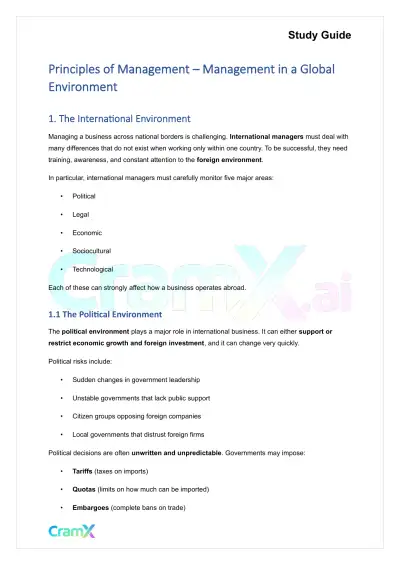 Quick Guides
Principles of Management - Management in a Global Environment
Management
14 pagesMar 2026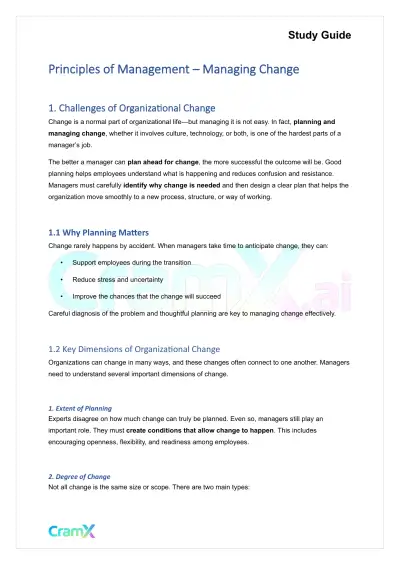 Quick Guides
Principles of Management - Managing Change
Management
16 pagesMar 2026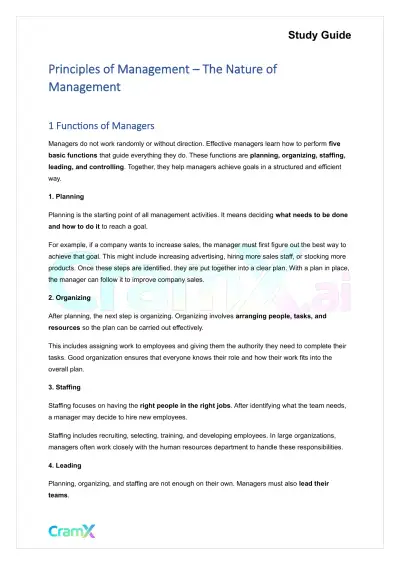 Quick Guides
Principles of Management - The Nature of Management
Management
10 pagesMar 2026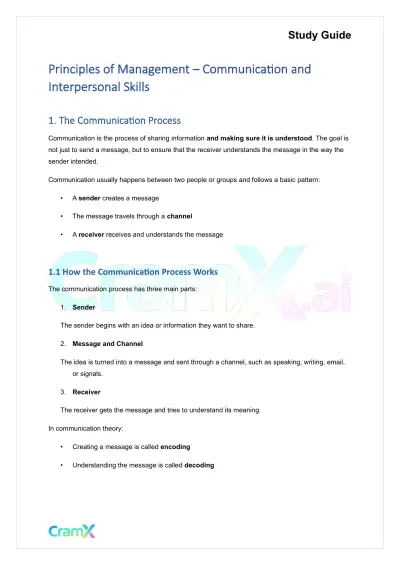 Quick Guides
Principles of Management - Communication and Interpersonal Skills
Management
13 pagesMar 2026 Quick Guides
Principles of Management - The Evolution of Management Thought
Management
21 pagesMar 2026 Quick Guides
Principles of Management - Creating Organizational Structure
Management
9 pagesMar 2026 Quick Guides
Principles of Management - Organizational Planning
Management
10 pagesMar 2026 Quick Guides
Principles of Management - Understanding Teams
Management
12 pagesMar 2026
Study this document with CramX
Once it is in your library, every tool can work from it.