

Principles of Management - The Nature of Management
- Management
- Texas A&M University
- 10 pages
- Shared March 2026
Preview 3 of 10 pages
See the first 3 pages exactly as they appear in the document.
Page 1 Read page 1 as text
Study Guide Principles of Management – The Nature of Management 1 Functions of Managers Managers do not work randomly or without direction. Effective managers learn how to perform five basic functions that guide everything they do. These functions are planning, organizing, staffing, leading, and controlling . Together, they help managers achieve goals in a structured and efficient way. 1. Planning Planning is the starting point of all management activities. It means deciding what needs to be done and how to do it to reach a goal. For example, if a company wants to increase sales, the manager must first figure out the best way to achieve that goal. This might include increasing advertising, hiring more sales staff, or stocking more products. Once these steps are identified, they are put together into a clear plan. With a plan in place, the manager can follow it to improve company sales. 2. Organizing After planning, the next step is organizing. Organizing involves arranging people, tasks, and resources so the plan can be carried out effectively. This includes assigning work to employees and giving them the authority they need to complete their tasks. Good organization ensures that everyone knows their role and how their work fits into the overall plan. 3. Staffing Staffing focuses on having the right people in the right jobs . After identifying what the team needs, a manager may decide to hire new employees. Staffing includes recruiting, selecting, training, and developing employees. In large organizations, managers often work closely with the human resources department to handle these responsibilities. 4. Leading Planning, organizing, and staffing are not enough on their own. Managers must also lead their teams .
Page 2 Read page 2 as text
Study Guide Leading involves motivating employees, communicating clearly, guiding their work, and encouraging them to do their best. Managers act as coaches by helping employees solve problems, offering support, and keeping morale high. 5. Controlling Controlling is the final function of management, but it is ongoing. Managers regularly check progress and results to see if goals are being met. If performance is not matching the plan, managers take corrective action to get things back on track. This ensures that plans continue to move in the right direction. All managers — at every level and in every organization — perform these five functions. However, the amount of time spent on each function depends on the manager’s level and the type of organization. 1.1 Roles Performed by Managers Managers wear many hats. They are not just supervisors. A manager is also a planner, organizer, coach, motivator, problem solver, and decision maker — all at the same time. Managers also tend to have very busy schedules. Their days are filled with meetings, unexpected issues, planning sessions, and constant communication, including emails. Management expert Henry Mintzberg , in his book The Nature of Managerial Work , identified ten different roles that managers perform. These roles fall into three main categories:
Page 3 Read page 3 as text
Study Guide 1.2 Skills Needed by Managers Not everyone can be an effective manager. Managers need specific skills , which are abilities that turn knowledge into action and improve performance. These skills fall into three main categories. 1. Technical Skills Technical skills involve using specialized knowledge or expertise to perform tasks. Examples include skills used by accountants, engineers, computer scientists, and market researchers.
7 more pages in the full document
Unlock it once and it stays in your library, ready to chat with or turn into flashcards.
Unlock the full documentMore Management study materials
See all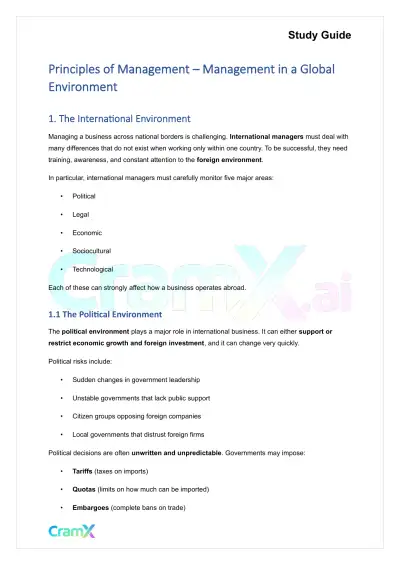 Quick Guides
Principles of Management - Management in a Global Environment
Management
14 pagesMar 2026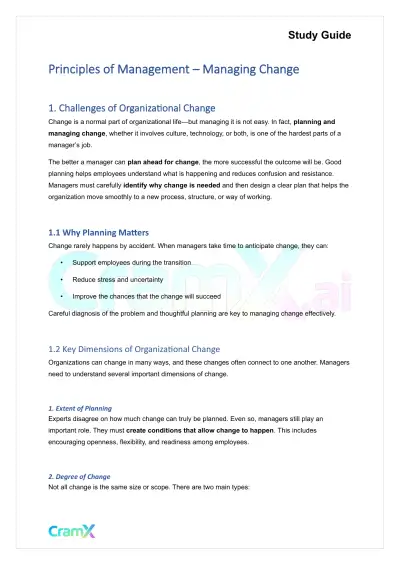 Quick Guides
Principles of Management - Managing Change
Management
16 pagesMar 2026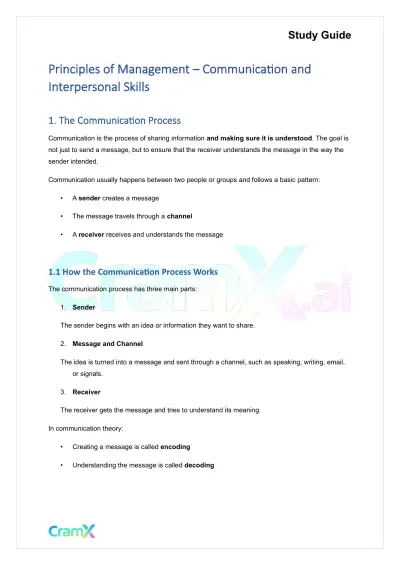 Quick Guides
Principles of Management - Communication and Interpersonal Skills
Management
13 pagesMar 2026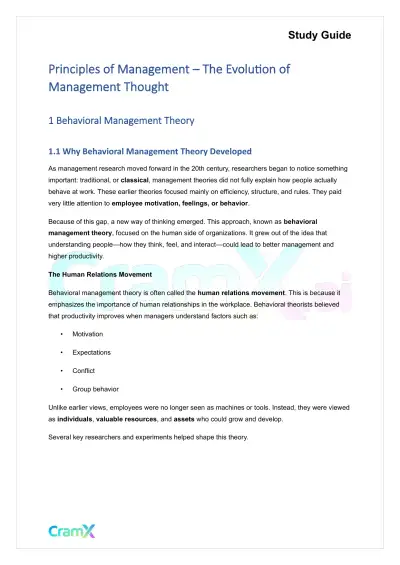 Quick Guides
Principles of Management - The Evolution of Management Thought
Management
21 pagesMar 2026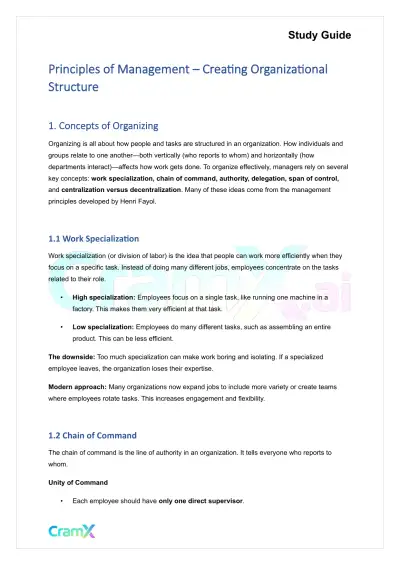 Quick Guides
Principles of Management - Creating Organizational Structure
Management
9 pagesMar 2026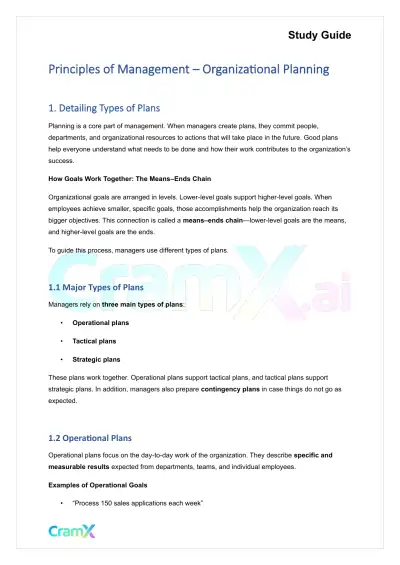 Quick Guides
Principles of Management - Organizational Planning
Management
10 pagesMar 2026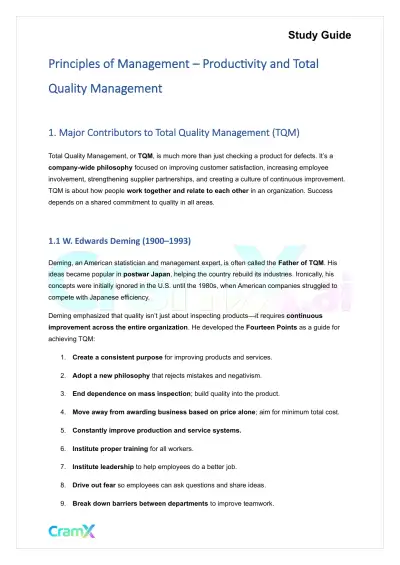 Quick Guides
Principles of Management - Productivity and Total Quality Management
Management
9 pagesMar 2026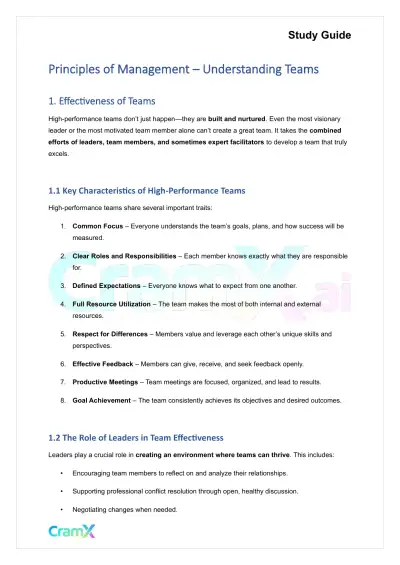 Quick Guides
Principles of Management - Understanding Teams
Management
12 pagesMar 2026
Study this document with CramX
Once it is in your library, every tool can work from it.