

A First Course in Probability, 10th Edition Solution Manual
- Mathematics
- 160 pages
- Shared May 2025
A First Course in Probability, 10th Edition Solution Manual gives you all the tools you need to solve your textbook problems effectively.
Preview 16 of 160 pages
See the first 16 pages exactly as they appear in the document.
Page 1 Read page 1 as text
S OLUTIONS M ANUAL A F IRST C OURSE IN P ROBABILITY T ENTH E DITION Sheldon Ross University of Southern California
Page 2 Page 3 Read page 3 as text
1 Chapter 1 Problems 1. (a) By the generalized basic principle of counting there are 26 ⋅ 26 ⋅ 10 ⋅ 10 ⋅ 10 ⋅ 10 ⋅ 10 = 67,600,000 (b) 26 ⋅ 25 ⋅ 10 ⋅ 9 ⋅ 8 ⋅ 7 ⋅ 6 = 19,656,000 2. 6 4 = 1296 3. An assignment is a sequence i 1 , …, i 20 where i j is the job to which person j is assigned. Since only one person can be assigned to a job, it follows that the sequence is a permutation of the numbers 1, …, 20 and so there are 20! different possible assignments. 4. There are 4! possible arrangements. By assigning instruments to Jay, Jack, John and Jim, in that order, we see by the generalized basic principle that there are 2 ⋅ 1 ⋅ 2 ⋅ 1 = 4 possibilities. 5. There were 8 ⋅ 2 ⋅ 9 = 144 possible codes. There were 1 ⋅ 2 ⋅ 9 = 18 that started with a 4. 6. Each kitten can be identified by a code number i, j, k, l where each of i, j, k, l is any of the numbers from 1 to 7. The number i represents which wife is carrying the kitten, j then represents which of that wife’s 7 sacks contain the kitten; k represents which of the 7 cats in sack j of wife i is the mother of the kitten; and l represents the number of the kitten of cat k in sack j of wife i . By the generalized principle there are thus 7 ⋅ 7 ⋅ 7 ⋅ 7 = 2401 kittens 7. (a) 6! = 720 (b) 2 ⋅ 3! ⋅ 3! = 72 (c) 4!3! = 144 (d) 6 ⋅ 3 ⋅ 2 ⋅ 2 ⋅ 1 ⋅ 1 = 72 8. (a) 5! = 120 (b) 7! 2!2! = 1260 (c) 11! 4!4!2! = 34,650 (d) 7! 2!2! = 1260 9. (12)! 6!4! = 27,720
Page 4 Read page 4 as text
2 Chapter 1 10. (a) 8! = 40,320 (b) 2 ⋅ 7! = 10,080 (c) 5!4! = 2,880 (d) 4!2 4 = 384 11. (a) 6! (b) 3!2!3! (c) 3!4! 12. 10 3 − 10 ⋅ 9 ⋅ 8 = 280 numbers have at least 2 equal values. 280 − 10 = 270 have exactly 2 equal values. 13. With n i equal to the number of length i , n 1 = 3, n 2 = 8, n 3 = 12, n 4 = 30, n 5 = 30, giving the answer of 83. 14. (a) 30 5 (b) 30 ⋅ 29 ⋅ 28 ⋅ 27 ⋅ 26 15. 20 2 16. 52 5 15. There are 10 12 5 5 possible choices of the 5 men and 5 women. They can then be paired up in 5! ways, since if we arbitrarily order the men then the first man can be paired with any of the 5 women, the next with any of the remaining 4, and so on. Hence, there are 10 12 5! 5 5 possible results. 18. (a) 6 7 4 2 2 2 + + = 42 possibilities. (b) There are 6 ⋅ 7 choices of a math and a science book, 6 ⋅ 4 choices of a math and an economics book, and 7 ⋅ 4 choices of a science and an economics book. Hence, there are 94 possible choices. 19. The first gift can go to any of the 10 children, the second to any of the remaining 9 children, and so on. Hence, there are 10 ⋅ 9 ⋅ 8 ⋅ ⋅ ⋅ 5 ⋅ 4 = 604,800 possibilities.
Page 5 Read page 5 as text
Chapter 1 3 20. 5 6 4 2 2 3 = 600 21. (a) There are 8 4 8 2 4 3 3 3 1 2 + = 896 possible committees. There are 8 4 3 3 that do not contain either of the 2 men, and there are 8 2 4 3 1 2 that contain exactly 1 of them. (b) There are 6 6 2 6 6 3 3 1 2 3 + = 1000 possible committees. (c) There are 7 5 7 5 7 5 3 3 2 3 3 2 + + = 910 possible committees. There are 7 5 3 3 in which neither feuding party serves; 7 5 2 3 in which the feuding women serves; and 7 5 3 2 in which the feuding man serves. 22. 6 2 6 6 6 , 5 1 4 5 3 + + 23. 7! 3!4! = 35. Each path is a linear arrangement of 4 r ’s and 3 u ’s ( r for right and u for up). For instance the arrangement r , r , u , u , r , r , u specifies the path whose first 2 steps are to the right, next 2 steps are up, next 2 are to the right, and final step is up. 24. There are 4! 2!2! paths from A to the circled point; and 3! 2!1! paths from the circled point to B. Thus, by the basic principle, there are 18 different paths from A to B that go through the circled point. 25. 3!2 3 26. (a) ( ) 0 2 2 1 n n k k n k = = + (b) ( ) 0 1 n n k k n x x k = = +
Page 6 Read page 6 as text
4 Chapter 1 28. 52 13,13,13,13 30. 12 12! 3, 4, 5 3!4!5! = 31. Assuming teachers are distinct. (a) 4 8 (b) 4 8 8! 2, 2, 2, 2 (2) = = 2520. 32. (a) (10)!/3!4!2! (b) 3 7! 3 2 4!2! 33. 2 ⋅ 9! − 2 2 8! since 2 ⋅ 9! is the number in which the French and English are next to each other and 2 2 8! the number in which the French and English are next to each other and the U.S. and Russian are next to each other. 34. (a) number of nonnegative integer solutions of x 1 + x 2 + x 3 + x 4 = 8. Hence, answer is 11 3 = 165 (b) here it is the number of positive solutions—hence answer is 7 3 = 35 35. (a) number of nonnegative solutions of x 1 + … + x 6 = 8 answer = 13 5 (b) (number of solutions of x 1 + … + x 6 = 5) × (number of solutions of x 1 + … + x 6 = 3) = 10 8 5 5
Page 7 Read page 7 as text
Chapter 1 5 36. (a) x 1 + x 2 + x 3 + x 4 = 20, x 1 ≥ 2, x 2 ≥ 2, x 3 ≥ 3, x 4 ≥ 4 Let y 1 = x 1 − 1, y 2 = x 2 − 1, y 3 = x 3 − 2, y 4 = x 4 − 3 y 1 + y 2 + y 3 + y 4 = 13, y i > 0 Hence, there are 12 3 = 220 possible strategies. (b) there are 15 2 investments only in 1, 2, 3 there are 14 2 investments only in 1, 2, 4 there are 13 2 investments only in 1, 3, 4 there are 13 2 investments only in 2, 3, 4 15 2 + 14 2 + 13 12 2 2 3 + = 552 possibilities 37. (a) 14 1001 4 = (b) 10 120 3 = (c) There are 13 286 3 = possible outcomes having 0 trout caught and 12 220 3 = possible outcomes having 1 trout caught. Hence, using (a), there are 1001 286 220 495 − − = possible outcomes in which at least 2 of the 10 are trout.
Page 8 Read page 8 as text
6 Chapter 1 Theoretical Exercises 2. 1 m i i n = 3. n ( n − 1) ⋅ ⋅ ⋅ ( n − r + 1) = n !/( n − r )! 4. Each arrangement is determined by the choice of the r positions where the black balls are situated. 5. There are n j different 0 − 1 vectors whose sum is j , since any such vector can be characterized by a selection of j of the n indices whose values are then set equal to 1. Hence there are n j k n j = vectors that meet the criterion. 6. n k 7. 1 1 1 n n r r − − + − = ( 1)! ( 1)! !( 1 )! ( )!( 1)! n n r n r n r r − − + − − − − = ! !( )! n n n r r r r n r n n − + = − 8. There are n m r + gropus of size r . As there are n m i r i − groups of size r that consist of i men and r − i women, we see that 0 r i n m n m r i r i = + = − . 9. 0 2 n i n n n n i n i = = − = 2 0 n i n i = 10. Parts (a), (b), (c), and (d) are immediate. For part (e), we have the following: n k k = ! ! ! ( )! ! ( )!( 1)! k n n n k k n k k = − − − ( 1) 1 n n k k − + − = ( 1) ! ! ( 1)!( 1)! ( )!( 1)! n k n n n k k n k k − + = − + − − − 1 1 n n k − − = ( 1)! ! ( )!( 1)! ( )!( 1)! n n n n k k n k k − = − − − −
Page 9 Read page 9 as text
Chapter 1 7 11. The number of subsets of size k that have i as their highest numbered member is equal to 1 1 i k − − , the number of ways of choosing k − 1 of the numbers 1, …, i − 1. Summing over i yields the number of subsets of size k . 12. Number of possible selections of a committee of size k and a chairperson is n k k and so 1 n k n k k = represents the desired number. On the other hand, the chairperson can be anyone of the n persons and then each of the other n − 1 can either be on or off the committee. Hence, n 2 n − 1 also represents the desired quantity. (i) 2 n k k (ii) n 2 n − 1 since there are n possible choices for the combined chairperson and secretary and then each of the other n − 1 can either be on or off the committee. (iii) n ( n − 1)2 n − 2 (c) From a set of n we want to choose a committee, its chairperson its secretary and its treasurer (possibly the same). The result follows since (a) there are n 2 n − 1 selections in which the chair, secretary and treasurer are the same person. (b) there are 3 n ( n − 1)2 n − 2 selection in which the chair, secretary and treasurer jobs are held by 2 people. (c) there are n ( n − 1)( n − 2)2 n − 3 selections in which the chair, secretary and treasurer are all different. (d) there are 3 n k k selections in which the committee is of size k . 13. (1 − 1) n = 1 0 ( 1) n n i n i − = − 14. (a) n j n n i j i i j i − = − (b) From (a), n j i n j j i = = 2 1 n n i j i n n i n i j i − = − = − (c) ( 1) n n j j i n j j i − = − = ( 1) 1 n n j j i n n i i j − = − − − = 0 ( 1) n i n i k k n n i i k − − − = − − = 0
Page 10 Read page 10 as text
8 Chapter 1 15. (a) The number of vectors that have x k = j is equal to the number of vectors x 1 ≤ x 2 ≤ … ≤ x k − 1 satisfying 1 ≤ x i ≤ j . That is, the number of vectors is equal to H k − 1 ( j ), and the result follows. (b) H 2 (1) = H 1 (1) = 1 H 2 (2) = H 1 (1) + H 1 (2) = 3 H 2 (3) = H 1 (1) + H 1 (2) + H 1 (3) = 6 H 2 (4) = H 1 (1) + H 1 (2) + H 1 (3) + H 1 (4) = 10 H 2 (5) = H 1 (1) + H 1 (2) + H 1 (3) + H 1 (4) + H 1 (5) = 15 H 3 (5) = H 2 (1) + H 2 (2) + H 2 (3) + H 2 (4) + H 2 (5) = 35 16. (a) 1 < 2 < 3, 1 < 3 < 2, 2 < 1 < 3, 2 < 3 < 1, 3 < 1 < 2, 3 < 2 < 1, 1 = 2 < 3, 1 = 3 < 2, 2 = 3 < 1, 1 < 2 = 3, 2 < 1 = 3, 3 < 1 = 2, 1 = 2 = 3 (b) The number of outcomes in which i players tie for last place is equal to n i , the number of ways to choose these i players, multiplied by the number of outcomes of the remaining n − i players, which is clearly equal to N ( n − i ). (c) 1 ( 1) n i n N n i = − = 1 ( ) n i n N n i n i = − − = 1 0 ( ) n j n N j j − = where the final equality followed by letting j = n − i . (d) N (3) = 1 + 3 N (1) + 3 N (2) = 1 + 3 + 9 = 13 N (4) = 1 + 4 N (1) + 6 N (2) + 4 N (3) = 75 17. A choice of r elements from a set of n elements is equivalent to breaking these elements into two subsets, one of size r (equal to the elements selected) and the other of size n − r (equal to the elements not selected). 18. Suppose that r labeled subsets of respective sizes n 1 , n 2 , …, n r are to be made up from elements 1, 2, …, n where n = 1 r i i n = . As 1 1 ,..., 1,... i r n n n n − − represents the number of possibilities when person n is put in subset i , the result follows. 19. By induction: ( x 1 + x 2 + … + x r ) n = 1 1 1 1 2 1 0 ( ... ) n i n i r i n x x x i − = + + by the Binomial theorem
Page 11 Read page 11 as text
Chapter 1 9 = 1 1 1 1 0 n i i n x i = 2 ,..., ... r i i 2 2 1 1 2 ... ,..., i i r r n i x x i i − 2 1 ... r i i n i + + = − = 1 ,..., ... r i i 1 1 1 ... ,..., r i i r r n x x i i 1 2 ... r i i i n + + + = where the second equality follows from the induction hypothesis and the last from the identity 1 1 1 2 ,..., ,..., r n n i n n i i i i i − = . 20. The number of integer solutions of x 1 + … + x r = n , x i ≥ m i is the same as the number of nonnegative solutions of y 1 + … + y r = n − 1 r i m , y i ≥ 0. Proposition 6.2 gives the result 1 1 1 r i n m r r − + − − . 21. There are r k choices of the k of the x ’s to equal 0. Given this choice the other r − k of the x ’s must be positive and sum to n . By Proposition 6.1, there are 1 1 1 n n r k n r k − − = − − − + such solutions. Hence the result follows. 22. 1 1 n r n + − − by Proposition 6.2. 23. There are 1 j n j + − nonnegative integer solutions of 1 n i i x j = = Hence, there are 0 1 k j j n j = + − such vectors.
Page 12 Read page 12 as text
10 Chapter 2 Problems 1. (a) S = {( r , r ), ( r , g ), ( r , b ), ( g , r ), ( g , g ), ( g , b ), ( b , r ), b , g ), ( b , b )} (b) S = {( r , g ), ( r , b ), ( g , r ), ( g , b ), ( b , r ), ( b , g )} 2. S = {( n , x 1 , …, x n − 1 ), n ≥ 1, x i ≠ 6, i = 1, …, n − 1}, with the interpretation that the outcome is ( n , x 1 , …, x n − 1 ) if the first 6 appears on roll n , and x i appears on roll, i , i = 1, …, n − 1. The event 1 ( ) c n n E ∞ = ∪ is the event that 6 never appears. 3. EF = {(1, 2), (1, 4), (1, 6), (2, 1), (4, 1), (6, 1)}. E ∪ F occurs if the sum is odd or if at least one of the dice lands on 1. FG = {(1, 4), (4, 1)}. EF c is the event that neither of the dice lands on 1 and the sum is odd. EFG = FG . 4. A = {1,0001,0000001, …} B = {01, 00001, 00000001, …} ( A ∪ B ) c = {00000 …, 001, 000001, …} 5. (a) 2 5 = 32 (b) W = {(1, 1, 1, 1, 1), (1, 1, 1, 1, 0), (1, 1, 1, 0, 1), (1, 1, 0, 1, 1), (1, 1, 1, 0, 0), (1, 1, 0, 1, 0) (1, 1, 0, 0, 1), (1, 1, 0, 0, 0), (1, 0, 1, 1, 1), (0, 1, 1, 1, 1), (1, 0, 1, 1, 0), (0, 1, 1, 1, 0) (0, 0, 1, 1, 1) (0, 0, 1, 1, 0), (1, 0, 1, 0, 1)} (c) 8 (d) AW = {(1, 1, 1, 0, 0), (1, 1, 0, 0, 0)} 6. (a) S = {(1, g ), (0, g ), (1, f ), (0, f ), (1, s ), (0, s )} (b) A = {(1, s ), (0, s )} (c) B = {(0, g ), (0, f ), (0, s )} (d) {(1, s ), (0, s ), (1, g ), (1, f )} 7. (a) 6 15 (b) 6 15 − 3 15 (c) 4 15 8. (a) .8 (b) .3 (c) 0
Page 13 Read page 13 as text
Chapter 2 11 9. Choose a customer at random. Let A denote the event that this customer carries an American Express card and V the event that he or she carries a VISA card. P ( A ∪ V ) = P ( A ) + P ( V ) − P ( AV ) = .24 + .61 − .11 = .74. Therefore, 74 percent of the establishment’s customers carry at least one of the two types of credit cards that it accepts. 10. Let R and N denote the events, respectively, that the student wears a ring and wears a necklace. (a) P ( R ∪ N ) = 1 − .6 = .4 (b) .4 = P ( R ∪ N ) = P ( R ) + P ( N ) − P ( RN ) = .2 + .3 − P ( RN ) Thus, P ( RN ) = .1 11. Let A be the event that a randomly chosen person is a cigarette smoker and let B be the event that she or he is a cigar smoker. (a) 1 − P ( A ∪ B ) = 1 − (.07 + .28 − .05) = .7. Hence, 70 percent smoke neither. (b) P ( A c B ) = P ( B ) − P ( AB ) = .07 − .05 = .02. Hence, 2 percent smoke cigars but not cigarettes. 12. (a) P ( S ∪ F ∪ G ) = (28 + 26 + 16 − 12 − 4 − 6 + 2)/100 = 1/2 The desired probability is 1 − 1/2 = 1/2. (b) Use the Venn diagram below to obtain the answer 32/100. 14 10 10 S F 8 G 2 4 2 (c) Since 50 students are not taking any of the courses, the probability that neither one is taking a course is 50 100 2 2 = 49/198 and so the probability that at least one is taking a course is 149/198.
Page 14 Read page 14 as text
12 Chapter 2 13. (a) 20,000 (b) 12,000 (c) 11,000 (d) 68,000 (e) 10,000 14. P ( M ) + P ( W ) + P ( G ) − P ( MW ) − P ( MG ) − P ( WG ) + P ( MWG ) = .312 + .470 + .525 − .086 − .042 − .147 + .025 = 1.057 15. (a) 13 52 4 5 5 (b) 4 12 4 4 4 52 13 2 3 1 1 1 5 (c) 13 4 4 44 52 2 2 2 1 5 (d) 4 12 4 4 52 13 3 2 1 1 5 (e) 4 48 52 13 4 1 5 16. (a) 5 6 5 4 3 2 6 ⋅ ⋅ ⋅ ⋅ (b) 5 5 6 5 4 3 2 6 ⋅ ⋅ (c) 5 6 5 3 4 2 2 2 6 (d) 5 6 5 4 3 21 ⋅ ⋅ (e) 5 5 6 5 3 6 ⋅ (f) 5 5 6 5 4 6 ⋅ (g) 5 6 6 1000 7000 19000 I II 0 III 1000 3000 1000
Page 15 Read page 15 as text
Chapter 2 13 17. 15 10 7 8 8 1 .1102 25 9 16 1 = 18. 2 4 16 52 51 ⋅ ⋅ ⋅ 19. 4/36 + 4/36 +1/36 + 1/36 = 5/18 20. Let A be the event that you are dealt blackjack and let B be the event that the dealer is dealt blackjack. Then, P ( A ∪ B ) = P ( A ) + P ( B ) − P ( AB ) = 4 4 16 4 4 16 3 15 52 51 52 51 50 49 ⋅ ⋅ ⋅ ⋅ ⋅ ⋅ + ⋅ ⋅ ⋅ ⋅ = .0983 where the preceding used that P ( A ) = P ( B ) = 2 × 4 16 52 51 ⋅ ⋅ . Hence, the probability that neither is dealt blackjack is .9017. 21. (a) p 1 = 4/20, p 2 = 8/20, p 3 = 5/20, p 4 = 2/20, p 5 = 1/20 (b) There are a total of 4 ⋅ 1 + 8 ⋅ 2 + 5 ⋅ 3 + 2 ⋅ 4 + 1 ⋅ 5 = 48 children. Hence, q 1 = 4/48, q 2 = 16/48, q 3 = 15/48, q 4 = 8/48, q 5 = 5/48 22. The ordering will be unchanged if for some k , 0 ≤ k ≤ n , the first k coin tosses land heads and the last n − k land tails. Hence, the desired probability is ( n + 1/2 n 23. The answer is 5/12, which can be seen as follows: 1 = P {first higher} + P {second higher} + p {same} = 2 P {second higher} + p {same} = 2 P {second higher} + 1/6 Another way of solving is to list all the outcomes for which the second is higher. There is 1 outcome when the second die lands on two, 2 when it lands on three, 3 when it lands on four, 4 when it lands on five, and 5 when it lands on six. Hence, the probability is (1 + 2 + 3 + 4 + 5)/36 = 5/12. 25. P ( E n ) = 1 1 26 6 2 , ( ) 36 36 5 n n n P E − ∞ = =
Page 16 Read page 16 as text
14 Chapter 2 27. Imagine that all 10 balls are withdrawn P ( A ) = 3 9! 7 6 3 7! 7 6 5 4 3 5! 7 6 5 4 3 2 3 3! 10! ⋅ + ⋅ ⋅ ⋅ + ⋅ ⋅ ⋅ ⋅ ⋅ + ⋅ ⋅ ⋅ ⋅ ⋅ ⋅ ⋅ 28. P {same} = 5 6 8 3 3 3 19 3 + + P {different} = 5 6 8 19 1 1 1 3 If sampling is with replacement P {same} = 3 3 3 3 5 6 8 (19) + + P {different} = P ( RBG ) + P { BRG ) + P (RGB) + … + P ( GBR ) = 3 6 5 6 8 (19) ⋅ ⋅ ⋅ 29. (a) ( 1) ( 1) ( )( 1) n n m m n m n m − + − + + − (b) Putting all terms over the common denominator ( n + m ) 2 ( n + m − 1) shows that we must prove that n 2 ( n + m − 1) + m 2 ( n + m − 1) ≥ n ( n − 1)( n + m ) + m ( m − 1)( n + m ) which is immediate upon multiplying through and simplifying. 30. (a) 7 8 3! 3 3 8 9 4! 4 4 = 1/18 (b) 7 8 3! 3 3 8 9 4! 4 4 − 1/18 = 1/6 (c) 7 8 7 8 3 4 4 3 8 9 4 4 + = 1/2
144 more pages in the full document
Unlock it once and it stays in your library, ready to chat with or turn into flashcards.
Unlock the full documentMore Mathematics study materials
See all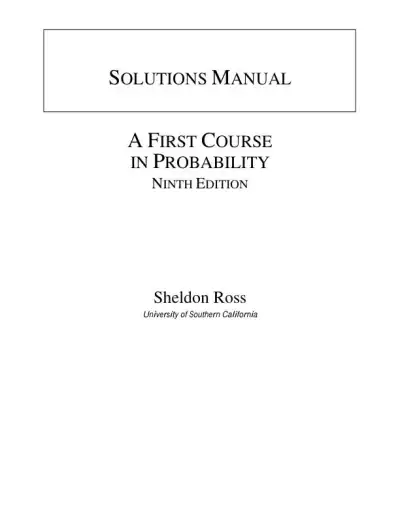 Textbook Guides
Solution Manual for First Course in Probability, 9th Edition
Mathematics
154 pagesMay 2025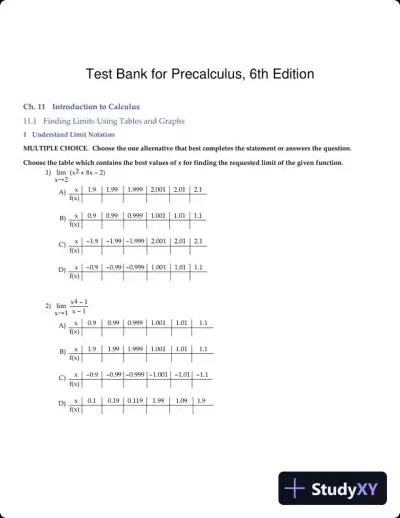 Exam Guides
Test Bank for Precalculus, 6th Edition
Mathematics
1051 pages175downloadsFeb 2025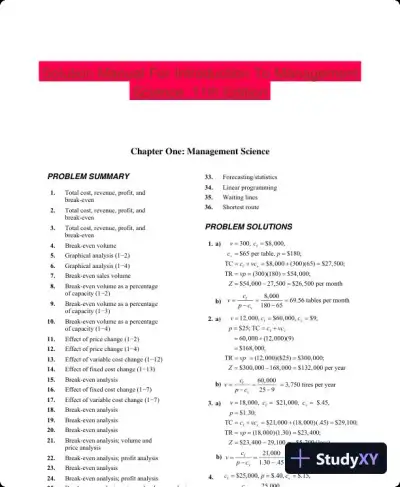 Textbook Guides
Solution Manual For Introduction To Management Science, 11th Edition
Mathematics
437 pages167downloadsFeb 2025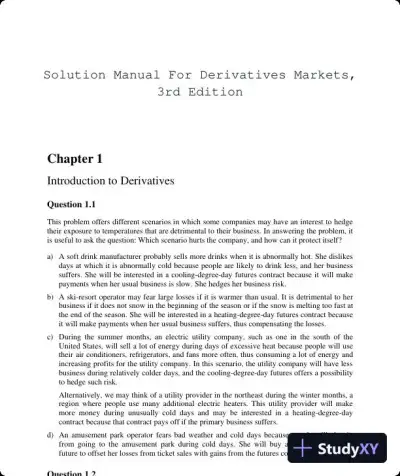 Textbook Guides
Solution Manual For Derivatives Markets, 3rd Edition
Mathematics
358 pages143downloadsFeb 2025 Textbook Guides
Solution Manual for Geometry, 1st Edition
Mathematics
446 pages141downloadsFeb 2025 Textbook Guides
Solution Manual for Beginning Algebra, 7th Edition
Mathematics
479 pages139downloadsFeb 2025 Textbook Guides
Solution Manual for Developmental Mathematics, 1st Edition
Mathematics
1623 pages137downloadsFeb 2025 Textbook Guides
Solution Manual for Elementary and Intermediate Algebra: Graphs and Models, 5th Edition
Mathematics
1278 pages126downloadsFeb 2025
Study this document with CramX
Once it is in your library, every tool can work from it.